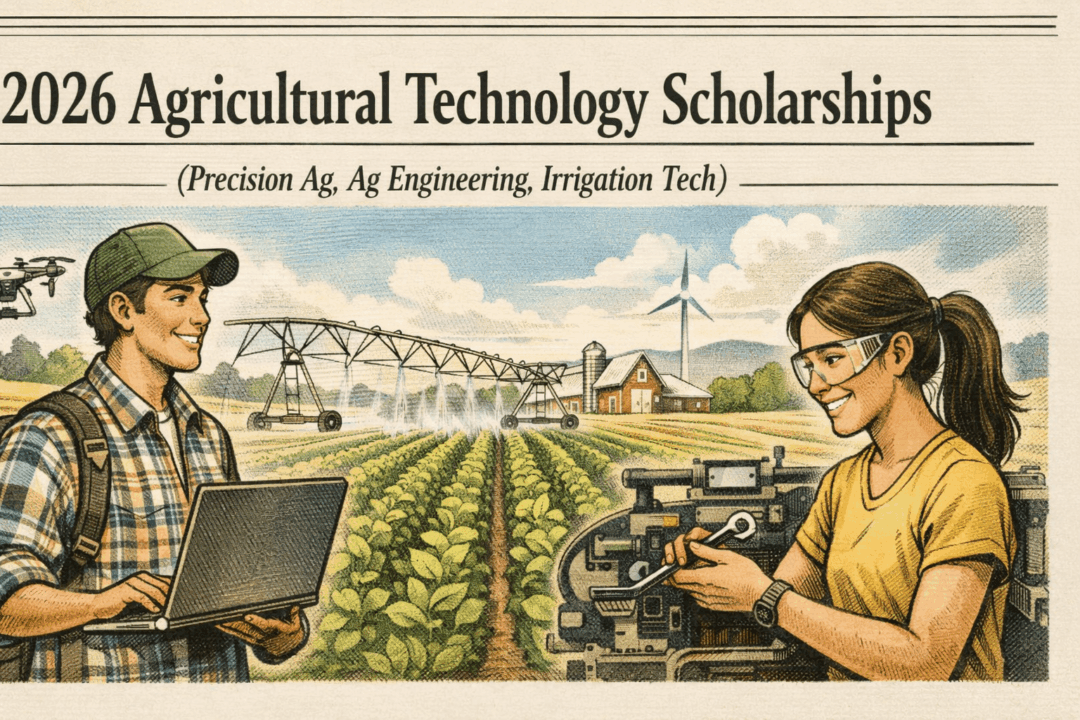
Agricultural Technology Scholarships (Precision Ag, Ag Engineering, Irrigation Tech) — 2026
Verified, up-to-date list of 20+ agricultural technology scholarships for students in precision agriculture, ag engineering, irrigation technology, ag systems/ETMAS, ag informatics, and equipment tech.
January Deadlines
National FFA Scholarship Program (hub for multiple ag-tech-friendly awards)
💥 Why It Slaps: One application unlocks dozens of sponsor scholarships for ag tech, engineering, precision ag, and equipment pathways (including Bayer Grow Ag Leaders, Deere, Ford, Rabo, etc.).
💰 Amount: Varies widely ($1,000–$10,000+; most common $1,000–$2,500).
⏰ Deadline: Jan 16, 2026 (member app close)
🔗 Apply/info: https://www.ffa.org/participate/grants-and-scholarships/scholarships/
Bayer Fund — America’s Farmers Grow Ag Leaders (via FFA)
💥 Why It Slaps: Signature ag-tech award backing majors like precision ag, ag engineering, data/AI in ag; farmer endorsements highlight real-world ties.
💰 Amount: $1,500 per scholarship (many awarded nationally).
⏰ Deadline: Jan 16, 2026 (applies through FFA hub)
🔗 Apply/info: https://www.ffa.org/participate/grants-and-scholarships/scholarships/
Deere & Company — FFA Sponsor Scholarships
💥 Why It Slaps: For students headed into agricultural equipment, ag power, and systems tech; pairs nicely with John Deere Tech programs.
💰 Amount: $2,000 (typical).
⏰ Deadline: Jan 16, 2026 (via FFA hub)
🔗 Apply/info: https://www.ffa.org/participate/grants-and-scholarships/scholarships/
Ford Motor Company Fund “Built Ford Tough” — FFA Sponsor Scholarships
💥 Why It Slaps: Popular entry-level award that supports tech-heavy ag pathways (mechanics, power & equipment).
💰 Amount: $1,000.
⏰ Deadline: Jan 16, 2026 (via FFA hub)
🔗 Apply/info: https://www.ffa.org/participate/grants-and-scholarships/scholarships/
Rabo AgriFinance — FFA Sponsor Scholarships
💥 Why It Slaps: Recognizes business + technology students driving smarter farming systems.
💰 Amount: $2,000 (typical).
⏰ Deadline: Jan 16, 2026 (via FFA hub)
🔗 Apply/info: https://www.ffa.org/participate/grants-and-scholarships/scholarships/
National FFA Alumni & Supporters — Future Agriculture Teachers Scholarship
💥 Why It Slaps: For ag ed majors who bring drones, sensors & precision-ag labs into classrooms — multiplier effect for ag-tech literacy.
💰 Amount: $1,000.
⏰ Deadline: Jan 16, 2026 (awarded within the FFA scholarship cycle)
🔗 Apply/info: https://www.ffa.org/alumni-and-supporters/chapter-opportunities/
USDA — 1890 National Scholars Program (HBCU Land-Grant)
💥 Why It Slaps: Full ride + paid internships + potential conversion to employment in ag/tech fields (precision ag, data, engineering).
💰 Amount: Full tuition, fees, books, room & board (multi-year).
⏰ Deadline: Opens early January; deadline announced each cycle (2025 cycle opened Jan 7).
🔗 Apply/info: https://www.usda.gov/…/1890-program/usda-1890-national-scholars-program
USDA — 1994 Tribal Scholars Program (TCU Land-Grant)
💥 Why It Slaps: Full tuition + stipends + USDA internships; supports ag tech at Tribal Colleges & onward.
💰 Amount: Full tuition, fees, books + housing/living stipend (multi-year).
⏰ Deadline: Typically late Jan (varies by year) — check current cycle.
🔗 Apply/info: https://www.usda.gov/about-usda/general-information/staff-offices/office-tribal-relations/usda-1994-tribal-scholars-program
February Deadlines
Irrigation Foundation Scholarship (Irrigation Association)
💥 Why It Slaps: Directly funds students in irrigation technology, water management, and precision ag — core ag-tech skills.
💰 Amount: $1,000–$3,000.
⏰ Deadline: Feb 15, 2026 (apps open each fall).
🔗 Apply/info: https://www.irrigation.org/education-careers/scholarships
ASABE Undergraduate/Pre-Professional Scholarships (American Society of Agricultural & Biological Engineers)
💥 Why It Slaps: Flagship scholarships for ag engineering, ag systems & precision ag students; many awards under one roof.
💰 Amount: Typically $1,000–$2,000 per award (varies by fund).
⏰ Deadline: Feb 15–Mar 15, 2026 window (varies by award).
🔗 Apply/info: https://asabe.org/studentevents
Iowa State University — ABE/AST Department Scholarships
💥 Why It Slaps: One portal for Agricultural Systems Technology (AST) & Ag/Biosystems Engineering awards; strong precision-ag and machinery focus.
💰 Amount: Varies (dozens of named funds).
⏰ Deadline: Feb 1 (current students); Dec 1 (incoming) — departmental cycle.
🔗 Apply/info: https://www.abe.iastate.edu/undergraduate-students/scholarships/
Farm Credit of the Virginias — Ag Student Scholarships
💥 Why It Slaps: Regional lender backing agriculture & ag tech majors; friendly to precision ag/equipment paths.
💰 Amount: Varies by year.
⏰ Deadline: Usually late winter (Feb window) — see current cycle.
🔗 Apply/info: https://fcfoundationforag.org/
March (and Spring) Deadlines
Agriculture Future of America (AFA) — Academic Scholarships + Leaders Conference
💥 Why It Slaps: Tuition support plus AFA Leaders Conference access — huge network for ag-tech careers (data, robotics, equipment, irrigation).
💰 Amount: $1,600–$3,200, includes conference admission.
⏰ Deadline: Opens annually; closes in spring (watch page for 2026 dates).
🔗 Apply/info: https://www.agfuture.org/scholarships
AgCountry Farm Credit Services — Scholarships
💥 Why It Slaps: Supports rural students in ag sciences, precision ag, and equipment/operations across its territory.
💰 Amount: Varies.
⏰ Deadline: Opens in winter; closes in early spring (cycle posted on page).
🔗 Apply/info: https://www.agcountry.com/about/community-involvement/scholarships
AgWest Farm Credit — Scholarships
💥 Why It Slaps: Western-region Farm Credit with awards for agriculture and related tech fields.
💰 Amount: Often $2,500 per recipient (check current cycle).
⏰ Deadline: Spring (varies by category).
🔗 Apply/info: https://www.agwestfc.com/about/community-engagement/scholarships
Texas A&M — Biological & Agricultural Engineering (BAEN) Scholarships
💥 Why It Slaps: Major hub for ag robotics, sensors, controlled environment & machinery; many department-level awards.
💰 Amount: Varies (multiple departmental funds).
⏰ Deadline: Spring (varies by fund).
🔗 Apply/info: https://baen.tamu.edu/scholarships-and-financial-aid/
University of Nebraska–Lincoln — Biological Systems Engineering Scholarships
💥 Why It Slaps: Powerhouse for ag systems, machinery & precision water/soil tech; multiple college/department awards.
💰 Amount: Varies.
⏰ Deadline: Spring (varies).
🔗 Apply/info: https://bse.unl.edu/academic-programs/scholarships-fellowships/
University of Illinois Urbana-Champaign — ABE/ETMAS Department Scholarships
💥 Why It Slaps: ETMAS (Engineering Technology & Management for Ag Systems) is tailor-made for ag tech & operations; recurring scholarships.
💰 Amount: Varies; department awards annually.
⏰ Deadline: Spring (varies).
🔗 Apply/info: https://abe.illinois.edu/future-students/financial-support/undergraduate-financial-support
Kansas State University — Agricultural Technology Management / BAE Scholarships
💥 Why It Slaps: Long tradition in machinery systems & precision ag; multiple college/department awards.
💰 Amount: Varies.
⏰ Deadline: Spring (varies; many due by Feb–Mar).
🔗 Apply/info: https://www.engg.ksu.edu/student-success/scholarships/
University of Minnesota — Bioproducts & Biosystems Engineering (BBE) Scholarships
💥 Why It Slaps: Strong ag robotics/remote sensing/precision ag research; department awards up to $3,000/year (renewable).
💰 Amount: Up to $3,000/year (max 4 years) for eligible students (plus other awards).
⏰ Deadline: Varies (departmental cycles; see page).
🔗 Apply/info: https://bbe.umn.edu/undergraduate/scholarships
Rolling / Multiple Windows (Check Pages for Current Dates)
GROWMARK Foundation Scholarships
💥 Why It Slaps: Cooperative system funding ag students — great fit for ag systems/precision retail agronomy/equipment roles.
💰 Amount: $2,000 each (recent cycle).
⏰ Deadline: Varies by cycle (spring announcement).
🔗 Apply/info: https://www.growmark.com/ → navigate: About → Foundation → Scholarships
ASABE Named Scholarships (additional inside the ASABE portal)
💥 Why It Slaps: Beyond the main undergraduate awards, ASABE hosts many named funds supporting ag engineering/system tech students.
💰 Amount: Varies.
⏰ Deadline: Most fall in Feb–Mar.
🔗 Apply/info: https://asabe.org/donate-to-the-asabe-foundation/foundation-scholarships
National/Regional Farm Credit Associations (additional options)
💥 Why It Slaps: Multiple associations fund ag majors including precision ag, equipment tech, and data-driven ag.
💰 Amount: Varies.
⏰ Deadline: Winter–Spring (varies by association).
🔗 Apply/info:
• Farm Credit East: https://www.fca.gov/bank-oversight/about-banks-and-associations (scholarships section)
• (Also see AgCountry & AgWest items above.)
Financing the Digital Farm
A Data-Driven Research Paper on Agricultural Technology Scholarships in the United States
Agricultural technology (“AgTech”) is no longer a niche: it is a labor market, an innovation system, and a climate-and-food-security strategy wrapped into one. Yet the talent pipeline that feeds AgTech—students trained in agronomy plus data science, robotics plus irrigation engineering, remote sensing plus farm business—faces the same affordability pressures as the rest of U.S. higher education, and often additional geographic barriers (rural location, limited local programs, constrained internship access). This paper analyzes the U.S. scholarship ecosystem supporting AgTech education, with a focus on how scholarship design influences (1) entry into AgTech majors, (2) persistence through degree completion, and (3) transition into high-demand roles. Using desk research across federal programs, labor-market statistics, and scholarship-provider disclosures, the paper develops a typology of AgTech scholarships—public-service pipeline awards, land-grant institutional aid, youth-organization scholarships, professional-society awards, industry-funded scholarships, and place-based agricultural philanthropy. It then proposes evidence-informed design principles and outcome metrics (completion, placement, equity, and cost-effectiveness) that scholarship funders and applicants can use to improve return on investment—both private (wages, employment) and social (productivity, sustainability, resilient food systems).
1) Why AgTech scholarships matter now
AgTech’s rise is fundamentally about technology diffusion across a massive, geographically distributed sector. Precision agriculture adoption data illustrate the point: USDA’s Economic Research Service (ERS) has documented widespread growth in guidance/auto-steer and related tools across major row crops, with auto-steer guidance rising sharply over time (e.g., a reported increase from low single digits in the early 2000s to a majority share of planted corn acres by 2016). ERS’s earlier synthesis also reported substantial use of yield mapping, GPS soil maps, and variable rate technologies across corn and soybean acreage—evidence that “digital agriculture” is not hypothetical, it is operational on millions of acres.
This diffusion creates a workforce problem: farms, input suppliers, equipment manufacturers, ag retailers, and public agencies need workers who can operate in hybrid domains—plant/animal science plus analytics, machinery plus software, geospatial tools plus sustainability compliance. In labor-market terms, AgTech maps onto multiple occupational families rather than a single job code. Still, the wages and outlook in key anchor occupations show why students and funders care. For example, BLS reports a May 2024 median annual wage of $84,630 for agricultural engineers. Agricultural and food scientists—another core AgTech-adjacent group spanning soil/plant science, animal science, and food technology—show a May 2024 median annual wage of $78,770.
The affordability constraint is real. College “sticker price” and total budgets remain high relative to median household cash flow, particularly for students who must relocate for specialized programs (common in agriculture and engineering). College Board reports average published tuition and fees around $11,950 for in-state students at public four-year institutions and $45,000 at private nonprofit four-year institutions (reported in its pricing highlights). NCES estimates that in 2022–23, the average total cost of attendance for first-time, full-time undergraduates living on campus at public 4-year institutions was $27,100. Even in a system where grant aid is large in aggregate (College Board estimates $173.7B total grant aid in 2024–25), that aid is unevenly distributed and often insufficient for high-cost pathways that require equipment, labs, and unpaid experiential learning.
Bottom line: AgTech scholarships are not only about reducing student debt—they are a strategic lever for workforce development, technology adoption, and resilience in U.S. food and agricultural systems.
2) Defining “Agricultural Technology” for scholarship ecosystems
“Agricultural Technology” scholarships often sit inside broader categories like agriculture, engineering, environmental science, natural resources, GIS, or data science. In practice, AgTech education clusters into six capability domains:
-
Precision agriculture & geospatial systems: GPS guidance, auto-steer, yield monitors, aerial imagery, variable-rate application.
-
Sensors, IoT, and automation: soil moisture networks, telemetry, robotics, greenhouse automation; aligned with global trends toward automation and digital transformation.
-
Data science & decision support: analytics, machine learning, farm management platforms, forecasting.
-
Biological & environmental engineering: irrigation, controlled-environment agriculture, post-harvest systems.
-
Food tech & supply-chain tech: quality systems, traceability, cold chain, food processing innovation.
-
Climate and sustainability technology: nutrient optimization, conservation, soil carbon measurement, resilience tools.
Because these domains cross traditional departments, scholarship systems that are too narrowly labeled (“agriculture only”) can miss students in the most “digital” parts of AgTech (computer science, engineering, statistics) who nonetheless intend to work in agriculture.
3) A typology of Agricultural Technology scholarships
AgTech scholarships in the U.S. tend to fall into six overlapping categories. This typology matters because each category has different incentives, selection criteria, and outcomes.
A) Federal “service-to-career pipeline” scholarships (high-value, high-structure)
These are among the most economically significant scholarships in agriculture because they can cover full cost and include internships and employment pathways.
USDA 1890 National Scholars Program
USDA describes the 1890 program as covering full tuition, fees, books, room and board, plus a summer internship that may convert to full-time USDA employment. Notably, the program became a national policy flashpoint when major outlets reported a suspension “pending further review” in February 2025, with coverage citing USDA spending and scholarship counts in FY2024. As of mid-January 2026, USDA has publicly announced that it is accepting applications again, with a posted deadline in early March 2026.
USDA 1994 Tribal Scholars Program
USDA’s 1994 program is similarly structured, described as covering full tuition, fees, books, and room and board with paid summer internships and a pipeline to USDA careers, targeted to students at federally recognized Tribal Colleges and Universities (TCUs).
Why these matter for AgTech: They convert scholarship dollars into workforce commitments, reducing labor-market friction for both students and employers. From a human-capital perspective, they behave like “high-support apprenticeships” embedded in a degree pathway—often more effective than small, one-time awards when the goal is producing graduates who actually enter agriculture-related roles.
B) Land-grant and college-of-ag scholarships (scale via institutional portfolios)
Land-grant universities and colleges of agriculture often distribute large internal scholarship pools across majors like precision ag, biosystems engineering, plant science, and ag business analytics. For instance, Seed Your Future notes that NC State’s College of Agriculture and Life Sciences offers students more than $1 million in scholarships, with many awards in the $1,000–$2,000 range across hundreds of recipients.
These portfolios matter because they can be renewable, which is strongly linked to persistence (students are less likely to “stop out” when aid is predictable across years). The tradeoff is that institutional scholarships often require enrollment in specific colleges or departments—so students must already be admitted and sometimes already declared.
C) Youth pipeline scholarships (FFA / 4-H ecosystem)
Youth organizations function as a “pre-college talent system” for agriculture and AgTech, shaping early exposure to mechanization, leadership, and applied science.
The National FFA Organization reports awarding nearly $2.5 million annually in scholarships, with a single application potentially matching students to multiple opportunities. From an AgTech lens, FFA scholarships operate as an early-stage accelerator: they disproportionately reach rural students and those already embedded in applied agriculture experiences—precisely the group that may have high practical skill but less access to advanced STEM enrichment.
D) Professional societies and discipline-specific awards (signal technical identity)
Professional associations often fund smaller awards, but with high signaling value in technical fields.
Example: ASABE (American Society of Agricultural and Biological Engineers) describes a foundation scholarship of $2,000 for eligible biological/agricultural engineering students. Even modest awards can be strategically important because they:
-
validate the student’s fit for a specialized profession,
-
strengthen resumes for internships (which are pivotal in AgTech),
-
connect recipients to professional networks and conferences.
E) Industry-funded scholarships (align training with technology stacks)
Industry scholarships tend to emphasize job-readiness, internships, and applied projects (precision equipment, crop inputs, software platforms). A visible signal of this ecosystem is the role of corporate and cooperative foundations: Land O’Lakes Foundation reports providing scholarships directly to students, noting over $190,000 awarded in 2023, and describes partnerships with organizations that build the ag talent pipeline.
Industry awards can be especially relevant for AgTech because companies often care about specific skill bundles (e.g., GIS + agronomy; embedded systems + mechanization; data analytics + crop science). For students, these scholarships can double as a recruiting channel.
F) Place-based agriculture philanthropy (Farm Bureau, Farm Credit, regional ag funds)
Many agriculture scholarships are geographically bounded—county, state, or lender service area—reflecting the local nature of farming communities and regional workforce needs.
Examples include state Farm Bureau programs and regional Farm Credit scholarships; recent reporting shows ongoing commitments and multi-year totals in some regions, with 2026-cycle scholarship windows and sizable aggregate pools in specific service areas. Place-based awards are often overlooked by students searching nationally, but they can offer better odds because applicant pools are smaller.
4) The scholarship-to-workforce “production function”: how design affects outcomes
A doctoral lens treats scholarships as an intervention in a pipeline with measurable leak points. For AgTech, the biggest leak points are:
-
Entry: student awareness and major selection (often in high school).
-
Persistence: affordability across multiple years; access to tutoring and mentoring in quantitative courses.
-
Work transition: internships, equipment access, and professional networks.
Scholarship design influences each stage.
Table 1. Scholarship design features and expected effects (AgTech context)
| Design feature | Mechanism | Expected outcome |
|---|---|---|
| Renewability (multi-year aid) | reduces financial uncertainty | higher retention/completion |
| Paid internship requirement | builds experience + reduces opportunity cost | higher placement in AgTech roles |
| Cohort + mentoring | social capital + academic support | persistence in STEM-heavy curricula |
| Service/placement pathway (e.g., USDA) | lowers job search friction | faster transition to sector employment |
| Equipment/lab stipends | offsets hidden costs (laptops, field gear, software) | better performance in technical courses |
Federal pipeline scholarships exemplify the high-support model: full-cost coverage plus internships and possible USDA employment for both 1890 and 1994 programs.
5) Equity and access: why AgTech scholarship policy is unusually consequential
AgTech faces a structural equity challenge: many students most connected to agriculture are rural, first-generation, or from communities historically excluded from land-grant benefits. Programs targeted to 1890 land-grant universities (HBCUs) and 1994 TCUs are explicitly designed to address these historic gaps.
The 2025 controversy over the USDA 1890 Scholars program illustrates the fragility—and the stakes—of these pipelines. Major reporting described a suspension and political backlash, but by January 2026 USDA had posted a new application announcement and timeline. For scholarship ecosystems, the lesson is clear: equity pipelines depend on administrative continuity and clear communication to students making multi-year enrollment decisions.
In parallel, USDA/NIFA also funds scholarship-and-mentorship models through higher-education grants intended to increase multicultural diversity in the food and agricultural scientific workforce (e.g., Higher Education Multicultural Scholars Program descriptions emphasize scholarships, mentorship, and experiential learning).
6) What “data-driven” success looks like: recommended metrics for AgTech scholarship programs
For funders (and for scholarship directories that want to highlight high-impact awards), outcome measurement should go beyond “dollars awarded.” Suggested metrics:
-
Completion rate differential: recipients vs comparable non-recipients in the same majors.
-
Time-to-degree: especially in engineering/biosystems programs where delays are common.
-
Internship participation and quality: paid vs unpaid; relevance to AgTech domain.
-
Placement into agriculture-related roles: within 6–12 months after graduation.
-
Geographic return: do place-based scholarships strengthen local ag economies?
-
Equity indicators: first-generation status, rurality, representation in technical tracks.
-
Cost per placed graduate: (total scholarship + support costs) ÷ (graduates placed into relevant roles).
A particularly strong design is “scholarship + structured work experience”, which aligns with what NIFA frames as workforce development goals (financial support paired with experiential learning that strengthens the student-to-career pipeline).
7) Practical implications for students applying to Agricultural Technology scholarships
Because your site already lists specific scholarships, this section focuses on application strategy that is structurally advantaged in AgTech:
-
Translate interest into a skill story. AgTech reviewers respond well to specific stacks: “GIS + soil science,” “UAV imagery + crop scouting,” “Python/R + farm business analytics,” “automation + irrigation efficiency.” Tie the stack to outcomes farmers care about (inputs, yield stability, sustainability).
-
Prioritize scholarships that bundle internships. Work experience is an accelerator in AgTech because employers want proof you can operate in field conditions, not just labs. Federal pipeline programs explicitly include internships.
-
Exploit place-based advantage. County/state agriculture funds and lender/co-op scholarships often have smaller applicant pools than national STEM awards.
-
Use “bridge credentials” if you’re switching into AgTech. Students entering from CS, engineering, or environmental science can signal commitment through relevant projects (farm data dashboards, sensor prototypes, agronomic analytics).
-
Watch policy volatility and deadlines closely. The 1890 program’s recent public disruption and reinstatement shows why students should track official pages and press releases, not just third-party listings.
Conclusion
Agricultural Technology scholarships sit at the intersection of education finance and national capacity-building. The data show two realities at once: (1) digital/precision tools are already widespread across U.S. agriculture, making AgTech skills economically valuable, and (2) the cost structure of higher education remains a binding constraint for many students—especially those who would bring critical rural knowledge and lived agricultural experience into technical roles.
The strongest scholarship models in AgTech are not merely cash transfers. They are bundled interventions—renewable aid, mentoring, paid internships, and career pathways—exemplified by federal pipeline scholarships and reinforced by institutional portfolios and industry-linked foundations. For a scholarship platform, the practical opportunity is to classify and explain these structures clearly so students can choose not only the biggest award, but the best pathway into AgTech employment.
Selected References (linked via citations above)
- U.S. Bureau of Labor Statistics (Occupational Outlook Handbook): Agricultural Engineers; Agricultural and Food Scientists.
- USDA ERS reports and charts on precision/digital agriculture adoption.
- USDA scholarship programs: 1890 National Scholars; 1994 Tribal Scholars; official 2026 application announcement.
- National FFA scholarship reporting and scholarship portal.
- NCES and College Board: cost of attendance, tuition trends, and grant aid highlights.
- NIFA workforce development and multicultural scholars program descriptions.
FAQs — Agricultural Technology Scholarships (Precision Ag, Ag Engineering, Irrigation Tech, Ag Systems)
Q1) What counts as “agricultural technology” for scholarships?
Programs typically include Agricultural Engineering, Biosystems/Biological Systems Engineering, Agricultural Systems/ETMAS, Precision Agriculture/Ag Informatics, Irrigation & Water Management Technology, Ag Power/Equipment & Dealer Tech, Ag Data/Remote Sensing (GIS, drones), and Controlled-Environment/Automation. If your major sits at the crossroads of engineering + data + farming, you’re in the zone. 🌾⚙️
Q2) I’m a CS/data/EE major with an agriculture focus—am I eligible?
Usually yes. Many awards accept adjacent majors if your coursework, projects, internships, or essays clearly target ag applications (e.g., yield modeling, sensor networks, robotics, variable-rate systems).
Q3) Do I need an ag background or to have grown up on a farm?
No. It helps, but it’s not required. Admissions committees love hands-on proof (drone mapping, soil sensor builds, CAN-bus diagnostics, irrigation audits, greenhouse control projects).
Q4) Which deadlines should I expect?
Many national ag-tech scholarships open in fall and cluster January–March. Department and co-op/association awards often ride the same window. Some programs are rolling—always check the current cycle.
Q5) Are two-year programs and dealer tech pathways covered?
Yes. Plenty of awards support A.A.S./certificate students in ag equipment, diagnostics, precision systems, irrigation tech, and dealer tech programs.
Q6) What GPA is competitive?
Varies by award. A common floor is 3.0–3.2, with top national funds often seeing 3.5+—but impactful projects, leadership, FFA/4-H/ASABE involvement, and internships can offset a lower GPA.
Q7) I’m an international student. Can I apply?
Some private/department awards are open internationally, but many U.S. programs require U.S. citizenship or permanent residency. Read eligibility closely and prioritize departmental and industry awards, which tend to be more flexible.
Q8) Do I have to be in FFA or 4-H?
Not universally. Many programs do not require membership. That said, FFA/4-H leadership, SAE projects, and contests are strong skill signals for ag-tech committees.
Q9) What makes a winning ag-tech application?
Specificity and outcomes. Show:
- A problem you tackled (e.g., reduced irrigation water by 18% using soil-moisture thresholds).
- Tools you used (ArcGIS/QGIS, Python/R, RTK-GPS, CAN diagnostics, PLCs).
- What changed on the ground (bushels/acre, kWh saved, labor hours cut, input costs).
Numbers > adjectives. 📈
Q10) What should my résumé/portfolio include?
- One-page résumé with metrics.
- Project briefs: 150–250 words each, with photos/plots.
- Tech stack: drones/Part 107, GIS, coding, CAD/FEA, controllers/IoT.
- Links to demos (docs/videos) if allowed.
Keep it skimmable; reviewers read fast.
Q11) How important are recommendations?
Very. Choose recommenders who’ve seen you build/test/diagnose—ag mechanics instructors, engineering profs, internship mentors, irrigation managers. Give them a bullet list of projects and stats two weeks in advance. 🙏
Q12) Can funds cover gear, software, or certification exams?
Depends. Many restrict to tuition/fees/books/room & board; some allow education-related costs (e.g., safety gear, calculators, limited software). Always check allowable expenses.
Q13) Are there full-ride options?
A few flagship programs can approach full cost of attendance (especially tied to land-grant pathways). Competition is intense—apply early and pair them with departmental + association awards.
Q14) Can I stack ag-tech scholarships with institutional aid and Pell/State grants?
Often yes, but schools may recalculate your need. Coordinate with your financial aid office to avoid over-awards and to decide which funds to accept first.
Q15) How do renewals work?
Most renewables require:
- Maintaining major/track (ag tech/engineering/systems).
- Credit load (e.g., full-time).
- GPA threshold.
- Brief progress update or thank-you note. Miss a criterion and you may lose renewal.
Q16) Any tips if my campus doesn’t offer a named “Precision Ag” major?
Target Ag Engineering, Biosystems, Ag Systems/ETMAS, or EE/CS/ME with an ag concentration. Use electives + projects + internships to brand yourself as ag-tech.
Q17) What extracurriculars help most?
- ASABE student branch, FFA/4-H alumni involvement.
- Ag robotics/Capstone teams, maker clubs, UAS/drones.
- Farm Credit/Co-op events, Irrigation Association student programs.
- Service that creates measurable improvements for local producers.
Q18) I’m a community college student planning to transfer. Strategy?
Yes:
- Lock in a 2+2 plan with course mappings.
- Apply to departmental scholarships at both schools.
- Use your CC projects/internships to win upper-division awards after transfer.
Q19) Are there scholarships for specific demographics in ag-tech?
Yes—many programs support women in engineering, first-gen, veterans, rural students, and students at HBCUs/TCUs. Check eligibility tags and apply broadly.
Q20) How many applications should I submit per cycle?
Aim for 12–20 targeted applications: a mix of national (high $$) + departmental (good odds) + regional/association (niche fit). Block time weekly and track status (submitted / reference / result). 🗂️
Q21) How soon should I start?
Start now. Draft your core essay, update résumé, request transcripts, and line up recommenders. Many top cycles open in fall with Jan–Mar deadlines.
Q22) What if I switch majors within ag-tech?
Usually fine if the new track is still ag technology-aligned. Notify the scholarship administrator; some require approval to maintain eligibility.