
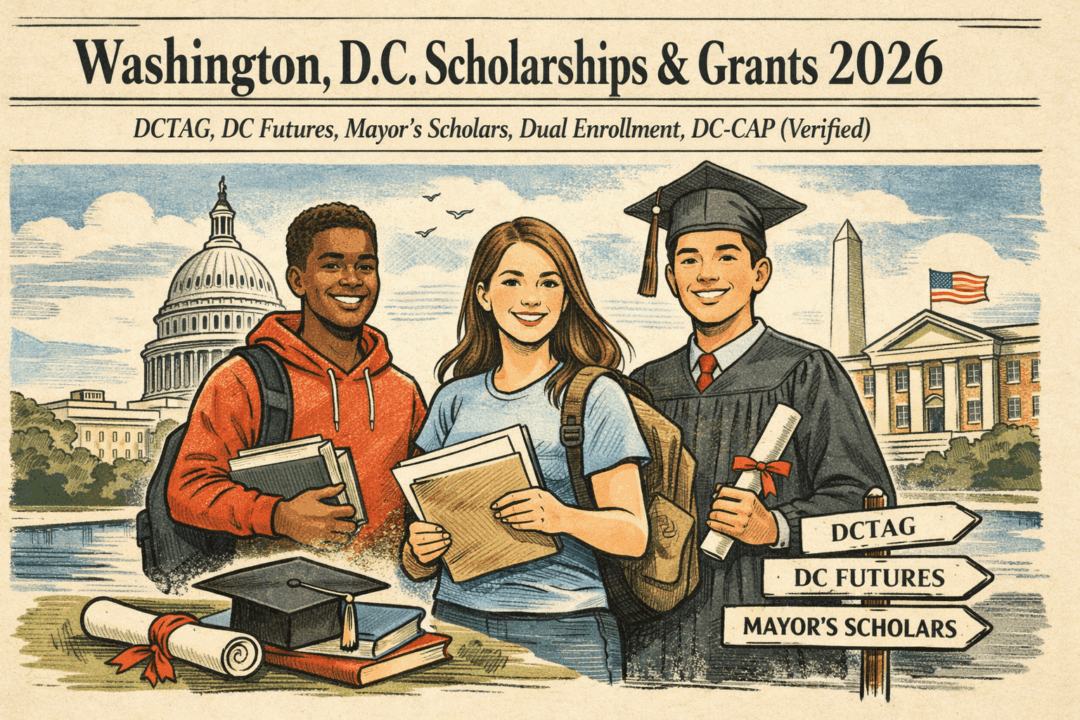
Washington, D.C. Scholarships & Grants: District Dollars, College Collars
One-page, verified guide to DC aid: DCTAG ($10k public / $2.5k private-HBCU/DC private; lifetime caps), DC Futures (last-dollar at 3 local universities + coaching), Mayor’s Scholars (last-dollar), DC-CAP (up to $4k/yr; Ward 7/8 $12k), Dual Enrollment (tuition/books covered), foster youth ETV.
District Headliners (official links — checked today )
DC Tuition Assistance Grant (DCTAG)
- Why it slaps
- Lets DC residents pay in-state-like rates at public colleges nationwide
- Also supports private HBCUs (nationwide) + DC-area private non-profits
- Amounts & caps: Up to $10,000/yr for public out-of-state tuition (lifetime max $50,000); up to $2,500/yr for private HBCUs/DC privates (lifetime max $12,500).
- Apply/info: https://osse.dc.gov/dctag — Link verified Aug 20, 2025.
DC Futures (associate or bachelor’s at three local partner universities
- Why it slaps
- Last-dollar scholarship covering tuition, fees, and COA gaps + college coaching
- Monthly coaching stipends for engaging with your coach
- 2025–26 note: OSSE indicates funding limits; the OneApp portal shows only current participants eligible for 2025–26.
- Program overview & Q&A: https://osse.dc.gov/dcfutures • https://osse.dc.gov/page/dc-futures-tuition-assistance-qa — Verified Aug 20, 2025.
- Stipend details (lifetime caps): Up to $1,050/yr; cap $6,000 (2-yr) / $9,000 (4-yr).
Mayor’s Scholars Undergraduate Program
- Why it slaps
- Last-dollar aid for DC residents at approved institutions; reapply each year
- School bills OSSE directly (tuition/fees)
- Student info & application hub: https://osse.dc.gov/mayorsscholars
- https://osse.dc.gov/page/district-columbia-mayor%E2%80%99s-scholars-undergraduate-program-information-students
DC-CAP (District of Columbia College Access Program)
- Why it slaps
- Last-dollar scholarships plus advising & retention support
- General DC-CAP Scholarship moved to up to $4,000/yr for up to 5 years (class of 2019+), per org filings; special programs include Ward 7 & 8 Scholarship: $12,000/yr (up to 5 years)
- DC-CAP scholarships: https://dccap.org/scholarships/ — Verified Aug 20, 2025.
- Amount sources: DC-CAP audited/IRS filings detail shift to $4,000/yr model.
Dual Enrollment (OSSE Consortium) — high schoolers
- Why it slaps
- Tuition + books covered for up to two 3-credit courses/term
- Earn college credit (often HS credit too) for free
- OSSE overview & IHE course options: https://osse.dc.gov/page/osse-dual-enrollment-opportunities • https://osse.dc.gov/page/dc-dual-enrollment-consortium-program-ihe-college-course-options
- DCPS page & timelines: https://dcps.dc.gov/page/osse-consortium-dual-enrollment
Foster Youth — Chafee Education & Training Voucher (ETV)
- Why it slaps
- Up to $5,000/yr for eligible current/former foster youth (tuition, fees, books, etc.)
- DC CFSA ETV info: https://cfsa.dc.gov/publication/ai-post-secondary-education-training-vouchers-etv
- Federal program details (GAO/ACF): caps & eligibility through age 26.
⸻
Speed-Run Your DC Aid Stack
- File FAFSA (or upload required docs if ineligible) before DC program deadlines.
- Submit OneApp for DCTAG; if eligible, also Mayor’s Scholars/DC Futures (note 2025–26 DC Futures participation limits).
- If you’re a HS student, add Dual Enrollment (tuition+books covered) to bank free credits.
- Need last-dollar help & coaching? Layer DC-CAP (and check Ward 7/8 if you qualify).
- In foster care/aged out? Apply for ETV early; coordinate with campus aid.
⸻
Helpful DC Resources
- OSSE Scholarships & Grants hub: https://osse.dc.gov/service/scholarships-and-grants-students — Verified.
- DCTAG “Prepare” checklist: FAFSA + docs steps. https://osse.dc.gov/prepare — Verified.
- DC Futures (students): https://osse.dc.gov/page/dc-futures-information-students — Verified.
- DC-CAP home + resources: https://dccap.org/ • https://dccap.org/resources/ — Verified.
- Dual Enrollment (DCPS overview): https://dcps.dc.gov/service/participate-dual-enrollment — Verified.
⸻
Washington, D.C. Scholarships & Grants
Washington, D.C.’s scholarship and grant ecosystem is unusually policy-intensive because the District lacks a “state” higher-education finance system comparable to the 50 states while simultaneously facing extreme neighborhood-level inequality in income and educational attainment. This has produced a hybrid model: a federally funded tuition equalization program (DCTAG) that functions like an “out-of-state tuition voucher,” local last-dollar completion supports (DC Futures), and a dense nonprofit advising-and-scholarship layer (e.g., DC CAP, College Success Foundation-DC). Using recent administrative metrics (award counts, disbursements, applicant flow), distributional data (ward and income patterns), and empirical evidence on price responsiveness, this paper evaluates D.C.’s aid architecture as a labor-market investment strategy and an equity intervention. It argues that D.C.’s approach is directionally strong—especially in using last-dollar design and coaching—but structurally vulnerable to funding volatility and “application friction,” and it identifies policy and implementation levers that can measurably increase degree completion over the next decade.
1) Why Washington, D.C. is a special case in scholarship policy
Most states build affordability through in-state tuition subsidies and state grant programs. D.C. is different: it has one public university (UDC) and no network of “in-state” public campuses across regions. As a result, D.C. affordability has historically relied on (1) portable aid that follows students out of the District and (2) non-governmental capacity to advise students through admissions, FAFSA, and persistence.
This is not merely administrative trivia. The District’s inequality is geographically concentrated. For example, the share of families with children below poverty is substantially higher east of the river, and median family income varies dramatically by ward (e.g., Ward 8 around ~$50k vs Ward 3 around ~$265k in the referenced ward-level dataset). These gaps correlate with differences in K–12 readiness and postsecondary transition support, meaning a scholarship system that is “neutral” on paper can still produce unequal outcomes without complementary advising and completion infrastructure.
The K–12 pipeline also signals why completion—not only access—must be the core outcome. OSSE-reported “key measures” show districtwide high school graduation around the high-70% range and persistent subgroup gaps, with markedly different postsecondary enrollment rates by race/ethnicity. In short, D.C.’s scholarship design must solve two problems at once: reduce price barriers at the point of entry and reduce institutional/behavioral barriers that cause “some college, no degree.”
2) The affordability problem in D.C. is partly a “tuition geography” problem
In most states, students have access to multiple public campuses charging in-state tuition. In D.C., the comparable “low price” option is limited, so the primary lever has been tuition equalization—paying the difference between in-state and out-of-state tuition at public universities (and a smaller benefit for certain private/HBCU options).
That design choice matters because evidence consistently shows college enrollment is price-sensitive. The classic empirical analysis of D.C.’s tuition equalization policy (Kane, NBER working paper) finds large enrollment responses to price changes, estimating that for affected institutions, each $1,000 relative price decrease was associated with enrollment increases in the range of ~5–6% (with larger impacts in some periods and subsets). In practical terms, when D.C. removes a large out-of-state premium, more students apply to and enroll in public institutions that previously priced them out—even when admissions constraints remain for selective flagships.
3) Core public programs: DCTAG as the anchor, DC Futures as the completion engine
3.1 DCTAG (DC Tuition Assistance Grant): scale, flow, and equity profile
DCTAG is the District’s cornerstone portability program. Recent OSSE reporting summarizes the policy in plain terms: grants “up to $10,000” for eligible D.C. residents (with a smaller benefit level for certain DC-metro private/HBCU options), with thousands served annually.
Scale and trend. OSSE’s annual reporting indicates 3,888 students received DCTAG awards in SY 2023–24, and 4,631 residents were deemed eligible in SY 2024–25, described as the highest numbers in the last five years. This matters because it suggests either growing awareness, growing demand, improved administrative throughput—or all three.
Applicant funnel and disbursement. The DCTAG Annual Performance Report (covering recent award cycles) documents:
-
Applications submitted: 5,812 (for the latest year shown in the table)
-
Applicants deemed eligible: 4,344 (≈76% of submitted)
-
Students receiving awards: ~3,746–3,747
-
Total funds disbursed (for the academic-year disbursement metric): $28.89M
A simple derived metric is informative: $28.89M / 3,747 ≈ $7,710 per recipient on average—suggesting DCTAG frequently covers a substantial share of the out-of-state premium but often not the full “cost of attendance” burden (tuition + fees + living costs).
Distributional profile (who benefits). The DCTAG Data Deck for AY 2022–23 provides unusually detailed equity signals:
-
Ward distribution: the majority of recipients come from Wards 4, 7, and 8 (e.g., Ward 4 ≈22%, Ward 8 ≈20%, Ward 7 ≈18%).
-
Race/ethnicity: a large share of recipients are Black/African American (≈65% in the deck’s breakdown).
-
Income: the median household income for recipients is reported around $43,204, far below the District’s median household income (~$101,027), implying the typical recipient is from a household with income roughly 43% of the city median.
This is a crucial finding: despite being a tuition equalization program (often criticized as potentially benefiting middle-income families), the observed recipient distribution suggests DCTAG is serving a strongly equity-relevant population in practice—though this does not guarantee equitable outcomes (completion and debt still matter).
Federal investment rationale and durability. Oversight analyses underscore the program’s long-run scale. A GAO summary notes DCTAG has distributed hundreds of millions of dollars and supported tens of thousands of residents over time. A Congressional Research Service report similarly documents cumulative totals through AY 2017–18 and annual spending/participation in that period. The policy implication is that DCTAG is not a boutique program—it is a central human-capital investment instrument for the District.
3.2 DC Futures: last-dollar + coaching + emergency aid (but funding volatility is real)
Where DCTAG primarily addresses tuition geography, DC Futures is explicitly designed around persistence and completion. Its applicant handbook frames it as “more than a scholarship,” bundling:
-
a last-dollar scholarship up to $8,000/year (semester cap $4,000; lifetime caps $32k associate / $48k bachelor’s),
-
structured college coaching,
-
and emergency funds up to $1,000 annually for enrolled participants.
On OSSE’s student information page, the program also specifies a coaching participation stipend of up to $1,050/year (with lifetime caps based on program length).
Design strengths (why this is academically important):
Last-dollar + coaching directly targets the two biggest failure points in urban college completion pipelines: (1) unmet need after grants are applied and (2) navigation burdens (course registration, SAP, financial holds, transfer complexity). Emergency micro-grants are increasingly supported in completion research because small shocks (car repair, medical bill, textbook costs) can trigger stop-out.
But: a key constraint for the current cycle. The DC Futures handbook states that only current participants are eligible for funding for the 2025–26 academic year, citing funding constraints. This is a high-stakes signal for D.C.’s ecosystem: completion-oriented programs are only as effective as their continuity. When a “completion engine” cannot onboard new cohorts, the system risks becoming a closed pipeline—helping those already in, while leaving incoming students to rely on older tools that are less completion-focused.
4) The nonprofit scholarship-and-advising layer: DC CAP and College Success Foundation-DC
D.C.’s ecosystem is unusually dense in advising infrastructure, and this is not accidental; it is a response to the administrative complexity of combining federal aid, DCTAG, institutional aid, and last-dollar programs.
4.1 DC CAP (DC College Access Program): scholarships tied to measurable outcomes
DC CAP reports >$7.2M in scholarships awarded to over 1,100 scholars in the 2024–2025 academic year, alongside outcome metrics such as 90% first-to-second-year retention (for a cited cohort context) and 75% on-time graduation in established programs. Their FAQ also describes annual award bands (e.g., $5,000–$7,500, renewable up to five years) for certain scholarship tracks.
Even without microdata, the implied scale is meaningful: using the reported “>$7.2M” and “1,100 scholars,” the average aid intensity is at least ~$6,500 per scholar per year—material enough to reduce borrowing or cover “last-dollar” gaps that Pell and institutional aid miss.
DC CAP has also publicly highlighted major philanthropic investment to expand access. This matters because it complements public funding and can be more flexible (supporting advising, emergency aid, and program operations that public dollars may not cover efficiently).
4.2 College Success Foundation-DC: targeting Wards 7 & 8 with long-horizon supports
College Success Foundation-DC describes its mission focus explicitly: improving college graduation outcomes for students in Wards 7 and 8, providing advising and supports that extend into and through college. The academic takeaway is that this is place-based completion infrastructure—a direct response to the ward-level inequality described earlier.
5) FAFSA completion and “application friction” as a measurable bottleneck
Scholarship dollars do not matter if students cannot access them. FAFSA is the gateway to Pell, federal loans, and many local programs.
Federal Student Aid’s high-school FAFSA submission reporting shows that in 2023–24, the District of Columbia’s overall FAFSA completion rate for seniors is reported around 76%, while early reporting for 2024–25 shows 70.7% (through the specified date), with a negative year-over-year change noted.
This aligns with what many jurisdictions saw during the “Better FAFSA” transition: operational delays and confusion can translate into fewer submissions, later submissions, and reduced aid certainty. For D.C., that friction is amplified because local programs (DCTAG, DC Futures, and institutional packaging) frequently interact with FAFSA-based eligibility and verification.
OSSE has responded in part through recognition and incentives (e.g., FAFSA completion awards for high schools). But from a policy design perspective, the deeper need is to reduce friction structurally: simplify document requirements where possible, expand direct data sharing, and automate renewals for eligible continuing students.
6) Synthesis: what D.C. is doing right—and where the system still leaks
What’s working (evidence-based strengths)
-
Price equalization at scale: DCTAG makes D.C. functionally “in-state somewhere,” and empirical research supports large enrollment responses to price reductions.
-
Equity-relevant reach: recipient income statistics and ward distribution indicate substantial penetration into lower-income communities.
-
Completion design is now explicit: DC Futures’ last-dollar + coaching + emergency aid package matches best practices emerging from completion research.
-
Nonprofit capacity provides the “last mile”: DC CAP’s reported retention and graduation outcomes suggest that advising + aid bundles can outperform baseline expectations for comparable populations.
Where the system leaks (structural weaknesses)
-
Funding volatility for completion-focused programs: limiting DC Futures to continuing participants (for 2025–26) is a red flag because cohort continuity is central to population-level completion gains.
-
Application and verification burdens: DCTAG’s own reporting shows thousands of incomplete applications annually, a direct measure of friction.
-
FAFSA shock sensitivity: recent declines in FAFSA submission/completion metrics can ripple through the entire aid stack.
-
Completion is still the binding constraint: K–12 and postsecondary transition measures show persistent subgroup gaps; scholarships that only address tuition without sustained supports will not fully close completion disparities.
7) Recommendations: a data-driven agenda for higher completion in D.C.
The policy objective should shift from “more awards” to more degrees per dollar, without reducing access. The following recommendations are grounded in the documented failure points above:
-
Stabilize and scale DC Futures cohort capacity
If the program cannot accept new applicants, the District loses its most modern completion mechanism. Prioritize multi-year appropriations or braided funding (public + philanthropic) to protect cohort onboarding. -
Reduce DCTAG friction with smarter renewals and document re-use
The annual performance report’s incomplete-application counts are a quantifiable target. Expand auto-renew pathways for students with stable residency documentation and verified enrollment, and broaden document re-use across OSSE programs via DC OneApp integrations. -
Treat FAFSA completion as a system KPI, not a seasonal campaign
Given the District’s FAFSA completion metrics and recent decline, build year-round FAFSA readiness: earlier FSA ID creation, school-based verification help, and “FAFSA-first” messaging for DCTAG/DC Futures eligibility continuity. -
Invest in advising capacity where need is geographically concentrated
Ward-level income disparities and targeted nonprofit missions already point to where marginal dollars have the highest returns: east-of-river schools and feeder patterns. Strengthen counselor-to-student ratios and fund embedded college-success teams. -
Align scholarship priorities with high-demand fields without over-restricting choice
DC Futures requires approved majors aligned with high-demand industries; that can improve labor-market ROI, but overly narrow lists can deter students. Maintain transparency, update lists annually, and provide bridge supports for students who change majors without losing momentum.
Conclusion: What this means for a “Washington, D.C.” scholarships page
A D.C.-specific scholarships and grants page should present the ecosystem as an aid stack—not a list—because students’ real outcomes depend on sequencing:
-
Start with FAFSA (gateway).
-
Anchor with DCTAG (tuition equalization; high scale).
-
Add DC Futures where eligible (completion supports; last-dollar + coaching).
-
Layer DC CAP and other nonprofits (advising + scholarships with strong outcome claims).
From a research standpoint, D.C. already possesses many of the components that high-performing completion systems use: portable tuition equalization, last-dollar completion aid, and intensive advising. The limiting factors are administrative friction and funding continuity—problems that are solvable with targeted design changes and stable financing. If D.C. treats “degree attainment per aid dollar” as the primary performance metric, its scholarship ecosystem can function not only as a social policy, but as a durable economic development strategy.
FAQ — Washington, D.C. Edition
Q1) DCTAG sounds huge—what exactly does it cover?
For public colleges nationwide: up to $10,000/yr toward the out-of-state tuition difference (lifetime $50,000). For private HBCUs (nationwide) and DC-area private non-profits: up to $2,500/yr (lifetime $12,500). You must reapply each year.
Q2) Who should apply to DC Futures vs Mayor’s Scholars?
DC Futures is last-dollar at three local partner universities and includes coaching (2025–26: continuing participants only, per OSSE). Mayor’s Scholars is last-dollar at approved institutions (not limited to the three) and is annual; schools bill OSSE directly.
Q3) Does DC Futures give cash refunds?
No. It’s a last-dollar award; no overage checks/refunds to students.
Q4) How much is the DC-CAP Scholarship?
DC-CAP’s general scholarship shifted to up to $4,000/yr for up to 5 years (per org filings). Special programs include Ward 7 & 8: $12,000/yr (up to 5 years). Amounts depend on funding and eligibility.
Q5) Dual Enrollment—what’s covered?
Through the OSSE Consortium, tuition and books are covered for up to two 3-credit courses per term for selected DCPS/charter students.
Q6) I’m a current/former foster youth—how do I pay for college?
Apply for Chafee ETV (up to $5,000/yr, to age 26, if eligible). Pair with DCTAG/DC-CAP and campus aid.  
Q7) Where do I actually submit the applications?
DCTAG, DC Futures, and some OSSE programs run through OSSE’s Application for Postsecondary Studies (APS / “OneApp”) portal. Check live status and deadlines on the program pages.