Washington Scholarships & Grants: Evergreen For Your Degree
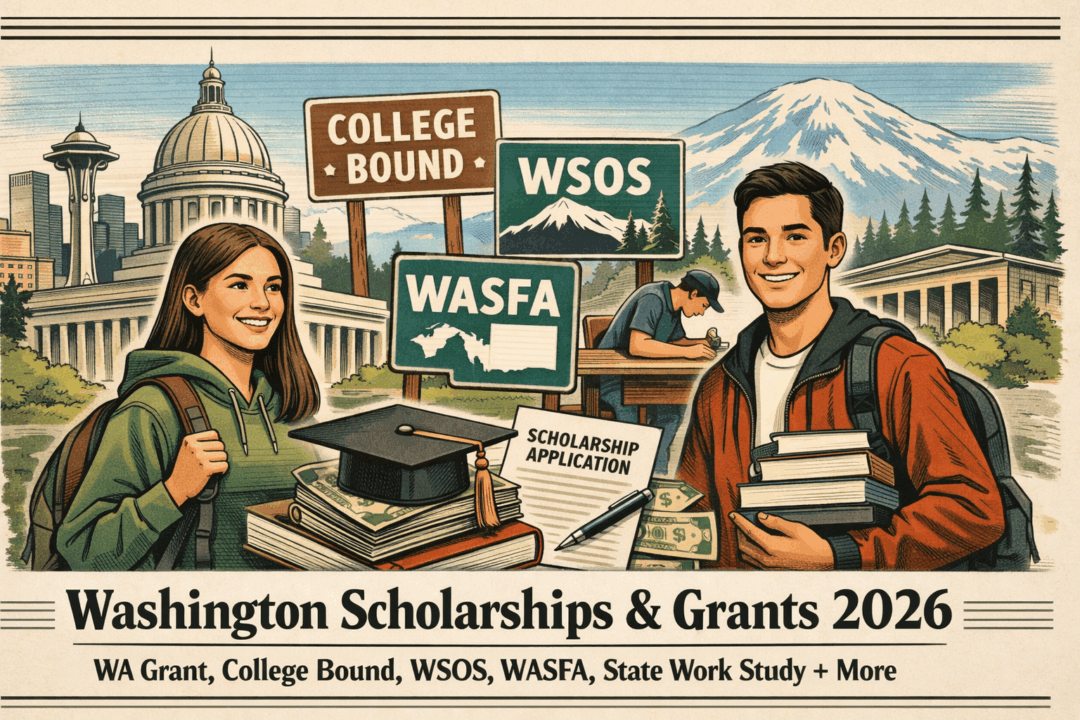
One-page, verified guide to WA aid: Washington College Grant (need-based), College Bound Scholarship (tuition promise), WSOS (STEM/health), WASFA (FAFSA alternative), State Work Study, Passport to Careers (foster/unhoused), National Guard Grant, veterans’ tuition waivers, Running Start/CiHS.
Washington College Grant (WCG)
- Why it slaps
- 💸 One of the most generous need-based grants in the U.S.
- 🎓 Covers college, technical programs, and registered apprenticeships
- 💰 Amount: Based on income, family size, school cost; in 2025–26, families of four earning ≤ $78,500 can receive a full award; many up to $131,000 still get some aid.
- 🔗 Apply/info: https://wsac.wa.gov/wcg
College Bound Scholarship (CBS)
- Why it slaps
- 🧾 For eligible students who signed in middle school; pairs with WCG to make public tuition free (or private equivalent) when requirements are met
- 💡 Note: 2025–26 manual updates timing/usage rules.
- 🔗 Info: https://wsac.wa.gov/college-bound
WASFA (Washington Application for State Financial Aid)
- Why it slaps
- 🧭 FAFSA alternative for undocumented or FAFSA-ineligible students to access state aid
- 🔗 Apply/info: https://wsac.wa.gov/wasfa (2025–26 guide available).
State Work Study (SWS)
- Why it slaps
- 💼 Paid, approved jobs (on/off campus) for low- & middle-income students; builds experience and reduces loans
- 🔗 Info: https://wsac.wa.gov/state-work-study
Washington State Opportunity Scholarship (WSOS) — 3 pathways
- Why it slaps
- 🚀 Baccalaureate Scholarship: up to $22,500 for high-demand STEM/health majors + support services
- 🛠️ Career & Technical Scholarship: certificates/AA, some apprenticeships
- 🎓 Graduate Scholarship: selected high-need fields
- 🔗 Apply/info: https://waopportunityscholarship.org/applicants/apply-for-a-scholarship/
Passport to Careers (foster & unaccompanied homeless youth)
- Why it slaps
- 🧡 Scholarship plus campus support; includes college and apprenticeship tracks
- 🔗 Info: https://wsac.wa.gov/passport-to-careers
WA National Guard — Postsecondary Education Grant (NGG)
- Why it slaps
- 🪖 Tuition/fee help for Guard members (and eligible dependents); can stack with other aid within COA rules
- 🔗 Info: https://wsac.wa.gov/national-guard
Veterans’ & Dependents’ Tuition Waivers (RCW 28B.15.621)
- Why it slaps
- 🎖️ Public colleges must waive tuition/fees for certain eligible dependents; schools also have veteran waivers
- 🔗 Program law/overview: https://wsac.wa.gov/tuition-waiver-veterans-dependents
Dual Credit Cost-Savers: Running Start & College in the High School (CiHS)
- Why it slaps
- 🏁 Earn college credit in high school; big tuition savings
- 📝 2025 update: “after-exit” Summer Running Start not reauthorized (no longer available).
- 🔗 Dual-credit hub: https://ospi.k12.wa.us/student-success/support-programs/dual-credit-programs
⚠️ Heads-up: Washington Bridge Grants were eliminated starting 2025–26 per WSAC guidance. If you saw older mentions online, they’re outdated.
Speed-Run Your WA Aid Stack 🏁
- File FAFSA (or WASFA if FAFSA-ineligible). WA posts timelines and links here: https://wsac.wa.gov/apply.
- Check WCG eligibility (most families qualify for something up to $131k income, family of 4).
- If you signed College Bound, meet the pledge requirements and enroll at a participating WA college.
- Add WSOS (BaS/CTS) for STEM/health pathways; it covers non-tuition costs too.
- Foster/unhoused? Apply for Passport to Careers support ASAP.
- Guard/veteran family? Compare NGG and RCW 28B.15.621 waivers.
Helpful WA Resources 🧭
- WSAC — WCG overview & award examples: https://wsac.wa.gov/wcg & https://wsac.wa.gov/wcg-awards
- Apply for aid (FAFSA/WASFA hub): https://wsac.wa.gov/apply
- WASFA Guide (2025–26): https://wsac.wa.gov/sites/default/files/2025-26-WASFA-Guide.pdf
- State Work Study: https://wsac.wa.gov/state-work-study
- WSOS (all pathways): https://waopportunityscholarship.org/applicants/apply-for-a-scholarship/
- Passport to Careers: https://wsac.wa.gov/passport-to-careers
- NGG (Guard grant): https://wsac.wa.gov/national-guard
- Veterans/Dependents Tuition Waiver: https://wsac.wa.gov/tuition-waiver-veterans-dependents
- Dual Credit overview: https://ospi.k12.wa.us/student-success/support-programs/dual-credit-programs
Washington Scholarships & Grants: Policy-Forward Analysis (2026)
Washington State has built one of the nation’s most expansive affordability systems by pairing moderated public tuition policy with a large, need-based grant architecture that reaches beyond the very lowest-income households. At the center is the Washington College Grant (WA Grant), supported by targeted programs (College Bound Scholarship, Passport to Careers, State Work Study, Washington Award for Vocational Excellence, workforce loan-repayment programs) and an inclusion pathway for students who cannot file the FAFSA via the Washington Application for State Financial Aid (WASFA). Using Washington Student Achievement Council (WSAC) expenditure forecasts, award schedules, and strategic planning documents, this paper quantifies the scale of state support, examines who benefits by income band, and evaluates the policy direction of recent reforms (AY 2025–26 and beyond). Key findings include: (1) Washington’s flagship need-based aid is large enough to operate like a “tuition guarantee” for many families—WSAC’s own policy framing describes full tuition/fees coverage up to 65% of state median family income (MFI) and partial support up to the statewide median; (2) forecasted program reach is broad—WSAC’s 2023–24 anticipated expenditures estimate 91,500 Washington College Grant recipients and 53,600 recipients of a non-tuition “bridge” stipend; (3) most state aid recipients are concentrated in the lowest MFI categories, but state support extends further up the income distribution than Pell; and (4) participation constraints persist—only about half of Washington public high school graduates complete the FAFSA, limiting automatic access to both federal and state dollars. The paper concludes with evidence-based recommendations for student-facing guidance and for Washington’s next-stage affordability policy—especially amid the phase-out of the Washington Bridge Grant after AY 2024–25 and other structural changes beginning in AY 2025–26.
1. Why Washington’s scholarship ecosystem matters: an attainment-and-equity frame
Washington’s scholarship and grant system is not simply a collection of awards; it is a core mechanism in a statewide attainment strategy. WSAC’s Strategic Action Plan anchors policy to a legislatively adopted goal that 70% of Washingtonians ages 25–44 hold a credential beyond high school, while noting that attainment stood at 61.0% in 2022 (statewide). This framing matters because it treats affordability interventions as productivity investments—aimed at raising enrollment, persistence, and completion, particularly for students historically excluded from postsecondary pathways.
WSAC also makes an unusually strong comparative claim: Washington “awards the highest amount of need-based grant aid per undergraduate full-time equivalent student in the country” (referencing NASSGAP 2021–22), and further states that total state grants exceed total federal Pell grants to Washington residents attending in-state institutions. If accurate (and WSAC positions it as such), Washington’s system should be evaluated not only on coverage and generosity but also on administrative throughput: how effectively eligible residents are connected to aid.
2. Data and approach
This analysis synthesizes public, program-adjacent data rather than student-level microdata. Primary sources include:
-
WSAC anticipated expenditures and estimated recipients (2023–24).
-
WA Grant maximum award schedules by sector and institution type (2023–24).
-
WSAC Strategic Action Plan metrics on aid distribution by MFI and FAFSA completion context.
-
WSAC public guidance on WA Grant income thresholds for 2025–26.
-
Program-rule and policy-change documentation describing reforms beginning AY 2025–26 (including MFI eligibility adjustments, sector eligibility changes, and sunset of the Bridge Grant).
-
Workforce-oriented, quasi-private scholarship programs (e.g., Washington State Opportunity Scholarship) that operate alongside state aid.
Because expenditures are “anticipated” and recipient counts are “estimated,” per-recipient averages below should be read as indicative magnitude—not precise benefit incidence.
3. Scale of Washington state aid: money, reach, and implied average support
WSAC’s 2023–24 anticipated expenditures table provides a rare, consolidated view of program scale across the state financial aid portfolio. Converting those totals into simple “dollars per estimated recipient” reveals the system’s functional design: large, tuition-anchored grants (WA Grant), a modest but broad non-tuition stipend (Bridge Grant), and smaller, targeted programs for specific populations and workforce needs.
Table 1. WSAC state financial aid programs (2023–24 anticipated)
(Computed from WSAC anticipated expenditures and estimated recipients.)
| Program | Anticipated expenditures | Estimated recipients | Approx. $ per recipient |
|---|---|---|---|
| Washington College Grant | $428.0M | 91,500 | ~$4,678 |
| WA Grant – Apprenticeships | $2.0M | 600 | ~$3,333 |
| College Bound Scholarship | $14.8M | 17,800 | ~$831 |
| Washington Bridge Grant | $27.6M | 53,600 | ~$515 |
| State Work Study | $12.8M (+ employer contrib. noted by WSAC) | 4,200 | ~$3,048 |
| Passport to College Promise | $5.12M | 1,260 | ~$4,063 |
| Passport Incentive Grants (supports) | $1.79M | 1,200 | ~$1,492 |
| Passport to Apprenticeship | $0.342M | 70 | ~$4,886 |
| SETuP (planning supports) | $0.343M | 280 | ~$1,225 |
| WAVE (vocational excellence) | $1.138M | 190 | ~$5,989 |
Two structural insights follow:
-
WA Grant is the volume engine (both dollars and recipients). At this scale, changes to eligibility thresholds or award formulas affect tens of thousands of households—more like a tax/transfer instrument than a boutique scholarship.
-
Non-tuition supports matter—yet are comparatively small per recipient. The Bridge Grant’s implied per-recipient magnitude (~$515) is consistent with a “gap filler” model aimed at transportation, food, childcare, or books—costs that drive stop-out even when tuition is covered.
4. The Washington College Grant: tuition-anchored affordability with income-band reach
4.1 Eligibility and income thresholds (2025–26 public-facing guidance)
WSAC’s consumer-facing materials communicate the WA Grant as broadly available: “Half of Washington families qualify,” and awards may cover tuition, supplies, and living expenses. For 2025–26, WSAC provides a concrete example: in a family of four, $78,500 or less corresponds to a full award, and up to $131,000 may still qualify for partial aid. This messaging positions the program as both need-based and middle-income relevant—an important distinction for outreach strategy and for how scholarship directories should label the program (“need-based” but not “low-income only”).
4.2 Maximum awards by sector (2023–24 schedule as a price signal)
WA Grant maximum award tables indicate that the state pegs maximum support to sector price points. For example, in 2023–24 the University of Washington maximum (Category A) is listed as $11,956, while community and technical colleges show $4,573; private nonprofit four-year institutions list $9,739. These amounts are not merely scholarship figures—they are an encoded policy statement about what the state considers the “tuition benchmark” by sector and how it expects students to allocate across sectors.
4.3 Program governance: from policy to caseload reality
The Caseload Forecast Council’s WA Grant document underscores that the caseload was established through legislation (HB 2158, 2019) and “was not an entitlement before 2020–21.” It also reports that the November 2025 forecast was higher than earlier forecasts, citing increased demand. This is a crucial nuance for practitioners: even if policy language reads as a guarantee, appropriations and caseload forecasting still shape operational capacity.
5. College Bound Scholarship: early commitment, automatic enrollment, and coordination with WA Grant
The College Bound Scholarship is designed as an early commitment mechanism—signaling to middle school students that college affordability is not out of reach. WSAC notes automatic enrollment for students eligible for free/reduced-price lunch in 7th/8th grade (or newly eligible in 9th), and for youth in foster care/dependent of the state. In the 2023–24 anticipated expenditure table, College Bound is forecast at $14.8M for 17,800 recipients.
The coordination logic matters: Washington’s affordability system is layered, and students may receive WA Grant, College Bound, Pell, and local scholarships simultaneously. WSAC program guidance emphasizes coordinated awarding across programs so that College Bound commitments align with WA Grant where applicable. In practice, this implies that scholarship directories and advising content should describe College Bound less as a standalone “check” and more as a guarantee/eligibility status that triggers tuition coverage when combined with FAFSA/WASFA completion.
6. The Washington Bridge Grant: non-tuition support—and the consequences of its sunset
WSAC describes the Washington Bridge Grant as a stipend intended to supplement financial support “beyond tuition and fees” for low-income students who are WA Grant eligible but not College Bound eligible. The program’s reach is wide (estimated 53,600 recipients in 2023–24) even though the implied per-recipient amount is modest (~$515). This scale strongly suggests that Washington recognized a critical constraint: tuition coverage alone does not prevent stop-out when living costs are binding.
However, policy documentation for program changes indicates that funding ended for Washington Bridge Grants after the 2024–2025 academic year. The analytical implication is straightforward: absent replacement supports (institutional emergency aid, philanthropic microgrants, expanded work-study, childcare subsidies), Washington risks eroding completion gains among exactly the groups the tuition guarantee is meant to serve—because “total cost of attendance” is not dominated by tuition for many low-income and parenting students.
7. Work-based aid and targeted pathways: State Work Study, Passport, WAVE, Health Corps, and more
WSAC’s program table shows several targeted investments that function as “completion stabilizers” or workforce pipeline instruments:
-
State Work Study: $12.8M with WSAC noting employer contributions (about $5M) and an estimated 4,200 participants. This program is often more impactful than its dollar total suggests because it ties aid to paid hours and employer networks.
-
Passport to Careers (foster youth): WSAC lists Passport scholarships plus incentives for institutions to provide supports. These designs reflect an evidence-informed view that high-need students require structured advising and wraparound services, not only tuition awards.
-
Washington Award for Vocational Excellence (WAVE): A merit-oriented CTE scholarship line item—small in total dollars but high in symbolic value and targeted workforce alignment.
-
Washington Health Corps / conditional scholarships for teaching: Loan repayment and service-obligation tools that address shortage areas (behavioral health, nursing education, teacher endorsements).
For a Washington-focused scholarship portal, these are especially important because students often search by career intent (“nursing scholarships Washington,” “teacher shortage scholarship WA,” “trade scholarships Seattle”), not by administering agency.
8. Equity and who benefits: MFI distribution and the Pell comparison
WSAC provides an unusually clear breakdown of state financial aid recipients by MFI category (AY 2022–23). Among state financial aid recipients, 67.9% are in the 0–55% MFI band, with additional recipients in 56–65% (9.0%), 66–75% (6.8%), and 76–100% (10.4%). The Pell distribution is even more bottom-weighted (89.2% in 0–55% MFI).
This comparison supports a key interpretation: Washington’s state aid extends meaningfully further into the moderate-income range than Pell, consistent with WSAC’s public claims about broader eligibility. It also implies that scholarship advising in Washington should avoid a common error: treating FAFSA completion as relevant only for the lowest-income households. In Washington, FAFSA/WASFA completion can unlock state aid across a wider set of families than in many states.
9. Administrative throughput constraint: FAFSA completion remains near 50%
Even a generous aid system underperforms if eligible students do not apply. WSAC reports that for the Class of 2023, about 52% of graduating seniors completed a FAFSA (up from 50% for the Class of 2022, but still below pre-pandemic levels). For Washington, this is not just a federal-aid problem: FAFSA completion is the intake mechanism for state dollars for most students, and WASFA is the parallel intake for students ineligible for FAFSA.
10. Inclusion architecture: WASFA and immigrant student eligibility
Washington’s aid system explicitly includes pathways for undocumented students and students with DACA, and WSAC states that students do not have to be U.S. citizens to access state financial aid or resident tuition, with multiple qualifying routes. WSAC’s WASFA guidance clarifies that the 2025–26 WASFA corresponds to enrollment from fall 2025 through spring 2026. This design makes Washington’s scholarship ecosystem structurally different from many states, and scholarship portals should treat WASFA not as a niche form but as a core access route.
11. Workforce-aligned scholarships outside WSAC: Washington State Opportunity Scholarship (WSOS)
WSOS is a major quasi-private complement to state aid, particularly for high-demand STEM, health care, and trades pathways:
-
Career & Technical Scholarship: up to $1,500 per quarter for eligible programs (associate degrees, certificates, apprenticeships), with proration for part-time enrollment.
-
Baccalaureate Scholarship: up to $22,500 total for eligible STEM and health care majors at Washington institutions, and can be used for costs beyond tuition.
Analytically, WSOS fills a policy niche: it targets fields tied to state labor-market demand while providing career navigation services, not only cash. This is consistent with a modern theory of change in financial aid research: dollars matter most when coupled with structure (advising, milestones, and labor-market linkage).
12. Policy trajectory: structural changes starting AY 2025–26 (and beyond)
Washington has been actively modifying the WA Grant / College Bound system. Program documentation summarizing legislative changes reports that beginning AY 2025–26, students with family incomes up to 60% of state MFI receive the maximum WA Grant award, and it also notes additional sector and timing changes (including limits on College Bound usage windows and removal of certain for-profit institutional eligibility on a future timeline). Alongside the Bridge Grant sunset, this indicates a policy pivot: tightening and clarifying maximum-award targeting while restructuring where state dollars can be used.
For scholarship platforms, this creates a practical requirement: Washington scholarship content must be versioned by academic year (AY 2024–25 vs AY 2025–26 vs AY 2026–27 changes), because eligibility rules and institutional participation can change in ways that materially alter student options.
13. Research and evaluation capacity: what Washington is positioned to learn next
A key marker of a mature aid system is whether it can be evaluated. The Institute of Education Sciences (IES) describes a collaborative study of the Washington College Grant program using statewide longitudinal data, noting a sample of roughly 640,000 public high school graduates from 2009–2024. This is important because it suggests Washington can move beyond descriptive metrics toward causal inference (e.g., enrollment and completion effects, heterogeneity by income band, race/ethnicity, geography, and sector).
14. Implications for a Washington-focused Scholarships & Grants page
A Washington hub page that is genuinely “data driven” should reflect how Washington functions in practice:
-
Lead with the intake mechanism: FAFSA/WASFA first, because it unlocks multiple programs at once. (WSAC’s own “Apply for financial aid” framing supports this.)
-
Segment by pathway: 4-year, community/technical, apprenticeship, adult learner—because award schedules and complementary programs differ sharply by sector.
-
Surface non-tuition reality: explicitly discuss food/housing/transportation gaps and what replaces the Bridge Grant after AY 2024–25.
-
Add an equity lens: show the MFI distribution (who receives aid) and the FAFSA completion constraint (who is missing out).
-
Integrate WSOS and major local scholarship ecosystems: state aid + workforce scholarships + community foundations is how students actually finance attendance.
Conclusion
Washington’s scholarship and grant environment stands out nationally because it treats affordability as a system: tuition policy + broad need-based aid + targeted supports + inclusive access via WASFA. The WA Grant’s scale (hundreds of millions annually and tens of thousands of recipients) makes it the dominant lever, while College Bound operates as an early-commitment enrollment catalyst. Yet the system’s effectiveness is limited by application throughput (FAFSA completion ~52% for the Class of 2023) and by the reality that non-tuition costs drive stop-out—made more urgent by the Bridge Grant’s post–AY 2024–25 funding end. The near-term policy direction emphasizes recalibrated maximum-award targeting (AY 2025–26 reforms) and institutional eligibility rules, increasing the importance of up-to-date guidance. For students and families, the practical takeaway is simple: FAFSA/WASFA completion is the gateway to a uniquely generous state system; for advisors and scholarship platforms, the takeaway is that Washington content must be operational (timelines, intake, sector pathways) rather than a static list of awards.
Selected References (key sources used)
WSAC WA Grant overview and awards guidance; WSAC 2023–24 anticipated expenditures; WSAC 2023–24 maximum award table; WSAC Strategic Action Plan (aid distribution by MFI, affordability claims); WSAC FAFSA completion digest; WSAC WASFA and immigrant student guidance; WSOS Career & Technical and Baccalaureate scholarship pages; Caseload Forecast Council WA Grant caseload document; IES description of WA Grant longitudinal study.
FAQ — Washington Edition 💬
Q1) Who should file WASFA instead of FAFSA?
Students who are ineligible for federal aid (e.g., undocumented) can submit WASFA to be considered for state aid like WCG/CBS.
Q2) How much does WCG actually pay?
It depends on income, family size, school type. In 2025–26, families of four at ≤ $78,500 can get a full award; up to $131,000 may get partial aid.
Q3) Is the Bridge Grant still a thing?
No. Eliminated beginning 2025–26 by the state budget.
Q4) I signed College Bound in middle school—do I still pay anything?
If you meet the CBS pledge and attend a participating WA college, tuition is covered (with WCG). You may still need to budget for housing/books.
Q5) Guard member here—how does the NGG work with my other aid?
NGG helps with tuition/fees and can stack with WCG/other aid within cost of attendance rules. Apply via WSAC.
Q6) Can I earn free college credit in high school?
Yes—Running Start (at the college) and CiHS (college class at your HS). Note: the 2025 legislature did not reauthorize “after-exit” Summer Running Start.