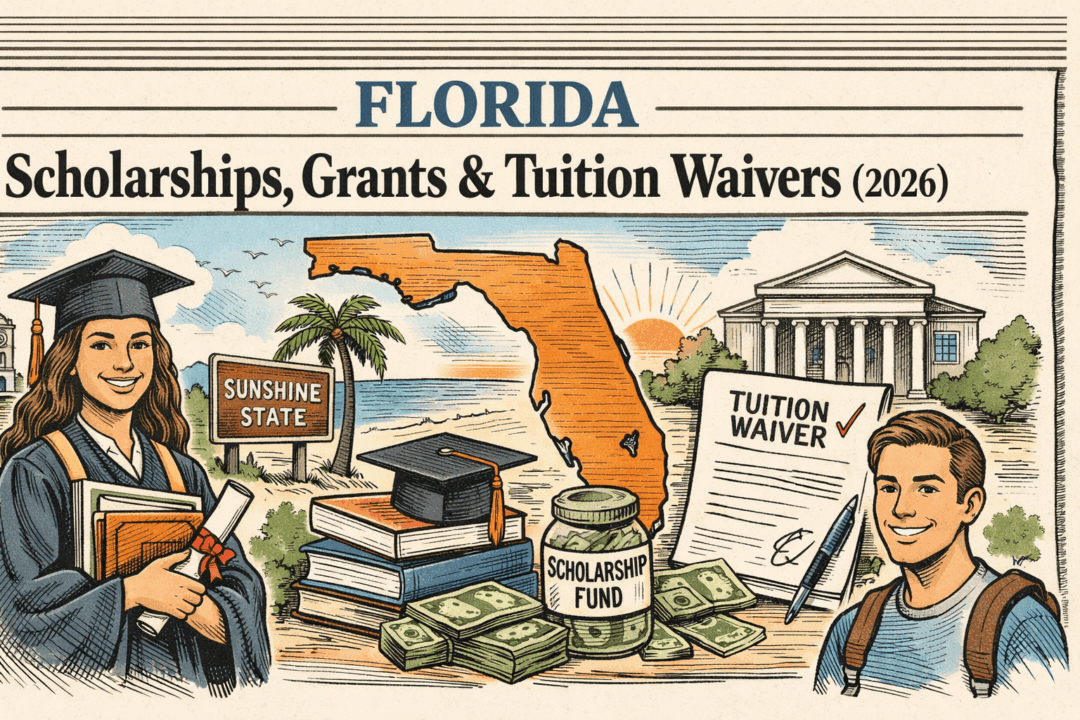
Florida Scholarships, Grants & Tuition Waivers (2026) — Verified Links & Deadlines
The ultimate 2026 guide to Florida scholarships, grants, and tuition/fee waivers. Bright Futures, FSAG, EASE, Benacquisto, José Martí, SSF, Miami HEAT, Florida PTA, Florida Realtors & more.
Florida Scholarships 2026 (sorted by deadline month)
January
Miami HEAT Scholarships (South Florida seniors)
💥 Why It Slaps: Big-name, community-rooted awards from the HEAT Charitable Fund that recognize academic grit, leadership, and service. If you’re in Miami-Dade, Broward, or Palm Beach counties, this is a marquee local scholarship with solid amounts and a clean application process. Awards can stack with Bright Futures and school aid to lower your net price.
💰 Amount: Varies (multiple awards)
⏰ Deadline: January 17, 2026
🔗 Apply/info: https://www.nba.com/heat/community/scholarships
February
Florida PTA Student Scholarships (multiple categories)
💥 Why It Slaps: A Florida-in-Florida award for seniors headed to college, CTE, or the arts — plus separate awards for future educators. Readable criteria, a predictable annual timeline, and statewide reach make it a must-try if you’ve been active in school or community life.
💰 Amount: Varies by award
⏰ Deadline: Early February (window posted each Dec)
🔗 Apply/info: https://floridapta.org/programs/student-scholarships/
Florida Council of the Blind Scholarships (students who are blind/low vision)
💥 Why It Slaps: Statewide support from a Florida-based advocacy org, with multiple scholarships that can renew and stack with other aid. Clear eligibility and a late-February cutoff keep you on track for spring decisions.
💰 Amount: Varies (multiple awards)
⏰ Deadline: February 28 (annual)
🔗 Apply/info: https://www.fcb.org/scholarships
Collier Scholars Common Application (Collier County & region)
💥 Why It Slaps: One portal, dozens of funds — great odds if you’re from Naples/Collier. The app opens in the fall and closes in early February, aligning well with FAFSA season.
💰 Amount: Varies (many awards)
⏰ Deadline: February 2, 2026 (2026–27 cycle)
🔗 Apply/info: https://colliercf.org/scholarships/apply-for-scholarships/
Florida Water Environment Association (FWEA) Student Scholarships (environmental/water)
💥 Why It Slaps: For civil/environmental/water-focused students, FWEA connects you with Florida’s water industry and professional mentors — and the money helps cover tuition or project costs.
💰 Amount: Varies
⏰ Deadline: Late February–March (annual; see page)
🔗 Apply/info: https://www.fwea.org/scholarships.php
Arts for Life! (Florida high school seniors in the arts)
💥 Why It Slaps: A Florida-only arts scholarship founded by former First Lady Columba Bush, celebrating excellence in dance, drama, music, visual art, and creative writing. It’s portfolio-forward and tailor-made for arts students applying in peak season.
💰 Amount: Typically $1,000 (historically)
⏰ Deadline: Early February (posted each fall)
🔗 Apply/info: https://www.artsforlifeaward.org/
March
ACEC Florida — Engineering Florida’s Future Scholarship
💥 Why It Slaps: Industry-backed support for future engineers in Florida — and a hard deadline you can actually plan around. Great for students with projects, internships, or leadership to showcase.
💰 Amount: Varies
⏰ Deadline: March 13, 2026
🔗 Apply/info: https://acecfl.org/education/scholarships/
Florida State Association of Supervisors of Elections (FSE) Scholarships
💥 Why It Slaps: A civics-minded award for majors like poli sci, public admin, journalism, or communications — plus you’ll build relationships with local SOE offices (internships, anyone?).
💰 Amount: $1,200 (historical amount per scholarship; see yearly app)
⏰ Deadline: March 8, 2026 (2026 cycle)
🔗 Apply/info: https://www.myfloridaelections.com/insidethefse/scholarships
Women In Defense — Space Coast STEM Scholarships
💥 Why It Slaps: Florida’s Space Coast pipeline to defense/aerospace careers, aimed at women in STEM. Strong professional network + scholarships = internships, mentorships, and a résumé glow-up.
💰 Amount: Varies
⏰ Deadline: Late March (annual)
🔗 Apply/info: https://widsc.org/scholarships/
Florida Realtors® Education Foundation Scholarships
💥 Why It Slaps: Florida’s real estate community funds hundreds of students each year — not just real-estate majors. A big statewide applicant pool with many individual awards.
💰 Amount: Varies (often up to several thousand)
⏰ Deadline: March (annual; see portal)
🔗 Apply/info: https://floridarealtors.org/about/scholarships
April
Southern Scholarship Foundation (SSF) — Rent-Free Housing (Fall move-in)
💥 Why It Slaps: SSF covers housing (rent-free in cooperative scholarship houses) at UF, FSU, FAMU, FGCU, Santa Fe, and TCC. That’s thousands saved per year — often more impactful than a small cash scholarship. Final spring app for fall move-in is April 1.
💰 Amount: Rent-free housing (you budget for food/utilities)
⏰ Deadline: April 1 (Fall); Nov 1 (Spring)
🔗 Apply/info: https://southernscholarship.org/how-to-apply/
José Martí Scholarship Challenge Grant (Hispanic students, need-based)
💥 Why It Slaps: Florida’s signature need-based scholarship for students of Hispanic origin attending eligible Florida institutions — use it to close gaps after federal/state aid. Priority FFAA timing matters.
💰 Amount: Set annually (OSFA)
⏰ Deadline: Priority by April 1 via FFAA + documents
🔗 Apply/info: https://www.floridastudentfinancialaidsg.org/PDF/factsheets/JoseMarti.pdf
Rosewood Family Scholarship (descendants of Rosewood families)
💥 Why It Slaps: A historically significant, Florida-specific award for direct descendants — limited in number but potentially transformative, and honored in statute. Apply early with documentation.
💰 Amount: Limited number of awards; amount set by OSFA
⏰ Deadline: Priority by April 1 via FFAA
🔗 Apply/info: https://www.floridastudentfinancialaidsg.org/PDF/factsheets/Rosewood.pdf
Florida Farmworker Student Scholarship (FFSS)
💥 Why It Slaps: Designed for farmworkers or their children; at Florida publics it covers tuition and specified fees — a powerful last-dollar style benefit when paired with Bright Futures/FSAG.
💰 Amount: Tuition + specified fees at Florida publics
⏰ Deadline: Priority by April 1 via FFAA
🔗 Apply/info: https://www.floridastudentfinancialaidsg.org/pdf/factsheets/ffss.pdf
Scholarships for Children & Spouses of Deceased or Disabled Veterans (CSDDV)
💥 Why It Slaps: A core Florida benefit for dependents/spouses — covers tuition/fees at public institutions (private award matrix available). Priority date now April 1 for new funding.
💰 Amount: Public tuition/fees (private award chart available)
⏰ Deadline: Priority by April 1 via FFAA (new applicants)
🔗 Apply/info: https://www.floridastudentfinancialaidsg.org/PDF/factsheets/CSDDV.pdf
The Miami Foundation — Scholarship Portal (multiple funds)
💥 Why It Slaps: One portal with many Miami-area scholarships (e.g., Venture Miami STEM, Ortega Foundation, Give Kids A Chance). Several close in late April; stackable with state aid.
💰 Amount: Varies (often up to several thousand)
⏰ Deadline: April 18–27 (typical windows; each fund has its own date)
🔗 Apply/info: https://miamifoundation.org/scholarships/
May
NASA Florida Space Grant Consortium — Undergraduate/Student Programs
💥 Why It Slaps: Florida’s NASA hub funds scholarships, research, design teams, and travel — perfect for aerospace/space-adjacent majors at FSGC-affiliated universities. Several programs hit late-May deadlines.
💰 Amount: Varies (scholarships, mini-grants, travel, etc.)
⏰ Deadline: Many programs due late May (others rolling)
🔗 Apply/info: https://floridaspacegrant.org/programs/
June
Florida Nurses Foundation (FNF) Scholarships
💥 Why It Slaps: Dozens of named funds for Florida nursing students (pre-licensure through graduate). Profession-run, Florida-specific, and a great add to your aid stack.
💰 Amount: Varies by fund
⏰ Deadline: June 1 (annual)
🔗 Apply/info: https://www.floridanursesfoundation.org/fnf-scholarships/
Florida Stormwater Association Educational Foundation (FSAEF) Scholarships
💥 Why It Slaps: Environmental, civil, and water-resource students can grab funds tied to Florida’s stormwater community — plus networking at FSA events.
💰 Amount: Varies
⏰ Deadline: Early June (annual)
🔗 Apply/info: https://www.florida-stormwater.org/page/Scholarships
ASCE Florida Section Student Scholarships (civil/structural)
💥 Why It Slaps: Florida’s civil-engineering network funds students and connects you with local chapters, mentors, and employers. Strong add if you’re active in ASCE student chapters.
💰 Amount: Varies
⏰ Deadline: Early summer (varies by award)
🔗 Apply/info: https://www.fla-asce.org/scholarships
August
Florida Bright Futures — FAS / FMS / Gold Seal (state flagship)
💥 Why It Slaps: Florida’s marquee scholarship: FAS covers 100% of tuition & applicable fees; FMS covers 75%; Gold Seal supports career/technical paths. You MUST file the FFAA by Aug 31 after graduation; test scores/hours accepted through Aug 31 for final eval.
💰 Amount: FAS 100% tuition/fees; FMS 75% tuition/fees; Gold Seal per program
⏰ Deadline: FFAA by August 31 after HS graduation
🔗 Apply/info: https://www.floridastudentfinancialaidsg.org/pdf/bfhandbookchapter1.pdf
FSAWWA — Roy Likins Scholarship (water/wastewater)
💥 Why It Slaps: Florida Section AWWA’s flagship scholarship pairs dollars with a deep professional network in Florida’s drinking-water sector — ideal for civil/environmental students.
💰 Amount: Varies (multiple awards)
⏰ Deadline: August (annual; check announcement)
🔗 Apply/info: https://fsawwa.org/page/Students
November
Southern Scholarship Foundation (SSF) — Rent-Free Housing (Spring move-in)
💥 Why It Slaps: Missed the fall window? SSF’s spring intake can still deliver rent-free housing at partner campuses — perfect for December grads or spring admits.
💰 Amount: Rent-free housing
⏰ Deadline: November 1 (Spring)
🔗 Apply/info: https://southernscholarship.org/how-to-apply/
Rolling / Campus-set (apply early & watch priority dates)
Florida Student Assistance Grant (FSAG) — need-based (Public/Private/Postsecondary/CE tracks)
💥 Why It Slaps: Florida’s largest need-based grant family; campus FA offices award until funds run out. Filing FAFSA on time and meeting campus priority dates is essential.
💰 Amount: Set annually; varies by sector
⏰ Deadline: FAFSA + campus priority dates
🔗 Apply/info: https://www.floridastudentfinancialaidsg.org/PDF/factsheets/FSAG.pdf
EASE Grant (William L. Boyd, IV) — private, nonprofit colleges
💥 Why It Slaps: Lowers net price for Florida residents at eligible independent Florida colleges; campus FA offices package it with other aid.
💰 Amount: Set annually by Legislature/OSFA
⏰ Deadline: FAFSA + campus timelines
🔗 Apply/info: https://www.floridastudentfinancialaidsg.org/pdf/factsheets/ease.pdf
ABLE Grant — eligible Florida for-profit institutions
💥 Why It Slaps: For Florida residents in eligible degree programs at qualifying independent (for-profit) colleges — often overlooked but helpful where applicable.
💰 Amount: Set annually
⏰ Deadline: FAFSA + campus timelines
🔗 Apply/info: https://www.floridastudentfinancialaidsg.org/PDF/factsheets/ABLE.pdf
Benacquisto Scholarship — National Merit Scholars (Florida residents)
💥 Why It Slaps: Designed to cover in-state COA minus Bright Futures + NM award at participating Florida institutions; still active for Florida residents (OOS intake ended in prior years). Campus packaging matters.
💰 Amount: Up to in-state COA gap
⏰ Deadline: Campus scholarship timelines (see your institution)
🔗 Apply/info: https://www.floridastudentfinancialaidsg.org/PDF/factsheets/FIS.pdf
Mary McLeod Bethune Scholarship (at B-CU, EWU, FAMU, FMU)
💥 Why It Slaps: Need-based support at Florida’s HBCUs; renewable with GPA/progress and administered on campus — lean on your FA office to maximize stacking.
💰 Amount: Set by OSFA & availability
⏰ Deadline: Campus FA timelines
🔗 Apply/info: https://www.floridastudentfinancialaidsg.org/PDF/factsheets/MMB.pdf
First Generation Matching Grant (FGMG)
💥 Why It Slaps: State + private dollars match to support first-gen Floridians at SUS/FCS schools; awarded by campuses, so apply early and watch your FAFSA status.
💰 Amount: Varies by campus and fund availability
⏰ Deadline: FAFSA + campus priority date
🔗 Apply/info: https://www.floridastudentfinancialaidsg.org/pdf/factsheets/fgmg.pdf
Florida Work Experience Program (FWEP)
💥 Why It Slaps: Need-based state work-study that keeps you employed on campus or with approved employers — get paid experience + reduce loans.
💰 Amount: Hourly wages; campus caps
⏰ Deadline: FAFSA + campus job timelines
🔗 Apply/info: https://www.floridastudentfinancialaidsg.org/PDF/factsheets/FWEP.pdf
Take Stock in Children (middle/high school entry → Florida Prepaid scholarship)
💥 Why It Slaps: Long-arc Florida program (mentoring + college coaching + Florida Prepaid scholarship). Entry is via your county affiliate; massive long-term payoff for eligible students.
💰 Amount: Florida Prepaid scholarship (2-yr/4-yr tracks), plus support
⏰ Deadline: County windows (often Aug–Dec)
🔗 Apply/info: https://www.takestockinchildren.org/
Florida National Guard — Educational Dollars for Duty (tuition assistance)
💥 Why It Slaps: State TA that can fully cover approved tuition/fees for Guard members at Florida publics — huge if you serve and study.
💰 Amount: Tuition/fees (per program rules)
⏰ Deadline: Apply prior to course start
🔗 Apply/info: https://www.floridaguard.edu/educational-dollars-for-duty-edd
Tuition/Fee Waivers & Exemptions (DCF/foster, homeless, adoption, line-of-duty, etc.)
💥 Why It Slaps: Florida law waives tuition/fees for several groups — don’t leave statutory benefits on the table. Bring documentation to your campus FA/Bursar for processing. (Includes veteran/military out-of-state fee waivers and the “grandparent” OOS waiver for high-achieving nonresidents with a Florida-resident grandparent.)
💰 Amount: Typically covers tuition/fees (not housing/books)
⏰ Deadline: Rolling; campus processing timelines
🔗 Apply/info: https://www.fldoe.org/schools/higher-ed/fl-college-system/student-services/tuition-fee-exempt.stml
Florida Elks Association — State Scholarships (plus local lodge awards)
💥 Why It Slaps: State + lodge ecosystem = more paths to win. Great for service-oriented seniors willing to work with a local lodge sponsor.
💰 Amount: Varies
⏰ Deadline: Lodge/state timelines (winter–spring)
🔗 Apply/info: https://floridaelks.org/scholarships
Florida Section ASCE / AWWA / FWEA — Professional Society Round-up
💥 Why It Slaps: Florida’s water/civil ecosystem (ASCE, AWWA, FWEA) offers multiple student awards — apply to all that fit your major for stackability + networking.
💰 Amount: Varies
⏰ Deadline: Mostly Feb–Aug (see each org)
🔗 Apply/info:
– ASCE FL: https://www.fla-asce.org/scholarships .
– FSAWWA: https://fsawwa.org/page/Students
– FWEA: https://www.fwea.org/scholarships.php
Johnson Scholarship (Students with Disabilities) — State University System
💥 Why It Slaps: SUS-wide program funded by the Johnson Scholarship Foundation — apply via your campus FA office; strong fit for Florida students with documented disabilities.
💰 Amount: Varies by campus
⏰ Deadline: Campus-set (often spring–summer)
🔗 Apply/info: https://jsf.bz/students/florida/
Florida Scholarships and State Student Aid: Analysis of Merit, Need, and Workforce Finance (1997–2025)
Abstract
Florida operates one of the nation’s most expansive state student-aid ecosystems, anchored by lottery-funded merit scholarships (notably Bright Futures) and complemented by large-scale need-based grants (notably the Florida Student Assistance Grant, FSAG), tuition assistance to independent colleges (EASE), and a growing set of workforce and service-targeted programs (e.g., Open Door, first responder, nursing loan forgiveness). Using Florida Office of Student Financial Assistance (OSFA) administrative reports, annual program tables, and national comparative data from NASSGAP, this paper quantifies the scale, composition, and distributional implications of Florida’s aid portfolio. Findings show that in 2023–24 Florida distributed over $1.11 billion in state scholarships and grants to 302,772 recipients (average $3,670), with Bright Futures alone accounting for ~55% of total dollars and FSAG Public representing the largest need-based channel by recipients. Long-run trends indicate Bright Futures disbursements expanded by ~9x since program inception, while eligibility and uptake rates among Florida high school graduates stabilized near the low-20% (eligible) and mid-teens (disbursed) range in recent years. Racial/ethnic composition of Bright Futures recipients has diversified substantially since the late 1990s, yet the program’s merit structure continues to raise equity and opportunity-cost questions documented in peer-reviewed research. Policy implications center on balancing merit incentives with targeted need-based support, ensuring fiscal sustainability, and improving alignment with workforce and completion goals.
Keywords: Florida Bright Futures, FSAG, EASE, state merit aid, need-based grants, lottery-funded scholarships, equity, college completion, workforce credentials
1. Introduction
State scholarship systems are policy instruments that do more than lower sticker price: they shape student behavior, institutional enrollment management, geographic mobility, and the distribution of public resources across households. Florida is a particularly consequential case because (1) it operates a large, stable lottery-funded merit program (Bright Futures) dating to 1997, (2) it simultaneously funds one of the largest need-based grant pipelines in the state (FSAG), and (3) it has expanded short-cycle, workforce-oriented aid (Open Door and related programs) that explicitly targets credentials on Florida’s Master Credentials List. Florida’s portfolio therefore offers a real-world policy laboratory for evaluating tradeoffs between merit signaling, broad access, and targeted investment.
This paper addresses four guiding questions:
-
Scale: How large is Florida’s state aid system, and how is funding distributed across programs?
-
Composition: What is the relative balance of merit-based vs. need-based aid, and how has this evolved?
-
Distribution: Who benefits—by high school eligibility, race/ethnicity composition, and program design?
-
Outcomes and policy: What does the research literature suggest about impacts, and what design refinements are most defensible given Florida’s data?
2. Data Sources and Analytical Approach
The analysis relies primarily on administrative program reporting published by Florida OSFA, including the statewide annual report (program tables with students funded, average awards, expenditures, and appropriations) and Bright Futures statistical reports (time series of recipients, dollars, and composition). These sources support descriptive trend analysis (1997–2025) and cross-program comparison (especially 2023–24, the most fully documented recent year in OSFA’s annual report).
To contextualize Florida nationally, the paper uses NASSGAP’s Annual Survey to compare Florida’s need-based vs. non-need-based (nonneed) grant-aid composition. NASSGAP and Florida do not always define categories identically; where differences exist, this paper treats them as complementary lenses rather than contradictory counts.
Finally, the paper synthesizes peer-reviewed and working-paper evidence on Bright Futures’ effects on enrollment and degree attainment, emphasizing the evolving empirical consensus and methodological differences across studies. ()
3. Florida’s Aid Architecture: Three Pillars and a “Long Tail”
Florida’s state student-aid ecosystem can be grouped into three structural pillars:
Pillar A: Lottery-funded merit scholarships (Bright Futures)
Bright Futures (created 1997, funded by the Florida Lottery) provides multiple awards: Florida Academic Scholars (FAS), Florida Medallion Scholars (FMS), plus Gold Seal variants aligned with career/technical education and CAPE credentials, and an additional Academic Top Scholars (ATS) supplement for a subset of high-performing students. Award design is primarily tuition-and-fee coverage at public institutions (and comparable amounts for eligible independent institutions), with program rules tied to academic metrics and credit-hour progression.
Pillar B: Need-based grants (FSAG and related)
FSAG (created 1972) is Florida’s largest need-based grant program, offered in public, private, and postsecondary career education variants. It is FAFSA-driven and institution-awarded within state parameters, emphasizing substantial financial need and academic progress.
Pillar C: Tuition assistance to independent colleges (EASE)
The William L. Boyd, IV, Effective Access to Student Education (EASE) Grant Program channels state support to eligible students at independent colleges and universities, functioning as a sector-balancing mechanism that can affect institutional choice and capacity distribution.
The “long tail”: Targeted scholarships, service, and workforce aid
Florida also funds numerous targeted programs (e.g., Rosewood Family Scholarship; Randolph Bracy Ocoee Scholarship; scholarships for children and spouses of deceased or disabled veterans; Mary McLeod Bethune Scholarship; Minority Teacher Education Scholars; nursing loan forgiveness; first responder programs) and workforce-aligned grants such as Open Door. These programs are smaller in aggregate dollars than the big three pillars but are crucial for equity, workforce supply, and historical redress goals.
4. Scale and Composition in 2023–24: Where the Money (and Students) Are
Florida OSFA reports that in 2023–24 the state distributed $1,111,274,774 in scholarships and grants to 302,772 recipients—an average of $3,670 per recipient.
Concentration: the “Big Three” dominate total dollars
Using OSFA’s reported 2023–24 expenditures, the system is highly concentrated:
-
Bright Futures disbursed ~$606.4M (about 54.6% of total state-aid dollars). ()
-
FSAG Public expended ~$269.3M (about 24.2% of total dollars) and funded 160,269 students—by far the largest program by recipients.
-
EASE expended ~$126.0M (about 11.3% of total dollars) for 41,991 students.
Together, these three channels account for roughly 90% of all state scholarship and grant dollars in 2023–24—an important governance fact because policy changes to any one of them can materially shift statewide affordability.
Comparative “program signatures” (selected 2023–24)
-
Bright Futures: 118,067 students disbursed; average award roughly $5,136. ()
-
FSAG Public: 160,269 students; average award about $1,680 (public sector).
-
EASE: 41,991 students; average award about $3,001, with a max award level of $3,500 (as reported for 2023–24).
-
Benacquisto: expended $36.5M with average award about $18,311 (reflecting a “COA minus other awards” design).
-
Open Door Grant Program: 16,464 students; average award about $1,969; expended $32.4M in 2023–24.
These signatures highlight Florida’s dual-track approach: high-dollar awards concentrated among merit-credentialed (Bright Futures) and National Merit-linked (Benacquisto) recipients, while need-based and workforce grants spread smaller awards across larger populations.
5. Bright Futures as Florida’s Flagship: Growth, Reach, and Cost Dynamics
5.1 Long-run expansion
Bright Futures disbursements rose from roughly $69.7M in 1997–98 to about $626.1M in 2024–25—an ~9x increase—while funded students rose from 42,319 to 120,887 (~2.86x). This implies that growth has been driven not only by participation but also by per-student award values, reflecting tuition/fee structures and program design changes over time.
Cumulatively, Bright Futures has disbursed about $9.92B since inception (through 2024–25, as reported).
5.2 Eligibility and uptake among high school graduates
Bright Futures is also large in reach relative to graduating cohorts. In 2023–24, OSFA statistical reporting indicates ~21% of Florida high school graduates were initially eligible and ~16% of graduates were ultimately disbursed (with similar rates in 2024–25). The time series shows that eligibility peaked near the high-30% range in the late 2000s/early 2010s and later stabilized closer to the low-20% range—evidence that Bright Futures is broad but not universal. ()
5.3 Award calculation and institutional variation
Formally, Bright Futures awards are tied to tuition and “specific/applicable fees” at public institutions (and comparable amounts at eligible independent institutions), with ATS providing a per-credit supplement (reported as $44 per credit hour in OSFA’s program description).
In practice, per-credit award amounts can vary by institution because “applicable fees” differ. For example, posted campus guidance shows per-credit amounts around the low-$200s for FAS and mid-$150s for FMS at large public universities (e.g., USF and UF examples). ()
5.4 A notable design nuance: FMS at Florida College System (associate degree)
OSFA’s annual report highlights that Bright Futures FMS students enrolled in an associate degree program at a Florida College System institution can receive an award equal to 100% of tuition and specific fees—a design feature that increases generosity for that pathway and potentially strengthens the two-year affordability and transfer pipeline.
6. Need-Based Aid at Scale: FSAG as the Counterweight to Merit
FSAG is the primary mechanism through which Florida targets financial need at scale. In 2023–24, the FSAG Public program funded 160,269 recipients, expending about $269.3M (average ~$1,680), and the program’s public-sector distribution included community college and state university allocations.
Two policy interpretations follow:
-
FSAG is broader by recipients than Bright Futures, meaning Florida does not rely solely on merit aid to reach large numbers of students.
-
Bright Futures dominates dollars, meaning that marginal changes to merit eligibility rules or award levels have outsized fiscal and distributional consequences.
FSAG’s FAFSA basis also means its effectiveness is linked to FAFSA completion and error-free filing, institutional deadlines, and verification processes. Florida has invested in outreach capacity (financial aid nights, FAFSA labs, data-sharing agreements with districts) as part of its implementation infrastructure—an often-overlooked but crucial “administrative equity” component.
7. Equity and Distribution: What the Administrative Data and Literature Suggest
7.1 Bright Futures racial/ethnic composition has diversified—substantially
Bright Futures recipients have shifted markedly over time. In 1997–98, OSFA reports about 76% White recipients; by 2023–24 the share is about 52% White, with ~29% Hispanic and ~6% Black recipients (with 2024–25 showing similar patterns). This trajectory reflects Florida’s broader demographic change and/or changing participation and eligibility patterns, and it underscores that Bright Futures is not static in composition. ()
However, compositional change does not automatically resolve equity debates, because distributional equity depends on counterfactual access, the opportunity cost of public dollars, and how merit thresholds interact with unequal K–12 preparation.
7.2 The “merit aid equity” debate: net benefits and opportunity costs
Peer-reviewed research has long argued that lottery-funded merit aid can produce regressive net flows when lower-income households contribute to lottery revenues but are less likely to qualify for merit scholarships, or qualify at lower award tiers. Classic work on Florida’s Bright Futures has documented these “net benefit” patterns and the underlying mechanisms (eligibility thresholds, partial vs. full awards, and differential participation). ()
A related empirical point—often missed in public debate—is that need-based programs can reach quite different populations than merit programs. For example, NBER work discussing Florida notes stark differences in recipient composition between Bright Futures and FSAG cohorts (e.g., free/reduced lunch proxy differences in earlier cohorts), illustrating how program design targets different segments. ()
7.3 Outcomes evidence is mixed and method-dependent
The research literature on Bright Futures’ causal impact has evolved:
-
Aggregated analyses using IPEDS and system-level enrollment/migration data have found meaningful increases in in-state enrollment and reduced out-migration, suggesting a potential “keep talent in-state” effect and expanded enrollment at Florida institutions. ()
-
More recent student-level quasi-experimental work using regression discontinuity around test-score thresholds has found small or null effects on enrollment and degree attainment at the margin of eligibility in some specifications—challenging earlier large-impact narratives and emphasizing how modern methods and data can revise conclusions. ()
For policy, the key takeaway is not that Bright Futures “works” or “doesn’t,” but that its marginal effects likely vary by student subgroup, award tier, institutional context, and the counterfactual choices students face. This implies that improvements in targeting (or complementary supports) may generate higher returns than uniform expansions.
8. Workforce and Service Alignment: Florida’s Strategic Expansion Beyond Traditional Aid
Florida’s newer or expanded aid streams reflect a national shift: credentials and workforce readiness are increasingly treated as state economic development tools, not solely individual-consumption goods.
8.1 Open Door Grant Program
Open Door funded 16,464 students in 2023–24, expending $32.4M with an average award around $1,969, supporting workforce education programs tied to the Master Credentials List and allowing coverage of tuition/fees and related materials after other aid is applied (plus potential stipends).
This “last-dollar plus materials” structure is conceptually distinct from traditional merit and need-based grants and may yield strong labor-market returns when aligned to high-demand credentials.
8.2 First responder and nursing pipelines
OSFA reports a renamed/modified first responder program (formerly law enforcement academy scholarship) and continued investment in nursing loan forgiveness (with maximum awards up to $4,000 and 2023–24 expenditures around $1.03M).
These programs are small in total dollars relative to Bright Futures or FSAG, but they illustrate targeted supply-side investment in shortage occupations—often where wage premiums or public service needs justify focused subsidies.
8.3 Reparative and historically targeted scholarships (Ocoee and Rosewood)
Programs such as the Randolph Bracy Ocoee Scholarship and Rosewood Family Scholarship are designed around historical injustice and intergenerational harm. In 2023–24, OSFA reports Ocoee funded 31 students (average ~$4,810) and Rosewood funded 43 students (average ~$5,600), with tuition/registration fee caps up to $6,100.
While small in fiscal footprint, these programs matter for equity narratives and the moral dimension of state aid.
9. Florida in National Context: A Merit-Heavy Grant-Aid Profile
NASSGAP’s 2023–24 survey data indicate Florida reported roughly $287.0M in need-based undergraduate grant aid (primary + other) and about $680.4M in nonneed (non-need-based) undergraduate grant aid—approximately 70% nonneed vs. 30% need in NASSGAP’s grant-aid categorization.
This aligns with the administrative reality that Bright Futures is the largest single driver of dollars and that Florida’s political economy has historically prioritized broad, achievement-linked awards.
The implication is not that merit aid is “bad,” but that Florida faces a classic budget constraint: every additional dollar allocated to broad merit is a dollar not allocated to deeper need-based support, completion supports, or targeted workforce upskilling. Given modern evidence that marginal merit impacts can be small in some settings, the opportunity cost of expansions deserves explicit evaluation.
10. Policy Implications and Design Recommendations
A data-driven policy agenda for Florida scholarships would prioritize efficiency (measured returns), equity (distribution and access), and sustainability (predictable funding):
-
Balance merit and need with explicit outcome metrics.
Given that Bright Futures commands a majority share of aid dollars, Florida could strengthen “return on investment” by pairing merit awards with completion supports for near-threshold students and by protecting FSAG purchasing power for the lowest-income recipients. -
Reduce administrative friction for need-based access.
FSAG and many need-based programs are FAFSA-dependent. Investments in FAFSA completion, error reduction, and advising infrastructure can be among the highest-yield “quiet reforms,” because they increase take-up without changing statutory award formulas. -
Treat workforce aid as a completion-and-earnings strategy, not just access.
Open Door’s linkage to credentials suggests Florida should evaluate program effectiveness using credential completion, employment, wage growth, and time-to-credential metrics—then scale the highest-return pathways. -
Monitor distributional impacts continuously.
OSFA’s race/ethnicity time series demonstrates that composition changes over time. Florida should similarly monitor income proxies (Pell/SAI bands), geography, and sector distribution to ensure that program design does not unintentionally widen gaps. ()
11. Practical Takeaways for Florida Students (and Families)
Even in a research framing, implementation matters—because students experience policy through deadlines and forms:
-
File the Florida Financial Aid Application (FFAA) by the required deadline for state scholarship consideration and file FAFSA early for need-based programs like FSAG.
-
Treat Bright Futures as a “rules-based contract.” Credit-hour completion, GPA renewal thresholds, and course withdrawal repayment rules can determine renewal and total value. (Students should follow OSFA guidance and campus financial aid offices.) ()
-
If you’re choosing between sectors (public vs. eligible independent), compare (a) net price after Bright Futures/FSAG, (b) EASE eligibility (if applicable), and (c) completion and program quality—because small per-credit differences can compound across semesters.
-
Workforce and credential programs (Open Door and related pathways) can be high-value when aligned to strong local labor demand—especially for students prioritizing rapid employment.
Conclusion
Florida’s scholarship system is best understood as an integrated portfolio with a highly concentrated fiscal core: Bright Futures, FSAG, and EASE account for the overwhelming majority of state-aid dollars. In 2023–24, Florida delivered over $1.11B in state scholarships and grants to more than 300,000 recipients, but program design channels resources differently: Bright Futures dominates dollars and signals achievement; FSAG spreads need-based support across a larger recipient base; EASE supports sector diversity; and targeted programs advance workforce supply and equity goals. Long-run administrative data confirm Bright Futures’ growth and reach, while the research literature suggests impacts depend strongly on method and margin—creating a compelling case for continuous evaluation and a more explicit balancing of merit incentives with need-based and completion-focused investments. Florida’s next-generation policy challenge is not choosing between merit and need, but optimizing the portfolio so that affordability, completion, and workforce outcomes improve together—while preserving fairness and fiscal sustainability.
Selected References (for further reading)
- Florida Office of Student Financial Assistance (OSFA). Annual Report (2023–24).
- OSFA. Bright Futures statistical reports (disbursement history; high school eligibility; race/ethnicity composition).
- NASSGAP. 55th Annual Survey (2023–24) – state grant aid by need/nonneed categories.
- Gurantz, O., & Odle, T. (2022). The Impact of Merit Aid on College Choice and Degree Attainment: Reexamining Florida’s Bright Futures Program. ()
- Zhang, L. (2013/2016). Studies on Bright Futures’ enrollment/migration/degree production (aggregated-level evidence). ()
- Stranahan, H. A. (2004). Some Futures are Brighter than Others: net benefit distribution in Bright Futures. ()
FAQs — Florida Scholarships & Aid (Florida Edition)
1) Do I need both FAFSA and the Florida FFAA?
Yes. File the FAFSA for federal/campus aid and the FFAA for several Florida state programs (e.g., Bright Futures, FFSS, José Martí, Rosewood, CSDDV). They’re different forms serving different programs.
2) If I miss the FFAA deadline for Bright Futures, can I fix it later?
Generally no. Bright Futures has a hard post-graduation deadline to complete the FFAA for initial eligibility. Still submit FAFSA and ask your college about institutional/other state options.
3) How do Bright Futures awards “stack” with other aid?
Schools package in this order (simplified): Bright Futures → need-based state/campus grants (FSAG/EASE/FGMG) → institutional scholarships → private/outside awards → loans/work. Your total aid can’t exceed your Cost of Attendance (COA), so expect adjustments if you’re over.
4) Does Bright Futures cover housing, meals, or books?
It primarily covers tuition and applicable fees at eligible Florida institutions. Housing, meals, books, and transportation are usually on you—use other grants, scholarships, or work-study to cover those.
5) Can I use Bright Futures at a private college in Florida?
Yes—if the school is eligible/participating. The scholarship still applies to tuition/fees (amounts/credit rates are set each year). Confirm your college’s participation with financial aid.
6) Can I take Bright Futures out of state?
No. Bright Futures is for Florida institutions only.
7) Do paid work hours count toward the Bright Futures service requirement?
Florida now recognizes certain paid work hours as an alternative to traditional community-service hours for Bright Futures. The number and documentation rules differ by award level—check the current student handbook and keep pay stubs/timecards.
8) Can I use Bright Futures in the summer?
Often yes—many students can receive summer Bright Futures if enrolled at least half-time in eligible coursework and their college certifies enrollment. Ask your financial aid office about your school’s summer disbursement process.
9) What GPA/hours do I need to renew Bright Futures?
Renewal has a minimum college GPA and credit-hour completion requirement by tier, plus a one-time restoration pathway if you fall short. Check your OSFA account/handbook for the exact thresholds and deadlines.
10) I’m homeschooled—can I qualify for Bright Futures?
Yes. Florida has specific home education pathways (testing/credentials). Document everything early (scores, coursework equivalents) and follow the OSFA checklist for your category.
11) I earned a GED. Am I eligible for Florida aid?
Some programs allow GED recipients via alternative criteria; others may not. Review each program’s fact sheet carefully—eligibility differs across Bright Futures (Gold Seal options), FSAG, EASE, etc.
12) Are undocumented/DACA students eligible for Florida state aid?
Eligibility varies by program and often requires U.S. citizenship or eligible noncitizen status. Some tuition waivers (e.g., certain residency provisions) may still apply, but many state grants/scholarships will not. Verify requirements for each program.
13) Does EASE change from year to year?
Yes. EASE (for residents at eligible private, nonprofit colleges) is set annually by the Legislature and administered by OSFA. Funding levels and program rules can change—watch your college’s packaging notes.
14) How does Benacquisto work now?
Florida residents who are National Merit Scholars may receive Benacquisto at participating Florida institutions; awards are designed to fill the in-state COA gap after Bright Futures + NMSC funds. Non-resident intake ended for new cohorts. Follow your campus’s instructions closely.
15) FSAG seems “first-come.” When should I file?
Treat FSAG like a priority-funds program: file FAFSA early (as soon as it opens) and meet your college’s priority date. Funds are limited and allocated by campuses per state guidance.
16) Do Florida tuition/fee waivers equal a full ride?
No. Waivers (e.g., DCF/foster, homeless, certain survivor waivers, military out-of-state fee waivers) generally cover tuition/fees only. You still need a plan for housing, meals, books, and transport.
17) I have Florida Prepaid. What happens when I also earn Bright Futures?
Colleges coordinate sequencing between Florida Prepaid and Bright Futures. Typically, Prepaid applies to tuition/fees first and Bright Futures fills remaining eligible tuition/fees. Your bursar can explain how it posts at your school.
18) Will outside/private scholarships reduce my state aid?
Sometimes. If your total aid exceeds COA, schools must adjust something. Ask FA to apply outside awards to unmet need (books, housing, transportation) first when possible, before reducing grants.
19) What’s the difference among Gold Seal awards?
Gold Seal pathways (e.g., GSV, GSC, CAPE) target career/technical programs with specific course/industry criteria. They’re not the same as FAS/FMS (the “academic” tiers). Check which pathway matches your program and institution.
20) I’m transferring from a Florida College System (AA) to a State University. Do my state awards follow?
Often yes—if you maintain renewal criteria and the university is eligible. Keep your OSFA account active, meet GPA/hour requirements, and coordinate with both schools during the transition.
21) How do I know my OSFA status and what documents are missing?
Create/log into your OSFA (state aid) account early senior year and monitor it monthly. You’ll see your Bright Futures evaluation, any missing items for state grants/scholarships, and award statuses.
22) What if my residency for tuition differs from residency for aid?
Florida has separate frameworks for residency for tuition purposes and state-aid eligibility. You may be considered a resident for one and not the other. Keep documentation (leases, bills, parent info) and ask the registrar/FA office which standard applies.
23) I’m military/Guard. What should I look at beyond FAFSA?
Combine federal benefits with state tuition assistance (e.g., Educational Dollars for Duty) and campus military success centers. Clarify whether you’re using TA, GI Bill, or both, and how your school sequences them with state aid.
24) Are foundation/portal scholarships worth my time?
Absolutely. Florida has strong community foundation portals (e.g., county-specific) and professional-society awards. One application often unlocks multiple funds and stacks with state aid—watch February–April deadlines.
25) What’s the smartest month-by-month plan for seniors?
-
Aug–Oct: Open OSFA account; track Bright Futures hours/testing; start FAFSA prep; identify local portals.
-
Nov–Jan: Submit early apps; chase local/civic awards (PTA/Elks/HEAT).
-
Feb–Mar: Heavy apply months (PTA, FWEA/ASCE, Realtors, county foundations).
-
Apr 1: Priority for several state programs (FFAA + docs).
-
May–Jun: Engineering/health/environment awards; confirm final packages; appeal for special circumstances if needed.
-
Aug 31 (post-grad): Bright Futures FFAA deadline for initial eligibility.
26) Any quick win tips unique to Florida?
-
Do FFAA + FAFSA early.
-
Use portals (county/community foundations) for multi-award efficiency.
-
Know what’s covered. Many state programs are tuition/fees only—budget for living costs.
-
Document everything (service/work hours, residency proofs, special circumstances).
-
Ask about sequencing (Prepaid, Bright Futures, outside awards) to avoid unnecessary reductions.