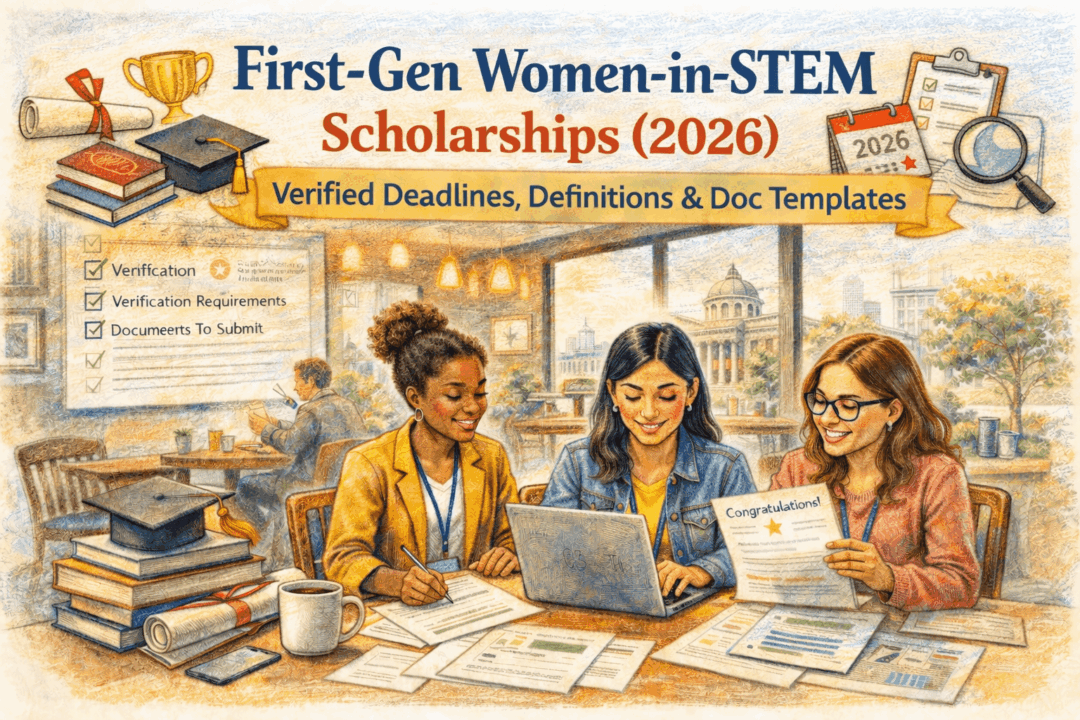
First-Gen Women-in-STEM Scholarships (2026) — Verified Deadlines, Links & Templates
First-gen definition you can use as a working rule
For scholarship planning, a practical starting point is this: you are usually considered first-generation if your parents or guardians did not complete a four-year bachelor’s degree. Some programs phrase that differently, but this is the most common pattern across the strongest verified awards in this list.
Doc templates to prep before you apply
1. Parent education statement template
“I identify as a first-generation college student because my parent(s)/guardian(s) did not complete a four-year bachelor’s degree. As a result, I am navigating college admissions, financial aid, and academic planning without the benefit of direct family experience in those systems.”
2. First-gen plus STEM mini-essay starter
“As a first-generation student pursuing STEM, I am not only working toward a degree, but also learning how to translate complex academic goals into a realistic college plan. My interest in STEM comes from [brief origin story], and my long-term goal is to use that training in [career field or problem you want to solve].”
3. Recommender request template
“I’m applying for scholarships focused on first-generation students, women in STEM, and high-achieving students with financial need. It would help if your letter could speak to my academic preparation, persistence, initiative, and how I have handled challenges while staying committed to STEM.”
4. Fast checklist
Have these ready before deadlines hit: unofficial transcript, basic resume, FAFSA or financial context notes, parent/guardian education info, one 150-word bio, one 300-word “why STEM” response, one 500-word adversity/persistence response, and a clean activity list.
Top 30 scholarships
January
1) WTS Sharon D. Banks Memorial Undergraduate Scholarship
Why It Slaps: This is one of the better niche STEM plays for students interested in transportation, infrastructure, civil engineering, planning, mobility systems, and related fields. It is specific enough to reward real subject-matter interest, but broad enough that a first-gen applicant can connect coursework, internships, research, or public-service goals to the future of transportation. For women who want a scholarship that feels more career-aligned than generic, this is a strong fit.
Amount: $5,000
Deadline: January 9, 2026
Apply/info: https://www.wtsinternational.org/wts-foundation/scholarships
2) WTS Molitoris Leadership Scholarship for Undergraduates
Why It Slaps: This one rewards leadership on top of transportation-related study, which makes it especially useful for first-gen applicants who have had to build credibility through clubs, community work, project leadership, internships, or campus involvement. If your story is not just “I like engineering,” but “I lead, organize, and move projects forward,” this award gives you room to make that case. It is one of the cleaner women-focused scholarships for students aiming at transportation-adjacent STEM careers.
Amount: $5,000
Deadline: January 9, 2026
Apply/info: https://www.wtsinternational.org/wts-foundation/scholarships
3) WTS Junior College/Trade School Scholarship
Why It Slaps: This is a strong option for women taking a lower-cost, workforce-focused route into STEM-adjacent fields. That matters for first-gen students because the best path is not always a four-year residential campus right away. If you are pursuing technical training, applied transportation work, or a community-college launch that leads into a bigger degree later, this scholarship fits the real way many first-gen students build careers.
Amount: $2,500
Deadline: January 9, 2026
Apply/info: https://www.wtsinternational.org/wts-foundation/scholarships
4) WTS Transportation YOU High School Scholarship
Why It Slaps: High school women interested in engineering, infrastructure, transportation systems, public transit, or smart-city work should not skip this one. It is one of the better pre-college STEM scholarships because it rewards early direction without expecting a graduate-level research profile. If you already know you want to build, design, optimize, or modernize systems people rely on every day, this award lines up nicely with that story.
Amount: $2,500
Deadline: January 9, 2026
Apply/info: https://www.wtsinternational.org/wts-foundation/scholarships
5) APIA Scholarship
Why It Slaps: This is one of the best national scholarships for students who want a serious award range instead of a small one-off check. It is not STEM-only, but it stacks extremely well for first-gen women in STEM because it can cover meaningful college costs while leaving you free to choose science, engineering, computer science, health, or math pathways. For Asian American, Native Hawaiian, and Pacific Islander students, it belongs on the must-apply list.
Amount: $2,500 to $20,000
Deadline: January 15, 2026 at 5:00 p.m. ET
Apply/info: https://apiascholars.org/scholarships/
February
6) Choose Ohio First at Ohio State
Why It Slaps: If you are Ohio-based and pursuing STEMM, this is one of those institutional scholarships that can quietly change your whole affordability picture. It is a smart first-gen target because state-supported STEM scholarships often combine well with Pell, merit aid, and university aid. The big win here is not glamour. It is cost reduction inside a real STEM pipeline.
Amount: Varies by campus and program
Deadline: Priority deadline February 1, 2026; final deadline April 15, 2026
Apply/info: https://ohse.osu.edu/apply-choose-ohio-first-ohio-state
7) Dorrance Scholarship
Why It Slaps: This is a serious, high-value option for Arizona students who want real multi-year support, not just a symbolic award. For first-gen women in STEM, the appeal is obvious: strong yearly funding, leadership emphasis, and a structure that can make a demanding major more manageable over time. If you qualify geographically, this should be treated like a top-tier application.
Amount: $12,000 per year for four years
Deadline: February 4, 2026 (Phase I)
Apply/info: https://dorrancescholarship.org/
8) HSF Scholar Program
Why It Slaps: This is one of the strongest national stackable scholarships for Hispanic students because it combines funding with a broader support ecosystem. For first-gen women in STEM, that support matters almost as much as the dollars. If you are trying to move from “I got in” to “I can actually stay and finish,” HSF is one of the programs that can help bridge that gap.
Amount: $500 to $5,000
Deadline: February 15, 2026
Apply/info: https://www.hsf.net/scholarship
9) Dell Scholars Program
Why It Slaps: Dell is one of the best examples of a scholarship that understands first-gen reality. The money matters, but the wraparound support is what makes this program special: a flexible scholarship, laptop, book credits, emergency aid, and coaching. For STEM students facing heavy course loads and budget pressure, that combination can do more than a larger scholarship with no support.
Amount: $20,000 plus laptop, book credits, and other support
Deadline: February 15, 2026
Apply/info: https://www.dellscholars.org/students/
10) Cadence First-Generation Student Scholarship
Why It Slaps: This is one of the clearest exact-match awards in the whole category because it is explicitly built for first-generation students. That makes it valuable beyond the money: your application does not have to “stretch” to explain why you belong. For first-gen women aiming at engineering, semiconductors, computing, or other technical fields, it is a highly relevant target.
Amount: $5,000
Deadline: February 27, 2026 at 12:00 p.m. PST
Apply/info: https://www.cadence.com/en_US/home/company/corporate-social-responsibility/academic-network/student-support.html
11) AWIS First-Generation College Student Scholarship
Why It Slaps: This is one of the purest page-title matches available because it is both first-gen specific and science focused. If you want a scholarship where your first-gen identity is not just acceptable but central to the award’s purpose, this is it. It is especially strong for undergrads who want a sponsor that actually understands women’s advancement in science rather than treating STEM as a buzzword.
Amount: Up to four awards of $2,000 each
Deadline: February 28, 2026
Apply/info: https://awis.org/undergraduate-scholarships/
12) AWIS Dr. Vicki L. Schechtman Scholarship
Why It Slaps: This is a strong women-in-science scholarship for undergraduates who may not qualify for a first-gen-only award but still need a serious, mission-aligned STEM application target. It works well for applicants with good academic focus, a clear science direction, and a need to show that their goals go beyond “I want a STEM major” into actual scientific contribution. It is also useful as a stackable companion to broader first-gen awards.
Amount: $2,000
Deadline: February 28, 2026
Apply/info: https://awis.org/undergraduate-scholarships/
13) AWIS Kirsten R. Lorentzen Award
Why It Slaps: This award is a particularly smart niche play for women in physics, geophysics, and geoscience. Those are fields where applicants often benefit from awards that recognize both academic preparation and the ability to persist in demanding technical environments. For a first-gen student in the physical sciences, that makes this scholarship feel much more on-target than generic women-in-college lists.
Amount: $2,500
Deadline: February 28, 2026
Apply/info: https://awis.org/kirsten-r-lorentzen-award/
March
14) NAWIC Founders’ Scholarship Foundation Undergraduate Scholarship
Why It Slaps: Women interested in construction management, construction engineering, building systems, and related applied-STEM fields should take this seriously. Construction is often under-listed on women-in-STEM pages even though it sits right at the intersection of engineering, design, logistics, math, and field leadership. For first-gen students who want strong career outcomes and a practical major, this is a very smart application.
Amount: Minimum $1,000
Deadline: March 6, 2026
Apply/info: https://nawic.org/nfsf-scholarships/
15) NAWIC Founders’ Scholarship Foundation Construction Trades Scholarship
Why It Slaps: This is a great reminder that STEM is not only about lab coats and coding. Skilled construction pathways rely on technical training, measurement, systems thinking, safety, and increasingly advanced technology. For first-gen women pursuing a trade, apprenticeship, or technical program, this is one of the better verified options that respects that route as a real professional pathway.
Amount: Minimum $1,000
Deadline: March 6, 2026
Apply/info: https://nawic.org/nfsf-scholarships/
16) NSHSS First Generation Scholarship
Why It Slaps: This is another exact-match first-gen award that is simple to understand and easy to justify in your application strategy. It is not STEM-only, but that is actually useful because it can stack beside women-in-STEM awards instead of competing with them. If you are building a portfolio of applications and want one that clearly centers first-generation identity, this belongs in the mix.
Amount: 10 awards of $2,000
Deadline: March 30, 2026 at 11:59 p.m. EST
Apply/info: https://www.nshss.org/scholarships/s/nshss-first-generation-scholarship/
17) SWE Scholarships
Why It Slaps: SWE remains one of the most important scholarship ecosystems for women pursuing engineering and engineering-related study. For first-gen women, the real advantage is that SWE sits inside a broader professional community, which means the scholarship can be both money and signal. If you are serious about engineering, this is one of the foundational applications you should build around.
Amount: Varies by scholarship
Deadline: March 31, 2026
Apply/info: https://swe.org/apply-for-a-swe-scholarship/
April
18) BHW Women in STEM Scholarship
Why It Slaps: This is a dependable annual women-in-STEM scholarship with a clean application and a clear deadline. It is especially useful for first-gen applicants who need a high-quality spring scholarship target after the heavier winter cycle closes. Because it is open to students attending college the next year, it also works well for high school seniors who are finalizing plans and still need more funding.
Amount: $3,000
Deadline: April 15 each year
Apply/info: https://thebhwgroup.com/scholarship
August
19) MPOWER Women in STEM Scholarship
Why It Slaps: This one is especially valuable for international and DACA students in STEM, which makes it a useful add for pages serving students who may not fit the standard federal-aid mold. It is women-in-STEM specific and comes from a sponsor that consistently runs scholarship programs with straightforward application pages. If your profile is technical and global, this one is worth keeping on your radar even if you are applying to other first-gen-friendly awards too.
Amount: $1,000 to $5,000
Deadline: August 31, 2026
Apply/info: https://www.mpowerfinancing.com/scholarships/women-in-stem
September
20) The Gates Scholarship
Why It Slaps: This is one of the biggest anchor opportunities on the board for low-income, high-achieving students. It is not women-only and not STEM-only, but for first-gen women in STEM it can be transformative because it is a last-dollar scholarship that covers full cost of attendance not already met by other aid. If you have the academics, leadership, and Pell-eligible profile, this is not optional.
Amount: Full cost of attendance not already covered by other aid and the Student Aid Index
Deadline: September 15, 2025 for the 2026 cycle
Apply/info: https://www.thegatesscholarship.org/scholarship
21) Coca-Cola Scholars Program
Why It Slaps: Coca-Cola is not a STEM scholarship, but it is one of the best stackable leadership scholarships in the country and can be a major funding piece for first-gen women headed into demanding STEM majors. The application is also more accessible than many elite scholarships because it does not start with essays. If you have leadership, service, and strong academics, this is one of the smartest broad-net applications you can submit.
Amount: $20,000
Deadline: September 30, 2025 at 5:00 p.m. ET for the 2026 cycle
Apply/info: https://www.coca-colascholarsfoundation.org/apply/
22) QuestBridge National College Match
Why It Slaps: This is less a small scholarship and more a whole affordability strategy. For first-gen women in STEM from low-income backgrounds, QuestBridge can be a game-changing route into highly selective colleges with full four-year scholarships. If your academic profile is strong and your family income is a real constraint, this should sit at the top of your fall list.
Amount: Full four-year scholarship, with Match awards described as worth over $325,000
Deadline: September 30, 2025 at 11:59 p.m. PT for the 2026 cycle
Apply/info: https://www.questbridge.org/apply-to-college/programs/national-college-match
October
23) Daniels Scholarship Program
Why It Slaps: Daniels is one of the strongest regional heavy-hitters in the country. For eligible students in Colorado, New Mexico, Utah, and Wyoming, it can mean full cost of attendance at partner schools or very large support at other nonprofit colleges. First-gen women in STEM from those states should treat it like a flagship application, not a side quest.
Amount: Up to full cost of attendance at partner schools, or up to $100,000 over four years at other schools
Deadline: October 17, 2025 for the 2026 cycle
Apply/info: https://danielsfund.org/our-work/scholarships/
24) NCWIT Aspirations in Computing High School Award
Why It Slaps: For high school students with real computing experience, this is one of the strongest recognition-based applications in the country. It is especially good for girls and young women building momentum in computer science, software, AI, cybersecurity, data, or tech projects because it rewards demonstrated interest and achievement, not just test scores. Recognition can also strengthen later scholarship and college applications.
Amount: Recognition and award-level prizes vary
Deadline: October 28, 2025 at 8:00 p.m. ET for the 2026 award cycle
Apply/info: https://www.aspirations.org/award-programs/aic-high-school-award
25) WAI Scholarship Program
Why It Slaps: Women in Aviation International is worth checking if your STEM interests lean toward aviation, aerospace, flight, maintenance, engineering, or operations. The big value is that one cycle can expose you to many different scholarship descriptions under one official umbrella. For students with a clear aviation or aerospace direction, that makes it a very efficient application target.
Amount: Varies by scholarship
Deadline: October 15, 2025 for the WAI2026 cycle
Apply/info: https://www.wai.org/scholarships
November
26) Jack Kent Cooke College Scholarship Program
Why It Slaps: This is one of the biggest prestige-plus-money scholarships for high-achieving students with financial need. It is not first-gen-only, but it fits first-gen women in STEM extremely well because it can provide major support at any accredited undergraduate institution while also reducing the pressure to over-borrow for an expensive science or engineering degree. This is a reach worth taking seriously.
Amount: Up to $55,000 per year
Deadline: November 12, 2025 for the 2026 cycle
Apply/info: https://www.jkcf.org/our-scholarships/college-scholarship-program/
27) NCWIT Aspirations in Computing Collegiate Award
Why It Slaps: This is one of the better computing awards for college and graduate students who already have technical projects with visible impact. If you are building tools, conducting applied research, or contributing to real software or data work, this award lets you present that output in a way generic scholarships often do not. It is especially valuable because the winner and honorable mention prizes include real cash, not just a badge.
Amount: $7,500 for winners; $2,500 for honorable mentions
Deadline: November 18, 2025 at 8:00 p.m. ET for the preliminary round
Apply/info: https://www.aspirations.org/award-programs/aic-collegiate-award
28) Elks Most Valuable Student Scholarship
Why It Slaps: This is one of the better broad-based national scholarships for high school seniors because the award structure is large, the application is well known, and male and female students compete separately. It is not STEM-specific, but that actually helps first-gen women in STEM because it broadens your stack instead of competing with your niche awards. If you are a senior, this should be in your fall batch.
Amount: 20 awards of $30,000 total and 480 awards of $4,000 total
Deadline: November 12, 2025 at 11:59 p.m. PT for the 2026 cycle
Apply/info: https://www.elks.org/scholars/scholarships/mvs.cfm
December
29) SMART Scholarship
Why It Slaps: If you are serious about STEM and open to service-connected pathways, SMART is one of the most valuable programs on the board. It covers full tuition, provides a substantial annual stipend, and includes internships and post-graduation employment. For first-gen students who want a highly structured path into a technical career, this is a heavyweight option.
Amount: Full tuition plus annual stipend of $30,000 to $46,000, with additional allowances
Deadline: First Friday in December for each cycle
Apply/info: https://www.smartscholarship.org/
30) Equitable Excellence Scholarship
Why It Slaps: This is a strong late-fall stackable award because it combines renewable support with leadership development resources. It is not STEM-specific, but it is highly relevant to this page because Equitable has said that nearly 60% of its recent recipients are first-generation college students. That makes it one of the better broad scholarships for first-gen women who want both money and long-term support.
Amount: $5,000 renewable annually for four years, for a total of $20,000
Deadline: December 18, 2025 for the 2026 cycle
Apply/info: https://equitable.com/foundation/equitable-excellence-scholarship
FAQs
What counts as first-generation for scholarships?
Usually, it means your parent or guardian did not complete a four-year bachelor’s degree, but each sponsor can define it differently. Use the sponsor’s exact wording every time.
Why are some “2026” deadlines in 2025?
Because many scholarship programs label the award cycle by the academic year or award year, not the calendar year when the application closes. That is why several 2026 opportunities in this guide had fall 2025 deadlines.
Can I apply to scholarships that are not first-gen-only?
Yes. You should. The best strategy for first-gen women in STEM is to apply to exact-match first-gen awards, women-in-STEM awards, and broader national scholarships that fit your academic and financial profile.
What documents should I prep first?
Start with your unofficial transcript, a one-page resume, parent/guardian education information, a short “why STEM” paragraph, a longer adversity/persistence essay, and a recommender list.
Should I reuse the same essay for every scholarship?
Reuse your core story, not the exact same draft. Strong applicants build a base essay, then tailor the intro, examples, and final paragraph to the sponsor’s mission.
Which scholarships here are the best exact-match targets?
The clearest exact-match choices are AWIS First-Generation College Student Scholarship, Cadence First-Generation Student Scholarship, and NSHSS First Generation Scholarship.
Which scholarships here are best for big-ticket affordability?
The strongest high-impact cost reducers in this list are The Gates Scholarship, QuestBridge National College Match, Daniels Scholarship, SMART Scholarship, and Jack Kent Cooke College Scholarship Program.