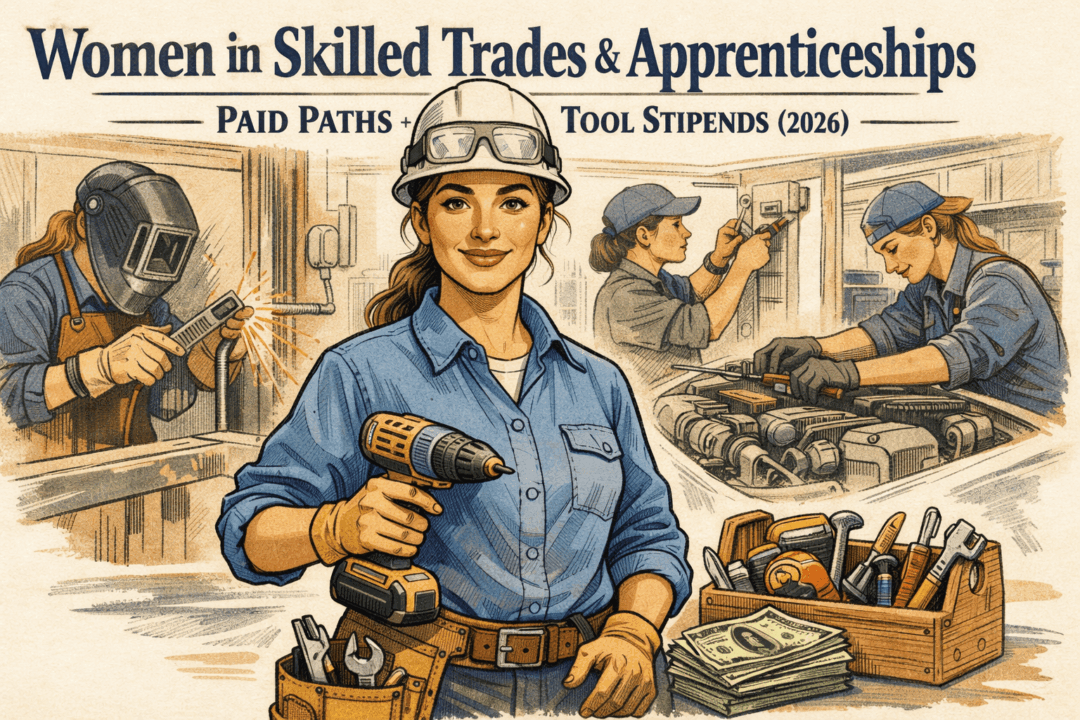
Women in Skilled Trades & Apprenticeships — Paid Paths + Tool Stipends (2026)
February
1) IEC Foundation EmpowerHER Scholarship
Why It Slaps: This is one of the cleaner women-focused electrical-industry scholarships on the board. It is built specifically to support women pursuing careers in the electrical field, which makes it highly relevant for students moving into apprenticeship-track or contractor-adjacent training. It is also backed by a major industry foundation rather than a generic scholarship directory, so it feels more targeted and more serious than broad “women in STEM” lists.
Amount: Varies.
Deadline: February 5, 2026; references due February 13, 2026.
Apply/info: IEC Foundation Apply Page
March
2) NAHB Professional Women in Building Strategies for Success Scholarship
Why It Slaps: This one is excellent for women heading into residential construction, construction technology, civil engineering, architecture, design, and related trade specialties. It is not just a generic college scholarship. It is tied to the home-building ecosystem and is aimed at students who want a real career lane in housing-industry work. For readers targeting construction-adjacent college, vocational, or technical programs, this is a strong industry-fit award.
Amount: Varies.
Deadline: March 6, 2026.
Apply/info: NAHB PWB Scholarships Page
3) NAHB Professional Women in Building Building Hope Scholarship
Why It Slaps: This is one of the more useful construction awards for trade-school readers because it explicitly includes building-related vocational and trade programs, not only four-year degrees. That matters for women taking the faster route into paid work through technical school or hands-on building training. It is also attractive because the award is meant for tuition and program fees, which are often the hardest near-term costs for trade students to cover.
Amount: Varies.
Deadline: March 6, 2026.
Apply/info: NAHB PWB Scholarships Page
4) NAWIC Founders Scholarship Foundation Construction Trades Scholarship
Why It Slaps: NAWIC is one of the best-known names in women-and-construction spaces, so this is a natural fit for the page. The construction trades scholarship is designed for students in approved construction-related craft or trade programs, which makes it much more relevant than broad academic awards. It is especially strong for readers who want a scholarship from an organization that already lives inside the industry they plan to enter.
Amount: Varies.
Deadline: March 6, 2026.
Apply/info: NAWIC NFSF Scholarships
5) ABC Keystone Women in the Trades Scholarship
Why It Slaps: This is exactly the kind of scholarship that belongs on a skilled-trades page because it is built around women entering construction and the trades, not around a generic college pathway. It is also useful editorially because it signals momentum in the industry itself: employer and contractor groups are actively trying to bring more women into the workforce. For readers considering the trades but unsure whether they will find support, this award sends the right message.
Amount: Varies.
Deadline: March 6, 2026.
Apply/info: ABC Keystone Women in the Trades Scholarship
6) Women’s Industry Network Collision Repair Scholarship
Why It Slaps: Collision repair is one of the better trade lanes for women who want a hands-on, tool-based career with strong shop demand, and WIN has built one of the most targeted scholarship ecosystems in that space. The 2026 round includes multiple award tiers plus mentorship and, in some cases, tools or extra student benefits. That combination of cash support, industry access, and practical add-ons makes this more valuable than many plain tuition-only awards.
Amount: $500 to $2,500, with some award tiers also including mentorship, tools, or related benefits.
Deadline: March 6, 2026.
Apply/info: WIN Scholarship Page
7) Professional Women in Construction — New Jersey Chapter Scholarship
Why It Slaps: This is one of the strongest regional scholarships on the list because it explicitly includes full-time trade or technical students in architecture, engineering, and construction-related fields. It is also unusually transparent about who can apply and what the award is worth. For New Jersey readers or anyone with a PWC-NJ member connection, this is absolutely a priority application.
Amount: Minimum of two $2,500 scholarships annually.
Deadline: March 20, 2026.
Apply/info: PWC-NJ Scholarships
8) Professional Women in Construction — New York Chapter Scholarship
Why It Slaps: This one is a clean, high-credibility AEC scholarship from a women-centered construction organization in one of the country’s largest construction markets. It is especially useful for students who want more than money, because the award also includes chapter membership and access to PWC-NY events. That makes it a networking-plus-scholarship play, not just a one-time check.
Amount: One-time $2,500 scholarship.
Deadline: March 29, 2026.
Apply/info: PWC-NY Scholarships
9) Women in Auto Care Scholarships
Why It Slaps: This is one of the biggest women-focused auto-care scholarship platforms in the country. The live official page says the program distributed 81 awards worth $425,000 in cash scholarships and tool kits in the most recent cycle, which tells readers this is not a tiny vanity award. It is especially strong for women pursuing auto tech, aftermarket, collision, heavy duty, or related automotive career paths.
Amount: Varies; the most recent official cycle distributed cash scholarships and tool kits across 81 awards totaling $425,000.
Deadline: March 31, 2026.
Apply/info: Women in Auto Care Scholarships
April
10) Maryland Women of Asphalt Educational Trust Scholarship
Why It Slaps: This one deserves space because it is unusually explicit about skilled-trades pathways. The eligibility language reaches beyond office-side industry roles and includes asphalt-related career tracks like equipment mechanic, CDL driver, field technician, and welding. For women in Maryland who want a scholarship tied directly to field work and heavy-industry mobility, this is a very good fit.
Amount: $500 to $1,500.
Deadline: April 3, 2026.
Apply/info: Maryland Women of Asphalt Scholarship
11) The Hourglass Foundation Women in Auto Tech Scholarship
Why It Slaps: This is one of the cleanest direct-hit awards for women in automotive training. It is specifically for female students in auto maintenance or auto technology programs, and the amount is large enough to matter. It also sits inside a foundation that clearly understands trade-school realities, which makes it more relevant than a broad women-in-education award.
Amount: $5,000.
Deadline: April 10, 2026.
Apply/info: Women in Auto Tech Scholarship Criteria
12) The Hourglass Foundation Women Rock Trades Scholarship
Why It Slaps: This is a strong fit for the page because it directly names skilled-trade fields like HVAC, electrical, plumbing, and construction. It is also designed for women 16 to 28 who are entering or continuing in trade-school or community-college training, which lines up well with re-entry students and younger readers alike. The application also values financial need and career intent, so it rewards students who can clearly explain why the trades are their path.
Amount: $2,500.
Deadline: April 10, 2026.
Apply/info: Women Rock Trades Scholarship Criteria
13) The Hourglass Foundation Tools of the Trade Scholarship
Why It Slaps: Tool money is often the difference between starting strong and starting behind, which is exactly why this scholarship stands out. Instead of pretending trade students only need tuition help, it addresses one of the most practical expenses in career training: buying the tools required to actually do the work. If your audience wants “paid paths + tool stipends,” this is one of the best entries on the whole page.
Amount: Two separate $2,000 scholarships for tools.
Deadline: April 10, 2026.
Apply/info: Tool Scholarship Criteria
14) Women In Trucking Foundation Scholarship
Why It Slaps: Trucking is one of the most overlooked trade-and-training lanes for women, and this scholarship is refreshingly direct about that. It supports women attending training for driving, safety, technical, or leadership roles in the trucking industry, which broadens the path beyond CDL-only assumptions. It is also awarded twice a year, giving readers more than one shot if they miss the spring cycle.
Amount: $1,000.
Deadline: April 15, 2026 for the spring cycle.
Apply/info: Women In Trucking Foundation Apply Page
15) Home Builders Association of Greater Charlotte PWB Scholarship
Why It Slaps: This is a strong regional award for women pursuing careers in residential construction and the home-building industry. The scholarship is female-only, tied to a respected builders association, and directly aligned with the page’s construction-and-trades theme. It is especially useful for readers who want both legitimacy and local industry credibility.
Amount: $1,000 minimum.
Deadline: April 15, 2026.
Apply/info: HBAGC Scholarship Information
16) Association of Women Contractors Apprentice Scholarship
Why It Slaps: This is one of the best fits on the list for actual apprentices, not just future students. It is designed for women already working as registered apprentices or entering one, which is exactly the kind of paid-pathway angle many “scholarship” pages miss. If the site wants to speak to women already inside the trades pipeline, this belongs near the top of the page.
Amount: Varies.
Deadline: April 30, 2026.
Apply/info: Association of Women Contractors Scholarships
17) Association of Women Contractors Academic Trades Diploma Scholarship
Why It Slaps: This one is a smart inclusion because it targets women in one-year certificate and two-year associate programs in construction trades education. That makes it highly usable for readers who are not chasing a bachelor’s degree and want the shortest route to employment. The scholarship also comes from an organization built specifically around women in the construction workforce, which improves relevance and trust.
Amount: Varies.
Deadline: April 30, 2026.
Apply/info: Association of Women Contractors Scholarships
May
18) PHCC Educational Foundation Scholarship Program
Why It Slaps: Plumbing, heating, and cooling readers need a scholarship that speaks directly to their lane, and PHCC does that. The live 2026 page is unusually robust: it covers apprentices, trade-school students, and directly related college majors, which makes it useful for a wide range of readers entering plumbing or HVACR careers. It is also one of the stronger-volume programs on this list, with 80-plus scholarships planned for 2026.
Amount: Awards range from $1,500 to $10,000.
Deadline: May 1, 2026.
Apply/info: PHCC Educational Foundation Scholarship Program
19) Edison International Lineworker Scholarship
Why It Slaps: This is one of the biggest practical-value awards on the page. It does not just cover tuition. The live page says it can also cover tools and support services such as housing, transportation, and childcare, which is unusually strong for adult learners, parents, and re-entry students. For women interested in utility work or lineworker training, this is a serious opportunity.
Amount: Up to $25,000.
Deadline: May 8, 2026.
Apply/info: Edison International Lineworker Scholarship
June
20) Women in HVACR Scholarship Program
Why It Slaps: This is a core anchor for any women-in-trades scholarship page because it is directly inside the HVACR industry, not merely adjacent to it. The live 2026 page is strong: it offers six scholarships and clearly distinguishes technical/trade-school applicants from four-year applicants. For women targeting HVAC installation, service, refrigeration, or related technical careers, this is one of the most relevant awards on the entire list.
Amount: Six scholarships of $5,000 each.
Deadline: June 1, 2026.
Apply/info: Women in HVACR Scholarships
21) Jessi Combs Foundation Scholarship
Why It Slaps: This is one of the most brand-true scholarships you can include for women in the trades. The foundation is built around pushing more women into trade careers and the eligibility language centers vocational schooling and industrial or construction-related skills. The live page confirms the 2026 application window opens April 30, and the most recent posted FAQ used a spring window that closed June 1, so this is a strong “watch and apply early” opportunity.
Amount: Varies.
Deadline: Watch the spring 2026 cycle closely; the live page says the 2026 window opens April 30, 2026, and the most recent posted FAQ used a June 1 close.
Apply/info: Jessi Combs Foundation Scholarship
22) Horatio Alger Career & Technical Education Scholarships
Why It Slaps: This is one of the better national trade-school scholarships because it is large, well-known, and open to community-college, certificate, and diploma pathways that lead directly to employment. It is not women-only, but it is still a very strong fit for women entering the trades, especially because the national CTE scholarship offers broad access and a clear application structure. It is also one of the easiest mainstream scholarships to explain to readers.
Amount: Up to $2,500 for the national CTE scholarship.
Deadline: June 15, 2026.
Apply/info: Horatio Alger CTE Scholarships
23) Automotive Women’s Alliance Foundation Scholarship
Why It Slaps: This is a solid automotive-and-mobility scholarship for women who want industry-aligned support from an organization focused on advancing women in the field. The live scholarship page states that AWAF runs two deadlines a year and is accepting Q3/4 2026 applications through mid-June, which gives this one a real, current 2026 pulse. It is best for readers whose trades path overlaps auto technology, mobility, manufacturing, or adjacent technical education.
Amount: Varies.
Deadline: June 16, 2026 for the current posted Q3/4 2026 cycle.
Apply/info: AWAF Scholarships
24) Southern Nevada Home Builders Association Professional Women in Building Scholarship
Why It Slaps: This is a useful building-industry scholarship because it covers not just students but also professionals seeking education, certification, or recognized industry training. That makes it broader and more practical than a typical undergraduate-only award. It is especially strong for women pursuing building, construction technology, civil engineering, architecture, design, or vocational trade specialties.
Amount: $500 to $2,000.
Deadline: June 30, 2026.
Apply/info: SNHBA PWB Scholarship
July
25) Women in Plumbing & Piping Scholarship Program
Why It Slaps: Plumbing and piping remains an under-covered category on women’s scholarship pages, so this program adds real depth. The live official page includes a direct women-in-trades message and awards specifically for women pursuing plumbing and piping careers. The page currently shows the latest posted cycle as June 3 to July 15 with five $2,000 WiPP scholarships plus an additional Bradford White Women’s Network scholarship, so this is a strong watch-list item even though the page has not fully refreshed to a new 2026 cycle yet.
Amount: Five $2,000 WiPP scholarships, plus two $3,500 Bradford White Women’s Network scholarships on the live posted cycle.
Deadline: Official page currently shows July 15 on the posted cycle; verify the next refresh before publishing a hard 2026 close date.
Apply/info: WiPP Scholarships
26) ShareMyToolbox Tools for Success Scholarship
Why It Slaps: This is one of the most practical scholarships on the list because it explicitly allows funds for tuition, fees, books, tools, and required course materials. It is also open to trade school, apprenticeship, and construction-related college pathways, which gives it broad usability. The official page says 2026 details are coming soon, but the live scholarship page still clearly shows the structure and the most recent deadline pattern.
Amount: Up to ten $500 scholarships per year.
Deadline: Official page says 2026 details are coming soon; the most recent posted cycle used a July 31 deadline.
Apply/info: ShareMyToolbox Scholarship
September
27) Women of Asphalt x Caterpillar Paving Operations Scholarship
Why It Slaps: This is not just tuition support. It is a full training experience with travel support, which makes it more like a career accelerator than a standard scholarship. The live page says it covers full course tuition plus travel, lodging, and food for Caterpillar’s paving operations training, giving women in asphalt a direct route into hands-on skill development with serious industry backing.
Amount: $6,000+ total value per participant.
Deadline: Watch early September; the live official page’s latest posted cycle closed September 10.
Apply/info: Women of Asphalt Scholarship Program
October
28) mikeroweWORKS Work Ethic Scholarship
Why It Slaps: This remains one of the biggest and most recognizable names in trade scholarship funding. The live 2026 page confirms the application window runs from February 23, 2026 through October 31, 2026, which gives readers a long runway to apply. It is not women-only, but it is absolutely relevant for women entering approved trade programs and it fits the page’s “paid path” angle extremely well.
Amount: Varies; the live 2026 program runs as a broad work-ethic trade scholarship fund rather than a single fixed award.
Deadline: October 31, 2026.
Apply/info: mikeroweWORKS Scholarship
November
29) Women of NATE WON Education Scholarship
Why It Slaps: Telecommunications infrastructure is not always included on women-in-trades pages, but it should be. This scholarship supports women entering or advancing in tower and communications infrastructure construction, service, and maintenance, which gives your page a wider and smarter view of the trades economy. The live page currently awards two $2,000 scholarships and says to watch for next-cycle details in November 2026, so it is best treated as a high-value watch-list opportunity.
Amount: Two $2,000 scholarships.
Deadline: Watch for details in November 2026; the live page does not yet post the next closing date.
Apply/info: WON Education Scholarship
30) AWS Welder Training Scholarship
Why It Slaps: Welding belongs on any serious skilled-trades scholarship page, and AWS is one of the most credible names available. The live page is unusually clear: it is for welder training programs under two years, awards are made on a rolling basis, and the scholarship can be used for tuition, fees, books, supplies, and required equipment. It is not women-only, but it is absolutely one of the strongest trade-training awards women welders should target.
Amount: Minimum $1,000; up to 800 welder training scholarships awarded annually.
Deadline: November 30, 2026.
Apply/info: AWS Welder Training Scholarship
FAQs
Are all of these scholarships women-only?
No. I prioritized women-only and women-centered programs first, but I also included a smaller number of high-fit trade scholarships that are not women-exclusive because they are too strong, too relevant, or too practical to leave off a serious women-in-trades page. Examples include PHCC, Horatio Alger CTE, mikeroweWORKS, and AWS Welder Training.
Can apprentices apply, or is this only for traditional college students?
Yes, apprentices can absolutely apply for several of these. The list includes awards built for registered apprentices, trade-school students, certificate students, vocational students, and women already moving through technical workforce pipelines. That is a major reason scholarships like AWC Apprentice, ShareMyToolbox, AWS Welder Training, and Women In Trucking made the final cut.
Which scholarships help with tools, gear, or real training costs beyond tuition?
Several do. The strongest examples are The Hourglass Foundation Tools of the Trade Scholarship, Women in Auto Care’s cash-plus-tool-kit model, Edison’s lineworker scholarship that can include tools and support services, AWS Welder Training for equipment and supplies, and the Women of Asphalt x Caterpillar award that includes travel and training costs.
What if I miss the big spring deadlines?
You still have late-cycle options. AWS Welder Training runs through November 30, 2026, mikeroweWORKS stays open through October 31, 2026, and some live pages signal later-season or not-yet-refreshed cycles worth watching, including Women of NATE, ShareMyToolbox, and Women of Asphalt.
Are there good options here for high school seniors?
Yes. Several live pages explicitly include high school seniors, GED holders, or students accepted into trade or technical programs. Strong examples include PWC-NJ, The Hourglass scholarships, Horatio Alger CTE, ShareMyToolbox, and the Jessi Combs Foundation.
How should readers handle awards whose official pages have not fully refreshed to 2026 yet?
Treat those as “watch now, apply early” opportunities instead of ignoring them. For a trustworthy page, the best approach is to keep the official link live, label the latest posted cycle honestly, and tell readers to verify the refreshed application window when it posts. That is the right editorial move for WiPP, ShareMyToolbox, Women of Asphalt, and Women of NATE right now.