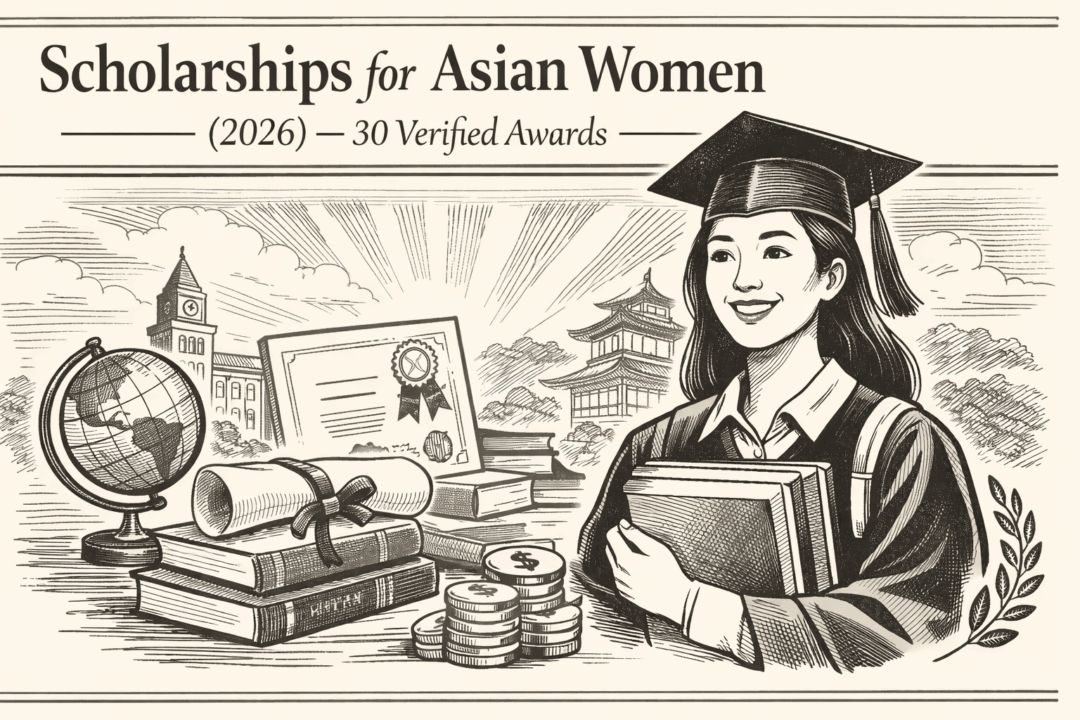
Scholarships for Asian Women (2026) — 30 Verified Awards with Real Deadlines & Active Links
Editor’s note: This update keeps the same month-by-month structure and long-form analysis, but every entry has been refreshed against current official pages. Where a 2026 cycle is already closed, not yet posted, rolling, or paused, that status is stated clearly instead of guessed.
January
APIA Scholars — APIA Scholarship Program
💥 Why It Slaps: This is still one of the biggest cornerstone scholarships in this space because it is not just money. It is funding, visibility, student-success programming, and a real APIA network. For Asian women who are first-gen, low-income, or trying to build both college access and career momentum, this remains one of the smartest anchor applications to build around.
💰 Amount: Varies. APIA says awards range from one-time awards to multi-year awards, with public materials historically showing awards up to $20,000.
⏰ Deadline: Closed for the 2026–2027 cycle. The last posted deadline was January 15, 2026 at 5:00 p.m. ET. The next cycle is expected to open in fall 2026.
🔗 Apply/info: https://apiascholars.org/scholarships/
AANAPISI Scholarship (via APIA Scholars)
💥 Why It Slaps: This is the best version of a campus-connected scholarship play. If you are attending a partner AANAPISI campus, the fit can be stronger than a broad national pool because the scholarship is tied to schools already serving Asian American, Native Hawaiian, and Pacific Islander students at scale. That makes it one of the smartest “check your campus first” moves on the whole list.
💰 Amount: APIA public materials for the program have shown campus-linked awards within the broader APIA system, with posted ranges commonly starting at $2,500 and going higher depending on the award.
⏰ Deadline: Treated through APIA Scholars’ current scholarship cycle. As of this update, the main 2026–2027 APIA cycle is closed. Verify your campus partner status before relying on older standalone AANAPISI pages.
🔗 Apply/info: https://apiascholars.org/scholarships/ | https://apiascholars.org/aanapisis/
P.E.O. Program for Continuing Education (Women, U.S./Canada)
💥 Why It Slaps: This is one of the strongest “life happened, now I need a realistic way back” funding options for women whose education was interrupted. If you are an Asian woman returning to school after work, caregiving, marriage, immigration transition, or a pause in college, this is a genuinely practical grant instead of a prestige contest.
💰 Amount: Need-based one-time grants up to $4,000.
⏰ Deadline: Rolling through local chapter sponsorship rather than one single national student-facing deadline. Start early because you need a local P.E.O. chapter sponsor.
🔗 Apply/info: https://www.peointernational.org/educational-support/program-for-continuing-education/ | https://www.peointernational.org/educational-support/program-for-continuing-education/eligibility-and-application-process/
February
Banatao Family Filipino American Education Fund (Asian Pacific Fund)
💥 Why It Slaps: If you are a Filipino American woman in engineering, math, computer science, environmental science, or physical science, this is still one of the highest-value targeted scholarships in California. The renewable structure makes it more powerful than a lot of flashy one-time awards.
💰 Amount: $5,000 per year, renewable up to four years, for a total of $20,000.
⏰ Deadline: Closed for 2026. APF says it will reopen in 2027.
🔗 Apply/info: https://asianpacificfund.org/what-we-do/scholarships/
Shui Kuen & Allen Chin Scholarship (Asian Pacific Fund)
💥 Why It Slaps: This one remains deeply specific in the best way. It values real family work, restaurant labor, community advocacy, and social justice. If you grew up balancing school with family restaurant life or immigrant-family responsibility, this scholarship sees labor that most resumes hide.
💰 Amount: $1,000.
⏰ Deadline: Closed for 2026. APF says it will reopen in 2027.
🔗 Apply/info: https://asianpacificfund.org/what-we-do/scholarships/
Hsiao Memorial Social Sciences Scholarship (Asian Pacific Fund)
💥 Why It Slaps: Good graduate-level funding in the social sciences is harder to find than people think. This one matters because it is aimed at research and study that can actually benefit communities in social or economic need, with preference for work that helps Asian and Asian American communities.
💰 Amount: $1,000.
⏰ Deadline: Closed for 2026. APF says it will reopen in 2027.
🔗 Apply/info: https://asianpacificfund.org/what-we-do/scholarships/
March
Chinese American Medical Society (CAMS) — Student Scholarships
💥 Why It Slaps: This is still a strong, serious scholarship if you are already in medical or dental school and want funding tied to a credible professional community. It is especially useful if your story includes service, Chinese-community health interest, or documented financial need.
💰 Amount: Varies by CAMS scholarship track.
⏰ Deadline: March 31, 2026 at 11:59 p.m. EST for the main 2026 CAMS student scholarship application.
🔗 Apply/info: https://camsociety.org/scholarship-applications | https://camsociety.org/scholarship-apply
AAJA (Asian American Journalists Association) Scholarships
💥 Why It Slaps: AAJA is one of those scholarships that can quietly become a career launchpad. If you are in journalism, communications, reporting, photojournalism, or media storytelling, you are not just applying for money. You are entering a network that actually hires, mentors, and opens doors.
💰 Amount: Varies by scholarship, grant, internship, and fellowship opportunity.
⏰ Deadline: Varies by opportunity. AAJA’s 2026 scholarships, internships, and fellowships opened in December 2025, and spring 2026 recipients have already been announced for some tracks. Check the current hub because dates are not one-size-fits-all.
🔗 Apply/info: https://www.aaja.org/news-and-resources/scholarships-internships/
SEED Foundation Scholarship Program (Indian American students)
💥 Why It Slaps: Historically, this has been a respected Indian-community scholarship for high-achieving students who care about both academic progress and community impact. It has real credibility and a real recipient history.
💰 Amount: Historically scholarship funding for selected SEED Scholars; amount varies by cycle.
⏰ Deadline: Paused. SEED says it paused the scholarship program for the 2025–2026 school year while it explores a new structure. Current recipients are still being funded.
🔗 Apply/info: https://www.seedfoundation.org/scholarship.html
Society of Women Engineers (SWE) Scholarships
💥 Why It Slaps: SWE is still one of the most powerful women-in-STEM funding systems because one application can put you into consideration for a huge scholarship network. For Asian women in engineering or adjacent technical fields, this is more than a scholarship play. It is also a career infrastructure play.
💰 Amount: Varies widely across the SWE scholarship system.
⏰ Deadline: Closed for the 2026–2027 academic year.
🔗 Apply/info: https://swe.org/apply-for-a-swe-scholarship/ | https://swe.org/scholarships/
ISACA Foundation — SheLeadsTech Scholarship
💥 Why It Slaps: This is one of the cleaner, more targeted tech scholarships right now if you are in cybersecurity, IT audit, assurance, or adjacent risk fields. It combines funding with professional exposure and community, which matters more than a cash-only award if you are trying to break into the field.
💰 Amount: Funding plus a career-building bundle. Specific award amounts can vary by year and region.
⏰ Deadline: May 5, 2026.
🔗 Apply/info: https://isaca.secure-platform.com/a/page/ISACAfoundation/aboutscholarships
MPOWER Women in STEM Scholarship
💥 Why It Slaps: This stays useful because it serves a student segment that often gets shut out elsewhere: international and DACA women in STEM. If citizenship rules block you from many mainstream scholarships, this remains one of the most practical private options to keep on your board.
💰 Amount: Multiple awards. MPOWER publicly describes awards for women currently enrolled in or accepted into STEM programs at MPOWER-supported schools.
⏰ Deadline: August 31, 2026.
🔗 Apply/info: https://www.mpowerfinancing.com/scholarships/women-in-stem
Frederick & Demi Seguritan Scholarship (Asian Pacific Fund)
💥 Why It Slaps: If your profile is business, leadership, service, and persistence, this remains one of the better APF scholarships to watch. It is a good match for students whose strengths are not just test scores but leadership and community contribution.
💰 Amount: Varies.
⏰ Deadline: Closed for 2026 through the APF scholarship cycle. Recheck the official APF hub in early 2027.
🔗 Apply/info: https://asianpacificfund.org/what-we-do/scholarships/
JACL National Scholarship Program
💥 Why It Slaps: JACL remains one of the longest-running and most serious Japanese American scholarship ecosystems. Membership is a real requirement, but in exchange you get access to a well-established national scholarship structure with multiple categories and a strong community legacy.
💰 Amount: Multiple awards; JACL says the program offers over 30 awards totaling more than $70,000 annually.
⏰ Deadline: Entering freshman applications were due March 2, 2026. General, graduate, law, arts, and financial-aid applications are due April 3, 2026 at 11:59 p.m. HST.
🔗 Apply/info: https://jacl.org/scholarships
OCA–UPS® Gold Mountain Scholarship
💥 Why It Slaps: This is still a very practical scholarship for first-generation high school seniors. The first-gen requirement makes it more realistic for students who do not always fit elite-scholar narrative templates but are carrying big family expectations and genuine financial pressure.
💰 Amount: $2,000 non-renewable.
⏰ Deadline: Closed. The 2026 deadline was March 22, 2026 at 11:59 p.m. PT.
🔗 Apply/info: https://www.ocanational.org/gold-mountain-scholarship-high-school
April
USPAACC College Scholarships
💥 Why It Slaps: USPAACC remains a strong Pan-Asian pathway for high school seniors who want business, leadership, or community-facing scholarship opportunities tied to a real national network. It is especially good if you want corporate-facing exposure along with scholarship money.
💰 Amount: USPAACC says approximately 15–20 scholarships ranging from $3,000 to $5,000 are awarded each year.
⏰ Deadline: Timing varies by program. As of this update, the general scholarship page is live but does not post a current 2026 application deadline on-page. The most recent publicly posted 2025–2026 Denny’s Hungry for Education partnership deadline was March 2, 2026, so monitor the official scholarship page and news feed for the next live cycle.
🔗 Apply/info: https://uspaacc.com/programs/education/college-scholarships | https://uspaacc.com/news
Taiwanese American Scholarship Fund (TASF)
💥 Why It Slaps: This remains one of the best high-value renewable scholarships in the category. If you fit the Taiwanese heritage requirement and economic criteria, this is the kind of award that can materially change the math of college instead of just giving you a nice line on a resume.
💰 Amount: 10 renewable scholarships of $7,500 per year for four years, with $300,000 total available in 2026.
⏰ Deadline: April 20, 2026 at 11:59 p.m.
🔗 Apply/info: https://tascholarshipfund.org/apply-2026/
APCF — Cathay Bank Foundation Scholarship
💥 Why It Slaps: This is one of the strongest currently live bank-sponsored scholarships because it is broad in geography, clear in rules, and meaningful in number of awards. It is not Asian-only, but it is highly relevant for many Asian women because the eligible counties include major AAPI population centers across multiple states.
💰 Amount: Twenty $2,500 scholarships, for $50,000 total.
⏰ Deadline: April 20, 2026 at 11:59 p.m. PDT.
🔗 Apply/info: https://www.apcf.org/cathay-bank-foundation-scholarship-open
APCF — Preferred Bank Scholarship
💥 Why It Slaps: This one is strong because it includes several states with large Asian communities, uses APCF’s common application, and stays fairly straightforward. If you are eligible, it is one of the easier “serious but manageable” scholarships to stack into a real April strategy.
💰 Amount: Eight $2,000 scholarships, for $16,000 total.
⏰ Deadline: April 20, 2026 at 11:59 p.m. PDT.
🔗 Apply/info: https://www.apcf.org/preferred-bank-scholarship-open
APCF — Mega Bank Scholarship
💥 Why It Slaps: Clean application. Clear county rules. No ethnicity requirement. If you live in the eligible Southern California footprint and need practical scholarship volume, this is exactly the kind of scholarship that should be on your active list instead of your someday list.
💰 Amount: Five $1,000 scholarships, for $5,000 total.
⏰ Deadline: Live for the 2026 cycle through APCF’s current scholarship system. Use the APCF common application and verify the posted program deadline on the page before submitting.
🔗 Apply/info: https://www.apcf.org/mega-bank-scholarship-open
APCF — Bank of the Sierra Scholarship
💥 Why It Slaps: The GPA floor is lower than many comparable scholarship programs, which matters. If you are a strong but not perfect student in the eligible California counties, this is one of the more accessible serious scholarships in the April cluster.
💰 Amount: Fourteen $2,000 scholarships, for $28,000 total.
⏰ Deadline: April 20, 2026 at 11:59 p.m. PDT.
🔗 Apply/info: https://www.apcf.org/bank-of-the-sierra-scholarship-open
APCF — Dragon Hearts College Scholarship Fund (Women in Business and STEM)
💥 Why It Slaps: This is one of the most directly on-theme scholarships here because it is explicitly for female students, it is currently live, and it is not limited to California. If you are an Asian woman in business, economics, or STEM and want a clean nationwide application with meaningful award size, this deserves attention.
💰 Amount: Ten $5,000 scholarships, for $50,000 total.
⏰ Deadline: April 20, 2026 at 11:59 p.m. PDT.
🔗 Apply/info: https://www.apcf.org/dragon-hearts-foundation-scholarship-open
APCF — Wei-Chee Scholarship Fund
💥 Why It Slaps: If you are a Chinese American student in California and you fit the income screen, this is a very practical targeted scholarship with a straightforward amount, clear fit, and a real 2026 application page.
💰 Amount: Five $1,000 scholarships, for $5,000 total.
⏰ Deadline: April 20, 2026 at 11:59 p.m. PDT.
🔗 Apply/info: https://www.apcf.org/wei-chee-scholarship-fund-program
May
OCA — Joe & Loanne Chiu Scholarship
💥 Why It Slaps: This is one of the best currently open first-gen scholarships on the board right now. The amount is strong, the deadline is still ahead, and there is no minimum GPA requirement. For first-gen Asian women entering college in fall 2026, that combination is rare.
💰 Amount: $5,000.
⏰ Deadline: May 22, 2026 at 11:59 p.m. PT.
🔗 Apply/info: https://www.ocanational.org/joe-and-loanne-chiu-scholarship
Korean American Scholarship Foundation (KASF)
💥 Why It Slaps: KASF remains one of the most dependable heritage-based scholarship systems because it is regional, recurring, and broad across education levels. The regional structure also means some applicants get better odds than they would in one giant national pool.
💰 Amount: KASF says scholarships range from $500 to $5,000.
⏰ Deadline: Regional deadlines vary. KASF states that 2026–2027 scholarship applications are currently open, so check your region immediately.
🔗 Apply/info: https://www.kasf.org/ | https://www.kasf.org/apply/
June
NAPABA Law Foundation — SAIL Scholarship
💥 Why It Slaps: This is one of the cleanest currently open law-school opportunities in the AAPI space. If you are a current 1L who will be a 2L in fall 2026 and you care about leadership, service, and AAPI impact, this is exactly the kind of scholarship that carries both money and signal value.
💰 Amount: At least one $7,500 scholarship, split across the second and third years of law school.
⏰ Deadline: June 30, 2026 at 5:00 p.m. ET.
🔗 Apply/info: https://www.napabalawfoundation.org/scholarships
September–November (Fall Heavy Hitters)
The Gates Scholarship (TGS)
💥 Why It Slaps: This is still one of the most powerful debt-reduction scholarships in the country. For an Asian woman who is Pell-eligible and academically strong, it can be a life-changing funding anchor because it is last-dollar and tied to full cost of attendance rather than a smaller symbolic award.
💰 Amount: Last-dollar funding for the full cost of attendance not already covered by other aid and the Student Aid Index.
⏰ Deadline: The most recently posted cycle was available July 15, 2025 and closed September 15, 2025, with awards rolling into 2026. Watch for the next cycle to open in mid-July 2026 if the organization follows the same timeline.
🔗 Apply/info: https://www.thegatesscholarship.org/scholarship
AAUW Fellowships & Grants
💥 Why It Slaps: This remains one of the biggest women-centered funding ecosystems in the country. It is especially valuable if you are further along academically and want graduate, doctoral, or program-linked funding instead of only undergraduate scholarship lists.
💰 Amount: Varies by fellowship and grant program.
⏰ Deadline: The 2026–2027 cycle has closed. Bookmark now for the next opening window.
🔗 Apply/info: https://www.aauw.org/resources/programs/fellowships-grants/
Soroptimist — Live Your Dream Awards
💥 Why It Slaps: This is still one of the best awards for women who are supporting themselves or their families while trying to stay in school. It is not niche to Asian women, but for Asian women carrying family-provider pressure, this one can match real life better than many traditional merit scholarships.
💰 Amount: Up to $16,000 across club, region, and federation levels.
⏰ Deadline: August 1 to November 15 each year.
🔗 Apply/info: https://www.soroptimist.org/our-work/live-your-dream-awards/apply-for-the-live-your-dream-awards.html
Open All Year / Specialized Watchlist
APALA Scholarship
💥 Why It Slaps: If you are in library and information science, APALA is one of the most targeted and relevant scholarships you can find. It is small compared with big national awards, but it is precise, respected, and aligned to a real professional home.
💰 Amount: APALA offers a $2,000 scholarship, and the organization also lists a second $2,000 scholarship sponsored by Sage Publishing.
⏰ Deadline: For the 2026 cycle, applications opened February 9, 2026 and were due March 23, 2026. Keep it on the annual watchlist for the next cycle.
🔗 Apply/info: https://www.apalaweb.org/awards/apala-scholarship/
Scholarships for Asian Women in the United States: Intersectional Analysis of Need, Opportunity, and Program Design
Scholarships for Asian women sit at an uncomfortable intersection of two facts that are both true at the same time. On one side, aggregate education data still show very strong college participation and degree attainment for Asian students overall. On the other side, current research keeps showing that aggregate “Asian success” stories can hide serious subgroup poverty, cost-of-living pressure, and uneven access to support. A useful scholarship page for Asian women in 2026 has to hold both of those realities at once.
That is why a high-quality funding list cannot just be a random pile of “AAPI scholarships” and “women in STEM” awards. It has to sort opportunities by how real student need actually works. That means looking at family income, first-generation status, interrupted schooling, caregiving, immigration-related barriers, regional cost pressure, field of study, and whether the scholarship’s official rules are still current.
1. Introduction: Why “Scholarships for Asian Women” Must Be Both Targeted and Nuanced
The phrase “Asian women” sounds simple, but in scholarship strategy it is not simple at all. The category includes students with very different histories, languages, migration paths, community resources, and cost burdens. A Filipina first-gen nursing student in California, a Taiwanese American high school senior in New Jersey, a Korean American graduate student, and a woman returning to school after caregiving can all fit the category while needing completely different funding pathways.
That is why the best scholarship curation should not stop at identity labels. It should also surface scholarships by hidden-need signals, subgroup-specific fit, women-centered barriers, and practical timing. In plain English, the best list is not the biggest list. It is the list that helps the right person act fast on the right opportunities.
2. Participation and Attainment: High Aggregate Rates, Limited Policy Salience
National data still show very high aggregate educational outcomes for Asian students. NCES reports that in 2022, the college enrollment rate for 18-to-24-year-olds was 61% for Asians, higher than every other racial or ethnic group reported. NCES also reports that in 2022, 72% of Asian adults ages 25 to 29 had attained a bachelor’s degree or higher. Those numbers matter because they shape how funders, institutions, and the public think about need.
But those same big numbers can weaken urgency. If the whole category looks broadly successful on paper, scholarship providers may underbuild targeted support. That is one reason pages like this matter. A good scholarship list can correct what aggregate data blur.
3. Economic Need Is Masked by Aggregation: Poverty, Cost of Living, and Housing Burdens
Urban Institute research published in 2025 directly pushes back on the myth of uniform success across Asian American and NHPI communities. The report highlights stark subgroup differences, points to much worse poverty results when the Supplemental Poverty Measure is used, and shows that more than 60% of AA and NHPI communities live in high-cost metropolitan areas. That matters because high-cost geography can turn “we look okay on paper” into very real unmet need.
For scholarship design, that means broad identity-only curation is not enough. The most useful scholarships are usually the ones that also catch one or more of these signals: low income, first-gen status, family responsibility, interrupted education, high-cost location, or a community-specific heritage filter. That is also why smaller, more targeted awards can sometimes be more useful than a giant national lottery scholarship.
4. The Affordability Problem: Published Prices Are Still High
College Board’s latest pricing highlights show that the average 2025–26 published tuition and fees are $11,950 for public four-year in-state students, $4,150 for public two-year in-district students, and $45,000 for private nonprofit four-year students. Even when grant aid reduces net tuition, students still face books, transportation, housing, food, and technology costs. For many students, especially in high-cost regions, those non-tuition costs are where the real pressure lives.
That changes how Asian women should search. It is not enough to chase prestige awards only. It is smart to stack scholarships that offset the “boring” but brutal parts of college cost: books, a laptop, commuting, food, housing, and emergency gaps. Those smaller awards can be the difference between persistence and burnout.
5. Hidden Need Is Often a Better Organizing Principle Than Identity Alone
One of the strongest lessons from the current scholarship landscape is that hidden need is a better organizing principle than identity by itself. Scholarships for first-generation students, women returning to school, women in tech, first-year college students, women supporting families, or students in specific high-cost counties may fit an Asian woman applicant better than a generic “Asian scholarship” with vague rules.
That is why the strongest pages in this space should combine identity-aware scholarships with practical need-aware scholarships. Students should not have to choose between cultural fit and realistic odds. The smartest strategy uses both.
6. Student Debt Still Matters
Debt pressure remains part of the picture. The New York Fed reported that outstanding student loan debt stood at $1.66 trillion in 2025 Q4 and that 9.6% of student loan balances were 90 or more days delinquent. At the same time, AAUW continues to highlight that women hold nearly two-thirds of U.S. student debt overall. Even where Asian women on average may not carry the highest debt of any demographic subgroup, the larger structural point still holds: women often face student debt alongside wage gaps, family obligations, and caregiving expectations.
That makes scholarships matter beyond access. They matter for what happens after enrollment too. Less borrowing can mean more flexibility, less pressure to overwork, and more freedom to choose internships, public-interest work, graduate school, or service pathways without being crushed by repayment pressure.
7. The Scholarship Ecosystem for Asian Women: What Actually Exists in 2026
The real scholarship ecosystem for Asian women in 2026 falls into a few practical buckets.
- Heritage-based scholarship systems: APIA Scholars, APF, APCF, JACL, KASF, TASF, and OCA remain important because they directly recognize community identity, legacy, or subgroup history.
- Women-centered funding systems: AAUW, Soroptimist, P.E.O., SWE, ISACA SheLeadsTech, and MPOWER Women in STEM are strong because they address the reality that many educational barriers are gendered even when the scholarship is not race-specific.
- Professional-pipeline scholarships: CAMS, AAJA, APALA, and NAPABA matter because they are tied to real professional communities rather than only financial aid language.
- Local and regional bank or foundation scholarships: APCF’s current 2026 programs are especially useful because they are official, current, and easy to verify.
- First-gen and mobility scholarships: OCA’s Gold Mountain and Joe & Loanne Chiu scholarships show how valuable first-generation framing can be for applicants whose lives are shaped by immigration, class mobility, and family responsibility.
8. Legal and Policy Volatility Matters More Now
The policy environment is more volatile than it was a few years ago. In February 2025, the U.S. Department of Education’s Office for Civil Rights issued a Dear Colleague Letter stating that federally funded educational institutions must cease using race preferences in areas including scholarships, prizes, and related programming. That means scholarship language can shift quickly even when the mission stays the same.
For applicants, this means two things. First, always use the current official page and not an old scholarship directory. Second, be ready for scholarships to move from identity-only wording toward criteria like first-generation status, service, community impact, financial need, geography, or intended field. In practice, many of those “race-neutral but mission-aligned” shifts may still strongly benefit Asian women depending on how the scholarship is structured.
9. A Better Framework for Curating This Page
If this page is going to stay useful, it should be curated with filters that reflect real decision-making, not just SEO labels. The strongest filters are:
- Who it is for: high school senior, current undergrad, graduate student, adult learner, returning student.
- Core fit: Asian heritage, women-focused, first-gen, low-income, caregiver, or profession-specific.
- Field: STEM, health, law, journalism, business, social sciences, information science, or open-major.
- Timing: currently open, deadline this month, closed for this cycle, or annual watchlist.
- Application intensity: simple, moderate, or essay-heavy.
That kind of structure is more useful than dumping scholarships in alphabetical order. It helps students quickly identify the scholarships they should apply to now, the ones to save for the next cycle, and the ones that are a weak fit and should not waste their time.
10. Recommendations for Funders, Advisors, and Applicants
For funders: Do not assume aggregate Asian attainment means low need. Use subgroup-aware outreach, geography, and cost-sensitive criteria. Scholarships that support tuition only are often less helpful than scholarships that cover the real-life friction costs of persistence.
For advisors: Teach students how to stack scholarships and how to match their lived story to the right category. A student may qualify better through first-gen, women in STEM, public-service, or interrupted-education pathways than through an “Asian scholarship” search alone.
For applicants: Search with multiple identities and multiple need signals. Use terms like Asian American, AAPI, AANHPI, first-gen, women in STEM, returning student, low-income, public service, journalism, law, and your specific heritage group. That is how you uncover the scholarships most people never see.
11. Conclusion
Scholarships for Asian women are not justified because Asian women lack educational achievement. They are justified because aggregate achievement hides uneven need, subgroup disparities, cost-of-living pressure, and gendered barriers. A serious scholarship page in 2026 should reflect that reality honestly.
The best version of this page is not the loudest. It is the most accurate. It uses official links, current status labels, realistic deadlines, and a framework that helps applicants act. That is what actually saves time, raises odds, and makes the page worth bookmarking.
References (selected, updated for this 2026 refresh)
American Association of University Women. Fellowships & Grants.
Asian Pacific Fund. Scholarships hub and scholarship FAQ.
Asian Pacific Community Fund. Current 2026 scholarship programs and individual scholarship pages.
APIA Scholars. Scholarship page and application support materials.
College Board. Trends in College Pricing 2025 highlights.
JACL National Scholarship Program.
Korean American Scholarship Foundation.
National Center for Education Statistics. College Enrollment Rates and Educational Attainment of Young Adults.
New York Fed. Household Debt and Credit Report, Q4 2025.
OCA National Center scholarship pages.
P.E.O. Program for Continuing Education.
Soroptimist. Live Your Dream Awards.
The Gates Scholarship.
Urban Institute. Unveiling the Economic Realities of AA and NHPI Communities.
U.S. Department of Education. AANAPISI program page and 2025 civil-rights guidance pages.
Editor’s Notes for the 2026 Cycle
Dates move every year. Where a cycle is already closed, that is stated directly instead of padded with recycled third-party dates.
Always use the official page even if another scholarship directory shows different rules. Several organizations explicitly warn that third-party sites may show outdated deadlines or inaccurate eligibility language.
For APCF programs, use the current common application and read the county, GPA, and income rules carefully. Many of the best currently live options in this update are inside APCF’s 2026 scholarship system.