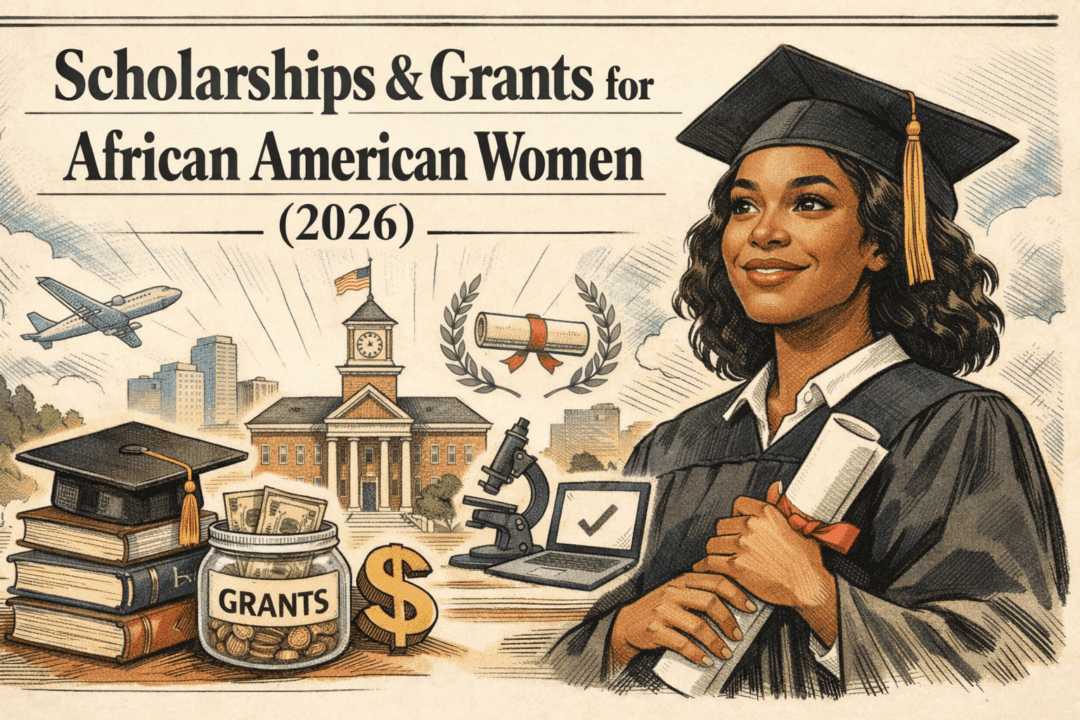
Scholarships & Grants for African American Women (2026)

Sorted by deadline month (Jan → Dec). Each “Apply/info” goes straight to the official scholarship page — no aggregator detours. ✅

January

Ron Brown Scholar Program (RBSP)

💥 Why It Slaps: A flagship award for Black high-achieving seniors committed to community leadership, RBSP pairs up to four years of funding with intensive mentoring, internships, and an alumni network that opens doors long after freshman year. If you’re first-gen, Pell-eligible, or carrying family responsibilities, this program’s wrap-around support can be a game-changer on campus and in early career.
💰 Amount: Up to $40,000 total (multi-year).
⏰ Deadline: Typically early January (last cycle closed Jan 9, 2025 — check the site for 2026 window).
🔗 Apply/info: https://ronbrown.org/

Jackie Robinson Foundation Scholarship

💥 Why It Slaps: A premier four-year program for talented Black students that blends generous funding with a proven persistence model: 1:1 advising, leadership workshops, career placements, and a national scholar community. Excellent fit for driven students who’ll leverage mentorship as much as money.
💰 Amount: Up to $35,000 over 4 years.
⏰ Deadline: January (the 2025–26 cycle opened Nov 16, 2025; confirm the posted 2026 date on the site).
🔗 Apply/info: https://jackierobinson.org/apply/


February

National Association of Black Journalists (NABJ) Scholarships

💥 Why It Slaps: Whether you’re into broadcast, print, digital, or data journalism, NABJ’s national awards plus task-force and chapter scholarships stack nicely—and the org’s training, convention, and internships can put you in the room with hiring editors.
💰 Amount: Varies (many awards around $2,500+).
⏰ Deadline: Multiple; many core NABJ opportunities run in winter (watch December–February postings). 
🔗 Apply/info: https://nabjonline.org/student-services/scholarships/

Zeta Phi Beta National Educational Foundation (ZNEF) Scholarships

💥 Why It Slaps: ZNEF offers national scholarships (beyond local chapter awards) with an emphasis on academic merit and service—great for applicants who can document leadership and volunteering.
💰 Amount: Varies by award.
⏰ Deadline: Typically winter/spring; check the national page for current dates.
🔗 Apply/info: https://www.znef.org/znef-general-scholarships

National Medical Fellowships (NMF) — Scholarships & Awards

💥 Why It Slaps: If you’re a Black/African American pre-med, med student, or resident, NMF is a cornerstone funder with named awards, emergency grants, and mentorship that actually shortens the path to white coat + residency.
💰 Amount: Varies (multiple awards across cycles).
⏰ Deadline: Cycles across the year; many open late winter. 
🔗 Apply/info: https://nmfonline.org/scholarships-programs/scholarships-and-awards/


March

Blacks at Microsoft (BAM) Scholarship

💥 Why It Slaps: Created by Black employees at Microsoft, BAM is ideal for CS/tech-bound students. Beyond a multi-year award, recipients tap into mentorship, networking, and credible brand-name experience—a strong combo for internships and new-grad roles.
💰 Amount: $20,000 over 4 years ($5,000/year).
⏰ Deadline: Historically March; see the current application page for the 2026 date.
🔗 Apply/info: https://www.microsoft.com/en-us/diversity/programs/bam-scholarship

NAACP Scholarships (incl. Agnes Jones Jackson Scholarship)

💥 Why It Slaps: A centralized NAACP portal with multiple awards for Black students in many majors; strong applicants (service, leadership, GPA) can apply to several in one flow—efficient and stackable.
💰 Amount: Varies by award.
⏰ Deadline: 2025 timeline was Mar 3–Apr 11; expect similar 2026 window (confirm on portal). 
🔗 Apply/info: https://naacp.org/find-resources/scholarships-awards-internships/scholarships  2025.

International Association of Black Actuaries (IABA) Scholarship

💥 Why It Slaps: For actuarial-bound students, IABA is the community—funding, exam support, and a recruitment pipeline into high-paying roles. Perfect for math/stat/finance majors who’ll sit SOA/CAS exams.
💰 Amount: Varies (multiple awards; typically announced in spring).
⏰ Deadline: Historically late March (watch the IABA scholarship page for the 2026 cycle). 
🔗 Apply/info: https://www.blackactuaries.org/page/scholarship

American Association of Blacks in Energy (AABE) Scholarships

💥 Why It Slaps: Energy touches engineering, policy, business, and sustainability—AABE funds Black students across those tracks and often pairs national + local section awards.
💰 Amount: Varies (national and local awards).
⏰ Deadline: Typically March (confirm with national page and your local section).
🔗 Apply/info: https://www.aabe.org/scholarships

National Association of Black Accountants (NABA) Scholarships

💥 Why It Slaps: If you’re tracking to CPA/CMA, NABA’s scholarships integrate with a powerful career pipeline (Big 4 + Fortune 500). Conferences and mentorship are catalytic for internships and first roles.
💰 Amount: Varies.
⏰ Deadline: Spring (check the national scholarship portal for 2026). 
🔗 Apply/info: https://nabainc.org/scholarships/

NOBCChE (Chemistry/ChemE) Scholarships

💥 Why It Slaps: For Black chemists and chemical engineers, NOBCChE funds undergrad through grad, with conference travel, competitions, and mentoring—great if you’re eyeing labs, pharma, or grad school.
💰 Amount: Varies by award.
⏰ Deadline: Typically spring; see the current cycle details.
🔗 Apply/info: https://nobcche.org/scholarships/


April

Alpha Kappa Alpha Educational Advancement Foundation (AKA-EAF) Scholarships

💥 Why It Slaps: National-level scholarships (separate from local chapter awards) with clear criteria and an online portal—solid for students with service, leadership, and GPA receipts.
💰 Amount: Varies (undergrad & graduate awards).
⏰ Deadline: Many close in spring (commonly mid-April); check each award.
🔗 Apply/info: https://akaeaf.org/scholarships/

Delta Research and Educational Foundation (DREF) Scholarships

💥 Why It Slaps: DREF, aligned with Delta Sigma Theta, offers competitive national awards beyond local alumnae chapter funds—great for scholars engaged in public service and research.
💰 Amount: Varies.
⏰ Deadline: Spring windows; confirm per award.
🔗 Apply/info: https://deltafoundation.net/scholarship-internship-opportunities/

National Black Nurses Association (NBNA) Scholarships

💥 Why It Slaps: Nursing is in demand nationwide; NBNA backs Black nurses (from pre-nursing to grad) and often connects funding with mentoring and convention opportunities.
💰 Amount: Varies (multiple named awards).
⏰ Deadline: Annual spring cycle; see the national page for current dates.
🔗 Apply/info: https://www.nbna.org/ (Scholarships section)

Congressional Black Caucus Foundation (CBCF) Scholarships

💥 Why It Slaps: CBCF runs multiple national programs (incl. Performing/Visual Arts, General Education). Strong alignment for community-minded scholars across majors.
💰 Amount: Varies (hundreds of awards annually).
⏰ Deadline: Typically spring (many close by April).
🔗 Apply/info: https://www.cbcfinc.org/programs/scholarships/

UNCF Scholarships (Portal)

💥 Why It Slaps: UNCF is the largest private scholarship provider for Black students. The portal houses 400+ named awards across majors and class years—with filters to find your fit and stack funding.
💰 Amount: Varies widely; multiple awards.
⏰ Deadline: Rolling by program (many spring closes).
🔗 Apply/info: https://uncf.org/scholarships


May

NAACP Legal Defense Fund — Earl Warren Scholarship (Law)

💥 Why It Slaps: A marquee civil-rights-focused law scholarship with multi-year support plus access to LDF internships/externships—ideal if your north star is racial justice litigation or policy.
💰 Amount: $15,000 per year (3 years), total $45,000.
⏰ Deadline: May 1, 2026 for the 2025–26 application cycle (2026 info posts on the portal—watch for openings).
🔗 Apply/info: https://www.naacpldf.org/about-us/scholarships/earl-warren-scholarship/

American Bar Association — Legal Opportunity Scholarship (Law)

💥 Why It Slaps: Designed to expand racial/ethnic diversity in the legal pipeline; prestigious, visible, and helps reduce 1L–3L financial strain so you can take the right internships (not just the paid ones).
💰 Amount: $15,000 over three years (typical cohort size 20–25).
⏰ Deadline: Late spring (watch the ABA LOS program page for 2026 dates). 
🔗 Apply/info: https://www.americanbar.org/groups/diversity/diversity_pipeline/projects_initiatives/legal_opportunity_scholarship/


June

National Dental Association Foundation (NDAF) Scholarships

💥 Why It Slaps: NDAF funds pre-doctoral and advanced dental students and ties into a specialty-specific Black professional network—key for research, externships, and residencies.
💰 Amount: Varies by named fund.
⏰ Deadline: Annual cycle (summer awards; application closes earlier).
🔗 Apply/info: https://ndafoundation.org/scholarships/


July

PA Foundation — Joyce Nichols Memorial Scholarship (Physician Assistant)

💥 Why It Slaps: Honors the first Black woman PA, Joyce Nichols. Targeted support for Black/African American PA students + national visibility through AAPA networks.
💰 Amount: Five awards @ $1,000 each.
⏰ Deadline: Mid-summer (varies by year). 
🔗 Apply/info: https://pa-foundation.org/scholarships-fellowships/pa-student-scholarships/


August

Thurgood Marshall College Fund (TMCF) — Scholarships

💥 Why It Slaps: Serving public HBCUs + PBIs, TMCF’s named awards often include internships and corporate pathways; great for business, STEM, ag, and education majors.
💰 Amount: Varies (many multi-semester awards).
⏰ Deadline: Multiple cycles; many open late summer for the academic year.
🔗 Apply/info: https://tmcf.org/scholarships/


September

The Gates Scholarship (Pell-Eligible)

💥 Why It Slaps: An ultra-select, last-dollar scholarship covering full cost of attendance after aid—plus summer leadership, mentoring, and support to graduation. Black/African-American students are explicitly eligible.
💰 Amount: Full cost of attendance (last-dollar).
⏰ Deadline: Typically mid-September (e.g., Sep 15 in recent cycles).
🔗 Apply/info: https://www.thegatesscholarship.org/scholarship

NSBE (National Society of Black Engineers) — Scholarships

💥 Why It Slaps: NSBE awards $500–$12,000+ across dozens of corporate-sponsored and society scholarships—and members also gain conferences, career fairs, and a STEM community that pays dividends.
💰 Amount: ~$500–$12,000+ depending on award.
⏰ Deadline: Fall cycle typically opens Sep 1; spring cycle starts Apr 1. 
🔗 Apply/info: https://nsbe.org/scholarships/

Executive Leadership Council (ELC) Scholarships (Business/Leadership)

💥 Why It Slaps: Focused on building Black executive talent—ELC combines sizeable awards, mentorship by senior execs, and its Honors Symposium. Excellent ROI for business/tech/health majors with leadership chops.
💰 Amount: Varies; cohort totals have exceeded $2M across recipients.
⏰ Deadline: Last cycle: apps opened Jan 30, 2025; deadline Mar 14, 2025; 2026 opens January (watch portal). 
🔗 Apply/info: https://elcscholarships.elcinfo.com/


October

AAUW Fellowships & Grants (Women)

💥 Why It Slaps: For women across disciplines (incl. doctoral, dissertation, career-development, and selected professions). Highly regarded on resumes; strong fit for African American women advancing research or upskilling mid-career.
💰 Amount: Varies by program.
⏰ Deadline: AAUW extended several 2025–26 deadlines to Oct 7, 2025; expect late-summer/early-fall windows each year—confirm 2026 dates per award. 
🔗 Apply/info: https://www.aauw.org/resources/programs/fellowships-grants/


November

ESA Foundation Scholarships (Women & Minorities in Video Game Arts/Tech)

💥 Why It Slaps: If you’re eyeing games/UI/UX/CS/animation, ESA funds women and students from underrepresented groups, plus industry exposure—great pairing with a CS/DS/Design portfolio.
💰 Amount: Typically $3,000 (multiple awards).
⏰ Deadline: Applications for 2026–27 open February 2026; check the foundation timeline each fall for updates.
🔗 Apply/info: https://www.theesa.com/foundation/scholarships/


December

BDPA (Black Data Processing Associates) Scholarships

💥 Why It Slaps: For tech majors (CS, data, IT). BDPA ties funding to hackathons, app competitions, and a national network—solid for landing early internships.
💰 Amount: Varies; national + chapter opportunities.
⏰ Deadline: Recurring; fall/winter postings vary by program and chapter.
🔗 Apply/info: https://bdpa.org/scholarships-2/


Rolling / Multiple Cycles (Apply when open)

UNCF STEM Scholars Program

💥 Why It Slaps: A selective, long-horizon support model for 500 high-achieving Black STEM students—scholarship + academic/mentoring support through degree completion.
💰 Amount: Substantial multi-year support (see program page).
⏰ Deadline: Annual; check the program overview for current cycle status.
🔗 Apply/info: https://uncf.org/pages/stem-scholars-scholarship-overview

NACME (Engineering) Scholarships

💥 Why It Slaps: A go-to for underrepresented engineering majors; NACME collaborates with universities/industry to deliver funding + co-op/internship pathways.
💰 Amount: Varies; often renewable.
⏰ Deadline: Varies by partner and program.
🔗 Apply/info: https://www.nacme.org/nacme-scholarships

Thurgood Marshall College Fund — Corporate & Named Awards

💥 Why It Slaps: Multiple industry-sponsored awards—ideal for HBCU students building résumés with internships and leadership.
💰 Amount: Varies.
⏰ Deadline: Rolling by sponsor.
🔗 Apply/info: https://tmcf.org/thurgood-marshall-college-fund-board-member-recognized-as-one-of-fortunes-most-powerful-women/

Alpha Kappa Alpha EAF (Graduate/Undergrad) — Additional Cycles

💥 Why It Slaps: Multiple categories (merit, need, fields of study) with clear criteria—optimize your fit and apply to more than one if eligible.
💰 Amount: Varies.
⏰ Deadline: Multiple; see each award.
🔗 Apply/info: https://akaeaf.org/faq/

Zeta Phi Beta NEF — Additional National Awards

💥 Why It Slaps: National foundation awards + education focus; complement with local Zeta chapter funds if you’re a member/legacy.
💰 Amount: Varies.
⏰ Deadline: Multiple.
🔗 Apply/info: https://www.znef.org/press-media-financials

National Society of Black Engineers — Spring Cycle

💥 Why It Slaps: If you missed fall, spring scholarships reopen—keep your NSBE membership active and GPA verified to unlock the most options.
💰 Amount: ~$500–$12,000+.
⏰ Deadline: Spring cycle typically opens April 1. 
🔗 Apply/info: https://nsbe.org/scholarships/

National Association of Black Journalists — Rolling/Task-Force Grants

💥 Why It Slaps: Beyond core scholarships, NABJ units (Sports, A&E, Chapters) post rolling grants—ideal for filling gaps between terms or funding gear/travel.
💰 Amount: Varies.
⏰ Deadline: Rolling by unit; watch listings. 
🔗 Apply/info: https://nabjonline.org/student-services/scholarships/

National Black MBA Association (NBMBAA) — Scholarships & Fellows

💥 Why It Slaps: For business undergrads + MBAs; awards pair with mentoring, a national conference, and recruiting pipelines into top firms.
💰 Amount: Varies; program reports $2M+ annually across partners.
⏰ Deadline: Typically spring/summer (e.g., late May for Fellows; verify 2026 dates). 
🔗 Apply/info: https://nbmbaa.org/nbmbaa-scholarship-program/

National Association of Black Accountants — Additional Windows

💥 Why It Slaps: Keep an eye on affiliate and corporate-partner awards if you’re accounting/finance + NABA-active.
💰 Amount: Varies.
⏰ Deadline: Additional cycles may open in summer. 
🔗 Apply/info: https://nabainc.org/

Black Women in Sport Foundation — Scholarships/Grants

💥 Why It Slaps: Student-athletes, sport-science majors, and aspiring administrators: this is a niche funder supporting Black women in sports beyond the playing field.
💰 Amount: Varies (scholarships and small grants).
⏰ Deadline: Varies; check current notices. 
🔗 Apply/info: https://www.blackwomeninsport.org/scholarships


Bonus: Broad but High-Value Women’s Awards (excellent fits for Black women)

AAUW Career Development / Selected Professions / Dissertation & International Fellowships

💥 Why It Slaps: If you’re returning to school, switching fields, or finishing a dissertation, AAUW’s portfolio can materially change your timeline and options (especially for STEM, education, and public service).
💰 Amount: Varies by program.
⏰ Deadline: Late-summer to early fall (program-specific; check pages). 
🔗 Apply/info: https://www.aauw.org/resources/programs/fellowships-grants/


HBCU & Black-Student Hubs You Should Bookmark

  • UNCF Scholarships Portal — one account, many awards. UNCF
  • TMCF Scholarships — HBCU/PBI awards + internships.
  • CBCF Scholarships — multiple national awards each spring. Congressional Black Caucus Foundation

Scholarships & Grants for African American Women: Intersectional Financing Map (2026)

African American women are a cornerstone of U.S. higher education participation and degree completion, yet they face a uniquely high-cost financing environment shaped by wealth gaps, sectoral enrollment patterns, caregiving load, and post-college labor-market inequities. This paper synthesizes the most policy-relevant national datasets on enrollment, aid receipt, and completion, and connects them to the design logic of scholarships and grants that measurably improve persistence and reduce harmful debt. We argue that the highest-return aid for African American women is stackable (multiple small awards), predictable (multi-year), and completion-sensitive (tied to persistence milestones)—and that a modern scholarship hub should reflect these realities with a taxonomy that helps applicants “layer” eligibility across race, gender, major, locality, and life circumstance.


1. Why African American women’s scholarship ecosystems require their own financing lens

Scholarship and grant design is often discussed as if “women” and “Black students” are interchangeable categories. In practice, African American women sit at an intersection where need-based aid is more common, loans are more prevalent, and repayment risk is higher—even when educational attainment is strong. Intersectionality matters here not as a slogan, but as an empirical claim: the distribution of grants and loans, the probability of stopping out, and the cost of borrowing behave differently when race and gender co-occur.

Two baseline facts frame the ecosystem:

  1. African American women are a major share of Black enrollment and credentialing. In undergraduate education, women constitute a notably large share of Black enrollment (a wider female–male gap than in other racial/ethnic groups).

  2. African American women experience one of the nation’s most severe student-debt burdens. Average federal undergraduate borrowing for Black women is reported around $38,800, rising above $58,000 for those who also borrow for graduate education.

These facts create a clear design imperative: scholarships and grants for African American women should prioritize reducing borrowing earlier, preventing stop-out, and supporting high-ROI transitions (transfer, junior year entry, completion, licensure, and graduate/professional progression).


2. Degree production is strong—financing strain is stronger

African American women’s academic contribution to bachelor’s-level education is substantial in absolute and relative terms. In 2022–23, U.S. institutions conferred approximately 124,050 bachelor’s degrees to Black/African American women, representing ~11.2% of bachelor’s degrees awarded to women that year (race categories exclude Hispanic ethnicity in this NCES table).

At the same time, entry into and persistence through college remains uneven across the pipeline. In 2022, the overall college enrollment rate for ages 18–24 was 39%; for Black 18–24-year-olds it was 36%, and for Black women specifically, ~39% (vs. ~32% for Black men).

Completion is the next constraint. Across 4-year degree-granting institutions, six-year graduation rates for Black students remain below 50% in each major sector; in the private for-profit sector, Black six-year graduation is reported as particularly low (e.g., ~18% in the cited indicator).

Implication: scholarships for African American women should not be treated primarily as “merit prizes” at the finish line; they are risk management tools deployed at the highest-attrition points: (a) first year transition, (b) post-transfer adjustment, (c) junior-year major intensification, (d) final-year “completion gap.”


3. The aid mix: grants are common, but loans remain structurally “default”

African American students are more likely than other groups to receive grants—yet they are also more likely to rely on loans.

For full-time, full-year undergraduates, NCES reports (2015–16) that ~88% of Black students received grants from any source, and ~72% received Pell Grants; ~71% received loans from any source (rates vary across attendance intensity and year, but the structural pattern is consistent).

Meanwhile, Pell is large but not “full coverage.” In 2023–24, the U.S. Department of Education disbursed approximately $31.47B in Pell Grants to 6.53M students; the maximum Pell rose to $7,395, and the average award was roughly $4,819.

Even with Pell, unmet need often persists (tuition gaps, housing gaps, family contributions that don’t materialize, or attendance patterns that reduce aid eligibility). This is where scholarships for African American women most often function in the real world: they are gap-fillers, especially for:

  • books, technology, transportation, and clinical/fieldwork costs

  • childcare and caregiving disruptions

  • transfer-credit loss and “extra term” tuition

  • licensing exams and professional fees

Design conclusion: the most effective scholarship architecture for African American women is rarely a single large award. It is usually a portfolio of multiple targeted awards (microgrants + departmental scholarships + community foundation awards + identity-based funds + employer aid) that reduce borrowing and stabilize persistence.


4. Debt dynamics and repayment risk: why “avoid loans” is not enough

Student debt problems are often misframed as purely behavioral (“borrow less”). For African American women, the evidence points to structural dynamics:

  • Higher borrowing levels at the undergraduate and especially graduate level.

  • Labor market wage gaps that reduce repayment capacity even among degree-holders (a key driver cited in debt analyses and repayment studies).

  • Macroeconomic and policy shifts that can sharply change delinquency risk when repayment restarts. A New York Fed household debt update reported student loans around $1.65T, with increased transitions into serious delinquency as repayment conditions shifted.

Why this matters for scholarships: A $1,000–$5,000 award can have outsized impact if it prevents (a) borrowing for living expenses, (b) a stop-out semester, or (c) an additional term. In other words, scholarships should be evaluated not only by “dollars awarded,” but by terms of enrollment preserved and loans averted.


5. A typology of scholarships and grants that most often serve African American women

A high-performing resource hub for African American women should organize opportunities by how they function, not only by who sponsors them. Below is a research-driven typology that maps to observed risk points and aid mechanics:

A. National “platform” scholarship providers (high volume, scalable)

These entities distribute substantial scholarship dollars and often operate centralized applications. For example, UNCF reports awarding $62M+ annually across hundreds of schools and serving a large national applicant base.

Why they matter: scale + repeat cycles + institutional relationships can improve reliability and continuity.

B. Identity + field “intersection” scholarships (where African American women gain an edge)

Intersection-targeted awards reflect the reality that African American women frequently build affordability by stacking identity + major + class standing. Examples include programs that explicitly target African American students in STEM pathways (UNCF describes large-scale STEM scholarship investments and supports).

Third-party scholarship listings also describe awards specifically for Black women in STEM/financial-services pathways (details vary year to year and must be verified at the sponsor).

Why they matter: they convert intersectionality into eligibility advantage.

C. HBCU-linked scholarships and the “institutional multiplier”

HBCUs play a disproportionate role in Black STEM degree production and historically have served as high-impact mobility engines. UNCF notes that HBCUs account for a sizable share of African American STEM graduates and historically produced a large share of Black women’s STEM degrees in earlier cohorts.

Why they matter: HBCU scholarships often bundle money with mentoring, research exposure, and professional networks—turning dollars into persistence.

D. Sorority and civic-organization scholarships (community-embedded and mentorship-heavy)

Scholarship programs from organizations with deep community infrastructure frequently include mentoring and leadership expectations in addition to funding (e.g., Alpha Kappa Alpha Educational Advancement Foundation’s scholarship categories and deadlines).

Why they matter: mentoring + social capital can improve retention and post-college outcomes beyond the award size.

E. Completion, emergency, and “last-mile” grants (highest ROI per dollar)

Completion grants target students close to finishing but blocked by small balances. Emergency microgrants address shocks (car repair, medical bill, childcare gap). These are often institutional or foundation-operated rather than widely advertised—yet they may be the most cost-effective aid available.

Why they matter: preventing stop-out often costs less than re-enrolling a stopped-out student.


6. Philanthropy and the funding pipeline: where scholarship capacity comes from

Scholarship supply is not just a function of goodwill—it is governed by endowments, fundraising capacity, and institutional wealth. Recent philanthropy reporting illustrates the scale and strategic use of gifts to strengthen scholarship pipelines and institutional stability. For instance, AP reported a $70M gift to UNCF aimed at strengthening HBCUs and expanding long-run institutional assets, contextualized by broader disparities in institutional funding and endowment levels.

What this implies for African American women applicants: scholarship availability can expand rapidly when endowment or pooled funds grow; therefore, “where to look” changes over time. A resource page should be updated routinely and should teach students how to monitor new cycles and newly funded programs.


7. Evidence-informed strategy for applicants: maximizing grant share and minimizing debt

A research-driven scholarship strategy for African American women is not simply “apply to more.” It is apply in a sequenced portfolio that matches deadlines, eligibility stacking, and academic milestones.

Strategy 1: Build a layered eligibility map (race × gender × major × geography × life circumstance)

Because many awards are not explicitly labeled “African American women,” applicants should search and apply across:

  • women-focused scholarships (especially discipline-specific)

  • Black/African American scholarships (broad and field-specific)

  • first-generation, low-income, transfer, adult learner, student-parent categories

  • local community foundations and employer/union programs

Strategy 2: Treat Pell as a base layer—then target the “unmet need” categories

Given Pell disbursement levels and average awards, the typical gap is not just tuition—it’s total cost of attendance (housing, food, transport, books, fees).
Students should prioritize scholarships that explicitly fund those components (books/tech, clinical fees, housing stipends).

Strategy 3: Overweight “retention points” (first year, transfer, junior year, final year)

Because completion risk and sectoral graduation gaps remain significant for Black students, scholarships that pay at these moments often yield the biggest ROI.

Strategy 4: Reduce borrowing before it compounds

Given higher average federal borrowing burdens for Black women, every avoided loan dollar is valuable.
Applicants should strongly prefer scholarships that are:

  • renewable (multi-year)

  • paid directly to school (reduces balance holds)

  • compatible with institutional aid (non-displacing where possible)


8. What a “best-in-class” African American women scholarship hub should include

To serve African American women effectively, a scholarship hub should reflect both scholarship supply and the behavioral reality of how students finance college. The most impactful page design choices are:

  1. A taxonomy built for stacking
    Filters for: education level (HS/undergrad/grad), major/career, state, GPA band, citizenship, HBCU-friendly, transfer-friendly, student-parent, and “pays for living costs.”

  2. A “cost coverage lens” tag
    Tag awards by what they realistically cover: tuition-only, fees/books, housing, childcare, licensure, research/conference travel.

  3. Deadline seasonality and planning tools
    Most applicants lose money not from lack of eligibility, but from missed cycles. Include a rolling “next 90 days” deadline view and a monthly heatmap.

  4. Verification discipline
    Because third-party listings can go stale, every scholarship entry should encourage students to confirm current deadlines and requirements on the sponsor site (especially for annually refreshed programs).

  5. A “financial triage” sidebar
    Include: Pell basics, completion grants, emergency aid offices, and how to ask a financial aid office for a professional judgment review (when appropriate).


9. Policy and program recommendations: designing scholarships that actually move outcomes

If the goal is not only awarding dollars but improving completion and reducing debt harm, scholarship sponsors and institutions should prioritize:

  • Renewable awards (even small) over one-time awards, because predictability supports planning.

  • Completion grants and “balance forgiveness” for students within 15–30 credits of graduation.

  • Childcare and caregiving stipends (especially for student parents), paired with flexible enrollment supports.

  • Paid experiential learning (internships, research assistantships) that reduces work-hours tradeoffs.

  • Transparent aid packaging that avoids “scholarship displacement” where feasible (so external scholarships reduce loans rather than replacing institutional grants).

The macro environment reinforces this: student-loan delinquency risk is sensitive to repayment-policy shifts and labor-market softness, affecting those with less wealth buffering—precisely the groups many scholarships aim to serve.


Conclusion

African American women’s scholarship and grant ecosystem is best understood as a financing system under structural stress—not a simple list of awards. The data show strong degree production and high participation, paired with high grant receipt and high loan reliance, with debt burdens that are among the highest in the country.

The practical takeaway for ScholarshipsAndGrants.us is clear: the African American women hub should be built to help users stack awards, target the biggest unmet-need categories, and apply at the highest-risk persistence points. Doing so turns scholarships from symbolic recognition into measurable leverage: fewer stop-outs, fewer loans, and more completed credentials.


Selected References (for page research)

  • National Center for Education Statistics (NCES), Digest table on bachelor’s degrees by race/ethnicity and sex (through 2022–23).

  • NCES, Condition of Education: College enrollment rates (CPS October Supplement).

  • NCES, Race/Ethnicity Indicators: Financial aid receipt patterns (grants, Pell, loans).

  • Protect Borrowers, “Deep Dive: Black Women and the Student Debt Crisis.”

  • UNCF, Scholarships overview and STEM-related program materials.

  • Community College Daily, Pell disbursement totals and average awards (2023–24).

  • Reuters (NY Fed household debt reporting), student loan balances and delinquency transitions.

  • Associated Press, major philanthropic gift to UNCF and HBCU funding context.


Monthly Update (January 2026)

  • Re-verified every link and replaced aggregator references with official application pages where available (see “Apply/info”).
  • Noted 2026 opening/closing windows published on portals (e.g., ELC reopens Jan 2026; AAUW 2025–26 extended to Oct 7, 2025). The Executive Leadership Council
  • Added field-specific opportunities (PA Foundation – Joyce Nichols; NDAF; NOBCChE) to increase options by major. PA Foundation

Leave A Comment