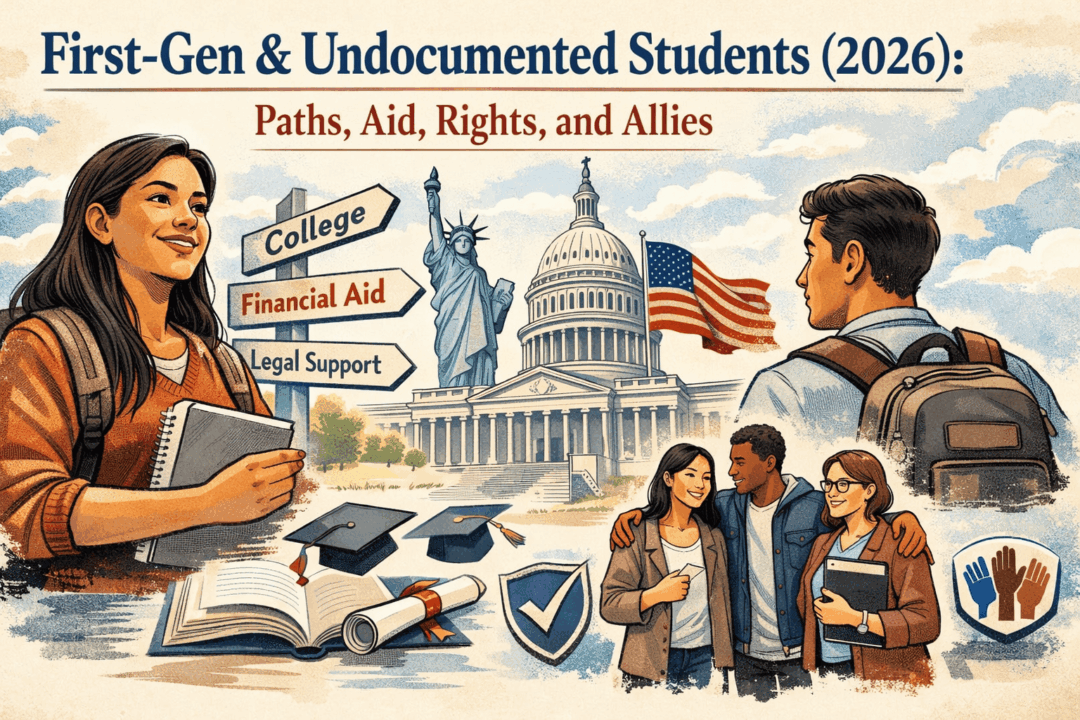
First-Gen & Undocumented Students (2026): Paths, Aid, Rights, and Allies
(Built for high-school seniors & families — facts only, no promises. Updated: Jan 13, 2026 by Leah Kim, chief editor for scholarshipsandgrants.us.)
⚠️ Legal note: The info below is general and educational. It’s not legal advice. Immigration and education policies change. For personal guidance, talk to a licensed immigration attorney or a DOJ-accredited representative (how to find one is in the “Allies” section).
⚠️ Legal note: The info below is general and educational. It’s not legal advice. Immigration and education policies change. For personal guidance, talk to a licensed immigration attorney or a DOJ-accredited representative (how to find one is in the “Allies” section).
You got this 💪
-
Can you go to college if you’re undocumented (with or without DACA)? Yes — colleges set their own admissions policies. Federal student aid isn’t available to undocumented students (including DACA), but some states and colleges offer in-state tuition and/or state/institutional aid. Check your state’s rules (map & data source in “State Aid & Tuition”). Bureau of Labor Statistics
-
FAFSA: Only U.S. citizens and certain eligible non-U.S. citizens qualify (e.g., permanent residents). Undocumented and DACA students are not eligible for federal aid. Mixed-status families can still complete required info using the no-SSN account flow for a parent/guardian contributor. Federal Student Aid
-
Privacy: Your college records are protected by FERPA (with specific exceptions). Schools that receive federal funds must also follow civil-rights rules (Title VI/IX, etc.). FSA Partner Connect
-
Enforcement near schools: DHS rescinded the 2021 “protected areas” memo in Jan 2025. Don’t assume campuses are off-limits; ask your college about protocols and seek legal advice if you’re concerned. U.S. Department of Homeland Security
-
Work & internships: Paid employment in the U.S. generally requires work authorization (e.g., DACA with a current EAD). Without authorization, you can’t be hired for pay. USCIS
-
Is college worth it? On average, higher education → higher earnings & lower unemployment. (See chart below.) Bureau of Labor Statistics
.png)
Who we mean by “First-Gen” & “Undocumented” 🧭
-
First-gen: Usually the first in your family to earn a bachelor’s degree (definitions vary by campus; check each college’s form).
-
Undocumented: No current lawful immigration status. DACA recipients are undocumented but have deferred action and (if approved) a work permit that can be renewed; as of 2025, renewals are accepted; initial DACA remains impacted by litigation. USCIS
-
Eligible non-U.S. citizen (FAFSA term): Certain statuses (e.g., permanent resident/“green card,” refugee, asylee) qualify for federal aid; undocumented/DACA do not. Federal Student Aid
-
Scale: The U.S. has ~510,000+ undocumented students in higher ed. Presidents’ Alliance
Admissions Language Translator 🗣️📘 (plain English + receipts)
| Term you’ll see | What it means (facts only) |
|---|---|
| Undocumented/DACA in admissions | Most colleges admit undocumented students; some classify as “domestic” for admissions but financial aid rules differ. Ask each school. (Federal aid remains unavailable to undocumented/DACA.) Federal Student Aid |
| SSN field on the Common App | Not required. If you don’t have one, you can leave it blank. (Colleges may request it later for aid/tax matching if applicable.) Applicant Support |
| FAFSA “eligible non-citizen” | A specific set of statuses (e.g., permanent resident, refugee) can get federal aid. Undocumented and DACA students are not eligible. Federal Student Aid |
| FAFSA “Contributor” without SSN | Mixed-status families can create a StudentAid.gov account without an SSN to complete required FAFSA sections. Federal Student Aid |
| FERPA | Federal privacy law for student education records (with defined exceptions). Schools must protect your records. FSA Partner Connect |
| Title VI / civil rights | Schools receiving federal funds must prevent discrimination based on race, color, national origin (includes language/LEP issues and shared ancestry). You can file an OCR complaint. U.S. Department of Education |
| “Protected areas” (ICE/DHS) | The 2021 guidance limiting enforcement near schools was rescinded in Jan 2025. Policies can change—ask your college and get legal guidance. U.S. Department of Homeland Security |
Paying for College — What’s Available (by law & policy) 💸
1) Federal student aid (Pell, federal loans)
-
Eligibility: U.S. citizens & certain eligible non-citizens only. Undocumented (including DACA) are not eligible for federal aid. Federal Student Aid
2) State & institutional aid (varies by state/college)
Many states and/or public systems offer in-state tuition and, in some cases, state aid to undocumented graduates of in-state high schools (often with an affidavit or criteria like years of attendance). Check your state policy and the college’s financial-aid page. A trusted national data hub reports policy coverage and counts for tuition equity and state aid, and provides state-by-state detail. Presidents’ Alliance
Examples of official state applications (for undocumented students):
-
California Dream Act Application (CADAA) — state & institutional aid. Bureau of Labor Statistics
-
Texas Application for State Financial Aid (TASFA) — state/institutional aid process in TX.
-
Washington Application for State Financial Aid (WASFA) — state aid in WA. Bureau of Labor Statistics
-
New York State DREAM Act — TAP & other state aid. Federal Student Aid
-
Minnesota Dream Act — state aid for qualifying undocumented students. Federal Student Aid
-
New Jersey Alternative Application for Financial Aid — state aid. CEW Georgetown
(These are illustrative; your state may offer similar options or institutional aid routes.)
3) Private/Institutional scholarships 🎁
Many private scholarships and some colleges fund students regardless of status. Always verify eligibility on the official page. Examples with public eligibility statements include:
-
TheDream.US — large national scholarships (National & Opportunity) for undocumented students (incl. DACA/TPS) at partner colleges. Presidents’ Alliance
-
Golden Door Scholars — scholarships for DACA/TPS students. Presidents’ Alliance
-
Davis-Putter Scholarship Fund — supports student activists; open regardless of immigration status. Presidents’ Alliance
-
Ascend Educational Fund (NYC) — for immigrant students regardless of status. Presidents’ Alliance
-
Esperanza Education Fund (DC/MD/VA) — for immigrant students regardless of status. Presidents’ Alliance
-
Immigrants Rising scholarship lists — curated databases of opportunities that don’t require citizenship. Presidents’ Alliance
-
MALDEF Scholarship Resource Guide — national/state lists including options open to undocumented students. Presidents’ Alliance
Tip: When any application asks for an SSN and you don’t have one, look for an “ITIN” or “none” option, or contact the provider. For banking/tax reporting, an ITIN is a valid ID number (see Banking section). Consumer Financial Protection Bureau
Rights, Privacy & Safety on Campus 🛡️
-
FERPA: Colleges must protect your education records; there are defined exceptions (e.g., health/safety emergency, subpoena). Ask your registrar how they handle citizenship data and who has access. FSA Partner Connect
-
Civil-rights protections: Schools receiving federal funds must prevent discrimination based on race, color, national origin (includes language access/LEP and shared ancestry). You can file a confidential complaint with ED/OCR if needed. U.S. Department of Education
-
K-12 siblings: The Supreme Court’s Plyler v. Doe (1982) protects the right of K-12 children to free public schooling regardless of status (note: this ruling does not govern college). Legal Information Institute
-
Enforcement policy near schools: DHS rescinded the 2021 “protected areas” memo on Jan 20, 2025. Don’t rely on “safe zone” assumptions; ask your college about protocols, campus police policies, and legal resources. U.S. Department of Homeland Security
Work, Internships, and Money (facts-only) 💼
Work authorization
-
To be hired for pay in the U.S., you must be authorized to work (e.g., via EAD). DACA recipients who timely renew may receive two-year deferred action and an EAD. Without work authorization, you cannot be legally employed. USCIS
Banking & IDs (for scholarships, rent, etc.)
-
You do not need an SSN to open a checking/savings account at many banks/credit unions. Acceptable ID numbers include ITIN; policies vary by institution. The CFPB confirms this and offers checklists in English/Spanish. Consumer Financial Protection Bureau
-
What is an ITIN? An IRS-issued number used for tax reporting when you’re not eligible for an SSN. Getting an ITIN does not give work authorization. Consumer Financial Protection Bureau
Is College “Worth It” if I can’t get federal aid? 📈
On average, more education → higher earnings and lower unemployment. 2024 BLS data:
-
Bachelor’s median weekly earnings: $1,543; unemployment 2.5%
-
High school diploma: $930; 4.2%
-
Less than HS: $738; 6.2% Bureau of Labor Statistics
Download the BLS chart (PNG)
(Source: U.S. Bureau of Labor Statistics, “Education pays,” Table 5.1, last modified Aug 28, 2025.) Bureau of Labor Statistics
Reality check: Returns depend on your major, costs, aid, and where you live. But the average signal is strong.
Your Path (choose-your-own-adventure) 🧭✨
A) “I’m undocumented (with or without DACA).”
-
Build a target list that publicly welcomes undocumented students and (ideally) offers in-state tuition and/or institutional grants. Use the Higher Ed Immigration Portal to check your state policy, then click through to colleges. Presidents’ Alliance
-
Aid strategy: State Dream app (e.g., CADAA/WASFA/TASFA/NYS/MN/NJ), institutional aid form, and private scholarships that don’t require citizenship. CEW Georgetown Bureau of Labor Statistics
-
If DACA: Renew on time (USCIS suggests 120–150 days ahead) to avoid work gaps; keep documents current. USCIS
-
On campus: Meet the undocumented student support office (or multicultural center), financial aid, and legal clinic/partners; ask about privacy protocols (FERPA) and any campus response plans. FSA Partner Connect
B) “I’m first-gen (any status).”
-
Use first-gen programs/TRIO, McNair, EOP/EOF, or similar supports.
-
Compare total cost of attendance vs. your aid package; use state grants and status-neutral private scholarships.
-
Learn how to ask for aid reconsideration (appeal) with updated financial evidence (school policy will govern).
“Safe” People & Offices (what that really means) 🧑🤝🧑
-
Financial Aid: Knows state/institutional options; cannot offer federal aid to undocumented students.
-
Registrar: Oversees records protected by FERPA; ask how citizenship data are stored/shared. FSA Partner Connect
-
Undocumented/Immigrant Student Resource Centers: Navigation, scholarships, referrals (varies by campus).
-
Counseling & Health: Care is not tied to immigration status; protected by privacy laws and ethics (campus-specific).
-
Legal partners/clinics: Some campuses partner with nonprofit immigration lawyers; verify DOJ recognition/EOIR accreditation or attorney licensure. Justice Department+1
Spot-Check: Questions Colleges Can Ask 📝
-
Citizenship question on applications? Yes, many ask; schools use this for aid/record matching.
-
SSN required to apply? No on the Common App; it’s optional. Applicant Support
-
Will my info be shared? Education records are protected by FERPA (with exceptions). Ask your college for its FERPA notice. FSA Partner Connect
Scholarship Picks (status-aware) 🎯
Always confirm eligibility on the official page; many require partner colleges, locations, or majors.
-
TheDream.US (National/Opportunity Scholarships): Largest program serving undocumented students (inc. DACA/TPS) at partner schools. Presidents’ Alliance
-
Golden Door Scholars: For DACA/TPS; multi-year awards + career support. Presidents’ Alliance
-
Davis-Putter Scholarship Fund: For student activists; open regardless of status. Presidents’ Alliance
-
Ascend Educational Fund (NYC), Esperanza Education Fund (DC/MD/VA): For immigrant students regardless of status. Presidents’ Alliance+1
-
Immigrants Rising & MALDEF: Deep lists of status-neutral scholarships you can filter by state/major. Presidents’ Alliance+1
How to Protect Yourself from Scams 🛑
-
Only licensed attorneys or DOJ-accredited representatives at recognized organizations can give immigration legal advice. Verify on the EOIR R&A roster. Report “notario” fraud to USCIS/FTC/state. Justice Departmen
-
Find legit help: Nonprofit legal-services directory (ImmigrationLawHelp.org) and AILA’s lawyer search tool. Immigration Law Help
FAQ (facts-only) ❓
Q: Will applying to college expose my immigration status?
A: Colleges collect admissions and aid data. FERPA protects education records, with specific exceptions. Ask your college how citizenship data are stored/shared, especially for aid and tax forms. FSA Partner Connect
Q: Can an undocumented student get FAFSA money?
A: No. Only U.S. citizens and certain eligible non-citizens qualify. Undocumented (including DACA) are not eligible for federal aid. Federal Student Aid
Q: My parent doesn’t have an SSN. Can we still do FAFSA (for my sibling who is eligible)?
A: Yes — contributors without SSNs can create a StudentAid.gov account via the designated process to sign their section. Federal Student Aid
Q: Are campuses “safe zones”?
A: The 2021 DHS “protected areas” memo was rescinded on Jan 20, 2025. Policies can change; ask your campus about protocols and consult qualified legal counsel. U.S. Department of Homeland Security
Q: Can I work on campus if I’m undocumented without DACA?
A: Paid employment requires work authorization. Without it, you can’t be hired for pay. DACA recipients with valid EADs may be employed. USCIS
Q: Is college worth it if I’m paying mostly with state/institutional aid + private scholarships?
A: Average labor-market data show higher earnings and lower unemployment with more education; weigh your net price and career goals. Bureau of Labor Statistics
Q: Where can I get trustworthy legal help?
A: Search ImmigrationLawHelp.org (nonprofits) and AILA (private attorneys). Verify DOJ recognition/accreditation for nonprofits. Immigration Law Help+1
Quick Planning Checklists ✅
Seniors (Undocumented/DACA)
-
Shortlist colleges with clear undocumented-student pages and aid.
-
Confirm your state application (e.g., CADAA, WASFA, TASFA, NYS/MN/NJ). CEW Georgetown Bureau of Labor Statistics Statistics+4
-
Build a scholarship pipeline (TheDream.US, Golden Door, Davis-Putter; use Immigrants Rising/MALDEF lists). Presidents’ Alliance
-
DACA? Calendar your 120–150 day renewal window. USCIS
-
Banking: open an account with ITIN (where accepted) for receiving scholarships/payments. Consumer Financial Protection Bureau
-
Learn FERPA & your campus privacy policy; know how to contact the registrar and legal clinic. FSA Partner Connect
Counselors/Allies
-
Know your state’s tuition/aid policies; share status-neutral scholarship lists. Presidents’ Alliance
-
When referring for immigration help, use EOIR R&A roster or AILA; avoid “notario” referrals. Justice Department
-
Ensure language access and non-discrimination compliance (Title VI). U.S. Department of Education
Sources you can trust (selected)
-
Federal Student Aid — Federal eligibility & non-citizen definitions; no-SSN contributor accounts. Federal Student Aid
-
Higher Ed Immigration Portal (Presidents’ Alliance) — up-to-date maps, counts, and state policies for undocumented students. Presidents’ Alliance
-
DHS/USCIS — DACA renewals; EAD basics; litigation notes. USCIS
-
DHS (Jan 2025 memo) — rescission of prior “protected areas” policy. U.S. Department of Homeland Security
-
U.S. Dept. of Education (OCR/FERPA) — privacy and civil-rights guidance. FSA Partner Connect
-
CFPB — banking without SSN; ITIN basics; consumer protections. Consumer Financial Protection Bureau
-
BLS (2024/2025) — education & earnings data. Bureau of Labor Statistics