
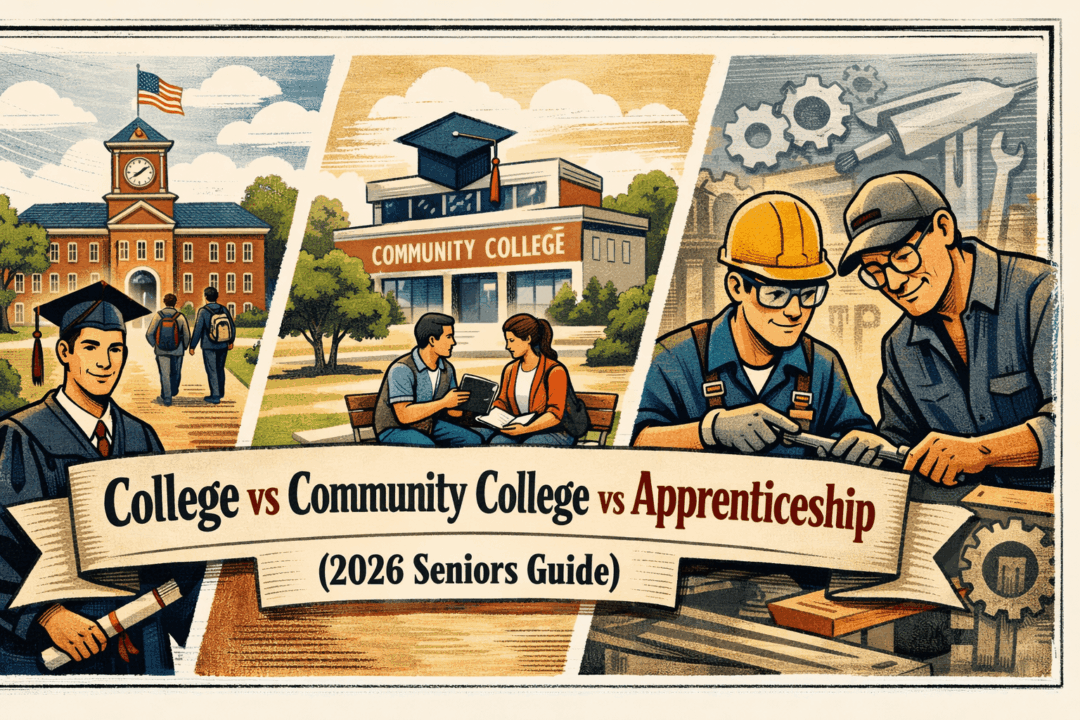
College vs Community College vs Apprenticeship (2026 Seniors Guide)
Updated: Jan 13, 2026 • For U.S. high-school seniors (Class of 2026)
Which path fits you?
-
4-year college (BA/BS): Best if your target career requires a bachelor’s (engineering, many business/tech roles, teaching licensure in many states). Highest median earnings long-term, but also the priciest.
-
Community college (2-year / 2+2 transfer): Smart “low-cost on-ramp.” Earn an associate’s or follow a 2+2 plan (2 years at CC + 2 at a state university) to cut tuition ~30–50% versus four full years at a university. Works great if you want smaller classes, to stay local, or to rebuild your GPA.
-
Registered Apprenticeship: You earn while you learn in a paid, structured program leading to an industry credential (electrician, HVAC, lineworker, advanced manufacturing, some IT/health). Average completer salaries have been around $80k in FY2023 with little/no debt.
Cost & ROI snapshots (national averages)
| Path | Cost & ROI snapshot (national averages) |
|---|---|
| 4-year public, in-state | Annual tuition & fees: $11,610 · Total budget (tuition + living): $29,910 · Time: 4–5 yrs · Median earnings (2024): $1,543/week (BA) ≈ $80,236/yr |
| Community college, in-district | Annual tuition & fees: $4,050 · Total budget (tuition + living): $20,570 · Time: 2–3 yrs · Median earnings (2024): $1,099/week (AA) ≈ $57,148/yr |
| Apprenticeship (paid) | Annual tuition & fees: Instruction costs often covered; you get wages · Total budget (tuition + living): You’re paid; typical tools/fees vary · Time: 1–5 yrs · Median earnings: ~$80,000/yr (completers, FY2023) |
Sources: College Board 2024–25 averages for tuition/fees and student budgets; BLS 2024 median weekly earnings by education; U.S. DOL-reported apprenticeship outcomes.
Reality check: “Budget” includes living costs you’ll pay in any path (food, rent, transport). The big swing you control is tuition/fees—that’s where CC and apprenticeships can save you a lot.
The 2+2 Transfer Pathway (Community College → University)
What it is: Complete your first two years (general ed + major prerequisites) at a community college, then transfer to finish the BA/BS.
-
Many states have guaranteed-transfer frameworks. Example: California’s Associate Degree for Transfer (ADT) guarantees admission to the CSU system (not always to a specific campus/major). Cal-GETC becomes the single GE transfer pattern in Fall 2025 to streamline CC-to-CSU/UC transfer.
-
California’s official CC portal explains that an ADT gives you a guaranteed spot at a participating university.
Why students love 2+2:
-
Cost: Tuition math (tuition/fees only): 2 × $4,050 (CC) + 2 × $11,610 (university) ≈ $31,320 vs 4 × $11,610 = $46,440 at a university all four years. (Private universities cost far more.)
-
Fit: Smaller classes early on; time to explore majors; transfer with a stronger transcript.
Watch-outs: Credit loss if you wander off the mapped plan; some competitive majors (CS, nursing) have tight prerequisite sequencing—meet with transfer advising early.
Apprenticeships & Pre-apprenticeships (earn while you learn)
Registered Apprenticeship (U.S. Department of Labor-recognized) blends paid on-the-job training with classroom instruction, ending in a portable, industry-recognized credential. Typical length: 1–5 years; wages rise as you progress. Completers reported ~$80k average salary in FY2023, often without student loan debt.
Pre-apprenticeship gets you ready for a Registered Apprenticeship—usually a few weeks to a few months; may include stipends, basic skills, and direct entry agreements. (It’s formally defined in federal guidance and regulation.)
Where apprenticeships exist: Building trades (IBEW, UA, Sheet Metal, Carpenters), utilities/linework, advanced manufacturing, logistics, cybersecurity/IT helpdesk, medical assisting, pharmacy tech—and growing.
Pros: Paid from day one, little/no debt, strong job placement.
Cons: Local availability varies; physically demanding in some trades; licensure progression can take years.
“Is it worth it?” — Honest scenarios
1) Alex (wants Software Engineering @ a flagship)
-
Best fit: 4-year direct entry (or CC→transfer if money is tight and the CS transfer map is rock-solid).
-
Why: Employers often prefer accredited CS/CE degrees; recruiting pipelines target 4-year schools. BA median earnings remain highest across the labor market.
2) Maya (wants RN quickly; budget is tight)
-
Best fit: Local community college ADN → work as RN → employer-paid RN-to-BSN later; or CC pre-nursing 2+2 into a BSN if she wants direct BSN.
-
Why: CC keeps tuition low; nursing has clear licensure ladders. (Check your state’s nursing board and university transfer maps.)
3) Jamal (likes hands-on work; wants to earn now)
-
Best fit: Electrician Registered Apprenticeship with a local JATC/contractor.
-
Why: Paid from day one, benefits, raises as skills increase; strong demand; FY2023 completers reported ~$80k avg salaries.
4) Priya (undecided; wants to test fields)
-
Best fit: Community college for breadth + career exploration, with a mapped 2+2 option.
-
Why: Low cost to “discover,” then transfer once the major clicks.
Side-by-side: Pros, cons, and best-for
| Path | Pros | Cons | Best for |
|---|---|---|---|
| 4-year college | Highest median earnings; campus resources; many majors & internships | Highest tuition; more debt risk; selective admissions | Careers that require BA/BS; students with clear major + strong academic prep |
| Community college | Lowest tuition; smaller classes; 2+2 savings; local | Need careful transfer planning; limited on-campus life | Explorers, commuters, cost-sensitive students, rebuild GPA |
| Apprenticeship | Paid training; little/no debt; strong job placement | Availability varies; multi-year skill ladder; physically demanding trades | Hands-on learners; trades, utilities, some IT/health entry roles |
Decide in 10 minutes: quick checklist
Give yourself 0–2 points for each statement (0 = not me, 1 = somewhat, 2 = very me). Tally by column.
| 4-Year | CC / 2+2 | Apprenticeship | |
|---|---|---|---|
| My target career requires a bachelor’s | 2 | 0 | 0 |
| I want the full campus experience | 2 | 1 | 0 |
| I need to minimize tuition | 0 | 2 | 2 |
| I prefer smaller classes early on | 1 | 2 | 0 |
| I learn best hands-on/paid work | 0 | 1 | 2 |
| I’m ready for calc/chem/CS rigor now | 2 | 1 | 0 |
| I need to work a lot while in school | 1 | 2 | 2 |
| My state has guaranteed transfer | 1 | 2 | 0 |
| I want an industry credential fast | 0 | 1 | 2 |
| I can manage loan risk if ROI is strong | 2 | 1 | 0 |
Interpretation: Highest column = frontrunner. If tie, combine paths (e.g., CC→university; pre-apprenticeship → apprenticeship; apprenticeship + later AA/BA using employer tuition benefits).
How to execute each path (step-by-step)
4-year college
-
Shortlist 6–8 schools: 2 reaches, 3 matches, 2 safeties.
-
Price them with net price calculators (not sticker price).
-
Apply EA/priority where possible; line up FAFSA/CSS Profile on release.
-
Compare program-level outcomes (internships, licensure pass rates, starting salaries).
Community college (2 or 2+2)
-
Meet a transfer advisor before your first term.
-
Choose a transfer major map (e.g., ADT in CA) and register for mapped courses only.
-
Maintain the required GPA; apply for guaranteed-admission/priority transfer where offered.
-
Use state transfer portals and articulation guides every term.
Apprenticeship / Pre-apprenticeship
-
Search Apprenticeship.gov and local trade organizations; look for “Registered Apprenticeship.”
-
If you’re new to the field, start with a pre-apprenticeship that pipelines into a RAP.
-
Apply with a resume that highlights hands-on work (CTE, shop, robotics, volunteering).
-
Budget for tools/boots; expect progressive wage increases.
“Is it worth it?” — A simple rule of thumb
-
If your target job requires a bachelor’s (and has solid entry-level pay), a 4-year or 2+2 path is worth it—just cap your loans so your total borrowed ≤ your projected first-year salary. (E.g., new engineers/CS grads often clear this bar.)
-
If your target job is a licensed trade with strong union or employer pathways, apprenticeship can beat a BA on debt-adjusted ROI because you’re earning during training and reaching ~$80k outcomes without loans.
-
If you’re undecided or cost-sensitive, community college keeps options open while you discover your major and protect your budget. Many states’ transfer systems are improving to make credit flow smoother.
Real-world examples you can copy
-
2+2 Business: Two years at your local CC on the Business ADT (or equivalent), then transfer to a state university for BA in Finance/Marketing. Join Phi Theta Kappa, keep a 3.5+, and you’ll often land transfer scholarships at the university level. Cal State University
-
Apprentice → Degree later: Start as an industrial maintenance apprentice; after journey status, use employer tuition benefits to finish an AAS or BS in Applied Technology while working.
-
Healthcare ladder: Medical Assistant pre-apprenticeship → Registered Apprenticeship at a hospital → employer-funded LPN/RN bridge → later RN-to-BSN. Apprenticeship.gov
FAQs
Do apprenticeships really pay enough to skip college?
Many do. DOL reported ~$80k average salary for Registered Apprenticeship completers in FY2023—comparable to national bachelor’s medians—often with little/no debt. Outcomes vary by trade and region. Government Accountability Office
Is community college “less than” a university?
No. It’s a different on-ramp. With a mapped 2+2 you can end with the same BA/BS the university grants to direct entrants—often thousands cheaper. Just follow the transfer map precisely. Cal State University
Will starting at CC hurt my chances for competitive majors later?
Not if you work the plan. States are consolidating general-ed patterns (e.g., Cal-GETC in CA starting Fall 2025) to reduce credit loss. Competitive majors still require specific GPAs and prereqs. Cal State University
What are the real costs I should compare?
Compare net price (after grants) and tuition/fees (where paths differ the most). Living costs exist in any path. College Board’s 2024–25 averages: public 4-year in-state $11,610 tuition; public 2-year $4,050; private 4-year $43,350. College Board Research
How do earnings differ by education level overall?
BLS 2024 medians: bachelor’s $1,543/week, associate’s $1,099/week, high-school $930/week; unemployment falls as education rises. Bureau of Labor Statistics
🔍 How to Check If Your College Requires SAT/ACT
1. Go straight to the Admissions Website
-
Google:
"[College Name] admission SAT ACT site:.edu" -
Look for a page called “First-Year Admission Requirements,” “Testing Policy,” or “Apply as a Freshman.”
-
✅ That’s the official policy—don’t rely on old blogs or forums.
2. Check if the school is Test-Free, Test-Optional, or Test-Required
-
Test-Free (score-free): Will not consider SAT/ACT at all (UC, CSU).
-
Test-Optional: You choose whether to send scores (UChicago, Columbia, etc.).
-
Test-Required: You must submit scores (MIT, Harvard, UT Austin for 2026).
3. Look for dates and class year labels
-
Policies often change by application cycle.
-
Example: “Beginning with applicants to the Class of 2026, SAT/ACT will be required again.”
-
Make sure it matches your year (Fall 2026 enrollment).
4. Watch for program-specific exceptions
-
Even if the university is test-optional, some programs (like Nursing, Engineering, or Honors) may require/recommend scores.
-
Always check your intended major/college page.
5. Confirm for scholarships & placement
-
Some colleges don’t require SAT/ACT for admission but do for:
-
Merit scholarships (though ASU/Arizona don’t).
-
Course placement (math/English after you enroll).
-
6. Call or email admissions (if still unclear)
-
Use the official admissions email or phone number.
-
Pro tip: Phrase it as → “I’m applying for Fall 2026. Could you confirm your SAT/ACT requirement for my major?”
✨ Shortcut Tools
-
FairTest.org keeps an updated national database of test-optional/test-free schools.
-
Big state systems (UC, CSU, SUNY, CUNY) post official testing policy pages every cycle.
👉 Rule of thumb: Never assume—always verify directly on the school’s site for your application year.