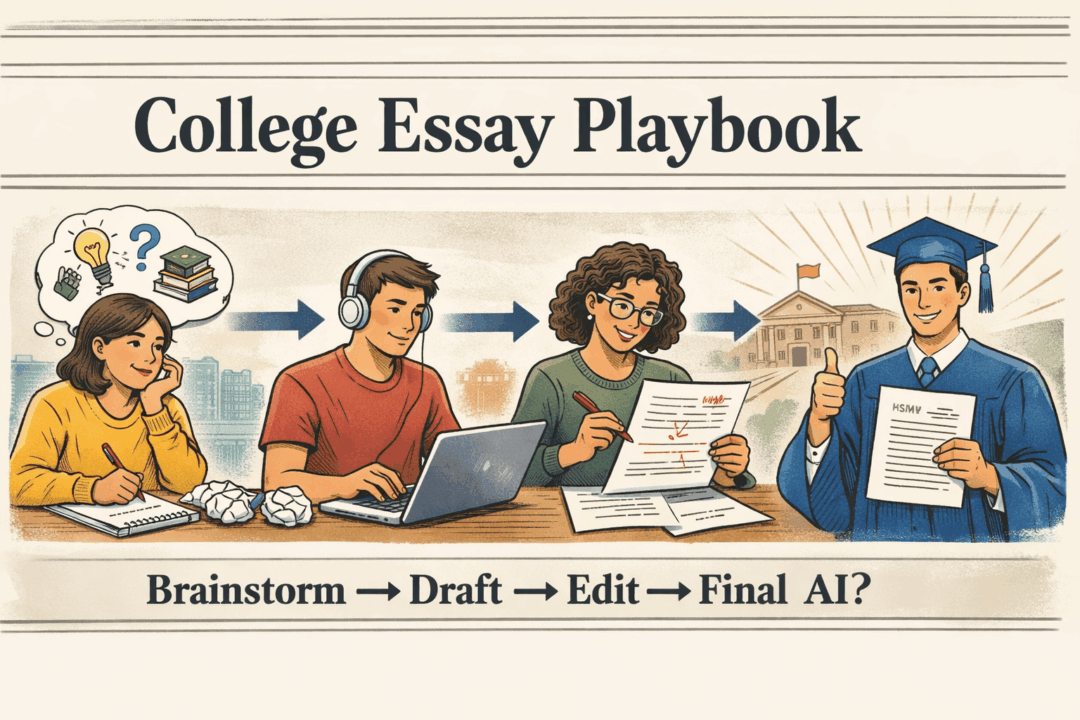
College Essay Playbook (Brainstorm → Draft → Edit → Final) / AI? 🎯✍️
Updated: Jan 13, 2026 by Leah Kim, chief editor for scholarshipsandgrants.us
A Gen-Z friendly, step-by-step playbook for the 650-word college essay. Includes 10 prompts, “spike” narrative examples, checklists, and a dedicated first-gen guide. HowTo + FAQ schema included.
🤖 AI + College Essays: Advantage or Disadvantage?
The Reality
- Admissions officers read for voice — your quirks, humor, rhythms, and lived details. AI can’t fake that convincingly.
- But AI can help with: brainstorming, idea organization, editing clarity, and cutting fluff.
- Think of AI as your coach, not your ghostwriter. You run the game; it just drills you.
🎯 Advantages of Using AI
- Brainstorm Booster: Feed AI your “moments map” → it can suggest themes or metaphors you didn’t notice.
- Cut the Fluff: AI is ruthless at trimming overlong sentences and repetition.
- Flow Fixer: Can suggest transitions to smooth out scene jumps.
- Prompt Rehearsal: You can test your draft against multiple Common App prompts—AI helps reframe.
- Confidence Builder: Seeing your story reframed helps you confirm what sounds like you.
⚠️ Disadvantages (if misused)
- Voice Erosion: Over-editing with AI can sand down your personality → you sound like everyone else.
- Over-polish: Essays that read like perfect PR blurbs raise red flags.
- Ethics Risk: If AI generates full paragraphs that you copy-paste, that’s not your work. Admissions want authenticity.
- Dependence: Leaning too hard on AI = you lose the practice of expressing ideas in your own words.
✅ Rules of Thumb
- Green Zone (yes): Outlines, brainstorming prompts, grammar nudges, cutting words.
- Yellow Zone (careful): Rewrites that “sound nice” but erase your slang, humor, or cultural detail.
- Red Zone (nope): Submitting AI’s words as your own.
🔑 Prompt Examples (Safe & Smart Use)
Brainstorming:
“I’m a first-gen student who helps my siblings after school and also run a composting club. Can you suggest 5 possible essay angles or metaphors that highlight my initiative, but still sound authentic and personal?”
Cutting Fluff:
“Here’s a 650-word draft of my college essay. Highlight sentences I could cut or shorten to reduce word count by 80–100 words, without losing my main story or voice.”
Flow/Transitions:
“I’ve got three mini-scenes: caregiving, building a calendar system, and starting a phone-repair swap. Suggest transitions that connect these scenes smoothly without sounding fake.”
your 4-step recipe
- Brainstorm (30–45 min): Find a spike—a sharp angle where you’ve gone deeper than most.
- Draft (60–90 min): Show a few vivid moments → connect to meaning → look ahead.
- Edit (3 passes): Structure & cuts → clarity & flow → reflection & voice.
- Final (20 min): Proof, format, filename, submit ✅
What’s a “Spike” (and why admissions love it) 📈
A spike is a specific, earned strength (project, obsession, contribution) that shows depth + initiative + impact. It beats a “great-at-everything” summary because it’s memorable.
Spike checklist (hit at least 3):
- You went beyond class (self-taught, community initiative, original project).
- There’s impact (people helped, product built, results, dollars raised, hours saved).
- You can speak to process (failures, iterations, collaborations).
- There’s growth (a belief/skill changed).
- It hints at a future path (major, club, research, venture).
10 Brainstorm Prompts (pick 2–3 to test) 💡
- “Tiny Door, Big Room”: One small habit that changed how you think.
- The Unpaid Job: Invisible work you do for family/community (what, how, why it matters).
- Rabbit Hole: A niche you’ve explored obsessively (what you built/read/ tested).
- Fix-It Energy: A problem you noticed and the hack you made to solve it.
- Spiky B-Side: Not the obvious award—your weirdest, most specific skill.
- Moments Map: 5 moments you felt most alive; choose 1–2 to zoom into.
- Failure > Tool: A time you messed up → the system you built to prevent it again.
- Bridge-Builder: Two worlds you connect (languages, communities, tech + art).
- Econ of You: How you manage time/money/transport to make your life work.
- Teach-Back: Something you learned so well you could teach a 10-minute mini-class.
Spike Narrative Mini-Examples (quick reads) 🔥
A) Community Radio → Local Health PSA
I started on the graveyard shift, cueing songs at 1:12 a.m. When the station lost ad revenue, I pitched weekly PSAs explaining city heat alerts in two languages. I taught myself audio compression, interviewed our clinic nurse, and designed a text-back script in Google Voice. The first week a listener called to say her dad found the cooling center because of our show. I didn’t fix public health. But I learned that a cheap microphone + clarity can move people to action—and I can build that signal bigger.
B) Mycology Zine → School Compost Pilot
A mushroom zine I stapled at my kitchen table became an experiment behind the cafeteria. I logged temps, failed twice, then convinced the custodian to save coffee grounds. In month three, the pile finally steamed; in month four, our club spread compost in the courtyard beds. Next year I want to test oyster mushrooms on cardboard packaging—because feeding soil might be the most honest extra credit.
C) Caregiving → Micro-Business Ops
When my mom’s shifts changed, I ran mornings: lunches, metro cards, pharmacy lines. I built a wall calendar with “traffic-red” stickers and a $18/week grocery plan. To cover field trip fees, I started a neighborhood phone-screen swap: $15 to replace, $5 to teach you how. I thought it was money. It was actually operations—learn, systemize, hand off. College looks like more of that, just with bigger spreadsheets.
The Playbook: Step-by-Step
1) Brainstorm (30–45 min) 🧠
Do these fast:
- 30×30 List: 30 experiences in 30 minutes—no judging.
- Moments Map: Draw a line: childhood → now. Mark 5 spikes/shifts.
- Spare Parts Bin: Dump screenshots, notes, captions, DMs where you sounded like you.
- Three C’s Venn: Curiosity (what you chase), Contribution (what you gave), Context (conditions you operate in). Middle = essay seed.
Avoid these traps: the “trauma with no processing,” “lesson-as-platitude,” “sports = leadership because teamwork.”
2) Draft (60–90 min) 📝
Use this outline (works for 650 words):
- Hook (1–2 lines): Start in motion (action, sound, contrast).
- Snapshots (2–3 mini-scenes): Concrete details (1 smell, 1 texture, 1 micro-dialogue).
- Inflection: The moment something clicked/changed.
- Meaning: What did you learn/build/change?
- Look-ahead: How this travels to campus (major, lab, club, cause).
Show vs Tell micro-cheats:
- Tell: “I’m persistent.” → Show: “Ticket #47 failed again; I reintroduced the bug and watched the log crawl like a lie detector.”
- Tell: “I care about community.” → Show: “I texted 16 parents the bus route in Spanish before homeroom.”
Word budget guide: Hook 60 • Snapshots 350 • Meaning 160 • Look-ahead 80 (≈650)
3) Edit (3 passes) ✂️
- Structure & Cuts (15–20%): Delete resume lines, repeat sentences, throat-clearing intros.
- Clarity & Flow: Topic sentences, time jumps, clear pronouns, trim adverbs.
- Reflection & Voice: Add why it mattered; swap clichés for specifics; read aloud.
Reader rubric (grade yourself 1–5): Voice • Insight • Specificity • Cohesion • Impact
4) Final (20 min) ✅
- Proof: Read aloud + backwards line check.
- Format: 11–12 pt, standard font, plain formatting.
- Filename: lastname_firstname_commonappessay_2026.
- Integrity: 100% your ideas/words. Tools can help with grammar, but the substance must be yours.
- Submit + breathe.
First-Gen Add-On: Decode the “Hidden Rules” 🗺️
- Context is a feature, not a flaw. If you juggle work/siblings/translation, explain systems you built (calendars, budgets, rideshares).
- Advisor swap: If school rec support is thin, ask a supervisor, coach, community leader for concrete examples. Provide a brag sheet (impact, hours, outcomes).
- Money talk ≠ overshare. Focus on agency (what you did), not just adversity. Add one metric (dollars saved, hours covered).
- Access your field. If you couldn’t afford programs, show DIY paths (YouTube syllabus, library requests, community labs, open-source projects).
- Translate firsts. “First to file taxes” → “I created a step-by-step for my family; now three neighbors use it.”
Supplemental Short-Answers: Mini-Templates 🧩
Why Us (150–250):X (specific course/professor/lab) + Y (club/center you’ll join) + Z (the contribution only you bring) → 1 sentence on impact.
Why Major (150–250):Origin spark → 2 concrete projects → 1 future question you want to research → campus assets to pursue it.
Community (150–300):Define the community → what you noticed → the action you took → a small before/after.
Challenge (150–300):Obstacle → what you tried → what failed → the tool/process you built → where you used it again.
Printable Checklists 🧾
Brainstorm Kit
-
30×30 list done
-
Moments Map sketched
-
Three C’s overlapped
-
2 topic seeds circled
Draft Kit
-
Hook starts in motion
-
2–3 scenes, specific details
-
Inflection + meaning clear
-
Look-ahead ties to campus
Edit Kit
-
Cut 15–20% fluff
-
Sentences flow, no pronoun confusion
-
Reflection lines added
-
Read aloud once
Final Kit
-
Spelling/grammar pass
-
Filename clean
-
Word count within limit
-
Submitted ✔️
FAQs (fast answers) ❓
1) How long should the main essay be?
Common App max ~650 words; many great essays land 550–650.
2) Is it okay to write about sports/mission trips?
Yes—if the focus is a specific moment + process you built + new insight. Avoid clichés.
3) Can I write about mental health?
Yes, with care. Center coping systems, support-seeking, and growth, not only the crisis.
4) How personal is too personal?
If a detail doesn’t serve your insight or growth, cut it. Choose dignity + agency.
5) Should parents/AI edit my essay?
Proofreading is fine; ideas and voice must be yours. Admissions value authenticity.
6) How many drafts is normal?
2–4 rounds is common. Focus on quality of revision, not sheer count.
7) Can I reuse essays?
You can adapt, but match the prompt and add school-specific details.
8) What if I don’t have a “big” spike?
Micro-spikes work: a small project done deeply > a long activity list.
9) Do UCs use a 650-word essay?
No—UC PIQs are up to ~350 words each; pick 4 of 8 prompts.
10) How do I start my hook?
Drop us mid-action (sound, texture, dialogue). Then reveal context line 2–3.