


Veteran students and military families have access to a wide range of educational benefits. The Post‑9/11 GI Bill®, Yellow Ribbon Program, and other VA programs provide tuition coverage and housing stipends. In addition, private foundations and state governments offer scholarships that can stack with federal benefits. The updated list below reflects 2025‑26 award amounts, application windows and eligibility rules. It also includes several new scholarships for the 2026 academic year, ensuring that veterans, spouses and dependents don’t miss out on potential funding.
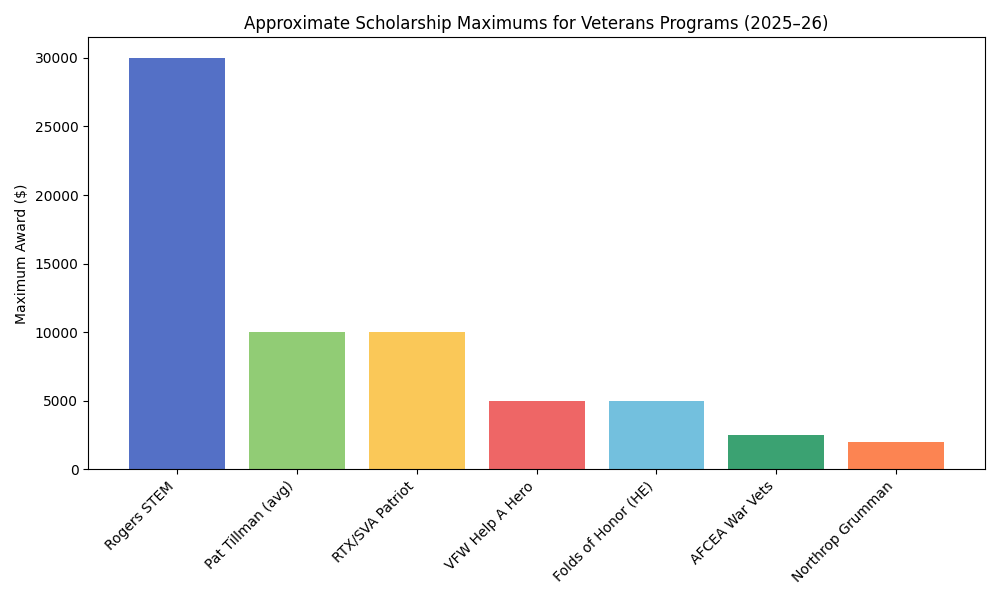
To illustrate the variety of award sizes, the following chart compares some of the largest scholarships covered on this page. Note that exact amounts vary based on eligibility and program rules.
Veterans Scholarships & Grants (2026)
Core VA Education Money (start here)
Post-9/11 GI Bill® (Chapter 33)
💥 Why It Slaps
Covers tuition/fees (up to in-state public cap), monthly housing allowance, and book stipend. It’s the backbone of your funding plan. Use your school’s profile to see true out-of-pocket after GI Bill, housing (BAH/MHA), and fees. Current 2025–26 payment rates are live and in effect Aug 1, 2025–Jul 31, 2026.
💰 Amount: Varies by service % and school; 2025–26 rates published for Aug 1, 2025–Jul 31, 2026.
⏰ Deadline: Rolling; apply anytime (schools certify by term).
🔗 Apply/info: Veterans Affairs — Post-9/11 GI Bill® — ✅ Link verified Oct 5, 2025.
Yellow Ribbon Program (bridges private/out-of-state gaps)
💥 Why It Slaps
When GI Bill® doesn’t fully cover certain tuition types (private, out-of-state, grad), the school and VA split the remainder—often taking tuition to $0. Check if your campus participates for 2025–26.
💰 Amount: Varies by school agreement.
⏰ Timeline: Schools renew annually; 2025–26 listings posted.
🔗 Apply/info: Veterans Affairs — Yellow Ribbon Program — ✅ Link verified Oct 5, 2025.
Edith Nourse Rogers STEM Scholarship (add-on to GI Bill®)
💥 Why It Slaps
Run out of GI Bill near the finish line in an approved STEM/teaching-cert path? This adds up to 9 months/$30,000 so you can graduate without stopping out. 2025–26 STEM scholarship rates are posted.
💰 Amount: Up to $30,000 (or 9 months of benefits).
⏰ Deadline: Rolling once eligible.
🔗 Apply/info: VA — Rogers STEM Scholarship — ✅ Link verified Oct 5, 2025.
Veteran Readiness & Employment (VR&E, Ch. 31)
💥 Why It Slaps
Career services plus funding for training/education and supplies. Crucially, using VR&E first doesn’t deduct from your GI Bill® entitlement, letting you maximize both benefits strategically.
💰 Amount: Based on plan/eligibility; may include tuition/fees, books, and subsistence.
⏰ Deadline: Apply any time.
🔗 Apply/info: Veterans Affairs — VR&E (Chapter 31) — ✅ Link verified Oct 5, 2025.
Top Private & Association Scholarships (verified)
Pat Tillman Foundation — Tillman Scholars (veterans & spouses)
💥 Why It Slaps
Selective funding plus a powerhouse leadership network, mentorship, and national visibility across fields (STEM, public service, health, policy, business, etc.).
💰 Amount: Varies; multi-year support + leadership programming.
⏰ Deadline: For the 2026 class, apps open Dec 1, 2025 (historically Dec–Feb).
🔗 Apply/info: Pat Tillman Foundation — Apply — ✅ Link verified Oct 5, 2025.
VFW × Sport Clips — Help A Hero Scholarship (service members & veterans)
💥 Why It Slaps
Straightforward up to $5,000 per term for tuition/fees—excellent for bridging gaps after GI Bill®. Two cycles every year.
💰 Amount: Up to $5,000 (per term).
⏰ Deadline: Fall cycle Jan 1–Apr 30; Spring cycle Aug 1–Nov 15.
🔗 Apply/info: VFW — Help A Hero — ✅ Link verified Oct 5, 2025.
AMVETS Scholarships (veterans, active duty, spouses, children)
💥 Why It Slaps
Multiple categories (including the Dr. Caccomo Memorial) with clear eligibility and national reach through a long-running VSO.
💰 Amount: Typically $4,000; select awards higher.
⏰ Deadline: Annual windows; check current cycle.
🔗 Apply/info: AMVETS — Scholarships — ✅ Link verified Oct 5, 2025.
AFCEA War Veterans Scholarships (veterans in STEM/Intel-related majors)
💥 Why It Slaps
Merit-based awards targeted to vets pursuing STEM, cyber, intelligence, and related majors—good fit if you’re pivoting into tech/defense sectors.
💰 Amount: About $2,500.
⏰ Deadline: Cycles vary; recent windows in fall.
🔗 Apply/info: AFCEA — War Veterans Scholarships — ✅ Link verified Oct 5, 2025.
Student Veterans of America (SVA) — RTX Partner Scholarships
💥 Why It Slaps
Named $10,000 awards (e.g., Patriot — Army, SPY-6 — Navy) with transparent windows and service-aligned recognition.
💰 Amount: $10,000 per award.
⏰ Deadline: Typically Feb–Mar annually (watch SVA partner pages).
🔗 Apply/info: SVA — RTX Patriot Scholarship — ✅ Link verified Oct 5, 2025.
Google × SVA — Student Veterans in CS
💥 Why It Slaps
$10,000 to student veterans in computer science plus connection to Google’s scholar community; strong signal for tech internships.
💰 Amount: $10,000.
⏰ Deadline: Historically Feb–Apr.
🔗 Apply/info: SVA — Google Scholarship (news hub) — ✅ Link verified Oct 5, 2025.
Wells Fargo Veterans Scholarship (Scholarship America)
💥 Why It Slaps
Designed to fill unmet need after GI Bill®/aid—solid backstop for finishing out terms without extra loans. Emergency grants run seasonally.
💰 Amount: Up to $5,000 (scholarship); separate emergency grants.
⏰ Deadline: 2025 cycle closed Apr 10, 2025; next cycle expected to reopen 2026.
🔗 Apply/info: Scholarship America — Wells Fargo Veterans — ✅ Link verified Oct 5, 2025.
For Veteran Families (spouses & dependents)
Folds of Honor — Higher Education & Children’s Fund
💥 Why It Slaps
Supports spouses & dependents of fallen/disabled service members with predictable annual window and up to $5,000/year based on unmet need (max $2,500/term).
💰 Amount: Up to $5,000/year (term cap applies).
⏰ Deadline: Feb 1–Mar 31 each year.
🔗 Apply/info: Folds of Honor — Scholarships — ✅ Link verified Oct 5, 2025.
Fisher House — Scholarships for Military Children (via DeCA commissaries)
💥 Why It Slaps
500 awards of $2,000 each year—at least one per commissary receiving qualified applications.
💰 Amount: $2,000 (500 awards).
⏰ Deadline: Annual winter window; 2026–27 opens Dec 10, 2025–Feb 11, 2026.
🔗 Apply/info: Fisher House — Scholarships for Military Children — ✅ Link verified Oct 5, 2025.
American Legion — Legacy Scholarship (children of fallen/disabled post-9/11)
💥 Why It Slaps
Needs-based, renewable—up to $20,000 (fallen) / up to $5,000 (disabled). Re-apply up to 6 times.
💰 Amount: Up to $20,000 / $5,000.
⏰ Deadline: 2025 cycle closed Mar 26, 2025; opens each January.
🔗 Apply/info: American Legion — Legacy Scholarship — ✅ Link verified Oct 5, 2025.
Marine Corps Scholarship Foundation (children of Marines/Navy Corpsmen/Docs)
💥 Why It Slaps
Large, long-running program focused on Marine families; clear eligibility and reliable annual cycle.
💰 Amount: Varies (need-based awards).
⏰ Deadline: Annual Jan–Mar window (check current year).
🔗 Apply/info: Marine Corps Scholarship Foundation — ✅ Link verified Oct 5, 2025.
Children of Fallen Patriots Foundation
💥 Why It Slaps
Bridges the entire cost to degree (tuition, room/board, books) for children who lost a parent in the line of duty—advising + last-dollar funding.
💰 Amount: Varies; last-dollar support up to full need.
⏰ Deadline: Rolling eligibility; apply any time.
🔗 Apply/info: Children of Fallen Patriots — ✅ Link verified Oct 5, 2025.
Quick Apply Game Plan (save time)
- Run your target schools through the VA Comparison Tool to see your real numbers: tuition/fees coverage, BAH/MHA, and Yellow Ribbon.
- Stack smart: GI Bill® → Yellow Ribbon (if eligible) → VR&E (if eligible) → private awards (Tillman, VFW, SVA partners, etc.)
- Calendar planning: Big fall openers (Tillman; SVA partner awards), winter/spring windows (Folds of Honor, VFW).
🎓 State Tuition Waivers & Big State Programs (Quick Hits)
Most waivers cover tuition at public colleges (not housing/books) and have residency + eligibility rules. Always confirm on the state page.
Texas — Hazlewood Act (Veterans + “Legacy” Dependent)
Why it slaps: Up to 150 credit hours of tuition exemption at Texas public institutions. Heads-up: Doesn’t cover housing/books; school determines final eligibility.
Apply/info: Texas Veterans Commission — Hazlewood — ✅ Verified Oct 5, 2025.
California — CalVet College Fee Waiver (Dependents)
Why it slaps: Waives mandatory system-wide tuition/fees at CCC/CSU/UC for eligible dependents of rated disabled/deceased veterans.
Apply/info: CalVet — College Fee Waiver — ✅ Verified Oct 5, 2025.
Illinois — Illinois Veterans’ Grant (IVG)
Why it slaps: Pays tuition + mandatory fees at Illinois publics; undergrad/grad; uses eligibility units (up to 4 years).
Apply/info: ISAC — IVG — ✅ Verified Oct 5, 2025.
New York — Veterans Tuition Award (VTA)
Why it slaps: Covers up to the average SUNY tuition (or actual tuition, whichever’s less).
Apply/info: HESC — VTA — ✅ Verified Oct 5, 2025.
Florida — Out-of-State Fee & Purple Heart Waivers
Why it slaps: In-state rate for honorably discharged veterans living in FL; Purple Heart/combat decoration tuition waivers.
Apply/info: Florida DVA — Education Benefits — ✅ Verified Oct 5, 2025.
Massachusetts — Tuition Waiver for Veterans
Why it slaps: Tuition waiver at MA state colleges/universities for eligible veterans.
Apply/info: Mass.gov — Veterans Tuition Waiver — ✅ Verified Oct 5, 2025.
Washington — Waiver for Dependents (100% Disabled/Deceased)
Why it slaps: Schools must waive all undergrad tuition/fees for eligible dependents up to 200 quarter credits.
Apply/info: WDVA — Education Benefits — ✅ Verified Oct 5, 2025.
Oregon — Veterans’ Dependent Tuition Waiver
Why it slaps: Full tuition waiver (not fees) at Oregon publics for eligible dependents.
Apply/info: ODVA — Education — ✅ Verified Oct 5, 2025.
Connecticut — Veterans Tuition Waiver
Why it slaps: Tuition waiver at CT publics; state fills tuition gap when VA benefits don’t cover.
Apply/info: CT Office of Higher Education — Waivers — ✅ Verified Oct 5, 2025.
Wisconsin — Wisconsin GI Bill® (Veterans + Some Dependents)
Why it slaps: Full tuition & segregated fee remission for up to 8 semesters/128 credits at UW/WTCS; many dependents eligible.
Apply/info: Universities of Wisconsin — WI GI Bill — ✅ Verified Oct 5, 2025.
Pro tip: Some states target veterans directly (TX, MA); others focus on dependents (CA, WA, OR). Fine print matters—check residency, disability ratings, and stacking rules.
🧭 Career-Field Scholarships (IT/Cyber • Teaching • Healthcare)
💻 IT / Cybersecurity
AFCEA War Veterans Scholarships (STEM, incl. cyber)
Why it slaps: Veteran-focused STEM awards tied to real-world defense/ISR/cyber pipelines.
Amount: $2,500 • When: Annual cycles (fall typical).
Apply/info: AFCEA — War Veterans Scholarships — ✅ Verified Oct 5, 2025.
Google × SVA Student Veterans in CS
Why it slaps: $10,000 for CS majors + access to Google Scholars’ network; strong hiring visibility.
Amount: $10,000 • When: Typically Feb–Apr via SVA.
Apply/info: SVA — Google Scholarship (news hub) — ✅ Verified Oct 5, 2025.
CyberCorps®: Scholarship for Service (SFS) (U.S. citizens; veterans welcome)
Why it slaps: Up to 3 years of tuition/fees + living stipend (~$27k undergrad / ~$37k grad) + $6k professional allowance, with a guaranteed post-grad federal cyber service commitment.
Amount: Tuition/fees + stipend + allowance • When: Rolling by campus.
Apply/info: SFS — Official Site — ✅ Verified Oct 5, 2025. (Use your campus SFS page for exact dates.)
🍎 Teaching
TEACH Grant (future teachers in high-need fields)
Why it slaps: Up to $4,000/yr (sequestration-adjusted max $3,772 for 2025–26) if you commit to 4 years teaching in a high-need field at a low-income school. Converts to a loan if service terms aren’t met.
Amount: Up to $3,772 (2025–26 adjusted max) per year.
When: Packaged via your school after FAFSA.
Apply/info: Federal Student Aid — TEACH Grant — ✅ Verified Oct 5, 2025.
🩺 Healthcare
VA Health Professional Scholarship Program (HPSP) — VHA
Why it slaps: Pays tuition/required fees and stipend for high-need VA health roles (e.g., nursing, PA, social work). Comes with a VA service commitment and a direct path to VA careers.
Amount: Tuition/fees + monthly stipend (by discipline) • When: Annual cycles via VA portal.
Apply/info: VA — Health Professional Scholarship Program — ✅ Verified Oct 5, 2025.
Army Nurse Corps Association (ANCA) Scholarships
Why it slaps: For nursing students who served (or are serving) in any Army component; certain family ties eligible.
Amount: Varies (historically around $3,000).
When: Annual.
Apply/info: ANCA — Scholarships — ✅ Verified Oct 5, 2025.
🏅 Local VSO & State-Level Scholarships (Starter Map)
Many departments of VFW, American Legion, and Auxiliaries run their own awards. Start here and drill down by your state:
-
VFW (National) — Voice of Democracy / Patriot’s Pen (state winners advance; big national $$).
Apply/info: VFW — Scholarships — ✅ Verified Oct 5, 2025. -
Texas VFW — State Programs & Competitions
Apply/info: Texas VFW — ✅ Verified Oct 5, 2025. -
California VFW — Department/Auxiliary Scholarships
Apply/info: VFW Dept. of California • VFW Auxiliary CA — ✅ Verified Oct 5, 2025. -
American Legion (National) — Scholarship Hub
Apply/info: The American Legion — Scholarships — ✅ Verified Oct 5, 2025. -
American Legion Auxiliary — California
Apply/info: ALA California — Education Scholarships — ✅ Verified Oct 5, 2025. -
American Legion — Ohio (Department Scholarships)
Apply/info: American Legion Dept. of Ohio — Scholarships — ✅ Verified Oct 5, 2025. -
American Legion Auxiliary — Texas
Apply/info: ALA Texas — Scholarships — ✅ Verified Oct 5, 2025.
Frequently Asked Questions: Scholarships for U.S. Veterans 🎖️
What types of scholarships and education benefits are available for U.S. veterans? 🎓
Answer: U.S. veterans have access to a wide range of educational funding options, from government benefits to private scholarships. The cornerstone is often federal veterans’ education benefits like the Post-9/11 GI Bill, which covers tuition, fees, and living costs for those who served after 9/11. Many colleges also participate in the Yellow Ribbon Program (an extension of the GI Bill) to help cover tuition beyond public school limits. In addition, state governments may offer tuition waivers or grants for veterans. Beyond government programs, numerous private scholarships are offered by veterans’ organizations, nonprofits, and even corporations to support veterans in college. Each program has its own focus and eligibility rules – for example, some are open to all honorably discharged veterans, while others target veterans of specific branches, career fields, or backgrounds. In some cases, even family members of veterans can utilize transferred benefits or dedicated scholarships (more on that below). Overall, after serving their country, veterans can tap into a robust mix of funding sources to pursue college or vocational training.
Who is eligible for veteran scholarships and education benefits? ✔️
Answer: Generally, U.S. military veterans – meaning former service members who were discharged under honorable conditions – are eligible for most veteran-focused scholarships and benefits. Specific criteria depend on the program: for example, the Post-9/11 GI Bill requires at least 90 days of active service after September 10, 2001 (or 30 days if discharged due to a service-related disability). Many scholarships define “veteran” eligibility by service in any branch of the U.S. Armed Forces (Army, Navy, Air Force, Marine Corps, Space Force, Coast Guard), including National Guard or Reserve components in some cases. Active-duty service members and reservists might also qualify for certain programs (like Tuition Assistance or the GI Bill while still in service), but most scholarships labeled “for veterans” assume you have completed service. Additionally, some opportunities are open to military retirees or those with specific discharge statuses (e.g. honorable or general discharge). It’s important to check each scholarship’s definition of veteran status. In all cases, you’ll typically need proof of service (such as a DD-214 discharge document or military service ID) when applying.
Tip: Don’t forget that military spouses and children may qualify for their own set of scholarships or can use transferred veteran benefits – we cover those in a later question. 👪
What government-funded education benefits can veterans use (e.g. GI Bill)? 🏛️
Answer: The U.S. government provides generous education benefits to veterans, the most famous being the Post-9/11 GI Bill. This program, administered by the Department of Veterans Affairs (VA), can fund up to 36 months of college or career training for eligible veterans. It covers full in-state tuition at public universities and up to a set annual amount (around $24,500 for 2019-2020) at private schools. In addition to tuition, the GI Bill provides a monthly housing allowance and stipends for books and supplies. Essentially, it’s designed to pay for a degree or certificate program and related expenses for veterans who meet the service requirements. Another key benefit is the Yellow Ribbon Program: if you attend a private or out-of-state school with costs above the GI Bill’s cap, participating schools and the VA will each contribute additional funds to cover tuition beyond the cap. This can make higher-cost institutions very affordable for veterans 🏅.
Beyond the Post-9/11 GI Bill, other government programs include the Montgomery GI Bill (an older program some veterans may have enrolled in during service), and Veteran Readiness & Employment (VR&E) (formerly Vocational Rehabilitation & Employment) which helps disabled veterans with education and job training. Moreover, state governments often have their own benefits: for example, some states waive tuition at public colleges for veterans or offer special grants (we discuss state programs in another FAQ). In 2017 alone, the U.S. government dedicated about $13.6 billion to veterans’ education benefits, with the Post-9/11 GI Bill accounting for $11 billion of that. These government-funded programs are entitlements for those who qualify, not competitive scholarships – if you’re eligible, you receive the benefit by applying through the VA or your state. Always start with these core benefits (they’re essentially earned through your service) and then consider additional private scholarships as a supplement.
Are there private scholarships specifically for veterans? 💰
Answer: Yes – thousands of private scholarships are available exclusively to veterans or military service members! 🎉 These are offered by foundations, nonprofits, companies, and veteran service organizations to honor your service and help pay for school. Unlike the GI Bill (which is guaranteed for eligible vets), private scholarships are usually competitive, meaning you have to apply and be selected. They often consider factors like your academic goals, service record, community service, or financial need. Here are a few prominent examples of scholarships for U.S. veterans:
-
Pat Tillman Foundation – Tillman Scholars: A highly regarded program providing scholarships to veterans and active-duty service members (and their spouses) who show leadership and a desire to continue serving their communities. This scholarship can cover tuition and living expenses for degree programs.
-
VFW “Sport Clips Help A Hero” Scholarship: Offered by the Veterans of Foreign Wars and Sport Clips, it grants awards (up to $5,000) for veterans and service members for tuition and fees, especially for those pursuing undergraduate or graduate degrees.
-
AMVETS Scholarships: AMVETS (American Veterans) offers several scholarships, including those for veterans, active duty, guard/reserve members, and even children or grandchildren of veterans.
-
American Legion Scholarships: The American Legion has programs like the Legacy Scholarship (for children of post-9/11 fallen or disabled veterans) and others that support veterans pursuing higher education.
-
Student Veterans of America (SVA) & Corporate Partners: SVA, in partnership with companies, offers various scholarships (for example, STEM scholarships funded by tech companies for student veterans).
(These are just a few – there are many more specialized awards out there, so it’s worth researching ones related to your field of study, background, or affiliations.)
Note: Private scholarships can often be used in addition to your GI Bill benefits. For instance, a scholarship might cover books or extra fees that your GI Bill doesn’t, or help pay tuition if you’re no longer eligible for GI Bill. When searching, use databases and resources (like the list on ScholarshipsandGrants.us or sites like Fastweb) filtering for “veteran” to find relevant opportunities. Each will have its own application (usually requiring an essay, recommendation, or proof of service). Pro tip – apply to multiple scholarships to increase your chances of an award 🎯.
Do states offer special scholarships or tuition benefits for veterans? 🌐
Answer: Yes, many U.S. states provide additional education benefits for veterans (and sometimes their families). State-level programs vary widely, but common offerings include tuition waivers or discounts at public colleges and universities for honorably discharged state resident veterans. For example, some states waive all in-state tuition and fees for veterans who served during certain conflicts or who meet specific criteria. In other cases, states might offer tuition reimbursement after course completion or provide annual grants/stipends to help cover education costs. States also frequently extend benefits to National Guard members (often via separate programs for Guard tuition assistance).
Importantly, several states have programs for spouses and children of veterans as well. For instance, states like Illinois, Texas, Florida, and others have scholarships or tuition waivers for dependents of disabled or deceased veterans. As one example, children and spouses of veterans who were disabled or lost their lives due to service can receive full tuition waivers at public universities in some states. In Alaska, similarly, spouses and dependents of veterans with service-connected disabilities or those killed in action may qualify for free tuition at state-supported schools. The criteria (such as the veteran’s residency, wartime service, disability rating, etc.) and benefit amount differ by state, so you should check your state’s veterans affairs office or education department for specifics.
Bottom line: Don’t overlook state benefits – they can significantly reduce or even eliminate tuition if you’re eligible. These can often be used alongside federal benefits. A good starting point is the VA or Military.com’s compilation of state veteran education benefits, which outlines what each state offers.
Can spouses or children of veterans get scholarships or education benefits? 👪
Answer: Absolutely. There are dedicated programs to help military families with education. If you’re the spouse or child of a U.S. veteran, you may qualify for both government-provided benefits and private scholarships:
-
Post-9/11 GI Bill Transfer: Veterans who are still on active duty can transfer unused GI Bill benefits to a spouse or children in certain cases. This must be done while the service member is still in service and requires a service commitment, but it allows a spouse or child to use the veteran’s GI Bill entitlement for their own schooling. For example, if a veteran only uses part of their GI Bill, they could transfer the remaining months to a dependent to pay for college. (Multiple dependents can even share transferred months, if allotted.) Keep in mind the Department of Defense must approve transfer requests, but it’s a fantastic benefit when utilized.
-
Survivors’ and Dependents’ Educational Assistance (DEA): The VA offers the DEA program (Chapter 35) for dependents of veterans who died or are totally and permanently disabled due to a service-related condition. Eligible spouses and children can receive up to 36 months of education benefits (or 45 months in some older cases) under DEA. This can be used for college degrees, certificate programs, apprenticeships, and other training. In practical terms, DEA may provide a monthly payment to the student (a few hundred dollars) to help with education costs. It’s not as large as the GI Bill, but it’s a valuable benefit for those who qualify.
-
Fry Scholarship: This is another VA-administered benefit similar to the Post-9/11 GI Bill, but it’s specifically for the children and spouses of service members who died in the line of duty on or after 9/11/2001. The Fry Scholarship effectively gives full Post-9/11 GI Bill benefits to surviving dependents (covering full tuition, housing, etc., just like it would for a veteran). This can be an alternative to DEA (eligible individuals usually choose one or the other).
-
State Family Benefits: As mentioned above, many states waive tuition or offer scholarships for children or spouses of veterans who were disabled or killed. For example, some states grant a full tuition waiver at public universities for the child of a 100% disabled veteran. Always check your state’s offerings.
-
Private Scholarships for Military Families: Numerous charities and organizations support military families. A notable one is Folds of Honor, which since 2007 has awarded tens of thousands of scholarships to the spouses and children of fallen or disabled service members. Similarly, the American Legion, VFW, ThanksUSA, and other groups have scholarship programs for military spouses and/or children (including those of veterans). These can help with college or even K-12 private school for kids in some cases.
In summary, being a family member of a veteran can open doors to education funding. Eligibility and application processes vary: for VA benefits like DEA or Fry Scholarship, you’ll apply through the VA (and need documentation of the veteran’s service and disability or death). For private scholarships, you’ll apply to each organization with proof of your relationship to the veteran and other required materials. Don’t hesitate to seek these out – they exist to honor the service of not just veterans, but the sacrifices of their families as well. 💖
Are there scholarships or programs for disabled veterans? ♿
Answer: Yes, veterans with service-connected disabilities have additional scholarship opportunities and support programs available. In fact, many general veteran education benefits already account for disability status – for example, if you were medically discharged due to injury, you become immediately eligible for the full Post-9/11 GI Bill (no 90-day service minimum). But beyond that, here are some avenues specifically for disabled veterans:
-
VA Veteran Readiness & Employment (VR&E): Formerly called Vocational Rehabilitation & Employment (Chapter 31), VR&E is a VA program that helps disabled veterans prep for new careers. It can cover tuition, fees, and related training costs (similar to a scholarship) if you qualify. Typically, veterans with a service-connected disability rating of at least 10% (with a serious employment handicap) or 20% (with an employment handicap) may be eligible. VR&E pays for education or training programs that lead to suitable employment and even provides a living allowance during training. This is an earned benefit for disabled vets and can sometimes be used before using your GI Bill entitlement. It’s a great resource for those who need career retraining due to service injuries.
-
Scholarships from Nonprofits: There are several private scholarships earmarked for disabled veterans. For example, the Paralyzed Veterans of America (PVA) has a scholarship program for members (veterans with spinal cord injuries or diseases) and their immediate family, to help with college expenses. Another example is the Ankin Law Office Disabled Veteran Scholarship, which awards funds to a disabled veteran or a child of a disabled veteran pursuing higher education. These are just a couple of examples; many other organizations (large and small) provide aid specifically to wounded or disabled vets – often focusing on those with specific injuries (blindness, amputations, PTSD, etc.) or a general category.
-
Adaptive Scholarship Programs: Some schools and foundations have programs tailored for injured veterans to pursue certain fields. For instance, there are scholarships encouraging disabled veterans to enter careers in technology, law, or other areas, sometimes sponsored by veteran advocacy groups or companies seeking to support vets. Always mention your veteran status and any disabilities to your school’s financial aid office and veteran support center – they can connect you with relevant opportunities.
Important: If you have a disability due to your service, also check out other benefits like the ADA accommodations in school, and support services on campus (tutoring, counseling, etc.). Scholarships are part of the picture, but overall support will ensure you succeed in your education journey. Many disabled veterans thrive in academia – for example, student veterans (including many with disabilities) actually achieve higher GPAs on average than traditional students, showing that with the right support, they excel. Don’t be shy about using all resources available to you.
How can I apply for veteran scholarships or education benefits? 📝
Answer: Applying for veteran education benefits and scholarships is a multi-step process, but we’ll break it down:
1. Applying for VA Benefits (e.g. GI Bill): To use federal benefits like the Post-9/11 GI Bill, you must submit an application to the Department of Veterans Affairs. This can be done online through the VA’s website (via the VA Education Benefits application, VA Form 22-1990)afba.com. You can also apply by mail or in person at a VA regional office. When applying, have your service history details ready (service dates, discharge status, etc.). The VA will review your eligibility and send you a Certificate of Eligibility (COE) if approved. Once you have a COE, you present it to your school’s VA certifying official (usually in the registrar or financial aid office) so they can process your tuition benefits. Tip: It’s wise to apply for the GI Bill a few months before you plan to start school to allow time for processing. (If you’re transferring GI Bill benefits to a family member, that requires an extra step of getting DoD approval while in service, as noted earlier.)
2. Applying for State Benefits: For state veteran education programs (tuition waivers, etc.), the process varies by state. Generally, you’d contact your state’s veterans affairs department or your college’s financial aid office. They often have a form to certify your eligibility (you might need to show proof of state residency and your discharge paperwork). Check state deadlines; some require you to apply annually or by a certain date each term.
3. Applying for Private Scholarships: This is similar to applying for any college scholarship, with the added element of proving your (or your family member’s) military service. Here’s how to proceed:
-
Research scholarships: Use online scholarship search engines and veteran organizations to find scholarships for which you qualify. (For example, search for terms like “veteran scholarship + [your major]” or check lists on reputable sites.)
-
Gather materials: Common requirements include: proof of service (DD-214 or military ID), transcripts (to show academic performance), an essay or personal statement (often about your service or career goals), letters of recommendation, and sometimes proof of financial need or acceptance into a program.
-
Mark deadlines: Scholarship deadlines can be as early as 6-12 months before the academic year starts. Note the due dates and plan ahead so you can request transcripts and letters in time.
-
Submit applications: Follow each scholarship’s instructions carefully. Many applications are now online; some might require mailing documents. Double-check that you’ve included everything asked for. It’s a good idea to tailor any essays to each scholarship’s questions or mission.
-
Follow up: Ensure you get confirmation of submission. If you receive a scholarship, coordinate with your school – outside scholarships are usually sent to the school’s financial aid office to be applied to your bill (or sometimes sent directly to you).
4. Using the funds: Once you’ve successfully applied and been approved, work closely with your school’s financial aid/veteran affairs office. For GI Bill, the VA pays the school (and you for housing) directly. For scholarships, funds might be sent to the school or to you; either way, clarify how they will be applied to tuition or other expenses.
Applying can feel daunting, but there are many resources to help veterans. Most colleges have a Veterans Services Office or at least a certifying official who can guide you through using GI Bill benefits. Don’t hesitate to ask them for help – they are there to assist those who served. Additionally, organizations like the American Legion, VFW, Student Veterans of America, and others often offer guidance or even workshops on applying for benefits and scholarships. Stay organized, start early, and take advantage of these opportunities you’ve earned! ✅
Can veterans use multiple scholarships or combine them with GI Bill benefits? 🔗
Answer: Yes. In most cases, veterans can stack multiple funding sources to fully cover education costs. Think of your education funding as a puzzle – different pieces can fit together to complete the picture. Here’s how it typically works:
-
Combining GI Bill with Scholarships: The Post-9/11 GI Bill will pay your tuition & fees (up to the allowed limit) directly to your school, and provide you housing and book stipends. If you receive a private scholarship as well, it can often be applied to any costs that the GI Bill doesn’t cover. For example, if you attend a private university that costs more than the GI Bill’s annual cap, a scholarship could cover the extra amount. Even if the GI Bill covers all your tuition, a scholarship might cover your housing, books, or other educational expenses (or be paid to you as a stipend). Receiving a scholarship does not reduce your GI Bill entitlement – you earned those 36 months of benefits and can use them regardless of other aid. (One note: if a scholarship specifically pays your tuition, it may affect how much the VA needs to pay the school – in such cases, the VA might be billed for the net tuition after the scholarship. But this doesn’t harm you; it just means the scholarship is reducing the amount the GI Bill has to pay, which can be beneficial if you have an annual cap.) Many veterans use a combination of GI Bill + scholarships + grants to graduate debt-free.
-
Multiple Scholarships: You are generally allowed to receive multiple scholarships as long as you meet each scholarship’s requirements. If you win several scholarships, inform your school’s financial aid office so they can coordinate the funds properly. The only time “too many scholarships” becomes an issue is if you exceed the school’s cost of attendance – for instance, if scholarships plus GI Bill stipends give you more money than needed for tuition, housing, etc., sometimes the excess cannot be kept (some scholarships might adjust the award in that case). However, this scenario is uncommon. It’s perfectly fine (and smart) to apply for many scholarships. Veterans often have a compelling story to tell, which can make scholarship essays stand out! Just keep track of renewal requirements – for example, some scholarships are multi-year but require you to maintain a certain GPA or reapply each year.
-
Federal/State Aid Coordination: If you’re eligible for Federal Pell Grants (needs-based aid) or other federal student aid, you can generally receive those in addition to veteran benefits. Pell Grants won’t reduce your GI Bill (and vice versa); they complement each other. Some schools might adjust need-based aid if you have outside scholarships – this is typically a concern for traditional students receiving large financial aid packages. For veterans, since the GI Bill is not income-based, it doesn’t count against financial need calculations. So you could, for example, get the GI Bill, a Pell Grant, and a private scholarship all for the same term. The key is communicating with your financial aid office to ensure everything is applied smoothly.
In summary, mixing and matching funding sources is encouraged to make sure all your educational expenses are covered. Many veterans use the GI Bill as their main funding and then layer on scholarships (and sometimes federal aid or student loans if needed). There’s no penalty for combining them; in fact, it’s often necessary given the rising cost of education. Use the resources available to you – you’ve earned the federal benefits, and you deserve any scholarship help you can win as well. It’s all about reducing or eliminating out-of-pocket costs. 💡
What are the chances of getting a scholarship as a veteran? 📊
Answer: The good news is that veterans have strong support for education, but it’s also true that not every veteran will get every scholarship they apply for. Let’s break down the “chances” in a couple of ways:
-
Using VA Education Benefits: If you are an eligible veteran, your “chance” of getting those benefits is essentially 100% as long as you apply – they are entitlements, not competitive awards. For instance, if you qualify for the Post-9/11 GI Bill, you will receive it for the number of months you’re entitled to. Hundreds of thousands of veterans use these benefits each year – e.g., in FY2021, over 610,000 individuals used the Post-9/11 GI Bill for their education. So in terms of government benefits, the opportunity is very high. Make sure you take advantage of them; they dramatically increase your ability to afford college or training.
-
Winning Private Scholarships: The probability of winning a private scholarship depends on how many scholarships you apply for and how you qualify for them. Overall, only about 11% of college students receive scholarship money from private or outside sources. However, as a veteran, you have access to specialized scholarships that less than 1% of students (only veterans) can even apply for – which can improve your odds for those awards. Some scholarships for veterans might only get a few dozen applicants, whereas big national scholarships open to everyone could get thousands. This means your military service can be a distinguishing factor that makes you eligible for a smaller pool of competitors. Your chances are best when you target scholarships where you meet all the criteria and put effort into a strong application (essay, etc.). It’s not possible to put a single number on it, but generally: applying for more scholarships and for those that fit you well will increase the likelihood that you’ll win at least one. Don’t be discouraged by not winning every time; even seasoned applicants get only a fraction of what they apply for. 🏆
-
Maximizing Your Chances: Focus on what you can control. Maintain a good GPA if you’re in school (many scholarships consider academic performance), get involved in community service or leadership (several veteran scholarships value continued service or campus leadership), and start applications early. Utilize your network – your school’s veteran office, military organizations, etc., often share scholarship opportunities that can increase your chances by alerting you to awards you might otherwise miss.
-
Success Rates and Outcomes: While not directly about “chances,” it’s inspiring to know that veterans who pursue higher education tend to succeed at high rates. Student veterans have about a 72% success rate (degree completion) in higher education and often outperform their peers academically. This is partly thanks to the financial support and discipline veterans bring. What this means for you is that once you secure the funding, your odds of completing your program and benefitting from it are excellent. In other words, the effort to obtain scholarships and use your benefits is well worth it – veterans on the whole make great use of these opportunities, leading to better career and salary outcomes after graduation.
In summary, your chances of getting some educational funding as a veteran are very high – virtually guaranteed if you use VA benefits. As for private scholarships, expect competition, but remember that you have exclusive access to certain awards. Treat applying like a mission: have a strategy, use all intel (information) available, and persevere. Even if only a small percentage of your applications hit the target, that could be thousands of dollars towards your education. Aim high, and you may be pleasantly surprised. 🎯
What qualifications or documents are required to apply for veteran scholarships? 📑
Answer: When applying for any veteran-focused scholarship or benefit, you’ll need to prove two main things: your identity/academic status and your military service (or relation to a veteran). Here’s a rundown of common requirements and documents:
-
Proof of Military Service: Typically, you’ll be asked for a copy of your DD-214 form (Certificate of Release or Discharge from Active Duty) to verify your service dates and discharge status. If you’re still serving, a statement of service or your military ID might be used instead. Some scholarship applications may accept a VA benefit eligibility letter or other proof if you’ve already qualified for something like the GI Bill. The key is showing you meet the military service criterion (e.g. honorably discharged veteran of X years or served in certain era). For family member scholarships, you’d need proof of the veteran’s service and your relationship (e.g., a birth or marriage certificate plus the veteran’s DD-214).
-
Eligibility Criteria Specifics: Each program has its own rules. For example, the Post-9/11 GI Bill requires that you have at least 90 days of active service post-9/11 or a service-connected disability discharge after 30 days. You won’t need to separately “prove” the 90 days beyond submitting your DD-214 – the VA will verify your service records when you apply for the GI Bill. Other scholarships might require that you served during a wartime period, or that you belong to a certain military association. Read the eligibility criteria carefully and be prepared to document any that apply (for instance, if a scholarship is for combat veterans, they might want a copy of your deployment orders or award citation that indicates you were deployed in a combat zone).
-
Academic Records: Almost all scholarships (including those for veterans) will require your school information. If you’re already in college, you’ll likely need to provide a transcript (official or unofficial, as specified) to show your current academic standing/GPA. If you’re an incoming student, you might provide a high school transcript or college acceptance letter. Some veteran scholarships set a minimum GPA (e.g., 2.5 or 3.0), so you’ll need to demonstrate you meet that. If a scholarship is for a specific field (say a STEM scholarship for vets), you might need to show proof of enrollment in a relevant program or major.
-
Personal Statements or Essays: Qualifications aren’t just checkboxes – many applications ask you to write an essay about your experiences, goals, or how the scholarship will help you. This is your chance to showcase your qualifications in a narrative form (leadership, perseverance, community service, etc.). While not a “document” like the others, it’s a critical part of what you submit. Letters of recommendation can also fall here – for example, a scholarship might ask for a letter from a professor or a supervisor (maybe even a military superior) who can vouch for your character and potential.
-
Financial Need Proof (if required): Some scholarships are need-based. Those might ask for income documentation or the Expected Family Contribution (EFC) from your FAFSA (Free Application for Federal Student Aid). If you have completed the FAFSA, you can often use the student aid report from that as evidence of need.
-
Other Military Documents: In specific cases, other documents might be needed. For instance, if applying for disabled veteran scholarships, you might need to show your VA disability award letter or rating decision. For scholarships targeting Purple Heart recipients, you might need a copy of the Purple Heart award documentation. If a program is for veterans of a certain unit or battle, you’d need something proving that service (like a unit award or commendation). These are less common, but be aware of any special proof you might have to dig up.
In all cases, organize your military paperwork ahead of time. A pro tip is to scan digital copies of your DD-214, VA disability letter, etc., so you can easily upload them to applications. Also, ensure your resume is up to date – some scholarships ask for a resume of education and service accomplishments. Lastly, remember that any GI Bill benefits require honorable or qualifying discharge status – dishonorable discharges generally disqualify individuals from VA education benefits. For most scholarships too, an honorable discharge is expected (some may allow general discharge under honorable conditions).
By having these documents ready and understanding the qualifications, you’ll be prepared to tackle applications efficiently. It might seem like a lot of paperwork, but once you assemble a “packet” of your DD-214, transcript, resume, and a basic essay, you can reuse much of it for multiple applications. 📂
Do colleges and universities offer special scholarships or discounts for veterans? 🎓
Answer: Many colleges and universities are very military-friendly and offer their own incentives for veteran students. Here are ways institutions might support veterans financially:
-
Institutional Scholarships for Veterans: Some schools have dedicated scholarships or grants for incoming veteran students. For example, a university might have an endowed scholarship fund honoring veterans or specific scholarships for veterans in certain majors (like a business school might have a “Veteran MBA Scholarship”). These awards may require a separate application or could be granted automatically based on your student record indicating veteran status. Always inquire with your school’s financial aid office if any internal scholarships exist for veterans – these often fly under the radar.
-
Yellow Ribbon Participation: We mentioned the Yellow Ribbon Program earlier – this is essentially a partnership between the VA and the college. If a private or out-of-state public university has tuition above what the GI Bill covers, and they participate in Yellow Ribbon, the school will waive a portion of the extra tuition and the VA will match that waiver. Many private universities (and graduate programs) have no out-of-pocket tuition for veterans because of Yellow Ribbon. Each school’s contribution varies, but some cover unlimited additional costs, effectively making expensive schools fully covered. However, Yellow Ribbon slots can be limited at a given school, so confirm early and secure your spot if required. This is a huge benefit acting like a scholarship/discount for veterans.
-
Military Tuition Rates or Waivers: Some colleges offer in-state tuition to all veterans, even if you’re not a resident of that state – this is common and can save you a lot of money by letting you pay resident rates (the GI Bill also pays full in-state rates by law). A number of public universities have policies to waive out-of-state fees for veterans (and often for active-duty or Guard/Reserve members stationed in the state). Additionally, certain schools simply discount tuition for active-duty or veterans in online programs.
-
Credit for Military Training: While not a direct scholarship, getting academic credit for your military training or experience can save you money (fewer courses to pay for). Many schools grant elective credits or even fulfill certain requirements if you have taken military courses (documented in your Joint Services Transcript). This can shorten your time to graduate, meaning you spend less overall and use fewer GI Bill months.
-
Work-Study and On-Campus Support: Through the VA’s work-study program, veteran students can work part-time (often in the campus veterans office or library, etc.) and get paid federally. It’s not a scholarship, but it’s another financial support avenue colleges facilitate. Also, colleges with robust veteran centers sometimes have emergency funds or book vouchers for veterans in need.
In summary, colleges definitely offer their own perks and financial support for veterans. Always identify yourself as a veteran to the admissions and financial aid offices – sometimes benefits are not automatically given unless they know your status. The combination of institutional support and your VA benefits can make certain schools very affordable. And beyond money, many schools have special orientation for vets, counseling, and academic advising tuned to veteran needs. When shopping for colleges, look for a designated “Veteran Friendly” or “Yellow Ribbon School” – this is a sign that they not only accept your benefits generously but often have scholarships or reduced costs specifically for vets. Mort importantly, don’t hesitate to ask what a school can do for you as a veteran; you might be pleasantly surprised at the resources available. 🎓🤝
When should I apply for veteran scholarships and benefits? ⏰
Answer: Timing can make a big difference in securing funds, so it’s smart that you’re thinking about when to apply. Here’s some guidance:
-
VA Education Benefits (GI Bill, etc.): You can apply for these as soon as you decide to go back to school (or at least a few months before you start classes). There’s no strict annual deadline for GI Bill benefits – they’re rolling. However, since the VA’s processing can take several weeks, it’s best to apply for your Certificate of Eligibility at least 2-3 months before your first semester. If you’re currently on active duty and planning to separate, you can even apply for benefits shortly before or right after separation so you have everything lined up. If you plan to use the benefit in, say, Fall next year, applying in the spring or early summer gives plenty of time. For the Yellow Ribbon Program: once you have your COE, you’ll need to apply to your school for a Yellow Ribbon slot if required – some schools allot them first-come, first-served, so do that as early as possible (usually in late spring or early summer before the fall term).
-
College Admission Timeline: Remember that you should align your benefit application with your college application. If you’re aiming to start school next fall, you’ll apply to colleges by the preceding winter or spring (depending on deadlines). It’s a good idea to sort out your veteran benefits as you apply or soon after you get admitted, so that the financial pieces are ready to go by the time you enroll.
-
Private Scholarships: These often have annual cycles. Many scholarship applications open in the fall and close by late winter or spring, for funds to be used in the upcoming academic year. For example, a scholarship for 2026 might have a deadline in February 2025. Start searching early – as early as a year before you need the money. If you plan to enroll in fall, the prime time to apply to outside scholarships is the preceding fall through spring. Some scholarships (especially those by veteran orgs) might have summer deadlines for fall awards, but you don’t want to miss the early ones. Mark your calendar with deadlines and try to get applications in before the due date (some have rolling decisions, too). Also, if you’re already in school, look each semester for new opportunities; some scholarships pop up mid-year or are offered on a semester basis.
-
State Programs: A few state veteran benefits (like tuition waivers) require you to apply by a certain date each term or academic year. For instance, a state grant might say “apply by July 1 for fall.” Check with your state VA or school’s financial aid office. If you miss a deadline, you might have to wait until the next term. Generally, earlier is better to ensure you don’t end up paying out-of-pocket and waiting for reimbursement.
-
FAFSA: Not a veteran-specific thing, but since many scholarships and even state benefits might ask for your FAFSA info, be sure to fill out the FAFSA each year, ideally in October when it opens for the next school year. This way, you’ll have the maximum aid consideration and the document ready if needed for any need-based scholarships.
In short: Apply early and plan ahead. ⏳ For benefits like the GI Bill, early application ensures you have your VA paperwork ready by the time school starts. For scholarships, treat it like college admissions – there’s a season for it each year. A good strategy is to create a timeline (e.g., “Summer: research scholarships; Fall: finalize essays and start applying; Winter: finish remaining scholarship apps and follow up; Spring: apply for next year’s state/school benefits”). By staying on top of deadlines, you’ll maximize the funding available to you as a veteran student.
What if I don’t qualify for certain veteran scholarships? Are there other options? 🤔
Answer: If you find that you’re not eligible for some veteran-specific scholarships (or if you exhaust those opportunities), don’t worry – there are many other forms of aid and strategies to fund your education. Here are some steps and options:
-
General Scholarships and Grants: In addition to veteran-targeted awards, you can apply for scholarships open to the general student population. These might be based on your field of study, hobbies, demographics, academic merit, or other criteria unrelated to military service. Being a veteran doesn’t exclude you from these – you just compete like any other student. Examples include scholarships for women, for STEM majors, for community service, etc. Grants (like the federal Pell Grant) are also available if you have financial need, and they don’t need to be repaid. Make sure you submit the FAFSA to be considered for federal and state grants.
-
School-based Aid: Universities often have their own financial aid which can include need-based grants or merit scholarships. Once you apply and get admitted, see if the school offers institutional aid (many do a calculation based on FAFSA). Some private colleges, for instance, will cover any remaining need after the GI Bill is applied, especially for veterans – essentially ensuring no vet has to pay out-of-pocket. This might not be advertised as a “veteran scholarship” but functions as extra support. Talk to your financial aid office; sometimes they can adjust or find funds if you explain your situation.
-
Tuition Assistance (TA) for Active Duty/Reserve: If you’re still serving in the Reserves or National Guard while going to school, you might qualify for Tuition Assistance through DoD, which can cover courses up to certain limits per credit hour. This isn’t a veteran program per se, but it’s relevant for those transitioning or serving part-time. Each branch has its own TA program.
-
Work-Study or Part-Time Work: The VA work-study program (mentioned earlier) allows those using VA education benefits to work part-time and get an untaxed stipend – a nice supplement if scholarships are thin. Additionally, you might consider a part-time job or paid internship in your field. Many veterans juggle work and school effectively, and some employers offer tuition assistance or scholarships to student-employees (e.g., some tech companies or government agencies have programs for student veterans).
-
Loans (as a last resort): Education loans are always an option if needed. Federal student loans offer low interest rates and flexible repayment. While the goal is to use scholarships and benefits to avoid debt, taking a small loan to fill a gap is not uncommon. If you do, use federal loans first (Stafford or Perkins loans) before considering private loans, as federal loans have better protections (and potential forgiveness options, especially if you later go into public service or qualify for programs like PSLF).
-
Veteran Service Organizations: If you are in a bind, local veteran groups (American Legion posts, VFW posts, etc.) sometimes have small funds or can hold fundraisers to help a veteran in their community with school expenses. Networking with fellow veterans can lead to informal support or learning about niche opportunities.
-
Reapply or Improve Eligibility: If you didn’t qualify for a scholarship this year, find out why. Was it GPA? Was it because you’re not far enough along in school or some other factor? Some scholarships for veterans may only be for those with a certain number of credits (like juniors/seniors) or for graduate study. You may become eligible later. Or if your GPA was the issue, focus on bringing it up and try again. Also, new scholarships emerge each year – keep searching.
Remember: Your status as a veteran is a strong asset, even if a particular scholarship didn’t pan out. The combination of your GI Bill benefits (if eligible) and the broad spectrum of financial aid available to any student can and does cover the cost of education for many vets. Statistically, about 100 billion dollars in grants and scholarship aid (government and private) is given out annually in the U.S. – there’s a good chance for you to get a slice of that, even beyond military-specific channels. Keep exploring and asking questions. Your school’s financial aid counselors and veteran representatives can be great allies to identify all possible funding sources. Stay persistent, and you’ll find a way to achieve your educational goals. 💪
Veterans’ Education Benefits and Scholarships in the United States
Veteran education benefits – often called “GI Bill” programs – provide tuition, fees, and living stipends to U.S. military veterans and their families. The landmark Post-9/11 GI Bill (Chapter 33) covers full tuition and fees at public colleges (or up to $29,000 per year at private institutions) plus a generous housing allowance and book stipend. In scale, this is one of the largest federal education investments: between 2009–2019 the VA budgeted nearly $100 billion for these benefits, covering millions of veterans. For every one percent increase in GI Bill utilization, analysts estimate a $2.1 billion boost to U.S. GDP and 54,000 new jobs, illustrating the economic return on educating veterans. These programs recognize veterans’ service by enabling them to earn credentials and degrees, aiding their civilian transition. However, uptake and outcomes vary widely. Roughly 2 in 5 eligible veterans did not use their GI Bill benefits. Access and completion are influenced by factors like institution quality, student preparation, and support services. The remainder of this paper examines the history, structure, effectiveness, and challenges of veterans’ scholarship programs in the U.S., with data-driven analysis and policy insights.
Historical Evolution of Veterans’ Education Benefits
Modern U.S. veterans’ scholarships trace back to the Servicemen’s Readjustment Act of 1944 (the original “GI Bill”), signed by President Roosevelt on June 22, 1944. That law provided WWII veterans up to four years of college or vocational training – and low-cost mortgages – at federal expense. By 1951, over 8 million veterans had attended college or training under the GI Bill, dramatically expanding higher education and the post-war economy. (Indeed, nearly half of all U.S. college students in 1947 were veterans.) Since WWII, Congress has enacted new education benefits after each major conflict. Notable milestones include the Montgomery GI Bill (1985), which made the GI Bill a permanent entitlement for Vietnam-era veterans, and the Post-9/11 GI Bill (2008), which offered even broader benefits for those serving after September 11, 2001. In 2017 the “Forever GI Bill” (Harry W. Colmery Act) removed the 15-year time limit on Post-9/11 benefits and improved support services (like expanding the on-campus VetSuccess counseling program). In sum, for 80 years the U.S. has continuously provided educational benefits to veterans, adapting programs to modern needs.
Major Federal Scholarship Programs
The primary federal programs for veterans are summarized below, each aimed at different student populations and uses:
-
Post-9/11 GI Bill (Chapter 33): The flagship benefit for veterans who served on active duty after 9/11/2001. It fully pays in-state public college tuition (up to private school caps of ~$29K) plus a monthly housing allowance and book stipend. It also allows benefit transfer to spouses/children. By FY2025, this program is projected to serve nearly 600,000 individuals with over $10 billion in annual benefits. In recent years it has accounted for 60–80% of all VA education spending.
-
Montgomery GI Bill (MGIB, Chapters 30/1606): A veteran- and reservist-oriented benefit that predates Post-9/11 GI Bill. Eligible veterans (Chapter 30) and Guard/Reserve members (Chapter 1606) get monthly cash stipends to use at colleges or trade schools. This “buy-up” program requires service members to pay into it during active duty in exchange for higher future payments. Though supplanted by the Post-9/11 Bill for many, MGIB remains in use by some service members and their dependents.
-
Yellow Ribbon Program: An add-on for the Post-9/11 GI Bill, Yellow Ribbon lets private colleges or out-of-state public schools cover tuition costs above the GI Bill cap. Participating schools and the VA split any remaining fees. This makes high-cost or out-of-state institutions accessible to veterans by scholarship. Yellow Ribbon participation has expanded significantly under Post-9/11 legislation.
-
Dependents’ Educational Assistance (Chapter 35 / Fry Scholarship): Scholarships for family members of veterans who died or are 100% disabled. For example, the Fry Scholarship covers tuition/fees (plus stipends) for veterans’ surviving spouses/children. The GI Bill laws explicitly include benefits for qualified dependents in cases of service-connected death or disability.
-
Edith Nourse Rogers STEM Scholarship: A newer VA scholarship providing up to 9 additional months (maximum $30,000) of GI Bill benefits for eligible veterans and Fry scholars in high-demand STEM fields. It was created to encourage veterans to enter critical fields like engineering, healthcare, and cybersecurity.
-
Tuition Assistance (Department of Defense): Although not a veteran “scholarship” per se, active-duty service members can use DoD Tuition Assistance while serving, often supplemented (or “topped-up”) by GI Bill benefits. Together with GI benefits, this forms the wider umbrella of military education funding.
Each of these federal programs is funded by Congress and administered by the VA (or DoD for some active-duty aid). For example, GAO reported that by FY2010 the Post-9/11 GI Bill had already paid out $5.7 billion to roughly 381,000 beneficiaries, with an $8 billion estimate for FY2011. The scale of these programs is matched by oversight concerns: GAO and others have documented implementation challenges (see below) even as the benefits cover a large share of college costs for millions of veterans.
State and Other Scholarship Initiatives
Beyond federal GI benefits, many U.S. states and private organizations offer scholarships or tuition waivers to veterans. For instance, the Texas Hazlewood Act provides up to 150 credit hours of free tuition at public colleges for qualifying Texas veterans (and allows transfer of unused hours to dependents). Several states (such as Florida, New York, Illinois, etc.) have programs waiving tuition for disabled or Purple Heart veterans, or offering scholarships to vets or their families. These state programs often cover veterans’ in-state college costs entirely or partially. In addition, dozens of private scholarships and grants (from veterans’ service organizations, non-profits, and corporations) specifically target veterans and military-affiliated students. For example, Student Veterans of America and other groups run scholarship funds for academic merit or need. Many colleges also offer their own “veteran scholarships” or tuition discounts to attract veteran students.
Importantly, veterans are typically eligible for all the same federal aid as other students. They can combine GI Bill benefits with Pell Grants, federal loans, and work-study. In fact, policymakers explicitly designed the Post-9/11 GI Bill to complement other federal aid: veterans can and often do receive Pell Grants or Armed Forces Tuition Assistance on top of GI Bill payments. This multiplies the overall financial support available. Yet this mix of benefits can also create complexity (e.g. coordinating GI Bill and Pell) and sometimes complicates school billing, which has been noted as an administrative challenge.
Campus Support and “Student Veteran” Services
Higher education institutions have increasingly recognized the importance of veteran students. Campus-based support ranges from veteran centers and academic advising to financial aid counselors knowledgeable about VA benefits. In the American Council on Education’s 2012 survey, 62% of colleges reported offering special programs or services for military/veteran students (up from 57% in 2009). Many campuses hire Veteran Services Officers to help certify GI Bill enrollment and navigate VA processes. Student Veterans of America (SVA) chapters on campus provide peer support and advocacy.
Importantly, some colleges offer scholarships or discounts specifically for veterans. In 2012, about 33% of surveyed institutions reported they offer scholarships exclusively for veteran students, and another 24% offer scholarships for active-duty military students. In other words, on-campus scholarship programs supplement federal aid: schools will sometimes use their own funds to attract and support veterans. This reflects a broader trend of institutions prioritizing military learners. The ACE study also found that 64% of colleges have veteran enrollment in their strategic plans and 64% actively recruit veterans. In short, veteran students often enjoy dedicated resources – something worth highlighting in policy analysis, since effective college partnerships can improve education outcomes.
Participation and Accessibility
Despite the generosity of benefits, not all veterans fully use them. As noted, roughly 40% of eligible veterans do not tap their GI Bill benefits. Usage rates vary: for example, the Air Force had about 45% non-use, whereas Marines had 30%. Reasons include lack of awareness (especially among older vets), employment opportunities that make college less attractive, disability or family obligations, and confusion over benefit processes. Another barrier is the “sticker shock” of navigating education bureaucracy: VA payment delays and certification issues have repeatedly been reported. For instance, GAO found that in 2012 many vets experienced tuition and housing payment delays (often more than 30 days on average), forcing them to take on debt or even consider leaving school.
Financial challenges remain for veterans who do enroll. Even with tuition covered, veterans may struggle with living expenses before GI Bill housing allowances arrive. GAO interviews revealed vets incurring credit card debt waiting for VA checks. Some institutions hesitate to front Pell Grants or other aid before GI Bill dollars arrive, compounding the problem. Schools have noted that a minority of veterans (especially at smaller or resource-strapped colleges) may lack adequate advising or may not fully understand VA policies – prompting GAO to recommend improved pre-enrollment guidance.
Another access issue is the quality and outcomes of institutions that veterans choose. The Veterans Education Success analysis found that student veterans disproportionately enroll in for-profit colleges, which tend to have high costs and lower completion rates. In that study, veterans at for-profit institutions had 15 percentage points lower completion rates than those at public colleges. Yet some vets select these schools because aggressive for-profit marketing targets GI Bill users. These findings have fueled debates about “Ch. 33” students at bad actors in higher ed. In recent years, policy reforms like closing the 90/10 loophole (which weakened for-profit recruiting incentives) and VA oversight measures aim to steer veterans away from low-quality providers. Indeed, newer data suggest a positive shift: between 2015 and 2021 the share of GI Bill beneficiaries in for-profit schools fell from 24% to 18%, while enrollment at public non-profit colleges rose. This shift may improve overall outcomes for veterans.
Educational Outcomes and Effectiveness
Research indicates that veteran students often achieve strong academic outcomes, though with important nuances. On average, veterans outperform comparable peers: the SVA’s National Veteran Education Success Tracker (NVEST) found that GI Bill student-veterans had a 72% graduation/success rate (earning an associate or bachelor’s) and GPAs 0.40 points higher than matched civilian students. President George W. Bush noted in 2008 that the GI Bill “empower[s]” veterans who “outperform your peers”, with higher graduation rates and degrees in STEM and professional fields. In other words, when veterans persist in college, they tend to succeed academically, perhaps due to veteran maturity, work ethic, or focus.
However, outcomes vary by institution and student background. The Veterans Education Success study mentioned that veterans in high-tuition, low-quality schools saw poorer outcomes. For-profit colleges not only produced lower completion rates for veterans, but their tuition was often twice that of public colleges with even worse results. Moreover, demographic gaps appear: although more minority and female veterans use the GI Bill (54% of minority vets and 60% of female vets use it, versus lower rates for white male vets), minorities and women tend to graduate at lower rates or earn less post-college. For example, Black veterans used benefits at higher rates than white veterans, but had lower completion and earnings on average. Cognitive assessments (AFQT scores) also correlate strongly: veterans with higher academic aptitude disproportionately use and benefit from GI Bill funding. Finally, many vets are non-traditional students (older, first-generation, with families), which requires supportive campus environments. All these factors underline that scholarship money alone is not a panacea – academic preparation, campus support services, and careful school choice all affect whether a veteran finishes a degree.
Policy Challenges and Administration
Administering veterans’ education benefits has proven complex. GAO and others have highlighted administrative and policy issues:
-
Payment Delays and Systems: When the Post-9/11 GI Bill launched, VA spent over $5.7 billion in the first year, but struggled with new IT systems and processes. Early GAO audits (2011, 2013) found processing delays, emergency overpayments, and missing eligibility info as obstacles. Though VA later improved its call centers and made processing faster, reports in 2024–25 (including an ACE advocacy letter) noted renewed payment delays impacting tens of thousands of dependents under the Survivors’ and Dependents’ Educational Assistance program. Congress has pressed VA to update its software and provide more transparency, but payment punctuality remains a critical challenge for students’ financial stability.
-
Benefit Complexity: Veterans often juggle multiple benefit streams (GI Bill plus federal grants/loans plus school aid). GAO 2011 recommended VA learn from the Education Department’s student aid systems to simplify processes. Congress and researchers have also called for clearer guidance so veterans know, in advance, what payments to expect and when.
-
Accountability and Quality: Policymakers continue to debate tying veteran education dollars to school quality. The “Principles of Excellence” and other rules set VA program standards, but enforcement has been uneven. Recent GAO work suggests linking more information (e.g., a school’s veteran graduation rate or student debt statistics) could help veterans choose schools wisely. SVA and other advocates push for stricter accreditation of GI Bill-approved programs.
-
Data and Evaluation: Although new studies (e.g. NVEST and the VA’s 20-year outcomes study) are underway, VA historically had little timely data on whether its benefits translated into student success. For decades, most outcome research came from the Dept. of Education or outside academics. GAO has recommended VA create a systematic data-analytics plan. Accurate outcome data will be crucial for future policy calibration (e.g. adjusting Pell or GI Bill formulas, or creating targeted scholarship programs).
-
Legislative Changes: Congress periodically updates the law, which can create uncertainty or opportunity. Recent changes (e.g. allowing monthly housing payments during online breaks, expanding STEM benefits, or enabling GI Bill transfers) have generally enhanced benefits. However, overlapping programs (e.g. multiple GI Bill chapters, VA vs. DoD vs. Ed rules) make policy analysis difficult. Going forward, proposals include expanding Yellow Ribbon slots, simplifying benefit comparisons, and increasing Pell/GI coordination.
In short, while the U.S. has a comprehensive veterans’ education system, the implementation and regulation of these scholarship dollars remain under scrutiny. Sound policy requires ongoing assessment: the GI Bill’s success as a national investment depends not only on funding levels, but on ensuring veterans can reliably access and complete their educations.
Future Directions and Recommendations
Building on the above analysis, several key recommendations emerge for improving veterans’ scholarships:
-
Enhance Outreach and Education: Many veterans still forgo education benefits from lack of information. Veteran organizations and VA should strengthen transition briefings, high school counselors (for ROTC and early planning), and online guides to raise awareness of available scholarships. VA could expand “education benefit orientation” for separating service members, ensuring they understand GI Bill, Pell, and other aid options.
-
Improve Benefit Administration: VA must continue modernizing its IT systems and processes. Prompt, predictable payments (tuition, housing, stipends) are vital; Congress and VA should maintain pressure (e.g. post-2025 tech fixes) to eliminate bottlenecks. Greater transparency (showing average processing times online) could help veterans plan finances. GAO’s advice to adopt Education Department best practices (e.g. for reconciling overpayments) should be implemented wherever possible.
-
Strengthen Academic Support: Colleges should scale up veteran-specific services. This means not only GI Bill offices, but also tutoring for veterans (67% of schools surveyed offered it) and mental health/PTSD counseling (84% of campuses with veteran offices provide this). Veterans’ lived experience and older age often mean they need tailored academic advising and life support (childcare, counseling). VA’s existing VetSuccess On Campus program, which places VA counselors at universities, should be expanded; colleges should disseminate best practices for serving veteran learners as GAO recommended.
-
Promote Quality School Selection: Given the data on outcomes, policymakers should encourage veterans to choose high-quality institutions. This might involve better public reporting on schools’ veteran graduation rates and debt loads (akin to the College Scorecard) and possibly incentives (extra funding) for schools that successfully graduate veterans. VA could work with DOE to integrate GI Bill info into tools like the Postsecondary School Comparison Tool, highlighting veteran success statistics.
-
Expand Career-Focused Pathways: The Edith Nourse Rogers STEM scholarship is a good model for targeted incentives. Similar scholarships for high-demand trades or healthcare could be developed. Ensuring that the Vet Tec (cyber/apprenticeship) and VR&E (vocational rehab) programs are funded and streamlined will give veterans more options outside traditional college, which suits many service members.
-
Legislative Adjustments: Congress might consider restoring or increasing certain living stipends. For example, the Post-9/11 GI Bill housing allowance currently excludes spring/summer breaks – legislation could cover at least part of those gaps, preventing veterans from seeking odd jobs or dropping classes. Additionally, ensuring that all veterans (including disabled or reserve) can fully use GI benefits (e.g. continuing to refund Pell if GI Bill pays tuition) will keep education attractive.
-
Ongoing Research and Feedback: Finally, VA and researchers should continue tracking veteran student outcomes (degree attainment, employment, earnings) and comparing them to civilian peers. The NVEST initiative and upcoming longitudinal studies are crucial; their findings should inform policy (e.g. if veterans in certain majors do especially well or poorly, benefits could be targeted accordingly). Incorporating veteran voice – through surveys or advisory councils – will also ensure that scholarship programs meet students’ real needs.
In summary, the combination of robust funding and smart administration is key. The GI Bill has already proven itself a “great investment”, but to fully realize its promise for today’s veterans, policymakers must address gaps in access, quality, and support. With continued oversight and improvements along the lines above, U.S. veterans’ scholarships can continue empowering service members and strengthening the nation’s workforce.
Conclusion
U.S. veterans’ scholarships, anchored by the GI Bill, are a cornerstone of veterans’ transition support. From the historic 1944 GI Bill that educated millions of WWII veterans to today’s multi-billion-dollar Post-9/11 program, these benefits have evolved to cover tuition, living costs, and more. Research shows veterans often graduate at high rates and on sound financial footing, validating the policy. Yet challenges remain: uneven utilization, administrative delays, and variable outcomes at different schools. By learning from data-driven analyses (like VES and NVEST) and implementing targeted reforms, policymakers can improve accessibility and outcomes. After all, educating veterans is both an obligation and an investment: one study finds that each 1% increase in GI Bill use yields a $2.1 billion economic gain. Ensuring all veterans have timely, equitable access to their educational benefits will honor their service and benefit American society as a whole.
Sources: Authoritative analyses and reports from government (VA, GAO, CRS), veterans’ organizations (Student Veterans of America, Veterans Education Success), higher-ed research (Ithaka S+R), and official VA materials were consulted to compile this comprehensive review, among others. Each cited fact is traceable to these sources.
