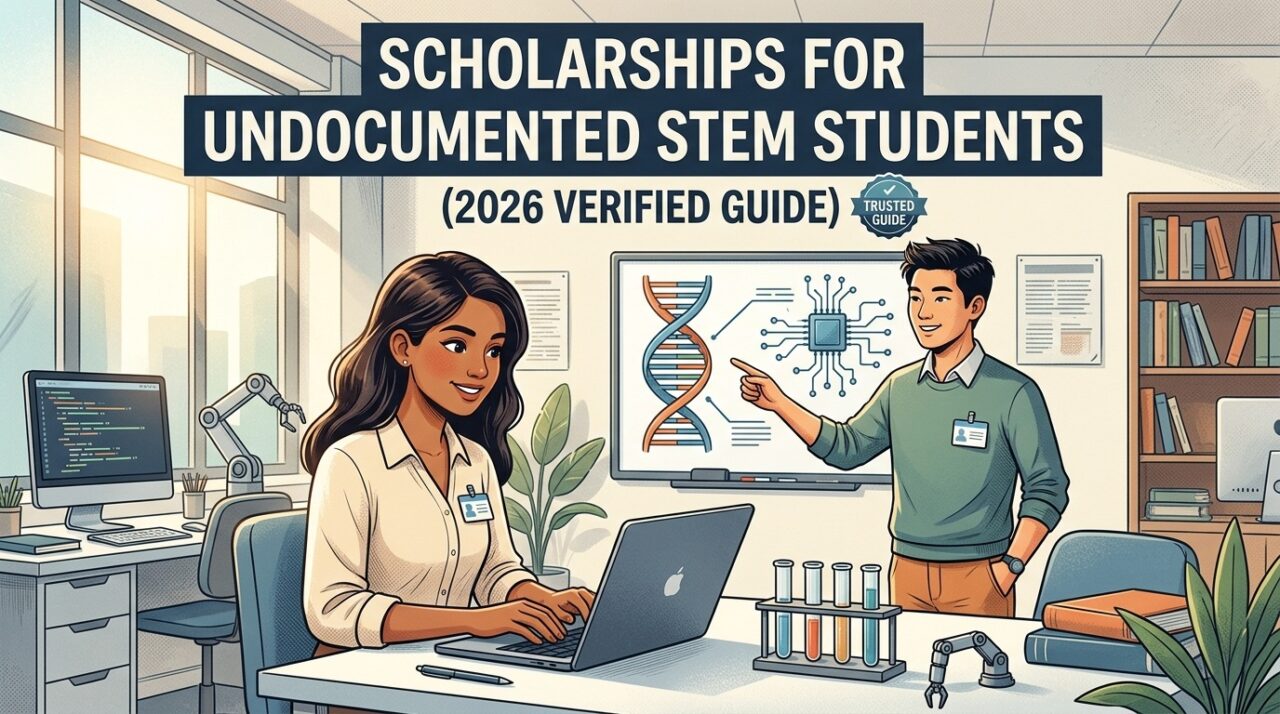
Scholarships for Undocumented STEM Students (2026 Verified Guide)
February
TheDream.US Opportunity Scholarship
Why It Slaps: This is one of the biggest deals in the entire undocumented-student space, period. It is built for students in “locked-out” states where in-state tuition is not available or college access is restricted, which makes it especially useful for STEM majors who cannot realistically self-fund engineering, computer science, biology, or pre-health pathways. The reason this one matters so much is simple: it is not a tiny one-off award. It is structured to cover the kind of full cost pressure that kills STEM plans before they start. For the right student, this is not just another scholarship application. It is a full college-access strategy.
Amount: Up to $100,000 for a bachelor’s degree.
Deadline: Most recent verified cycle closed February 2, 2026; the next round opens November 1, 2026.
Apply/info: TheDream.US Opportunity Scholarship
Equal Chance for Education (ECE) Scholarship
Why It Slaps: This is one of the best Tennessee-specific plays for undocumented students because the whole program is built around the exact barrier Dreamers face there: FAFSA ineligibility and blocked access to mainstream aid. It is not STEM-only, but it works beautifully for STEM students because the award size is serious and the program expects applicants to think clearly about career goals and degree completion. That makes it a strong fit for students heading into nursing, engineering, health science, computer science, or other structured pathways. It is geographically narrow, but for the right Tennessee student, it can beat a stack of smaller national awards.
Amount: $25,000, paid over eight semesters.
Deadline: Most recent verified cycle closed February 15, 2026; the 2026–2027 cycle opens November 1, 2026.
Apply/info: ECE Scholarship
Latinos in Technology Scholarship
Why It Slaps: This is one of the strongest regional STEM scholarships on the board because it is not just tuition help. The program combines scholarship money, professional development, and internship access, which is a huge edge for students trying to break into tech and engineering fields with limited family networks in those industries. It is best for Latino STEM students already in college and moving into junior/senior-level study, especially in Northern California. The public eligibility page is very specific about major, GPA, financial need, and region, which makes it easier to judge fit quickly.
Amount: Up to $18,000 over three years; up to $6,000 per year.
Deadline: Most recent verified SVCF-managed cycle deadline was February 27, 2026 at noon PST.
Apply/info: Latinos in Technology Scholarship
TheDream.US National Scholarship
Why It Slaps: This is the closest thing undocumented students have to a national anchor scholarship when they can use in-state tuition at a partner college. For STEM students, that matters because this is the kind of award that can help carry a real degree path instead of leaving you to stitch together small private scholarships every semester. The official page is unusually clear: it explicitly accepts students who are undocumented with or without DACA or TPS. The added stipend piece also helps because books, transport, and lab-heavy course costs can quietly wreck a budget.
Amount: Up to $33,000 for a bachelor’s degree, plus up to $6,000 in stipend support for books, supplies, and transportation.
Deadline: Most recent verified cycle closed February 28, 2026; the next round opens November 1, 2026.
Apply/info: TheDream.US National Scholarship
Ascend Educational Fund Scholarship
Why It Slaps: This one is not STEM-only, but it belongs in this guide because the official page directly says the scholarship serves immigrant students regardless of immigration status. That kind of clarity is rare and valuable. For undocumented students in New York City who want to study STEM, this can function as broad-use college funding rather than a narrow, tiny niche award. The award range is strong, and the mentorship expectations give it more long-term value than a random one-time scholarship with no community around it.
Amount: $2,500 to $20,000.
Deadline: Official page gives an illustrative February close rather than a fixed current-day deadline, so students should watch the cycle closely each winter.
Apply/info: Ascend Educational Fund Scholarship
April
GMiS California Health Sciences Scholarships
Why It Slaps: This is a smaller-dollar award, but it is much more usable than a lot of flashy scholarship lists because the official eligibility page is clear and specific. It is especially worth attention for DACA students in health-related fields, including paths tied to mental health, rehabilitation, geriatrics, and disability-related care. That mission focus can make it a better fit than generic STEM scholarships if your academic direction already lines up with service-oriented health science. It is not a national program, but it is a real, direct, official option with transparent requirements.
Amount: $1,000.
Deadline: April 30 annually.
Apply/info: GMiS California Health Sciences Scholarships
May
GMiS STEM Scholarships
Why It Slaps: This is one of the most practical broad STEM applications on the list because one program can put a student in front of multiple scholarship opportunities. The official FAQ makes clear that DACA status is accepted, and the program is open to all STEM majors with service or community involvement. The amount range varies, so not every award will be huge, but the combination of scholarship access, conference exposure, and professional signal makes this one worth the time. For students who want both money and credibility inside STEM spaces, it is a smart application.
Amount: Merit-based awards range from $500 to $5,000; some non-merit awards range from $500 to $1,000.
Deadline: 2026 STEM scholarship applications opened March 9, 2026 and the FAQ states submissions could be updated through May 8, 2026.
Apply/info: GMiS Scholarships
August
MPOWER Women in STEM Scholarship
Why It Slaps: This is one of the cleaner private scholarship options for female DACA students in STEM because the official scholarship page explicitly frames the award around female international and DACA students. It is not the giant-dollar centerpiece of an aid plan, but it is exactly the kind of realistic stackable award that can help close a gap. That makes it especially useful for students in engineering, computer science, data, and health-related STEM tracks who already know they will need multiple funding sources. It is also easier to recommend than a lot of generic STEM awards because the eligibility lane is publicly stated.
Amount: $1,000 to $5,000.
Deadline: August 31, 2026.
Apply/info: MPOWER Women in STEM Scholarship
Fall 2026
Science Ambassador Scholarship
Why It Slaps: This is one of the best non-citizenship STEM scholarships online for eligible applicants because the official FAQ clearly says U.S. citizenship is not required. It rewards the ability to explain science well, not just present a high GPA and a standard essay, which makes it a great fit for students who are strong communicators as well as strong learners. The catch is that it is specifically for women and non-binary students, so it is not universal. But for eligible undocumented students in STEM, it is a high-value opportunity with unusually clear public rules.
Amount: Five winners each receive a one-time $20,000 award.
Deadline: The official page says applications open in fall 2026; the exact deadline is not yet posted on the live page.
Apply/info: Science Ambassador Scholarship
October
Paul & Daisy Soros Fellowships for New Americans
Why It Slaps: This is the graduate-school move on this page, not the freshman-year move. For undocumented or DACA students who make it through undergrad and are headed into graduate or professional STEM study, this becomes a major next-stage funding target. The eligibility rules are more specific than many applicants realize, but the official page does explicitly say that some DACA recipients qualify if they were born abroad and graduated from both high school and college in the U.S. For medicine, engineering, research, public health, and other advanced STEM tracks, this is one of the biggest serious fellowships to know.
Amount: Up to $90,000 over two years.
Deadline: The 2027 fellowship deadline is October 29, 2026 at 2:00 p.m. Eastern.
Apply/info: Paul & Daisy Soros Fellowships for New Americans
December
Dr. Juan Andrade Jr. Scholarship for Young Hispanic Leaders
Why It Slaps: This is not STEM-exclusive, but it is still a smart stackable option for undocumented or non-U.S.-citizen Hispanic students in STEM who also bring leadership, service, and a real community story. The official page is refreshingly direct that non-U.S. citizens are eligible, which makes it safer to recommend than vague diversity scholarships with buried restrictions. It is not large enough to be the whole funding plan, but it can work very well as a secondary target alongside bigger awards. For students whose profile combines academic promise with leadership rather than only technical achievements, this one deserves a shot.
Amount: $1,000 one-time, non-renewable.
Deadline: On the current official page, recommendation letters for the most recent posted cycle were due December 30, 2025, and the application is marked closed with a note that it will reopen in the fall.
Apply/info: Dr. Juan Andrade Jr. Scholarship
FAQ
Are all the best scholarships here STEM-only?
No. Some of the strongest real-money options for undocumented students are broader undocumented or immigrant scholarships that can still fund a STEM degree. TheDream.US, Equal Chance for Education, Ascend Educational Fund, and Dr. Juan Andrade are all examples of awards that are not limited to one STEM major but can absolutely be used to support a STEM pathway.
Do undocumented students need DACA for every scholarship on this page?
No. Some programs explicitly allow applicants with or without DACA, such as TheDream.US. Others clearly state that U.S. citizenship is not required, such as Science Ambassador, or that immigration status is not a barrier, such as Ascend. But some scholarships here are more limited and specifically list DACA rather than all undocumented students, including GMiS California Health Sciences and MPOWER Women in STEM.
Which scholarships here are the most location-restricted?
Equal Chance for Education is for FAFSA-ineligible students tied to Tennessee high schools and Tennessee residency. Ascend is for graduating seniors from New York City high schools. The Latinos in Technology Scholarship is tied to Northern California/Silicon Valley eligibility rules. GMiS California Health Sciences is California-focused by design.
What should students prepare before scholarship season opens?
Across the verified pages above, the recurring materials are transcripts, essays or personal statements, recommendation letters, a resume, proof of college admission or enrollment, and sometimes a video component. Science Ambassador uses a short public STEM video. ECE asks for essays, recommendations, and an introductory video. GMiS and Dr. Juan Andrade also require standard academic and recommendation materials.
Is there a graduate-school option in this guide?
Yes. The Paul & Daisy Soros Fellowships are the clear graduate/professional-school option here. They are not for everyone, but they are worth knowing if a student is headed into advanced STEM training in the U.S. and fits the program’s New American eligibility rules.