Comparing SAI vs. Expected Family Contribution (EFC): What Changed and What It Means for Students in 2026
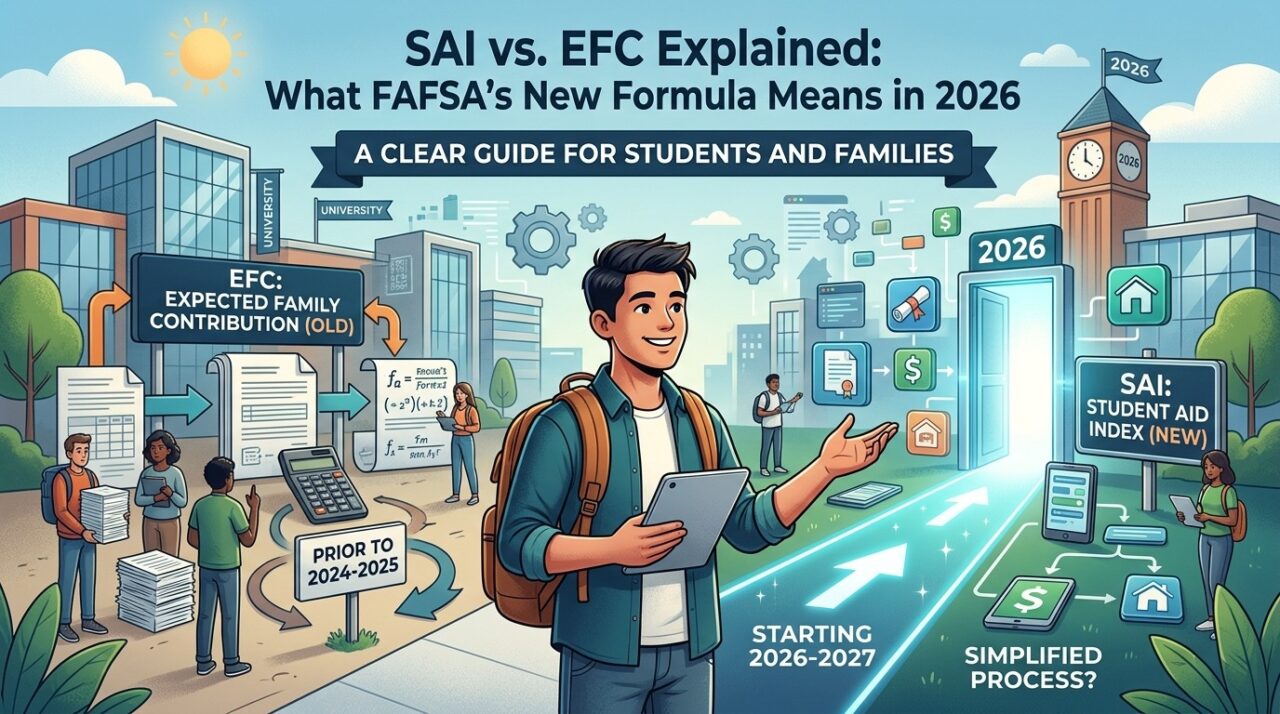
If you have older siblings, college-going friends, or parents who remember filling out the FAFSA a few years ago, you have probably heard the term Expected Family Contribution, or EFC. That used to be one of the most important numbers in federal financial aid. But that is no longer the number students see. Beginning with the 2024–25 award year, schools were required to move from EFC to Student Aid Index, or SAI. That change is still the system students use now, including for the current 2026–27 FAFSA cycle.
At first glance, SAI can look like a simple rebrand. It is not. The federal government did not just rename the number. It changed key parts of the formula, changed how Pell Grant eligibility works, allowed the number to go below zero, and removed the old rule that gave many families a break when more than one child was in college at the same time. For families trying to budget for college, that is a very big deal.
This matters because students often misunderstand what FAFSA numbers mean. Under the old system, many families saw “Expected Family Contribution” and assumed that was the exact amount they would be billed. Under the new system, the Department of Education is explicit that the Student Aid Index is not the amount of aid you will receive, not what your family is expected to pay, and not your final financial aid offer. Instead, it is an index colleges use when building aid packages.
So the short answer is this: EFC was the old FAFSA need-analysis number; SAI is the new one. But the smarter answer is that SAI changes how schools measure need, how some students qualify for Pell, and how families should read their FAFSA results. If you are a high school senior planning for college in 2026, you need to understand the difference before you compare offers or assume a school is affordable.
The quick definition: EFC vs. SAI
The EFC was the number schools used under the older FAFSA formula to determine eligibility for certain types of federal aid. In the 2023–24 Federal Student Aid Handbook, the Department explained that aid administrators subtracted the EFC from a student’s cost of attendance to determine financial need. The EFC formula also took into account the family’s number in college.
The SAI is the current number used under FAFSA simplification rules. The Department says SAI is an eligibility index number used to determine federal student aid, and it is calculated from information the student and any required contributors provide on the FAFSA, along with IRS-transferred tax data in many cases. It can range from –1,500 to 999,999, and a lower or negative SAI signals higher financial need.
That sounds technical, so here is the real-life translation. Under the old system, EFC tried to estimate how much “financial strength” a family had, even though many people wrongly read it as a bill. Under the new system, SAI is deliberately framed as an index, not a promised payment. Colleges still use it in aid calculations, but the language is clearer and some of the mechanics are different.
The biggest difference: SAI is not just EFC with a new name
The federal guidance is very clear that the shift from EFC to SAI came with major formula changes. The Department’s FAFSA simplification guidance lists three especially important ones: the removal of the number of family members in college from the eligibility calculation, the new ability for SAI to be negative down to –1,500, and the move away from older EFC-era formula structures.
That means families should stop thinking of SAI as “the new EFC” in the casual sense. Yes, both numbers sit in the same general place in the financial aid process. But they can produce different outcomes for the same household, especially for families with multiple children attending college at once or students at the lowest-income end of the spectrum.
Why EFC confused so many families
One reason the old term caused problems is right in its name. “Expected Family Contribution” sounded like the government was telling your parent exactly what they had to pay. In practice, that was never really how financial aid worked. Even under the EFC system, schools used the number as part of a formula. It was not a tuition bill, not a guarantee of affordability, and not a promise that a college would fill the gap between your aid and the school’s sticker price.
The current SAI system makes that point much more directly. Federal Student Aid says your SAI is not what your family is expected to provide, not a dollar amount of aid, and not your final offer. Your actual aid package still comes from each college after admission.
For high school seniors, this is the first mindset shift you need to make. Whether you are looking at an older article about EFC or a new FAFSA Submission Summary showing SAI, the number by itself does not answer the question, “Can I afford this school?” To answer that, you still need to compare the school’s cost of attendance, grants and scholarships, work-study, loans, and any remaining out-of-pocket cost.
How schools actually use SAI
The current packaging rules are straightforward in principle. The Federal Student Aid Handbook says students have financial need when their cost of attendance (COA) exceeds their SAI. For need-based programs, schools generally start with Pell Grant eligibility and then determine remaining need using this formula:
COA – SAI – other financial assistance = remaining need
That matters because it shows why SAI is not a bill. A college does not look at your SAI and send you an invoice for that exact amount. Instead, the financial aid office uses SAI as one part of a broader packaging process. Pell Grants are considered the first source of aid for students with need, and other need-based aid such as Federal Work-Study, FSEOG, and Direct Subsidized Loans is layered on top as long as total need-based aid does not exceed calculated need.
For non-need-based aid, the formula is different. The Handbook explains that eligibility for non-need-based federal aid is generally:
COA – other financial assistance = eligibility for non-need-based aid
That is why a student with a relatively high SAI may still qualify for some aid, especially non-need-based federal loans, depending on the rest of the package and the school’s cost of attendance. SAI affects the need-based side of the package most directly, but it is not the only number that matters.
Difference #1: The number in college no longer reduces the formula the way it used to
This is the change many families feel most sharply.
Under the old EFC system, the formula considered the family’s number in college. In the 2023–24 EFC guidance, the Department stated that the income protection allowance varied according to both household size and number in college. In other words, having multiple family members in college at the same time could help reduce the EFC result.
Under the SAI system, that is no longer the case. The Department’s 2024–25 FAFSA simplification guidance lists the removal of the number of family members in college from the eligibility calculation as one of the most significant changes. The current Handbook also says the FAFSA still asks the question, but number in college is no longer used to calculate a student’s SAI; schools may instead use it only in certain special-circumstance or professional-judgment situations.
What does that mean in plain English? Suppose a family has two children in college at the same time. Under the older EFC framework, that often helped lower each student’s aid index. Under SAI, that automatic break is gone. So some middle-income families can look “less needy” on paper than they expected, even if their real-life monthly bills feel tighter because they are supporting two students at once.
This is one reason students should not panic if a sibling’s older EFC-era experience does not match what happens on their own FAFSA. The formulas changed. Comparing your SAI directly with someone else’s past EFC is not an apples-to-apples comparison.
Difference #2: SAI can go negative
Under the newer system, SAI can go below zero. Federal Student Aid explains that the number ranges from –1,500 to 999,999, and the Department’s FAFSA simplification guidance specifically highlights a minimum SAI of –1,500 instead of zero.
That negative range matters because it gives the formula more room to identify students with the greatest financial need. A student with an SAI of –1,500 is not being told they will receive $1,500 in cash. Instead, the negative number signals to schools that the student’s financial circumstances are at the highest-need end of the scale. Federal Student Aid says a lower or negative SAI indicates higher financial need and a higher likelihood of qualifying for the maximum Pell Grant.
For students and parents, this is a major conceptual difference from the old EFC system. With EFC, people were used to seeing zero as the floor. With SAI, the negative range allows more differentiation among the lowest-income students. That can matter for how schools prioritize grants and limited campus-based aid in addition to Pell.
Difference #3: Pell Grant eligibility is no longer tied to SAI in the old way
This is another area where the change is deeper than most families realize.
For the current rules, Pell Grant determination is not just “low SAI equals Pell, high SAI equals no Pell.” The federal guidance now uses three pathways: maximum Pell, minimum Pell, and SAI-calculated Pell. The 2026–27 Pell award guidance explains that if a student qualifies for a Maximum Pell Grant, the SAI is not used to determine the amount of that grant. If a student does not qualify that way, an SAI-calculated Pell Grant is determined by subtracting the student’s SAI from the published maximum Pell amount and rounding to the nearest $5.
For the 2026–27 award year, the federal government says the maximum Pell Grant is $7,395 and the minimum Pell Grant is $740. The Department also states that an applicant whose SAI is equal to or greater than twice the maximum Pell amount is prohibited from receiving a Pell Grant, which for 2026–27 means an SAI threshold of $14,790.
There is another wrinkle students should know. The Handbook notes that in some cases a student’s SAI may be higher than the school’s cost of attendance, which means no general financial need under the normal formula, but the student may still qualify for a calculated Pell Grant or a minimum Pell Grant under Pell-specific rules. That surprises many families because they assume Pell always disappears once the index gets too high relative to cost.
The big takeaway is simple: do not use SAI alone to guess your Pell Grant. Pell now has its own eligibility structure layered on top of the SAI system. The safest move is to review your FAFSA Submission Summary, use the official Federal Student Aid Estimator, and then wait for the school’s actual financial aid offer.
Difference #4: Asset rules changed under SAI, and some 2026–27 rules changed again
The SAI formulas still use income and assets in many cases. The 2026–27 Handbook explains that SAI formulas use income, assets, and family size and then applies different formulas depending on whether the student is dependent, independent without dependents, or independent with dependents. It also explains that some applicants are exempt from asset reporting. For example, certain applicants who qualify for a maximum Pell Grant, or whose adjusted gross income is below certain thresholds and whose tax situation is simple enough, may not have to report assets for SAI purposes.
The Handbook also spells out the kinds of assets that can matter in the formula, including cash, savings, checking, investments, and adjusted net worth of business and/or farm, subject to the formula’s rules and asset protections.
But there is an important current 2026–27 update here. Federal Student Aid announced that, beginning with the 2026–27 award year, the One Big Beautiful Bill Act updates the SAI asset calculation to exclude certain items from the net worth of businesses and farms reported on the FAFSA. Those exclusions include the net worth of a family-owned business with 100 or fewer full-time or equivalent employees, the farm on which the family resides, and a family-owned commercial fishing business and related expenses.
That means families should be careful when reading older FAFSA advice online. Some articles written during the early SAI rollout said family business and family farm values would now count more often than under the old EFC era. That was true during the initial transition, but the current 2026–27 rules include new exclusions for certain businesses and farms. So the most accurate advice in 2026 is not to rely on a 2024 blog post. Use current Federal Student Aid guidance and current-year FAFSA instructions.
Difference #5: Some current Pell calculations changed again for 2026–27
There is one more current-year detail worth knowing. In the 2026–27 guidance, the Department says that, beginning with the 2026–27 award year, the foreign earned income exclusion reported on the FAFSA form is added to adjusted gross income when determining eligibility for the maximum or minimum Pell Grant.
This does not change the core definition of SAI for most students, but it does show why families need to think in award-year terms now. The SAI system is stable in the broad sense, but some aid rules, especially Pell details, can still change from one FAFSA cycle to the next. That is why the best question is not just “What is SAI?” but also “What are the rules for my specific FAFSA year?”
Where you find your SAI
When you submit the FAFSA, Federal Student Aid says your confirmation page shows your estimated Student Aid Index and estimated Pell eligibility. Your official SAI appears on your FAFSA Submission Summary, which is available after processing. Federal Student Aid says the FAFSA Submission Summary is usually available one to three business days after you submit a completed FAFSA form.
The FAFSA Submission Summary is important because it is the place where you can review your confirmed SAI, your aid estimates, your FAFSA answers, your listed schools, and your next steps. It is also where you can catch errors and start corrections. Federal Student Aid notes that schools, not the Department, make the final aid decision, so the Summary is an early signal, not your final package.
This is a crucial practical point for seniors. Do not screenshot your confirmation page and assume the story is over. Check the processed FAFSA Submission Summary, confirm that your SAI is present, review whether your information is accurate, and watch for notes about corrections or verification.
What students should do if the number looks wrong
If your SAI seems surprisingly high or low, the first step is to review the FAFSA Submission Summary carefully. Federal Student Aid says you can use the “Make a Correction” button to fix mistakes such as typos or school list changes. If you have been selected for verification, your college will tell you what documentation to provide.
If your financial situation changed after the tax year used on the FAFSA, that is a separate issue. Federal Student Aid explains that if a student or contributor had a life event that affects ability to pay, such as job loss or a change in marital status, the student should contact the school’s financial aid office. That is because schools can consider professional judgment in certain situations.
This is especially important for families who feel hurt by the loss of the old “number in college” advantage. The current Handbook says number in college is not used in SAI, but schools may use that information in a special circumstance adjustment. That does not guarantee more aid, but it does mean a family with multiple children in college should not assume the FAFSA formula is the final word.
Common myths students should ignore
Myth 1: “My SAI is what my family has to pay.”
False. Federal Student Aid explicitly says SAI is not the amount your family is expected to provide and not your final aid offer.
Myth 2: “A negative SAI means the college will send me extra money.”
Not automatically. A negative SAI indicates very high need, but colleges still package aid within federal rules tied to cost of attendance and program limits.
Myth 3: “If my SAI is high, I will get no aid at all.”
Not necessarily. Students may still qualify for non-need-based federal aid, and some students can still qualify for Pell under Pell-specific rules even when SAI is higher than COA in certain cases. States and colleges may also use FAFSA information for nonfederal aid decisions.
Myth 4: “EFC and SAI are basically interchangeable.”
No. The Department says the switch to SAI included major changes such as removing number in college from the calculation and allowing a negative minimum SAI.
The smartest way to compare colleges in the SAI era
The best way to use your SAI is as a starting point, not a conclusion. Once colleges send financial aid offers, compare these items side by side:
- total cost of attendance
- grants and scholarships
- work-study
- subsidized loans
- unsubsidized loans
- parent PLUS or private loans
- final net cost after free aid
That approach matches the federal packaging logic much better than obsessing over the FAFSA number alone. The Department says the aid estimates on the FAFSA Submission Summary are not guaranteed and that each school makes the final decision about the aid it offers.
In other words, two colleges can look at the same SAI and still offer very different packages because their costs, institutional grants, and packaging philosophies differ. A student should never choose a college based only on sticker price or based only on FAFSA jargon. Compare the actual offer letters.
Bottom line
The switch from Expected Family Contribution (EFC) to Student Aid Index (SAI) was not cosmetic. It changed the formula and changed how families should interpret the result. The current system removes the automatic benefit of having multiple children in college, allows SAI to go as low as –1,500, and uses more detailed Pell Grant rules than many older EFC-era guides explain. For the 2026–27 award year, current federal guidance also includes up-to-date Pell amounts and some newer asset-rule changes affecting certain family businesses and farms.
So here is the practical rule for seniors: do not ask, “What is my family expected to contribute?” Ask, “What is my SAI, what does my FAFSA Submission Summary show, and what is each college actually offering me?” That is the question that leads to better college decisions in 2026.
Official links for students and families
- Federal Student Aid: What Is the Student Aid Index (SAI)?
- FAFSA Submission Summary: What You Need To Know
- Federal Student Aid Estimator
- Federal Pell Grant Information
- 2026–27 Federal Pell Grant Maximum and Minimum Award Amounts
- 2026–27 Student Aid Index (SAI) and Pell Grant Eligibility Guide
- 2026–27 FAFSA Form and Pell Grant Eligibility Updates