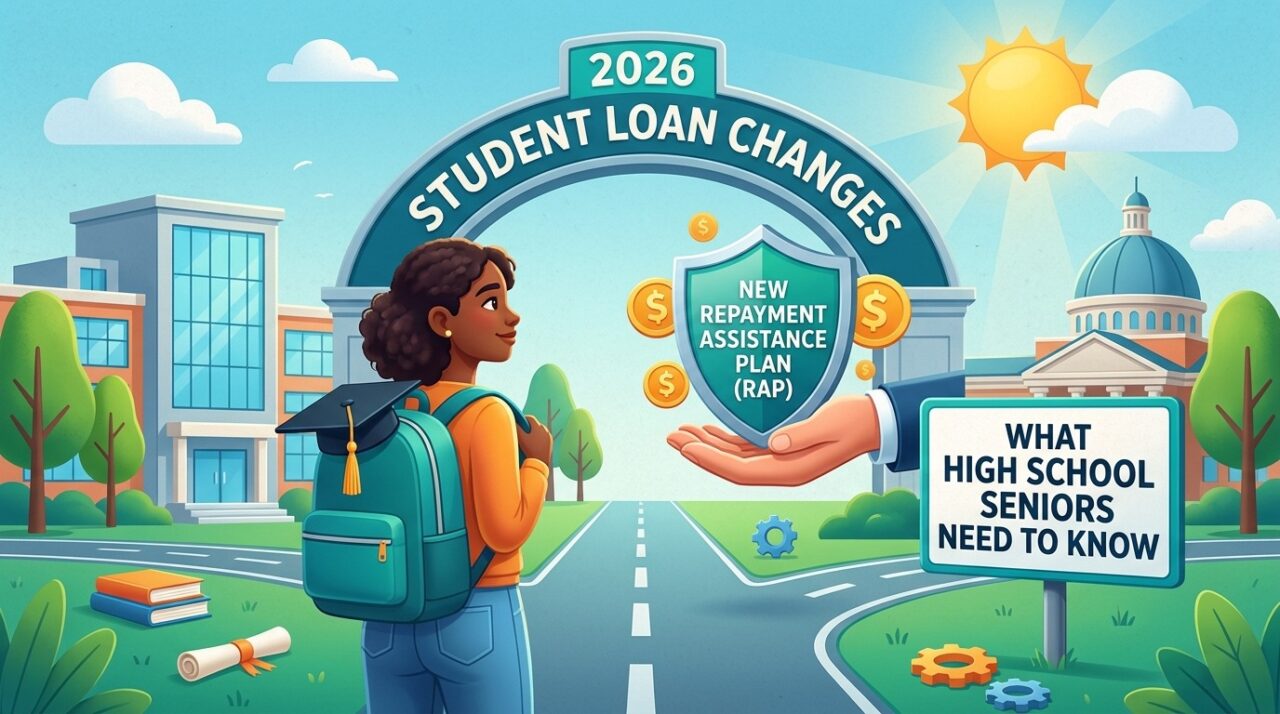
New Repayment Assistance Plan (RAP) and Student Loan Changes for 2026: What High School Seniors Need to Know
If you are a high school senior planning for college, the biggest student-loan story in 2026 is not just interest rates or forgiveness headlines. It is the rewrite of the repayment system itself. A new federal income-driven plan called the Repayment Assistance Plan, or RAP, is scheduled to launch by July 1, 2026. At the same time, the old menu of repayment options is shrinking for new borrowers, the SAVE plan has effectively ended, and families need to think about repayment rules before they borrow, not years later after graduation.
This matters because federal loans are not just “money for college.” They are contracts with future repayment terms. For students who borrow after July 1, 2026, the government’s new structure is much simpler than the old system, but also stricter in some important ways. New borrowers will generally be funneled toward just two repayment choices for those new Direct Loans: RAP or a Tiered Standard Repayment Plan. Older loans made before that date generally keep broader options, but new borrowing or new consolidation after that date can limit which plans are available.
The timing is important. StudentAid.gov says the law was signed on July 4, 2025, and many of the biggest federal student-aid changes take effect on July 1, 2026. The Department of Education has also told borrowers enrolled in SAVE that servicers will begin sending notices on July 1, 2026, and those borrowers will have at least 90 days to move into a legal plan or be placed into a standard option automatically.
What is the Repayment Assistance Plan, or RAP?
RAP is the new federal income-driven repayment plan created by the 2025 law. In plain English, it is the government’s new answer to this question: “How should borrowers repay federal loans if their income is low, unstable, or rising slowly?” The Department describes RAP as a plan that ties payments to income while also trying to stop balances from spiraling upward from unpaid interest.
That sounds borrower-friendly, and in some ways it is. Under the Department’s proposed implementation details, RAP gives borrowers two features that stand out. First, if a borrower makes the required on-time monthly payment, unpaid interest that is not covered by that payment is not charged to the borrower under RAP. Second, if an on-time payment does not reduce principal by at least $50, the government provides a matching principal reduction formula designed to help the balance move down faster. The catch is that those protections depend on making the required payment on time.
That is the central trade-off of RAP. It offers stronger anti-balance-growth protections than older income-driven plans, but it also asks many borrowers to stay in repayment longer and calculate payments from a tougher formula than the recent SAVE plan used. The Department’s own proposal says RAP would generally require repayment over 30 years, use the borrower’s full income rather than a poverty-shielded “discretionary income” formula like older plans, and include a minimum payment rule. It also says the income brackets used for RAP are not indexed to inflation, which could matter more over time than many families realize.
How RAP monthly payments are supposed to work
Under the January 2026 federal proposed rule, RAP starts with an annual base payment tied to a borrower’s adjusted gross income (AGI). Then the government divides that base payment by 12 to get a monthly amount, and subtracts $50 per month for each dependent. If the adjusted monthly amount falls below $10, the payment becomes $10.
The proposed RAP base-payment schedule is:
- AGI of $10,000 or less: annual base payment is $120
- $10,001 to $20,000: 1% of AGI
- $20,001 to $30,000: 2% of AGI
- $30,001 to $40,000: 3% of AGI
- $40,001 to $50,000: 4% of AGI
- $50,001 to $60,000: 5% of AGI
- $60,001 to $70,000: 6% of AGI
- $70,001 to $80,000: 7% of AGI
- $80,001 to $90,000: 8% of AGI
- $90,001 to $100,000: 9% of AGI
- Above $100,000: 10% of AGI
Here is what that means in real life.
If a borrower has an AGI of $35,000 and no dependents, the annual base payment would be 3% of $35,000, or $1,050. Divide that by 12 and the monthly payment is about $87.50.
If that same borrower has one dependent, the monthly amount would drop by $50, so the payment would be about $37.50.
If that same borrower has two dependents, the math would push the payment below zero, but RAP’s minimum would bring it back to $10 per month. Those examples follow the government’s published RAP formula.
For families used to hearing about older IDR plans, this formula is a major shift. Older plans such as IBR and PAYE use discretionary income, meaning income above a poverty-protected threshold. RAP instead uses AGI-based brackets. That helps explain why RAP can be lower than IBR for some lower- and middle-income borrowers, but also tougher over the long run for higher earners or borrowers who expected a shorter forgiveness timeline. The Department’s regulatory analysis says RAP payments are lower than IBR for borrowers with AGI between $30,000 and $70,000, but it also says RAP is designed to increase repayment overall because borrowers stay in repayment longer and the plan uses full income rather than discretionary income.
How RAP compares with the old system
Before this change, student borrowers could compare several major income-driven options such as IBR, PAYE, ICR, and, more recently, SAVE. The new system is moving away from that menu. For Direct Loans made on or after July 1, 2026, the federal framework limits those new loans to just two main repayment choices: the Tiered Standard Plan and RAP. If a borrower does nothing, the borrower is placed into the Tiered Standard Plan by default.
The Tiered Standard Plan is not income-driven. It is a fixed-payment plan with the repayment length based on total debt. Under the proposed federal rule for Direct Loans made on or after July 1, 2026, borrowers with under $25,000 in Direct Loans repay over 10 years; $25,000 to under $50,000 over 15 years; $50,000 to under $100,000 over 20 years; and $100,000 or more over 25 years. The minimum payment is generally $50 per month unless the remaining balance is smaller than that.
For older borrowers, the transition is more gradual. StudentAid.gov still lists IBR, ICR, and PAYE for eligible legacy loans, but it also says PAYE and ICR enrollment are available only until July 1, 2027, and borrowers on PAYE or ICR will need to move to a different plan by June 30, 2028. StudentAid.gov also says borrowers with new loans or a new consolidation loan on or after July 1, 2026 will not have access to IBR, ICR, or PAYE for those new loans, even if they would otherwise qualify.
What happened to SAVE?
SAVE is no longer the future of federal repayment. In March 2026, the Department of Education announced next steps for borrowers enrolled in what it called the unlawful SAVE plan. The Department said guidance was going out to about 7.5 million SAVE borrowers, that those borrowers would need to move into a legal repayment plan, and that servicers would start issuing formal notices on July 1, 2026. Borrowers who do not choose a new plan within their servicer’s 90-day window will be placed into the Standard or Tiered Standard plan automatically.
That matters even for current high school seniors who have never borrowed, because it shows how unstable repayment policy has been. It also reminds families that the repayment plan available when a student signs a promissory note may not be the same plan available years later. As of the latest federal data release, more than 6.5 million borrowers were still in SAVE-plan forbearance as of December 2025, part of a much larger federal loan portfolio under stress.
Other federal student-loan changes families should know
RAP is the headline, but it is not the only federal student-loan change tied to the new law.
One important change affects Parent PLUS borrowing. For periods of enrollment beginning on or after July 1, 2026, the proposed federal rules say all parents together generally could borrow no more than $20,000 per academic year on behalf of one dependent undergraduate and no more than $65,000 total for that student, subject to certain transition exceptions. Before that change, Parent PLUS borrowing was generally tied to cost of attendance minus other aid, which often let families borrow much more. For many households, this is one of the most important affordability changes in the entire package.
Another change is about default. Federal data released in March 2026 said about 7.7 million ED-held recipients with roughly $180 billion in outstanding federal student loans were in default as of December 2025, while the overall portfolio was about $1.61 trillion. In March 2026, the Departments of Education and Treasury also announced a partnership under which Treasury would assume operational responsibility for collecting defaulted federal student-loan debt. That does not change the rules of repayment overnight, but it shows the government is tightening its servicing and collections posture at the same time it launches RAP.
There is also a second-chance provision for rehabilitation. The Department’s January 2026 proposed rule says borrowers may get up to two rehabilitations of a defaulted Direct Loan beginning July 1, 2027, instead of the old one-time limit, and that the minimum rehabilitation payment for Direct Loans would rise to $10 beginning then. That is more relevant to existing borrowers than to new freshmen, but it is part of the broader federal reset.
Does RAP count for Public Service Loan Forgiveness?
Yes, with an important condition. The Department has said the 2025 law allows payments made under RAP to count toward Public Service Loan Forgiveness (PSLF) if the borrower meets the rest of the program’s requirements. But the proposed rule also says only on-time RAP payments count for RAP forgiveness protections and for PSLF credit under RAP. In other words, RAP can work with PSLF, but punctual payments matter.
This matters for seniors considering careers in teaching, nursing, government, public-interest law, social work, or nonprofit work. PSLF is still one of the strongest federal loan-relief pathways because the IRS does not treat PSLF forgiveness as taxable income.
Will forgiven balances under RAP be taxed?
Potentially, yes. This is one of the most overlooked parts of the 2026 landscape. StudentAid.gov says that if a borrower meets IDR forgiveness after the current federal tax exclusion window ends, the forgiven amount can create a federal tax liability. The IRS Taxpayer Advocate Service also warned in March 2026 that student-loan forgiveness starting in 2026 may come with tax consequences depending on the type and timing of forgiveness. By contrast, PSLF forgiveness is not federally taxable under current IRS guidance.
For a high school senior, the lesson is simple: do not evaluate repayment plans by the monthly payment alone. Ask three questions instead. How much will I pay each month? How long will I stay in repayment? And if any balance is forgiven later, could that trigger a tax bill? Those three questions now matter more than ever.
What high school seniors should do right now
First, treat federal borrowing as part of your college-choice decision, not as an afterthought. If you expect to borrow for a program beginning in the 2026–27 academic year, the loan terms you face in repayment may be very different from what older siblings, cousins, or college advisers remember. New borrowing after July 1, 2026 sits inside this newer RAP-or-Tiered-Standard framework.
Second, borrow federal loans conservatively even if RAP sounds helpful. RAP has real protections, especially against balance growth from unpaid interest, but it is not a magic eraser. The Department’s own analysis says RAP is designed to increase repayment compared with some prior plans because borrowers can stay in repayment for 30 years, payments are based on full income, and the brackets are not indexed to inflation.
Third, pay special attention to Parent PLUS strategy. Families who relied on Parent PLUS as a backstop need to understand the proposed $20,000 annual and $65,000 aggregate caps for new periods of enrollment beginning on or after July 1, 2026. For some families, that means the old “we’ll just cover the gap with Parent PLUS” strategy may no longer work.
Fourth, use official calculators and official servicer channels. Federal Student Aid recommends Loan Simulator to compare repayment options and estimate monthly costs, repayment length, and projected forgiveness. Families should also use the official Federal Student Aid repayment plans page and the official IDR application page rather than depending on social-media summaries.
Finally, build scholarships into the plan early. The new repayment system is another reminder that the safest loan is the one you never have to borrow. A $5,000 scholarship is not just $5,000 less debt. It is also years of interest risk, repayment pressure, and future-policy uncertainty that never enters your life in the first place.
Bottom line
The new Repayment Assistance Plan is one of the biggest federal student-loan changes in years. For new borrowers, it simplifies the repayment menu and offers strong protections against unpaid-interest growth when payments are made on time. But it also asks many borrowers to repay longer, uses a tougher income formula than recent plans like SAVE, and arrives during a period when the government is tightening collections and closing off some older repayment pathways.
For high school seniors, the smartest move is to stop thinking of repayment as a distant problem for “future me.” It is part of the cost of college right now. Before you commit to a school, estimate what you may need to borrow, understand that post-July 1, 2026 loans sit in a changed repayment system, and use official tools to stress-test what monthly payments could look like under RAP or a standard plan. In 2026, borrowing strategy and college-choice strategy are the same conversation.
Official resources and legit links
- Federal Student Aid: Repayment Plans
- Loan Simulator
- Income-Driven Repayment Application
- StudentAid.gov OBBBA Updates
- SAVE / IDR Court Actions Update
- Public Service Loan Forgiveness
- IRS Topic 431: Canceled Debt
Suggested internal links for ScholarshipsAndGrants.us
- Pell Grant Changes for 2026–27: What Students Need to Know
- Parent PLUS vs. New Loan Caps & SAI Strategies
- FAFSA Delays & College Deposit Deadlines
- Avoid These 8 FAFSA Mistakes: A 2026 Checklist for High-School Seniors
- Scholarship Negotiation & Appeal Strategies
FAQ
1. What is the new RAP plan for student loans?
RAP stands for Repayment Assistance Plan. It is a new federal income-driven repayment plan scheduled to launch by July 1, 2026. It bases payments on AGI and dependents, includes a $10 minimum monthly payment floor under the proposed rule, and offers unpaid-interest protection when required payments are made on time.
2. Will new borrowers still have access to SAVE?
No. The Department has said SAVE has ended and borrowers in SAVE must transition to a legal repayment plan. For new loans made on or after July 1, 2026, the federal system is moving to RAP and Tiered Standard for those new loans rather than SAVE.
3. Is RAP better than SAVE?
RAP is not simply “better” or “worse.” It protects borrowers from unpaid-interest growth on required on-time payments and includes a principal-reduction feature, but it also generally requires 30 years to forgiveness and uses full income rather than the more generous SAVE-style discretionary-income approach.
4. What happens if I do not choose a repayment plan?
For new Direct Loans made on or after July 1, 2026, the proposed default is the Tiered Standard Repayment Plan. SAVE borrowers who fail to act after servicer notice can also be placed automatically into a standard option.
5. Can RAP count toward PSLF?
Yes. Payments under RAP can count toward PSLF if you meet the other PSLF rules, and the Department has said this change took effect with the law. But the proposed rule emphasizes that only on-time RAP payments count for these RAP-specific benefits.
6. Will student-loan forgiveness be taxed?
It can be. StudentAid.gov says forgiveness after the current federal exclusion window may trigger a federal tax bill for some borrowers. PSLF remains a major exception because IRS guidance says PSLF forgiveness is not federally taxable.