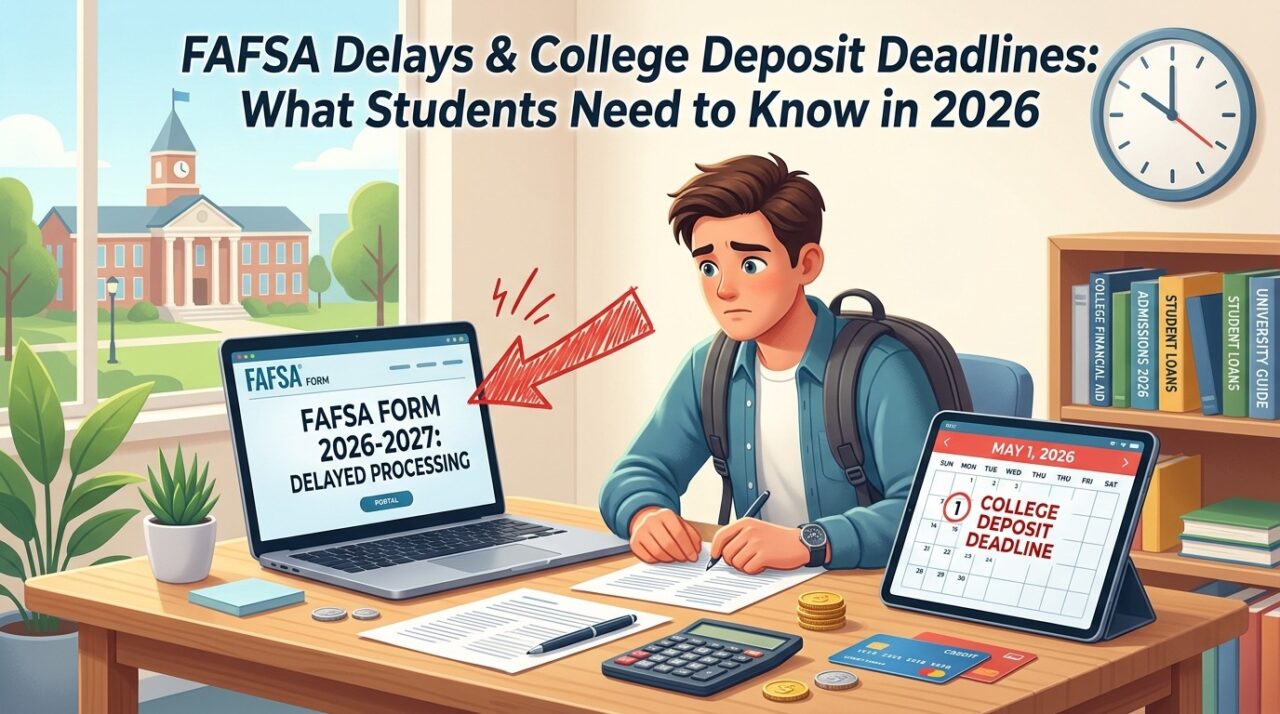
FAFSA Delays & College Deposit Deadlines: What Students Need to Know in 2026
For high-school seniors, one of the most stressful parts of spring is simple to describe and hard to live through: you may be admitted to college, but still not know the real price before your deposit deadline arrives. That problem became nationally visible during the chaotic 2024 FAFSA rollout, and it still matters in 2026 because a “FAFSA delay” does not only mean a federal website crash. It can also mean a missing signature, incomplete contributor step, correction, verification request, or slow school packaging timeline that keeps your final aid offer from reaching you before you have to decide where to enroll.
Here is the most important thing to understand right away. The FAFSA deadline and the college deposit deadline are not the same clock. For students starting college in fall 2026, the relevant form is the 2026–27 FAFSA, which covers attendance from July 1, 2026 through June 30, 2027. StudentAid.gov says the form could be submitted no earlier than October 1, 2025, and the federal deadline for that cycle is June 30, 2027. But Federal Student Aid also warns that state and college deadlines may be much earlier, and many schools use priority deadlines for the best chance at limited aid.
That difference matters because college admissions operates on a different timetable. NACAC’s current ethical practice guide says colleges should use the widely recognized date of May 1 as the earliest enrollment confirmation deadline for most first-year students, and that students should have time to receive notice of financial aid and scholarships before being asked to commit. NACAC also notes that Early Decision is the main exception, and colleges should clearly state whether a deposit is refundable or non-refundable.
So if you are a senior reading this in spring 2026, the real problem is not, “Can I still file the FAFSA by the federal deadline?” The real problem is, “Can I get a usable aid picture before I have to pay a deposit?” That is the question that should shape your next steps.
The 2026 reality: better than 2024, but still not automatic
The good news is that the 2026–27 cycle appears much more stable than the disastrous 2024–25 launch. The U.S. Department of Education said in December 2025 that more than 5 million 2026–27 FAFSA forms had already been submitted, a nearly 150% increase over the same point the prior year, and said the form launched earlier than any prior cycle. Federal Student Aid also says that once a completed FAFSA is submitted, processing usually takes one to three business days. That is a much stronger starting point than families faced in the 2024 crisis.
But a more stable federal launch does not guarantee a fast college decision. Your school still has to receive, review, and package your information. Your FAFSA Submission Summary is not your final college aid offer. Federal Student Aid explains that the Submission Summary comes from the U.S. Department of Education and includes your confirmed Student Aid Index (SAI) and estimated Pell eligibility, while your actual aid offer comes later from each school’s financial aid office and contains the exact mix of grants, work-study, loans, and institutional aid the school is offering you.
That distinction is where many families get tripped up. You may think, “My FAFSA is done, so I should be good.” But from the school’s perspective, “FAFSA done” is only one step. The school may still be waiting on corrections, verification documents, institutional forms, or internal packaging. In other words, your FAFSA can be processed and you can still feel delayed.
What actually causes FAFSA-related delays for students
In 2026, most student-level delays are likely to come from one of a few predictable places.
The first is an incomplete FAFSA. Federal Student Aid says a form can land in “Action Required” status if a required correction is needed, such as a missing signature or missing consent and approval. If your FAFSA Submission Summary shows action required, StudentAid.gov says it will not include your estimated federal student aid and SAI. That means your form is not yet giving schools what they need in a clean, usable way.
The second is a contributor problem. Federal Student Aid says each contributor on the FAFSA must provide the required consent and approval connected to federal tax information for the student to be eligible for federal aid. If a parent or spouse has not finished their required step, your timeline can stall even if you believe “your part” is done.
The third is a correction issue. StudentAid.gov says you should review your FAFSA Submission Summary carefully because you may need to correct answers, add a missing signature, or update other permitted fields online. Federal Student Aid also notes that some changes, especially those related to a major shift in family finances, must go through the school’s aid office rather than a simple online edit.
The fourth is verification or additional documentation. Federal Student Aid says some students are selected for verification at random, and some schools verify all students’ forms. If you are selected, you need to send the requested documents by the school’s deadlines or your aid can be delayed. The Department explicitly says being selected does not mean you did something wrong. It means the school needs more information before finalizing eligibility.
The fifth is school-side packaging. Even after your FAFSA is processed, the college has to combine federal data with its own policies, scholarship rules, state aid rules, and sometimes other forms. That is why two colleges can receive your FAFSA at roughly the same time and still send aid offers on very different schedules. StudentAid.gov says schools determine the exact amounts and types of aid in your offer, and that timing can vary by institution.
Why this matters so much: delayed aid can change enrollment decisions
This is not just a paperwork annoyance. Survey evidence shows aid timing can change real student outcomes. In the Lumina Foundation-Gallup 2025 State of Higher Education study, 25% of FAFSA applicants said submitting the 2024–25 form was difficult. More importantly, 51% said the timing of their financial aid offer affected where they went to college, and 55% said the timing affected whether they went to college at all. Among those who said timing had a negative effect, some reported dropping out for a semester or choosing a community college instead of a four-year college.
That helps explain why families feel intense pressure around deposit day. A deposit deadline is not just a date on the calendar. It is the point where uncertainty turns into financial risk. And when deposits are nonrefundable, the wrong choice can cost real money. NACAC says colleges should state whether deposits are refundable or non-refundable, which is exactly why students need to read admission terms closely instead of assuming every school treats deposits the same way.
Can colleges move or extend deposit deadlines?
Yes. They can, and in the 2024 FAFSA crisis many did. Saint Peter’s University officially extended its enrollment deposit deadline from May 1 to June 1, 2024 because FAFSA processing delays pushed back financial aid data and made it harder for families to evaluate options. Moravian University did the same, explaining that delays in FAFSA transmission were postponing aid offers and giving students less time to review them before deciding. Monmouth College also moved its deadline to June 1 in response to FAFSA delays and said the extra time was meant to help families understand aid offers and direct costs before choosing.
That history matters because it proves two things. First, deposit timelines are not sacred. Colleges can change them. Second, when you ask for extra time because your aid information is incomplete, you are not making a weird request. You are asking for something colleges themselves have recognized as reasonable when affordability information is late.
What to do if your deposit deadline is coming and your aid offer is still late
Start with the school, not with panic. The smartest move is to contact both the admissions office and the financial aid office immediately, preferably in writing so you have a timestamped record. Explain that you have submitted the FAFSA, describe what is still missing, and ask for one or more of the following: a deposit extension, a deposit waiver review, a housing deadline extension, an estimated net cost timeline, and confirmation of whether your place can be held until your aid information is complete. This is the practical path schools themselves describe.
There are current examples of schools offering this kind of flexibility. Stevenson University says that if a student has applied for financial aid but has not received the award letter by the deposit deadline, the student may request an extension until the aid award arrives. The University of Michigan says students who have not received a financial aid package before the deposit deadline should contact financial aid, and if an estimate is not available they can request an extension of the enrollment deposit deadline in order to review the notice before asking for a waiver.
That does not mean every school will say yes. But it does mean you should ask early and clearly. Ask before the deadline passes, not after. Michigan’s guidance specifically says the written explanation has to be submitted before the deposit deadline has passed. Timing matters.
A simple email template you can paste and send
Subject: Request for deposit deadline extension while financial aid is pending
Dear [Admissions Office / Financial Aid Office],
I am an admitted student for Fall 2026 and remain very interested in enrolling. I have completed my FAFSA, but I have not yet received my final financial aid offer / my file is still pending because [brief reason: correction submitted, verification requested, contributor issue resolved, etc.].
Because I need my final aid information to make an informed enrollment decision, I am respectfully requesting a short extension of my enrollment deposit deadline. If possible, I would also appreciate confirmation of any next steps I should complete now and an estimated timeline for when my aid offer may be available.
Thank you for your help. I am eager to make a decision as soon as I have complete cost information.
Sincerely,
[Full Name]
[Application ID]
[Phone Number]
That message is short, professional, and focused on the one fact colleges care about most here: you are trying to make a real decision based on real cost information.
What if one school is slow and another school wants a deposit now?
This is where students often make a rushed decision. The best approach is to protect your options without pretending uncertainty does not exist.
If one school is ready and another is still pending, compare the offer you do have using net price, not just the headline scholarship number. Federal Student Aid says the right starting point is the school’s cost of attendance, then subtract grants and scholarships, then look carefully at work-study and loans rather than treating them like free money. StudentAid.gov also says your aid offer is your best source of truth for exact aid amounts at that institution.
Use your FAFSA Submission Summary too, but use it correctly. Federal Student Aid says the School Information tab can help you compare things like graduation, retention, transfer, and default rates, as well as average annual cost of attendance. That is useful context, but it still does not replace the actual school-specific aid letter.
If you are also on a waitlist somewhere else, understand the financial reality. NYU’s waitlist FAQ tells students that they should generally confirm enrollment and pay a deposit at another college while waiting, and warns that it is very unlikely the first deposit will be refunded. At the same time, NYU says that if it later offers admission from the waitlist, it will not expect a student to commit until after reviewing the financial aid award. That is a useful example of how colleges can acknowledge both facts: students often need a backup deposit, and students also deserve to see aid before committing to a new offer.
What if the aid offer arrives but it is too low?
A late offer is one problem. An unaffordable offer is another.
Federal Student Aid says students should contact the financial aid office to request an aid adjustment when the FAFSA does not reflect the family’s current reality. This is often called professional judgment. Examples StudentAid.gov gives include layoffs, divorce, death in the family, major medical expenses, incarceration, and other significant income changes. The school may ask for documentation, and the school’s decision is final.
This matters because some students assume the FAFSA result is fixed and there is nothing else to do. That is not always true. If your family’s 2024 or 2025 tax picture is no longer a fair picture of your current finances, you may have a legitimate reason to ask the college to re-review your case. Do not skip that step just because you feel intimidated by the process.
Mistakes to avoid
The first mistake is treating June 30 as your real deadline. For federal aid, that deadline exists. But for competitive state aid, campus grants, and enrollment decisions, it is often far too late. StudentAid.gov repeatedly warns that state and college deadlines can come much earlier and that some schools have priority deadlines for the best aid package.
The second mistake is assuming a submitted FAFSA means there is no issue left. If your summary shows Action Required, if a contributor never completed consent, or if the school asked for verification documents, you may still be on a delayed track.
The third mistake is paying a deposit without understanding whether it is refundable. NACAC says colleges should state that clearly, and Stevenson’s published policy is one example of a school where the deposit becomes non-refundable after a specified date. Read the admission terms before you click “submit payment.”
The fourth mistake is rushing into private borrowing just to “hold your spot.” Federal Student Aid’s 2024 annual report documented complaints from students who said schools pushed them toward private loans while FAFSA processing was delayed. StudentAid.gov separately warns that before taking a private loan, students should compare terms carefully and first talk with the financial aid office about other options.
Bottom line
For 2026 seniors, the headline is this: the FAFSA system is in better shape than it was during the 2024 meltdown, but the college affordability timeline can still break down at the exact moment families need clarity most. Your FAFSA can be processed and your aid offer can still be late. Your federal deadline can be far away while your college deposit deadline is only days away. And your smartest move is not silence or guessing. It is fast, documented communication with the school, plus a disciplined review of your FAFSA status, corrections, verification items, and real net price.
If your aid is late, ask for time. If your aid is wrong, ask for review. If your costs are unclear, do not confuse a FAFSA Submission Summary with a final aid offer. And if a college wants your deposit before you can make an informed affordability decision, remember that schools can and do grant extensions, and many have publicly acknowledged that students need aid information before they commit.
FAQ
Is May 1 a law for every college?
No. It is the widely recognized earliest enrollment confirmation deadline recommended by NACAC for most first-year fall admission decisions, not a federal law that overrides every institutional policy. Early Decision is a recognized exception.
Can I ask a college to extend my deposit deadline because my financial aid is late?
Yes. Some colleges explicitly say students may request an extension when aid is still pending. Stevenson University and the University of Michigan both publish versions of this guidance.
My FAFSA says “Action Required.” What does that usually mean?
It usually means your form needs a required correction, such as a missing signature or missing consent and approval. If action is still required, StudentAid.gov says your SAI and estimated federal aid may not appear.
Is the FAFSA Submission Summary my actual financial aid package?
No. The FAFSA Submission Summary comes from the U.S. Department of Education and gives you a federal eligibility snapshot. Your actual financial aid offer comes from each school after admission.
What if my family’s finances changed after the tax year used on the FAFSA?
Contact the school’s financial aid office and ask about an aid adjustment or professional judgment review. Federal Student Aid says schools can review documented special financial circumstances such as layoffs, divorce, medical expenses, or death in the family.
Official resources
These are the most useful primary-source pages for students dealing with FAFSA timing and enrollment decisions.
- Federal Student Aid FAFSA page
- FAFSA deadlines
- Review and correct your FAFSA
- FAFSA Submission Summary guide
- Compare school financial aid offers
- How to evaluate your aid offers
Internal Links
- Pell Grant Changes for 2026–27: What Students Need to Know
- Avoid These 8 FAFSA Mistakes: A 2026 Checklist for High-School Seniors
- How to Appeal Your Financial Aid Offer: Templates & Deadlines (2026)
- Work-Study Explained: How Much You Can Earn and What Jobs Pay in 2026
- Dependency Overrides Explained: How to Apply as an Independent Student in 2026