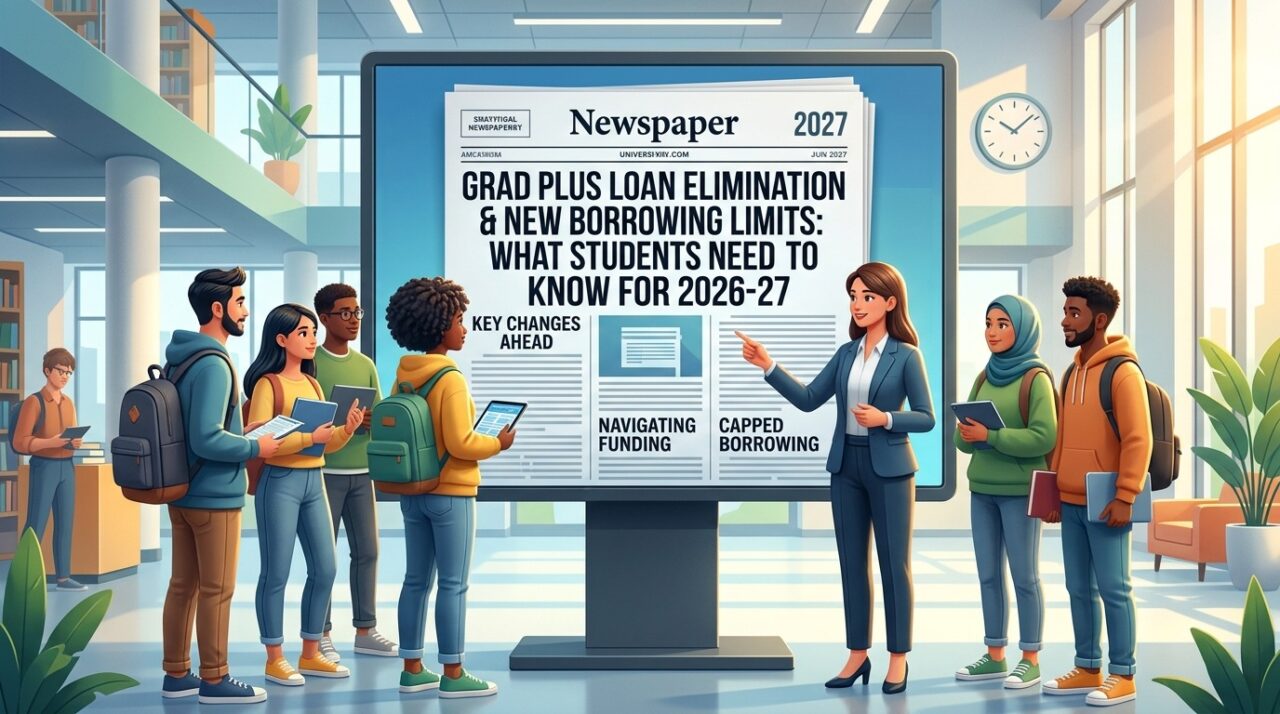
Grad PLUS Loan Elimination & New Borrowing Limits: What Students Need to Know for 2026-27
If you are a high school senior, this topic may sound like something you can ignore until years from now. That would be a mistake. The federal government has changed the graduate-school borrowing system in a way that could affect how affordable law school, medical school, business school, social work, public health, counseling, and many master’s programs feel by the time you get there. The big headline is simple: for affected borrowers, the old Grad PLUS model that let graduate and professional students borrow up to the full cost of attendance is being replaced by harder annual, aggregate, and lifetime borrowing limits beginning July 1, 2026.
The legal source is Public Law 119-21, the 2025 budget reconciliation law signed on July 4, 2025. Federal Student Aid and Department of Education materials say the law modifies loan limits, ends Grad PLUS eligibility for graduate and professional students under the new framework, and triggers system changes that go live on April 26, 2026, ahead of the July 1, 2026 effective date for the main loan-limit changes.
Here is the plain-English version. Under the current federal system, a graduate or professional student can usually take out a Direct Unsubsidized Loan up to a set annual amount and then use a Grad PLUS loan to fill the rest of the gap up to the school’s cost of attendance, as long as the borrower meets eligibility rules and passes the required credit standard for PLUS loans. Starting July 1, 2026, that “borrow up to the school’s full budget” structure is no longer the default path for affected graduate borrowers. Instead, federal borrowing becomes capped much more tightly.
What Grad PLUS is right now
Before the new rules take effect, Grad PLUS works like a federal gap-filler. The school sets a cost of attendance, subtracts other aid, and the student can borrow up to the remaining amount through Grad PLUS. That is why Grad PLUS has mattered so much in expensive graduate programs: it did not have the same kind of hard annual or lifetime ceiling that students see in ordinary federal student lending. For loans first disbursed between July 1, 2025 and June 30, 2026, the official Grad PLUS interest rate is 8.94%, while the graduate/professional Direct Unsubsidized rate is 7.94%; the loan fee is also much higher on PLUS than on unsubsidized loans.
That old structure is exactly what lawmakers and the Department say they were targeting. In the Department of Education’s January 2026 press release, ED said the Act eliminates the Grad PLUS program, described it as a source of unlimited borrowing, and said the new caps are intended to push institutions to reduce tuition and curb overborrowing. ED also said graduate borrowing now makes up a growing share of federal loan disbursements and the majority of balances in income-driven repayment plans.
What changes on July 1, 2026
Beginning in July 2026, affected graduate students are limited to $20,500 per year in federal student loans, with a $100,000 aggregate cap. Affected professional students are limited to $50,000 per year with a $200,000 aggregate cap. The Department has also said that professional programs include fields such as law and medicine, though the exact regulatory definition of “professional program” is still being finalized.
Just as important, the old graduate/professional PLUS loan type is being removed for the new system. CRS summarizes the change bluntly: effective for periods of instruction beginning on or after July 1, 2026, Public Law 119-21 eliminates the availability of Grad PLUS loans while keeping the other Direct Loan types. In its side-by-side table, CRS shows graduate/professional PLUS changing from “up to cost of attendance minus estimated financial assistance” to “loan type is eliminated.”
The law also adds a student lifetime maximum aggregate limit of $257,500 for graduate/professional borrowing under the new framework. That part matters because aggregate limits and lifetime limits are not the same thing. CRS explains that an aggregate limit caps how much outstanding principal you can owe at one time, so room can reopen if principal is paid down, discharged, or forgiven. A lifetime limit is harsher: it caps how much you may ever borrow, regardless of whether some of that debt was later repaid or discharged.
The fastest comparison
Under the old system, graduate borrowers typically had two federal layers: first the Direct Unsubsidized Loan, then Grad PLUS up to the rest of the school budget. Under the new system, for affected borrowers, graduate lending is mostly reduced to a capped unsubsidized-loan model. That means the biggest change is not just a smaller number. It is the disappearance of the old federal “fill the gap” option.
For a typical two-year master’s program, the annual cap can matter more than the aggregate cap. Two years at $20,500 equals $41,000 total federal borrowing, even though the formal graduate aggregate cap is $100,000. For a three-year master’s program, the annual cap points to about $61,500. By contrast, a four-year professional program at $50,000 per year could reach the full $200,000 professional aggregate cap. Urban Institute analysis notes this is why some programs will be constrained mostly by the annual cap and others by the aggregate cap.
Who is actually affected and who may be grandfathered
This is the most important nuance in the whole story. Not every current graduate student gets cut off immediately. Federal Student Aid’s 2026-27 FAFSA Specifications Guide says current borrowers are grandfathered into the pre-OBBBA limits. CRS provides the more precise legal rule: the amended limits generally do not apply to individuals who, as of June 30, 2026, are enrolled in a program of study and already received a Direct Loan for that same program, for the lesser of three academic years or the remaining time to completion in that program.
That means the cleanest way to think about it is this: if a student is already in the program and already borrowed for that program before July 1, 2026, there may be a temporary grandfathering runway. But for students who start borrowing under the new system after the change takes effect, the new caps are the real world. Federal Student Aid’s March 2026 implementation announcement also confirms that FAFSA, NSLDS, and COD systems are being updated specifically to track the new limits, lifetime caps, and exception flags.
What does not change for high school seniors in undergraduate study
One easy misunderstanding is thinking this law slashes current undergraduate federal borrowing limits. CRS says the law does not amend annual and aggregate borrowing limits for undergraduate students. So if you are entering college as a freshman in fall 2026, your standard undergraduate Direct Loan caps are not the part being rewritten here. The big change comes later if you decide to pursue graduate or professional education and need federal loans to finance it.
That distinction matters because many students build long-range plans assuming the graduate system will work like the undergraduate system, only bigger. The new law makes graduate financing less automatic and more selective. So even though undergraduate limits are unchanged, a high school senior who dreams of becoming a doctor, lawyer, psychologist, pharmacist, social worker, counselor, or public-health professional should now factor financing into program choice much earlier.
Why the new lifetime cap matters more than many students realize
The new $257,500 lifetime maximum is a hidden headline because it changes how stacking degrees works. CRS explains that the number represents the maximum a borrower could ever draw across eligible student borrowing categories in this new structure, excluding Parent PLUS amounts borrowed by parents on the student’s behalf. CRS also gives an example: a borrower who already used $57,500 as an independent undergraduate and $100,000 as a graduate student would sit at $157,500 total, leaving at most another $100,000 before hitting the lifetime ceiling if that borrower later entered a professional program.
This means students should stop thinking only in terms of “Can I borrow enough for this next degree?” and start thinking in terms of “How much of my total federal borrowing runway do I want to spend here?” A student who burns through federal capacity on a costly master’s degree may have less room later for a professional credential. That is a strategic shift, not just a paperwork change.
Program-level caps and part-time proration make the rules even tighter
The statute and proposed regulations do not just create federal ceilings. ED says institutions may also set program-level loan caps below the statutory limits, and CRS says schools can limit the dollar amount of Direct Loans a student may borrow for a specific program and academic year if applied consistently to all students in that program. So the number in the law may not be the number your school actually lets you borrow. Some programs may end up with lower internal caps.
The law also requires loan amounts to be prorated for less-than-full-time enrollment beginning with the 2026-27 year. That matters for adult learners, students trying to work while enrolled, and anyone stretching a program over more time. Going part-time does not magically preserve borrowing power. In many cases it reduces how much you can borrow for the year.
Repayment is changing too
The borrowing rule is the headline, but repayment is changing alongside it. ED’s FY 2027 Student Loans Overview says borrowers with one or more loans taken out on or after July 1, 2026 will choose from two new repayment plans, while borrowers with only pre-July 1, 2026 loans keep access to both the new plans and the older menu for now. Federal Student Aid help materials likewise say borrowers who take out a new loan or consolidate on or after July 1, 2026 will be required to repay their Direct Loans under the forthcoming Repayment Assistance Plan or the Tiered Standard Plan rather than the older PAYE/ICR-style menu.
That matters because the value of a federal loan is not only the interest rate. It is also the safety net. If the federal borrowing limit is lower and the repayment menu is narrower for new borrowers, students may feel more pressure to either pick cheaper programs or look at private credit markets. Urban Institute analysis says that is the likely direction for many graduate borrowers.
Why this matters for future affordability
ED’s own budget documents show why graduate debt policy is a real affordability issue. The Department reports that median graduate federal loan debt entering repayment reached $45,321 in 2024, and said graduate debt had rebounded since 2022. The Department also says that after July 1, 2026 all new graduate and professional borrowers will be restricted to unsubsidized loans with new limits. In other words, the government is not making graduate school cheaper. It is changing who bears the financing pressure.
For some students, the change could push schools to restrain prices or expand institutional aid. For other students, especially those considering expensive professional programs, it could mean bigger funding gaps. Urban Institute estimates many programs, especially dentistry, medicine, veterinary medicine, law, and certain master’s fields like public health, fine arts, and social work, are likely to feel the new caps sharply because past borrowing in those programs often exceeded the upcoming limits.
What high school seniors should do now
First, do not assume future graduate borrowing will “just work itself out.” When comparing colleges now, pay attention to outcomes in majors that commonly lead to graduate school. A lower-cost undergraduate path can preserve future borrowing room and reduce the chance that you later hit the lifetime cap too early.
Second, if your long-term goal requires graduate or professional school, start judging programs by net price, program length, expected starting pay, licensure path, and placement results, not brand name alone. ED has explicitly tied the new framework to concerns about overborrowing and weak return on investment in some graduate programs.
Third, maximize every non-loan dollar now. File the FAFSA early, chase scholarships aggressively, compare aid offers carefully, and avoid unnecessary undergraduate borrowing. The less federal debt you carry into your twenties, the more flexibility you may have if you later need federal borrowing room for a graduate credential. Federal Student Aid’s own comparison tools still point students toward grants and scholarships first, then work-study, then loans.
Fourth, watch the calendar. Federal Student Aid says system changes tied to the new law go live on April 26, 2026, and the actual eligibility and modified loan-limit changes take effect on July 1, 2026. If you are reading this as a current college senior or a student heading straight into graduate school, timing matters.
Fifth, remember that the official 2026-27 federal interest rates had not yet been posted in the Federal Student Aid rate tables when I checked on April 7, 2026. ED explains that federal student loan rates are set annually before the award year begins on July 1. So use the current 2025-26 rates only as the latest posted benchmark, not as a promise of next year’s exact rates.
Bottom line
The Grad PLUS change is not a small technical edit. It is a structural rewrite of how graduate education gets financed in the federal system. For affected borrowers starting July 1, 2026, the old “borrow up to cost of attendance” Grad PLUS path gives way to hard annual, aggregate, and lifetime limits, with schools allowed to set even lower program caps and with repayment options changing for new borrowers. Undergraduate loan limits are not the main target here, but any student who expects to need graduate or professional school should treat this as a future-planning issue right now.
The smartest response is not panic. It is planning. Pick lower-cost undergraduate paths when possible. Protect your borrowing capacity. Be skeptical of expensive graduate programs with weak earnings outcomes. And keep using official Federal Student Aid sources, because the Department is still finalizing some implementation details around the 2026 changes.
FAQs
Is Grad PLUS already gone right now?
No. The official implementation materials say the major loan-limit changes tied to this law take effect on July 1, 2026. Until then, current Grad PLUS rules still exist under the present system.
Are undergraduate federal loan limits being cut too?
Not by this part of the law. CRS says undergraduate annual and aggregate borrowing limits are unchanged.
What is the new graduate borrowing cap?
For affected graduate students, the new cap is $20,500 per year and $100,000 aggregate. For affected professional students, it is $50,000 per year and $200,000 aggregate.
What counts as a professional program?
Department of Education materials give examples such as law and medicine, but ED also says the precise definition is still being regulated.
If I am already in graduate school, do I automatically lose Grad PLUS on July 1, 2026?
Not necessarily. Federal Student Aid says current borrowers are grandfathered into pre-change limits, and CRS explains the exception generally applies when a borrower is already in the program and already received a Direct Loan for that same program before July 1, 2026, for the lesser of three academic years or the remaining time to finish.
What is the new lifetime federal borrowing maximum for graduate/professional study?
The new lifetime maximum is $257,500, excluding Parent PLUS borrowed by parents on the student’s behalf.
Could my school let me borrow less than the federal maximum?
Yes. ED says institutions may set program-level caps below the statutory maximum, and CRS says schools may limit borrowing for a particular program if the policy is applied consistently.
Will students borrow more private loans because of this?
That is not written into the law, but it is a likely market effect. Urban Institute analysis says the new federal limits will likely increase the need for private borrowing for many graduate students.
Official source links
- Federal Student Aid: Grad PLUS Loans
- Federal Student Aid: Federal Student Loan Interest Rates
- Federal Student Aid Partner Announcement on FAFSA and loan-limit updates
- U.S. Department of Education press release on the 2026 loan-rule proposal
- CRS report on P.L. 119-21 higher-education changes