OBBBA & FAFSA Deadline Act: What Students Need to Know
If you are a high school senior planning for college, trade school, or career school, two federal laws now matter a lot for your financial-aid timeline: the FAFSA Deadline Act and the One Big Beautiful Bill Act, often shortened to OBBBA. They do not do the same thing. The FAFSA Deadline Act is mainly about when the FAFSA must open. OBBBA is mainly about how some aid rules work, including parts of the FAFSA, Pell Grant eligibility, and other student-aid policies.
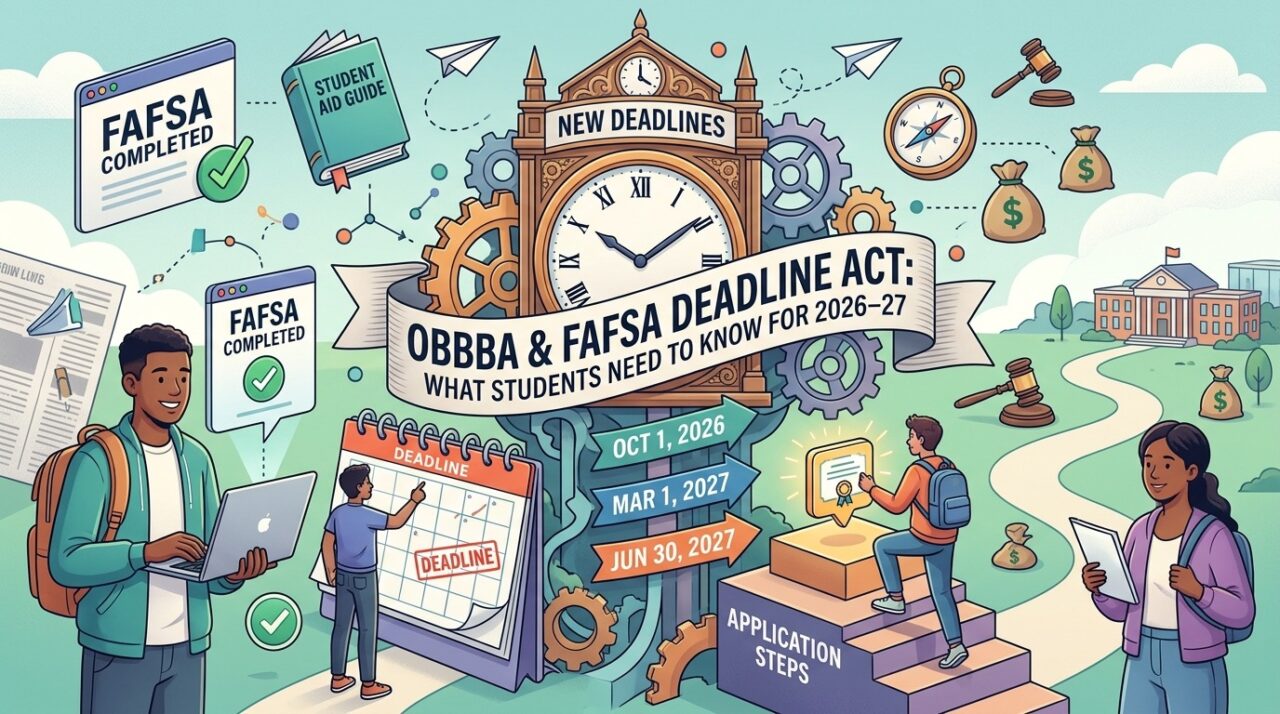
The big takeaway is this: October 1 is the FAFSA opening deadline for the federal government, not the deadline students should wait for. For the 2026–27 school year, the official FAFSA says students can submit as early as October 1, 2025, the federal filing deadline is June 30, 2027, and state or college deadlines can be much earlier, even as early as October 1, 2025 for some aid programs.
That distinction matters because many families hear “FAFSA deadline” and assume it means the last day to file. In this law, it mostly means the Department of Education now has to get the form out earlier and on time. For students, the smarter rule is still: file as early as you reasonably can, then fix mistakes fast if needed.
What is the FAFSA Deadline Act?
The FAFSA Deadline Act became Public Law 118-145 on December 11, 2024. It amended the Higher Education Act so the Department of Education must launch the FAFSA no later than October 1 before the school year for which aid is sought. Before that change, the law said the FAFSA had to be available no later than January 1, while also aiming for around October 1 “to the maximum extent practicable.” The new law removed that softer language and replaced it with a hard October 1 deadline.
The law also added accountability rules. By September 1 of each FAFSA cycle, the Secretary of Education has to certify to Congress either that the Department will meet the October 1 deadline or that it will not. If the Department says it will miss the deadline, the law requires testimony before Congress by September 30 explaining the expected failure and the financial impact on students and families.
For students and parents, that means the federal government has less room to drift into a late or messy launch. After the disastrous delays tied to the 2024–25 rollout, Congress made timing a legal requirement instead of a best-effort goal. That is why the FAFSA Deadline Act matters even if it does not directly change your Pell amount or your loan offer. It is a timing-and-accountability law, not a new grant program.
Did the 2026–27 FAFSA actually launch on time?
Yes. The Department of Education said the 2026–27 FAFSA officially launched on September 24, 2025, which was ahead of the October 1 legal deadline. The Department also said Secretary McMahon certified to Congress on August 27, 2025 that the form would launch on time, matching the new requirements created by the FAFSA Deadline Act.
That means the FAFSA Deadline Act already had a real-world effect. For the 2026–27 cycle, the government did not just say it hoped to open on time. It certified the launch and opened ahead of schedule. For families, that makes planning easier because students can start applications, colleges can receive data earlier, and states can run their own aid programs on a more stable calendar.
What is OBBBA?
OBBBA stands for the One Big Beautiful Bill Act. Federal Student Aid says it was signed into law on July 4, 2025 as Public Law 119-21. According to the Department, some OBBBA student-aid changes took effect immediately, while others are being implemented on July 1, 2026, and in later years.
For high school seniors, OBBBA matters because it already changed parts of the 2026–27 FAFSA and Pell rules, and more aid-system changes continue to roll out for students entering college in fall 2026 and after. In other words, if the FAFSA Deadline Act changed the calendar, OBBBA changed parts of the rules behind the money.
The most important difference between the two laws
Here is the plain-English version:
The FAFSA Deadline Act tells the government when the FAFSA must open.
OBBBA changes some of the rules used to calculate aid or determine eligibility, including changes already reflected in the 2026–27 FAFSA.
So if you are asking, “When should I file?” you are mostly dealing with the FAFSA Deadline Act and the official FAFSA calendar. If you are asking, “Will my Pell Grant or FAFSA answers be treated differently now?” you are mostly dealing with OBBBA.
What OBBBA already changed on the 2026–27 FAFSA
Federal Student Aid issued an official announcement in August 2025 explaining that OBBBA required changes to the 2026–27 FAFSA form and to Pell Grant eligibility. Those changes were implemented with the 2026–27 FAFSA launch.
The first major change is about assets. Beginning with the 2026–27 award year, OBBBA says the Student Aid Index, or SAI, should exclude certain assets from the FAFSA calculation. According to Federal Student Aid, families should not report the net worth of a family-owned business with 100 or fewer full-time or full-time-equivalent employees, the net worth of a farm on which the family resides, or the net worth of a commercial fishing business and related expenses owned and controlled by a family. For some families, that could reduce the amount of assets counted against aid eligibility.
The second major change is about foreign earned income exclusion. Federal Student Aid says that, beginning with the 2026–27 award year, the foreign earned income exclusion reported on the FAFSA is added back to adjusted gross income when determining Pell Grant eligibility. For families who earn income abroad, that could reduce or eliminate Pell eligibility compared with what they might have expected under older rules.
The third major change is a new Pell Grant cutoff tied to SAI. Federal Student Aid says that for the 2026–27 award year, a student with an SAI equal to or greater than twice the maximum Pell Grant award amount is not eligible for a Pell Grant. For 2026–27, the Department said that threshold is $14,790. It also said this particular limit does not apply to students who qualify under the Special Rule for dependents of certain deceased servicemembers and public safety officers.
That means OBBBA can cut in two different directions. Some students may look more needy on paper because certain family farm or small-business assets no longer count in the same way. Other students may lose Pell eligibility because of the new foreign-income treatment or because their SAI is at or above the new Pell cutoff. That is why students should not assume “new law” automatically means “more aid” or “less aid.” It depends on the family’s facts.
What students entering college in fall 2026 should watch next
Federal Student Aid announced in March 2026 that additional system changes related to OBBBA would go live on April 26, 2026, and that eligibility changes and modified loan limits would take effect on July 1, 2026. The same announcement said all student-facing FAFSA changes tied to OBBBA had already been made in September 2025 and that, after the April 26 processing updates, the Department did not anticipate additional OBBBA-related changes to the FAFSA application itself.
For a high school senior, that is important because it means the form you fill out for 2026–27 is largely settled, but some of the behind-the-scenes processing and broader aid rules are still landing on the institutional side in spring and summer 2026. In practice, some colleges may continue refining packaging, counseling, or award explanations as they implement the July 1, 2026 changes.
What is the federal FAFSA deadline for 2026–27?
The official 2026–27 FAFSA form says students can apply for the award year running from July 1, 2026, to June 30, 2027. It says students should submit for federal aid as early as possible, but no earlier than October 1, 2025, and that the application must be received no later than June 30, 2027. It also says your college must have your correct, complete information by your last day of enrollment in the 2026–27 school year.
Official FAFSA deadline guidance also says that for the 2026–27 cycle, corrections or updates must be submitted by 11:59 p.m. Central Time on September 12, 2027. That correction window matters if you make a mistake, add schools, fix contributor information, or update information the system allows you to change after filing.
But again, students should treat June 30, 2027 as the absolute federal last stop, not as the target date. The 2026–27 FAFSA itself warns that state or college deadlines may be as early as October 1, 2025 and that additional forms may be required. Waiting until the federal deadline is one of the easiest ways to miss state grants, school grants, and limited campus-based aid.
What this means for high school seniors in simple terms
If you are graduating high school in spring 2026 and starting college in fall 2026, your main aid form is the 2026–27 FAFSA. The law now expects that FAFSA to be open by October 1 before your college year starts. For your cycle, that already happened in September 2025. So the practical question is no longer “Has the form opened yet?” but “Have I submitted it, checked my state and college deadlines, and fixed errors quickly?”
You should also know that the 2026–27 FAFSA uses 2024 tax information. The paper FAFSA shows parent tax questions tied to whether the parent did or will file a 2024 IRS Form 1040 or 1040-NR. That matters because some families whose finances dropped in 2025 or 2026 may look stronger on the FAFSA than they really are right now.
If that happened to your family, do not skip the FAFSA. The official FAFSA form says families with significant financial changes, such as job loss or pay cuts, should still complete and submit the form and then talk to the financial aid office at the colleges involved. The Federal Student Aid Handbook also says aid administrators can use professional judgment on a case-by-case basis to adjust aid-related data when documented special circumstances exist.
The Pell Grant piece students should understand
For the 2026–27 award year, Federal Student Aid announced that the maximum Pell Grant remains $7,395 and the minimum is $740, though the Department also noted that Congress could still change the maximum if it takes later action. At the same time, Federal Student Aid reminded schools that OBBBA added the rule making students with an SAI of $14,790 or higher ineligible for Pell for 2026–27, except for certain Special Rule cases.
What that means in plain English is that the Pell program still exists, the maximum grant is still substantial, and many low-income students can still qualify. But the eligibility rules are not exactly the same as older FAFSA cycles. Students who assumed they would qualify because of older examples, older YouTube videos, or older counselor handouts need to check current results carefully.
FAFSA process changes that matter in real life
The 2026–27 FAFSA process also includes usability changes that families should know. Federal Student Aid’s product updates say students can now invite a required parent or spouse contributor by entering an email address, and the system generates a unique code for the contributor to use. The same updates say students can no longer manually enter contributor information; all contributors must be invited.
That means one of the fastest ways to get stuck is to start the FAFSA without making sure your required contributor is ready. If you are a dependent student, parent participation is usually part of the form. Federal Student Aid’s parent guidance also recommends that the student start the FAFSA first, because that usually saves time and reduces confusion.
The Department also highlighted faster StudentAid.gov account verification and a redesigned contributor-invite process as part of the 2026–27 cycle. Those are not just technical details. They are meant to reduce the completion drop-off that happens when a student starts the form but a parent or spouse never successfully joins and signs.
What to do right now
1) File before your school and state deadlines, not the federal last day
The federal deadline is late, but school and state deadlines are often much earlier. The official 2026–27 FAFSA says some state or college deadlines can be as early as October 1, 2025. If you want the best shot at grants, campus-based aid, and institutional money, you should think in terms of priority deadlines, not the last possible federal date.
2) Make sure the student and all required contributors have StudentAid.gov access
Because the new system relies heavily on contributor invitations and signatures, the student and any required parent or spouse should be ready to log in before the student gets deep into the application. This is now a bigger deal because manual contributor entry has been removed for the 2026–27 FAFSA flow.
3) Submit even if your family’s situation changed after the tax year used on FAFSA
The FAFSA may rely on older tax data, but that does not mean you are stuck with it forever. The official FAFSA instructions tell students with special circumstances like job loss or major pay cuts to submit the form first and then contact each college’s financial aid office. Federal aid administrators can make documented adjustments through professional judgment.
4) Check your FAFSA Submission Summary and correct mistakes fast
Federal Student Aid says students can review and correct their FAFSA after processing, and that contributors can begin corrections but can submit corrections only for their own sections, while students can submit corrections for any section. For the 2026–27 cycle, the general correction deadline is September 12, 2027, but waiting that long is a mistake if your college is packaging aid now.
5) Read your financial aid offer with OBBBA in mind
If your Pell result looks different from what you expected, do not assume the school made a mistake. It may be the result of OBBBA changes to asset treatment, foreign earned income treatment, or the new Pell SAI threshold. Ask the college’s financial aid office to explain how your FAFSA data translated into your award.
Biggest mistakes students should avoid
The first mistake is thinking October 1 is your filing deadline. Under the FAFSA Deadline Act, October 1 is the government’s deadline to make the FAFSA available, not the student’s last day to file. For the 2026–27 form, the federal filing deadline is June 30, 2027, but many priority deadlines are much earlier.
The second mistake is assuming older Pell advice still applies without checking. OBBBA changed the 2026–27 Pell rules in ways that can help some families and hurt others. A blog post, counselor handout, or YouTube video from before the law may not reflect the current SAI threshold or foreign-income rule.
The third mistake is delaying because your parent or contributor is busy. The redesigned FAFSA still requires the right people to participate and sign. If the contributor never gets in, the FAFSA can stall.
The fourth mistake is not appealing when your real financial picture is worse than the FAFSA shows. The FAFSA itself and the Federal Student Aid Handbook both make clear that colleges can review documented special circumstances. Families should be careful, honest, and organized, but they should not assume the original FAFSA result is always final.
FAQ
Does the FAFSA Deadline Act mean I have to file by October 1?
No. The FAFSA Deadline Act requires the Department of Education to release the FAFSA by October 1 before the school year. For the 2026–27 award year, the official FAFSA says students can submit beginning October 1, 2025, and the federal deadline is June 30, 2027.
What does OBBBA change for a typical high school senior?
The biggest FAFSA-related changes already reflected in the 2026–27 cycle are the new treatment of certain family business, farm, and fishing assets; the treatment of foreign earned income exclusion for Pell purposes; and the Pell ineligibility rule for students whose SAI is $14,790 or higher for 2026–27.
Can I still get Pell in 2026–27?
Yes, many students still can. Federal Student Aid says the 2026–27 maximum Pell Grant is $7,395 and the minimum is $740, but eligibility depends on your FAFSA results and current federal rules.
What if my parent lost a job after the FAFSA tax year?
File the FAFSA anyway, then contact each college’s financial aid office. The official FAFSA instructions specifically mention job loss, pay cuts, and other major financial changes as special circumstances, and Federal Student Aid guidance says aid administrators may adjust aid inputs case by case with documentation.
Can I fix a mistake after I submit?
Yes. Federal Student Aid says students can correct FAFSA information after processing. Contributors can begin corrections, but they can submit only their own sections; the student can submit corrections for any section. For the 2026–27 cycle, the official correction deadline is September 12, 2027.
Final word
The cleanest way to understand this topic is to separate timing from eligibility. The FAFSA Deadline Act changed timing by forcing the FAFSA onto an October 1 release schedule with stronger accountability. OBBBA changed parts of eligibility and FAFSA treatment for the 2026–27 cycle and beyond. Students who mix those two ideas together often get confused about what changed, what deadline actually applies to them, and why a Pell estimate looks different than expected.
For most high school seniors, the winning strategy is simple: submit the FAFSA early, get contributors ready before you start, check school and state priority deadlines, review your FAFSA Submission Summary, and appeal quickly if your family’s finances changed after the tax year the form uses. That approach fits the current federal rules better than waiting, guessing, or relying on outdated advice.
Official links
- Federal Student Aid: FAFSA deadlines
- Federal Student Aid: Start or manage your FAFSA
- Federal Student Aid: Pell Grant information
- Federal Student Aid: Review and correct your FAFSA
- Federal Student Aid: Steps for parents completing FAFSA
- FSA Partner Connect: 2026–27 FAFSA form and Pell Grant eligibility updates
- FSA Partner Connect: OBBBA information center
- U.S. Department of Education: 2026–27 FAFSA launch announcement
Internal links
- Pell Grant Changes for 2026–27: What Students Need to Know
- Avoid These 8 FAFSA Mistakes: A 2026 Checklist for High-School Seniors
- How to Appeal Your Financial Aid Offer: Templates & Deadlines (2026)
- Dependency Overrides Explained: How to Apply as an Independent Student in 2026
- Work-Study Explained: How Much You Can Earn and What Jobs Pay in 2026
- Refund Delays & Financial Aid Disbursement: What to Expect in 2026