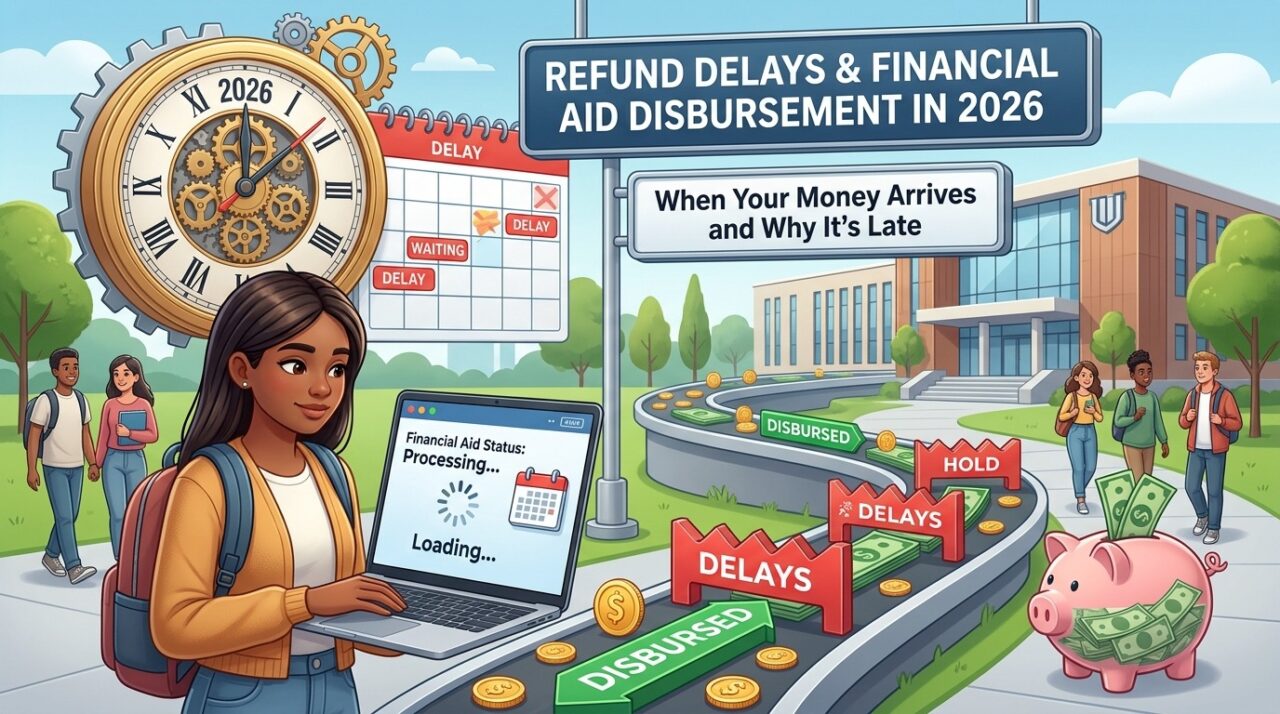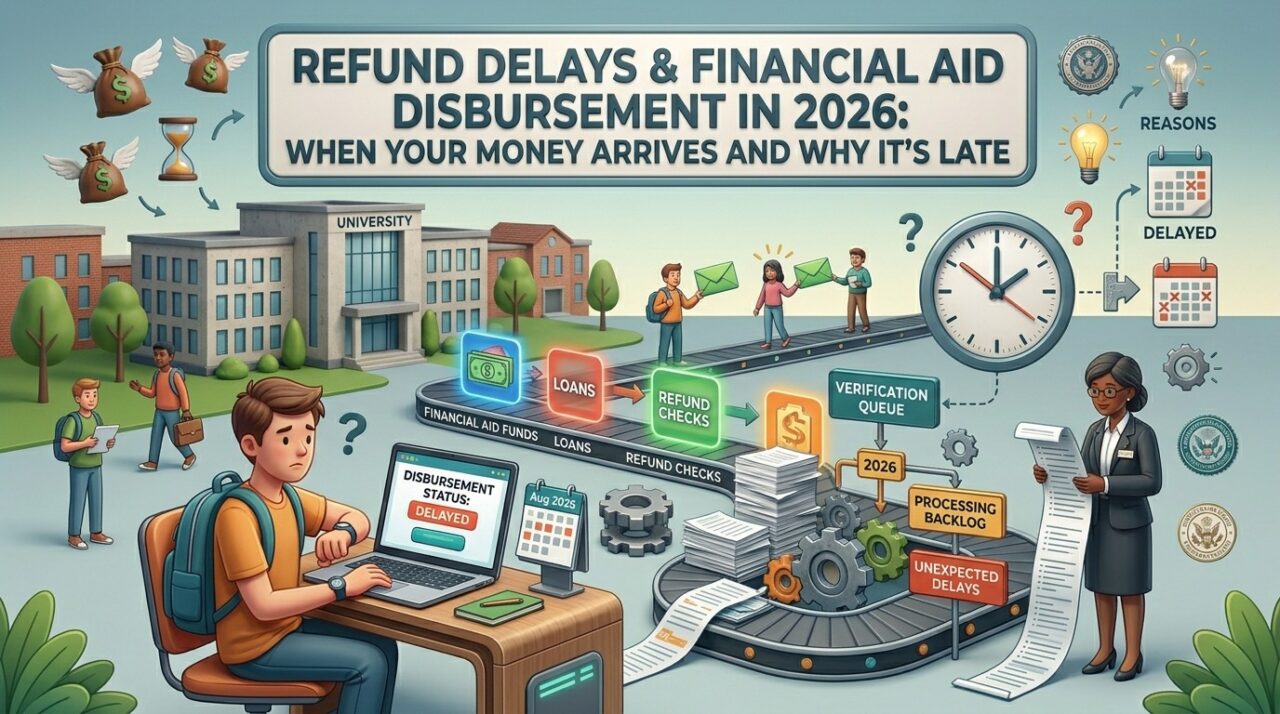
Refund Delays & Financial Aid Disbursement: What to Expect in 2026
If you are counting on financial aid to help pay for books, rent, food, transportation, or other college costs, the biggest surprise is usually this: your school does not send all aid straight to your bank account on day one. In most cases, the school gets the money first, applies it to your tuition, fees, and sometimes housing and meal-plan charges, and only then sends you whatever is left over. That leftover amount is what most students call a refund. Federal aid rules usually call it a Title IV credit balance.
That distinction matters. A financial aid disbursement is the school’s release of aid to your student account or directly to you. A refund is what remains after allowable school charges are covered. So if your FAFSA says you were awarded aid, that does not mean the same thing as “the money should already be in my checking account.” First the aid has to be processed, then posted, then matched against your charges, and only then can any excess be released.
For 2026, the most important federal timing rule is this: if federal Title IV aid on your account creates a credit balance, the school must pay that balance to you or your parent, as applicable, as soon as possible but no later than 14 days after the first day of class if the balance existed on or before that day, or no later than 14 days after the balance occurred if it happened after classes began. That rule is real, but students often misunderstand when the 14-day clock starts. It starts when a Title IV credit balance actually exists, not when you first filed the FAFSA or first saw an estimated award.
The short answer: when should you expect your refund?
At many schools, aid begins posting on or near the first day of the term, and federal rules generally allow schools to make many disbursements up to 10 days before classes start. But “can disburse” does not mean “must refund you that day.” The school still has to confirm eligibility, apply charges, and create an actual credit balance before the refund timeline kicks in.
So the most realistic student expectation for 2026 is this: if your file is complete, your enrollment is correct, your loan requirements are done, and your aid really exceeds your billed charges, your refund often shows up sometime from just before classes begin to within roughly the first two weeks after classes start. But if even one requirement is unresolved, that timeline can slide.
What “disbursement” actually means
Federal Student Aid says schools generally distribute grant or loan money in at least two disbursements, and schools usually apply the money to institutional charges first. That means your aid may arrive in parts across the year instead of one giant payment. If your annual award is split between fall and spring, your “big refund” may also be split.
For Direct Loans, federal rules say a school may not disburse loan proceeds unless the borrower has signed a legally enforceable promissory note. Schools also must follow cash-management rules under 34 CFR part 668 when processing those loan funds. In plain English, if your loan paperwork is incomplete, your refund can stall even if your grant aid is ready.
Why so many students think their refund is “late”
Most delays fall into a small set of categories. The frustrating part is that students often see an award amount in a portal and assume the money is already cleared to go. It usually is not. Awards are one stage. Disbursement is another. Refund release is another.
1) Your FAFSA or verification file is not actually complete
This is one of the biggest causes of delay. The 2026–27 Federal Student Aid Handbook says schools must verify applications selected by the FAFSA Processing System for students who will receive or have received subsidized Title IV aid. StudentAid also says that if you are selected for verification, your school may ask for a tax transcript or other documents to confirm the information you reported. Until that is resolved, aid can be delayed.
Schools say this plainly in their own disbursement pages. Rutgers states that if a student has not completed verification, the disbursement will be delayed until that requirement is met. The University of Maryland says disbursement depends on timely receipt of a valid FAFSA, completion of all aid requirements, and loan approval where applicable.
2) Your enrollment does not match the award assumptions
Aid is awarded based on things like enrollment status, payment period, and academic calendar. If you registered full time but later dropped credits, started only some classes, or changed sections in a way that affects your attendance pattern, the school may have to recalculate aid before releasing any refund. UT Dallas says aid can be delayed when the student’s current enrollment status does not match the enrollment status used to award aid.
This matters especially for Pell. The FSA Handbook says schools must calculate Pell for a term based on that term’s enrollment intensity, and if a student does not begin attendance in all classes for the payment period, the school must recalculate the Pell award based on the lower enrollment intensity. The handbook gives an example of a student awarded as full time before the term starts who only begins attendance in 9 credits when the term begins; the school must recalculate the award, and any difference becomes an overpayment the student is responsible for.
That is why refund money can shrink after you thought it was coming. If you added classes late, never started a late-start class, or dropped below the level the aid office used when building your package, the school may pause the refund until the recalculation is finished.
3) You are a first-year, first-time federal loan borrower
This one hits freshmen hard. Federal rules say a school generally may not disburse the proceeds of a Direct Subsidized or Direct Unsubsidized Loan to a first-year, first-time borrower until 30 days after the first day of the student’s program of study. The FSA Handbook repeats the same rule and notes that early disbursement is generally not allowed for these borrowers.
In practice, that means a freshman may see a Pell Grant post earlier, while the loan portion of the expected refund shows up later. So if a student built their budget assuming all aid would arrive together, the delay can feel like an error even when the school is following federal law. This is one of the most common reasons first-term students say, “My friend got their refund but I didn’t.”
4) You did not complete entrance counseling or the MPN
StudentAid says entrance counseling is required before you can receive your first Direct Subsidized or Direct Unsubsidized Loan, and the MPN is the legal document in which you promise to repay the loan. The University of Maryland also says students who accepted loans must complete any required entrance counseling and/or Master Promissory Notes before disbursement can proceed.
This is an easy delay to miss because your portal may still show the loan as “accepted” or “awarded,” while the aid office is still waiting for the last required federal step. If you are missing either item, the grant part of your aid might move while the loan-related refund does not.
5) Your school is waiting on attendance confirmation or grade-based SAP review
Some schools delay disbursement until attendance is confirmed. Rutgers says that if a student has not confirmed attendance, disbursement will be delayed. That is especially relevant in schools with required participation verification, roster reporting, or late-start modules.
Satisfactory Academic Progress, usually called SAP, is another major cause. UT Dallas says aid may be delayed if a student is not meeting SAP requirements, and that students on warning or probation may see delays while grades from the previous term are evaluated. CUNY’s School of Public Health says aid may not be disbursed until SAP has been evaluated and that delays can happen when prior-semester grades are not officially posted before the next term begins.
6) Your refund method itself is slowing you down
Even after a refund is approved, delivery method matters. Schools routinely note that direct deposit is faster than paper checks. NYU says direct deposit is the fastest and most secure way to receive a refund, and Columbia says paper checks are slower to process than direct deposit. If you did not set up direct deposit, or if your address is outdated, the money can be delayed after the school has already released it.
7) You are waiting on a refund, but there is no credit balance yet
This is the hidden issue. Federal guidance makes clear that a Title IV credit balance exists only when the total Title IV funds credited to your account exceed allowable charges. The school is also responsible for paying that balance within the federal timeline and may not require you to take extra action just to get it. But until the balance actually exists, the 14-day rule is not triggered.
That means if your tuition bill, housing charge, bookstore charge, or other allowable institutional charges are still being posted or adjusted, you might still be in the “aid is being applied” stage rather than the “refund is overdue” stage. Students often confuse those two stages.
The 14-day rule students should memorize
Here is the student-friendly version.
If federal aid creates a credit balance before or on the first day of class, the school generally has until 14 days after the first day of class to release it. If the credit balance is created after the first day of class, the school generally has 14 days after the balance occurred.
That does not mean every student should wait exactly 14 days. Many schools are faster. But it does mean that “my refund did not hit on day one” is not, by itself, proof that something is wrong. The key question is: On what date did my Title IV credit balance actually get created?
What students should know specifically for 2026
For the 2026–27 award year, Federal Student Aid says the maximum Pell Grant is $7,395, effective July 1, 2026, through June 30, 2027. That does not mean every student receives that amount, but it does matter because Pell remains the core grant many low-income students expect to see applied first to their account.
The 2026–27 FAFSA is already available through Federal Student Aid. Students should file as early as possible, because even when federal deadlines are later, school, state, and campus-based aid deadlines are often earlier, and late file completion can slow packaging and disbursement.
Another 2026-specific update matters if you withdraw or stop attending. Federal Student Aid announced that new Return of Title IV Funds (R2T4) regulations apply to students who withdraw, otherwise cease attendance, or begin an approved leave of absence on or after July 1, 2026. That means students who get a refund and then stop attending can still face recalculation and repayment risk under updated rules.
What about books and living expenses?
Federal rules also recognize that students need access to books and supplies at the start of a term. The FSA Handbook says that by the seventh day of a payment period, a school must provide a way for an eligible student to obtain required books and supplies if the student would have had a Title IV credit balance. But students with unresolved verification, an unresolved “C” code, or unresolved conflicting information are not covered by that special books-and-supplies provision unless those issues were cleared at least 10 days before the payment period starts.
That is a big deal for first-year students who are broke in August. If your refund is late because verification is unresolved, your school may not have to front the books-and-supplies access you expected. So if you are selected for verification, treat that request like a real deadline, not optional paperwork.
What to do if your refund still has not arrived
First, check whether your aid has actually disbursed or whether it is still only listed as accepted or anticipated. Then check whether your student account shows a real credit balance after tuition, fees, housing, and meal-plan charges were applied. If there is no credit balance yet, you are not really at the refund stage.
Second, check for unresolved requirements: verification, missing FAFSA corrections, entrance counseling, MPN, attendance confirmation, enrollment mismatch, SAP review, or late-start classes. Those are the most common real causes of delay.
Third, if the school already released the refund, confirm your refund method. Direct deposit is typically faster. Paper checks are slower and more vulnerable to address problems.
Fourth, if your concern is the loan amount, not the refund speed, remember that schools must tell borrowers the anticipated date and amount of disbursement and the right to cancel all or part of a loan disbursement. StudentAid also says that if you receive loan money and then decide you do not need it, you may cancel all or part of the loan within 120 days of receiving the money.
Finally, if you believe your school is mishandling federal aid, Federal Student Aid says you can use the FSA Feedback Center, and the Department of Education’s Office of Inspector General points refund-related concerns back to FSA’s complaint process. If a complaint is not resolved, the FSA Ombudsman Group is the escalation path.
Bottom line
In 2026, students should expect financial aid refunds to remain a process, not an instant payout. The school gets the aid, applies allowable charges, creates a credit balance if one exists, and then releases the excess under federal timing rules. The 14-day rule protects students, but it only applies once the credit balance is real. Verification, enrollment changes, SAP, freshmen loan delays, missing loan steps, and paper-check delivery are still the biggest reasons students wait longer than they expected.
The smartest move is to stop asking only, “Where is my refund?” and start asking, “Has my aid disbursed, has my account been adjusted, and on what date was my federal credit balance created?” That question gets you much closer to the truth.
FAQs
How long can a school legally hold my federal financial aid refund?
If federal Title IV aid creates a credit balance, the school generally must release it as soon as possible but no later than 14 days after the first day of class if the balance existed on or before that day, or no later than 14 days after the balance occurred if it happened later.
Why did my friend get a refund before I did?
Refund timing differs when students have different enrollment levels, verification status, SAP status, attendance confirmation, loan requirements, or freshman borrower status. A first-year, first-time borrower can also face a 30-day delay on the first Direct Loan disbursement.
Can my Pell Grant be reduced after I expected a refund?
Yes. If you do not begin attendance in all classes used to calculate your Pell enrollment intensity, the school may have to recalculate your Pell award based on lower enrollment intensity, and that can reduce the refund or create an overpayment.
Does filing the FAFSA mean I will automatically get a refund?
No. Filing the FAFSA only starts the aid process. Your school still has to determine eligibility, package aid, complete verification if required, disburse funds, apply charges, and then determine whether a credit balance exists.
Is direct deposit better than a mailed refund check?
Usually yes. Schools commonly state that direct deposit is faster and more secure, while paper checks are slower and can be delayed by mailing or bad address records.
Can I send back loan money if I got too much?
Yes. Federal rules require schools to tell you how to cancel all or part of a loan disbursement, and StudentAid says borrowers may cancel all or part of a loan within 120 days of receiving the money.