Do Pell Grants Have to Be Paid Back? Understanding Grants vs. Loans
If you are a high school senior filling out the FAFSA and comparing aid offers, one of the biggest questions is simple: Do Pell Grants have to be paid back? The good news is that a Federal Pell Grant usually does not have to be repaid. That is the basic rule, and it is one of the reasons Pell is so valuable. But there are a few important exceptions, and those exceptions are where students get tripped up.
This guide explains the real answer in plain English. You will learn what a Pell Grant is, how it differs from a loan, when repayment can happen, how to avoid owing money back, and how to read your financial aid offer the smart way. The goal is not just to answer one question, but to help you avoid a mistake that can cost you money in your first year of college.
The short answer
A Federal Pell Grant is grant aid, not borrowed money. That means it is generally money for college that does not have to be repaid. Federal Student Aid says this directly: unlike a loan, a Federal Pell Grant does not have to be repaid except under certain circumstances.
So if you receive Pell Grant money, stay eligible, attend your classes, and your school calculates your aid correctly, you normally keep it. In other words, Pell is not like a car loan, not like a credit card, and not like a federal student loan. You do not borrow it and then make monthly payments after graduation.
What a Pell Grant actually is
The Federal Pell Grant is one of the main need-based aid programs run by the U.S. Department of Education. It is usually awarded to undergraduate students with significant financial need, and the amount depends on factors such as your Student Aid Index, cost of attendance, enrollment level, and other eligibility rules.
Pell is not a tiny side program. In Federal Student Aid’s FY 2024 Annual Report, the Department said it disbursed about $33.0 billion in Pell Grants, averaging $5,218 to more than 6.3 million students. That is why Pell is often described as the foundation of many students’ federal aid packages.
For the 2026–27 award year, Federal Student Aid published a maximum Pell Grant of $7,395 and a minimum award of $740, effective July 1, 2026, through June 30, 2027. That does not mean every student gets $7,395. It means that is the top scheduled award under the current published rules.
Why students confuse grants and loans
A lot of students lump all financial aid together because it all shows up in one aid offer. But your aid offer can include grants, scholarships, work-study, and loans, and those are not the same thing. Some money is free aid. Some money is earned through work. Some money is borrowed and must be repaid.
That confusion gets worse because colleges sometimes list everything in one package and make the total look bigger than it really is. A school can say it offered you $25,000 in aid, but if a large part of that package is loans, then a big chunk of the “aid” is actually debt. Federal Student Aid specifically tells students to understand whether the money is aid that does not need to be repaid, money you earn, or borrowed money.
Grants vs. loans in plain English
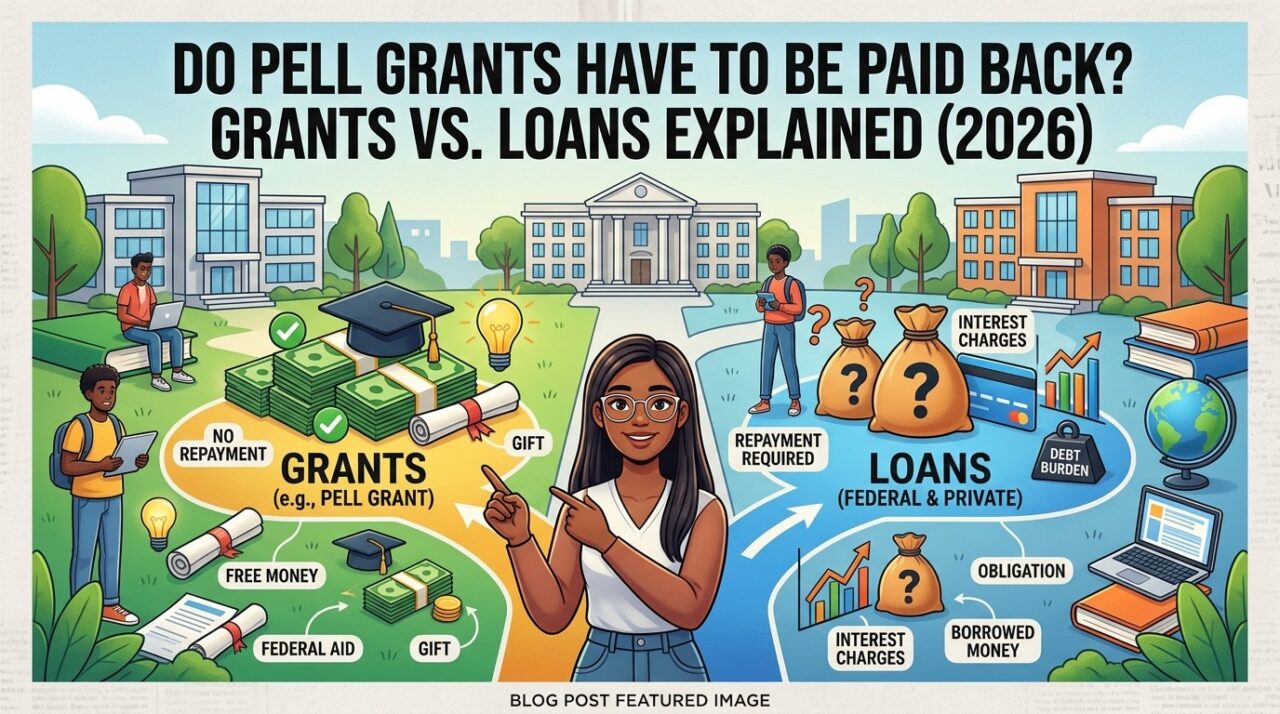
A grant is money for college that usually does not need to be repaid. Pell Grants are the best-known federal example. A loan is borrowed money that must be repaid, usually with interest. That is the cleanest and most important difference.
Here is the simple version high school seniors should remember:
- Grant: Usually free money for school.
- Loan: Borrowed money you pay back later.
- Work-study: Money you earn by working an approved student job.
If you remember only one sentence from this article, remember this: Pell is usually free aid, loans are debt.
When a Pell Grant may have to be paid back
This is the part that matters most. Pell usually does not have to be repaid, but sometimes part of it does. Federal Student Aid says certain situations can require a student to repay part or all of a grant.
1) You withdraw from school early
If you withdraw from school or stop attending during a payment period, your school may have to do a Return of Title IV Funds calculation. Under federal rules, if you attended 60% or less of the payment period or period of enrollment, your earned aid may be reduced. After the 60% point, a student is generally treated as having earned 100% of the Title IV aid scheduled for that period.
That matters because Pell is paid based on your actual attendance in an eligible period. If you leave very early, some of the money may be considered unearned aid, and the school may have to return part of it. If that creates a student grant overpayment, you can end up owing money back.
2) Your enrollment status changes
Your Pell amount is affected by your enrollment intensity and how long you attend during the award year. If you were awarded Pell based on one enrollment level and then you drop classes or stop attending enough classes, your school may have to recalculate your aid. That can reduce your Pell and create a balance you owe the school or the federal program.
This is one reason students get into trouble after the first refund hits their bank account. They think, “The money is mine now.” But if your schedule changes and the aid is recalculated, part of that refund may no longer be yours to keep.
3) You never started attending a class
Federal aid is tied to actual attendance in eligible coursework. If your school later determines that you never began attendance in one or more classes used to calculate your aid, your Pell may be adjusted. That can lead to an overpayment even if you did not mean to do anything wrong.
This is especially common when students register for a full schedule, collect a refund, and then never begin one class or get dropped for nonattendance. The paperwork catches up later.
4) Your FAFSA information changes or is corrected
Your eligibility is based on FAFSA data and school review. If your FAFSA is corrected, verified, or updated in a way that changes your eligibility, the Pell amount can change too. Federal Student Aid’s 2026–27 guidance also reflects updated Pell eligibility rules tied to statutory changes.
That does not mean every correction hurts you. Sometimes a correction helps. But if the correction lowers your eligibility after aid has already been paid out, your school may have to reduce the award and bill back the difference.
5) You received aid at more than one school for the same period
Federal Student Aid’s FAFSA materials state that if you are eligible for a Pell Grant, you may receive it from only one college for the same period of enrollment. If two schools end up paying Pell for the same term, one of those payments will have to be fixed, and that can create a repayment issue.
This sometimes happens when a student transfers, changes plans late, or forgets to fully withdraw from one school before starting at another. It sounds rare, but it is a real compliance problem.
6) Your school notifies you of a grant overpayment
Federal Student Aid says that if you must repay part of your grant, your school will notify you. From that point, you have 45 days to either repay that part of the grant in full or enter into a satisfactory repayment arrangement. That deadline is important. Do not ignore it.
What Pell repayment is not
Students often hear “you might have to pay Pell back” and imagine monthly bills for the next ten years. That is not what this usually means. Pell repayment issues are typically tied to a specific overpayment or adjustment, not a long-term repayment schedule like student loans.
So the real risk is usually this: you got aid, something changed, the school recalculated your eligibility, and now part of the grant must be returned. That is very different from borrowing $5,500 in loans and repaying principal plus interest after school.
How federal student loans are different
Federal student loans are the opposite of Pell in the most important way: they are borrowed money. You are expected to repay them. For Direct Subsidized and Direct Unsubsidized Loans, repayment generally begins after you graduate, leave school, or drop below half-time enrollment, and there is typically a six-month grace period before payments start.
The other big difference is interest. Federal Student Aid explains that Direct Subsidized Loans do not charge you interest while you are enrolled in school and during the six-month grace period, but Direct Unsubsidized Loans start accumulating interest from the date of the first disbursement. That is why unsubsidized loans get more expensive faster.
That is the heart of “grants vs. loans.” A Pell Grant usually stays free if you remain eligible. A loan becomes a future bill, and in many cases the bill grows because of interest.
The smartest order to accept aid
Federal Student Aid tells students to evaluate aid in this order: grants and scholarships first, then work-study, then student loans. That is smart because it puts the least risky money first and the debt last.
For a high school senior, that means this:
- Take Pell Grants and scholarships seriously because they usually do not need to be repaid.
- Consider work-study if it fits your schedule.
- If you still need to borrow, federal loans usually come before private loans because federal loans offer protections such as standard repayment structures and income-driven options.
A college with the bigger “aid package” is not always the better deal. The better deal is often the school that leaves you with less debt after grants and scholarships are counted. Federal Student Aid’s net-price guidance points students to calculate total cost minus grants and scholarships to see what they really owe out of pocket.
How your Pell amount is decided in 2026
Students often think Pell is one flat number. It is not. Your actual award depends on the formula and your school situation. Federal Student Aid says Pell amounts can depend on financial need, cost of attendance, enrollment, and related eligibility factors. The 2026–27 guidance adds that eligibility rules are tied to tax filing status, family size and composition, poverty guidelines, and state of residence, with SAI also used in many cases.
There are also important 2026–27 updates. Federal Student Aid’s August 2025 announcement says that beginning with the 2026–27 award year, an applicant with an SAI equal to or greater than twice the maximum Pell award is ineligible for Pell, and for 2026–27 that threshold is $14,790, except for students covered by the special rule for dependents of certain deceased servicemembers and public safety officers. The same announcement says the foreign earned income exclusion amount reported on the FAFSA is added to AGI for Pell eligibility determinations beginning in 2026–27.
That is why students should not rely on old FAFSA advice from social media. Pell rules can change by award year, and 2026 seniors should use current Federal Student Aid guidance.
How to avoid ever having to repay Pell money
The easiest way to avoid Pell repayment is to treat your aid like it is conditional until your attendance and enrollment are stable. That means showing up, staying enrolled as planned, and answering school requests quickly. Those simple habits prevent many overpayment problems before they start.
A smart checklist looks like this:
- Go to class and do not assume registration alone protects your aid.
- Do not drop courses without checking with the financial aid office first.
- If you withdraw, ask how the school will calculate Return of Title IV funds.
- If you get a refund, do not spend it too fast during add/drop season.
- Watch your FAFSA Submission Summary and school portal for corrections or verification notices.
- Make sure only one college is paying Pell for the same enrollment period.
What to do if your school says you owe Pell money back
Do not panic, but do not ignore it. Ask the financial aid office for the reason in writing. You want to know whether the issue came from a withdrawal, a class you never attended, a FAFSA correction, a duplicate Pell payment, or some other eligibility recalculation.
Then ask for the numbers. Specifically, ask for the date the school used as your withdrawal or attendance date, the enrollment level used in the recalculation, and the amount of the overpayment. If it is a Return of Title IV issue, ask for the school’s R2T4 calculation.
Most important, do not let the deadline slide. Federal Student Aid says you generally have 45 days from notification to repay the grant portion in full or make satisfactory repayment arrangements.
One more thing: Pell has a lifetime limit
This is not the same as repayment, but it matters. Pell Grant eligibility is limited by federal law to the equivalent of about 12 semesters, or roughly six years, which is commonly described as 600% Lifetime Eligibility Used. Federal Student Aid says students can track this through StudentAid.gov.
That means even if you never owe Pell money back, you still cannot collect it forever. Students who change majors repeatedly, attend part time for many years, or start and stop school a lot should keep an eye on this limit.
Can Pell money be paid to you as a refund?
Yes. Federal Student Aid’s FAFSA materials explain that aid is typically first applied to tuition, fees, and housing and food charged by the school. If money remains after those charges are covered, the remaining aid can be paid to you for other educational expenses.
That is normal, and getting a refund does not turn Pell into a loan. But it does mean you should handle that refund carefully, because if your aid later gets recalculated, part of the refunded amount may have to be returned.
How to check your Pell eligibility
After you submit the FAFSA, your confirmation page and later your FAFSA Submission Summary can show your estimated Pell eligibility and your Student Aid Index. Federal Student Aid also offers a Federal Student Aid Estimator for students who want an early estimate for the 2026–27 award year.
That estimate is not your final school award, but it is a good starting point. Your school still calculates the final offer based on federal rules and your college-specific cost of attendance.
Bottom line
So, do Pell Grants have to be paid back? Usually no. That is the rule students should start with. Pell is grant aid, and grant aid is not the same as debt.
But “usually no” does not mean “never.” You can end up owing Pell money back if you withdraw early, stop attending, have your enrollment or FAFSA data recalculated, receive duplicate Pell at two schools for the same period, or create another grant overpayment. The safest move is to understand your status, communicate with your financial aid office before making schedule changes, and treat refund money carefully until your attendance and aid are fully settled.
For high school seniors, the smartest mindset is this: accept grants first, borrow only when needed, and never assume all aid is free money just because it appears in one package. That one habit will help you choose a college more wisely and avoid unnecessary debt before freshman year even starts.
FAQ
Is a Pell Grant the same as a student loan?
No. A Pell Grant is grant aid that usually does not have to be repaid, while a student loan is borrowed money that must be repaid, often with interest.
Do parents have to pay back a Pell Grant?
Normally no, because Pell is not borrowed money. Repayment issues are usually tied to grant overpayments or eligibility changes, not a standard loan-style repayment obligation.
Can I lose Pell if I drop classes?
Yes, your Pell amount can be affected by enrollment changes, and if the school recalculates your aid, you may owe part of it back.
What happens if I withdraw halfway through the semester?
Your school may have to perform a Return of Title IV calculation. If you withdrew on or before the 60% point of the period, part of your aid may be treated as unearned and may have to be returned.
Can I get Pell at two schools at once?
Not for the same period of enrollment. Federal Student Aid says you may receive Pell from only one college for the same period.
How much Pell can I get in 2026–27?
For the 2026–27 award year, the published maximum Pell Grant is $7,395 and the minimum is $740, but your actual amount depends on your eligibility and school-specific factors.