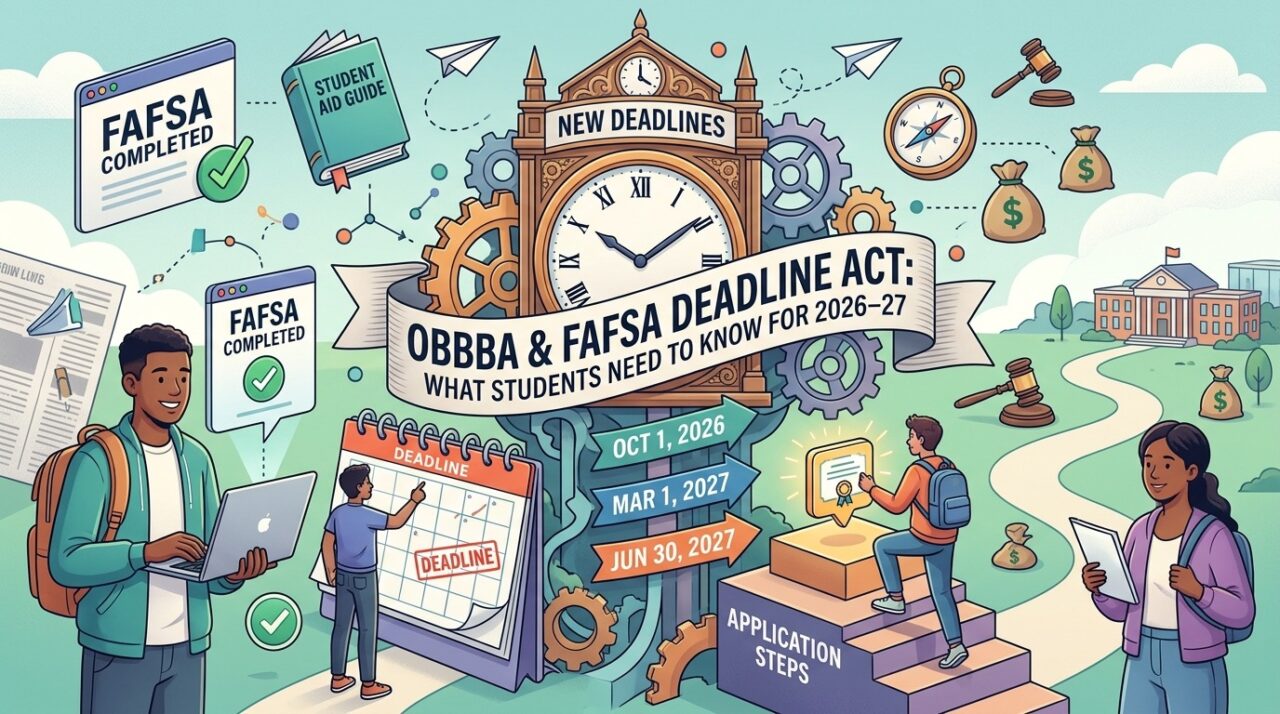
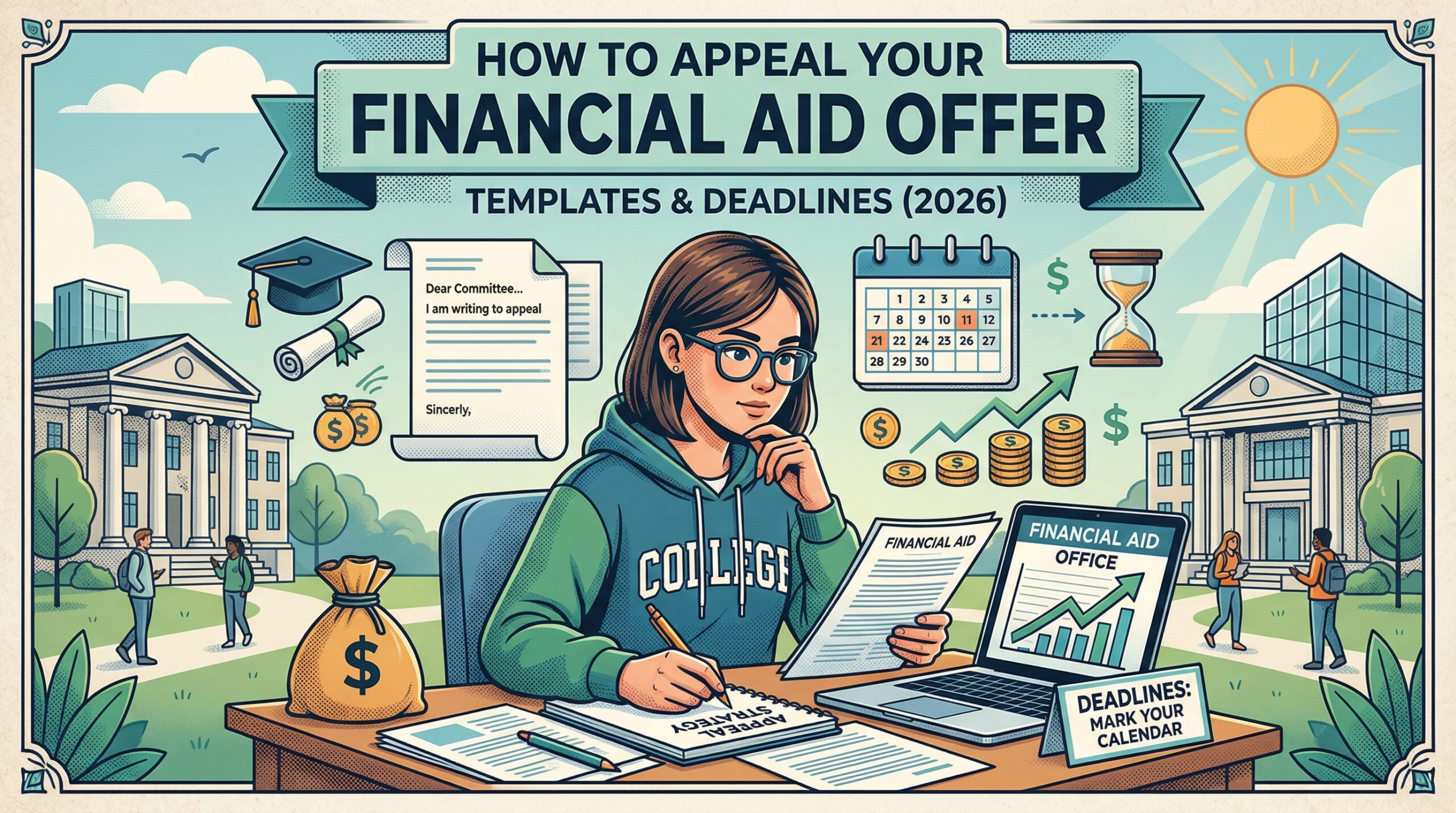
How to Appeal Your Financial Aid Offer: Templates & Deadlines (2026)
If your financial aid offer does not make college affordable, do not assume the first number is final. For the 2026–27 school year, the FAFSA uses 2024 tax information. That means your aid package may be based on a year that no longer reflects your family’s real situation today. If your parent lost a job, hours were cut, medical bills exploded, your parents separated, or your family had another major change, you may have a valid reason to ask the college to review your aid.
The official federal term for this kind of review is professional judgment. Under current U.S. Department of Education guidance for 2026–27, colleges may adjust parts of your cost of attendance, Pell Grant eligibility inputs, or Student Aid Index calculation when a student has special circumstances. They may also review unusual circumstances, which usually means dependency override situations when a student cannot safely contact a parent or parental contact would create risk. These decisions are made school by school, case by case, and the adjustment is valid only at the school that makes it.
So yes, a financial aid appeal is real. It is not begging. It is not cheating. It is not “trying your luck.” It is a formal process that exists because the aid formula cannot perfectly capture every family’s life. Federal Student Aid says colleges may request documentation and review your case under their own policy, and any decision the school makes is final and cannot be appealed to the U.S. Department of Education.
Who should appeal in 2026?
You should think seriously about appealing if your family’s current finances are worse than what your FAFSA or CSS Profile showed. The 2026–27 federal handbook specifically lists changes in employment, income, or assets; homelessness or other housing changes; K–12 tuition expenses; additional family members enrolled in college; medical, dental, or nursing home costs not covered by insurance; child or dependent care costs; severe disability in the household; and other changes that affect your ability to pay for college.
You may also need an appeal if your original aid package is missing something practical. Some colleges separate a normal need review from a cost of attendance or budget adjustment request. Johns Hopkins says families generally fall into two buckets: either the parent contribution is too high because the family’s financial picture changed, or the college’s budget is too low because the student has real costs not built into the standard estimate. UT Austin gives examples such as computers, extra books and supplies, rent, childcare, and travel.
A third category is the dependency override or unusual-circumstances appeal. Federal guidance says unusual circumstances can include human trafficking, refugee or asylee status, parental abuse, abandonment, estrangement, or incarceration. Students who indicate unusual circumstances on the FAFSA may be treated as provisionally independent while the school reviews the case.
A fourth category is merit reconsideration. Not every college does this, but some do. NJIT says students may submit competing scholarship offers for review, and RPI says its appeals committee may consider substantial costs not reflected on FAFSA or CSS Profile, other schools’ award letters, and even the amount that would make attendance feasible.
What usually qualifies and what usually does not
Strong appeal reasons usually involve a documentable change, not just disappointment. Good examples include a parent layoff, a major pay cut, a death in the family, a divorce or separation after filing, unusually high unreimbursed medical bills, a housing disruption, or a major expense the school’s budget does not reasonably capture. Federal Student Aid’s public guidance specifically points to layoff, incarceration, reduction in work, divorce, medical expenses, death in the family, or income loss from a rental property or court settlement as examples that can justify an aid adjustment request.
Weak appeal reasons are the ones families often wish counted but usually do not. Federal guidance says unusual circumstances do not include parents refusing to pay, parents refusing to provide FAFSA information, parents not claiming the student on taxes, or the student simply being self-supporting. The 2026–27 handbook also warns colleges not to treat routine living costs or consumer debt as a basis for unreasonable adjustments. University at Albany’s current appeal page similarly says house payments, car expenses, living without roommates, and credit card debt are not special circumstances, and that bankruptcy itself is not something need-based aid can cover.
That distinction matters because many students say, “My parents won’t help me.” That is a real hardship, but it is not automatically a dependency override. Federal guidance says a student in that situation may still be dependent for FAFSA purposes, though the school may let the student borrow only a dependent-level Direct Unsubsidized Loan if the college properly documents the lack of parental support.
Before you appeal: do this first
Before you send an appeal, make sure your original file is complete. Sometimes the real problem is not that the school said “no.” It is that the school is still missing required forms. RPI tells students that need-based aid packages may be delayed if either the FAFSA or CSS Profile is missing, or if forms were filed after the school’s priority deadline.
Also remember that FAFSA and CSS Profile are not the same thing. FAFSA is the federal form. CSS Profile is used by many colleges to award institutional aid, and College Board says it unlocks access to more than $14 billion in nonfederal aid. CSS Profile is also free for families making up to $100,000 a year. If a college uses CSS Profile, your appeal may need to address both your FAFSA-based federal aid and your school-based aid file.
For divorced or separated families, another issue may be the noncustodial parent requirement. College Board says students with no contact with a noncustodial parent may submit a CSS Profile Waiver Request for the Noncustodial Parent, and each college decides whether to waive that requirement.
Deadlines in 2026: there is no one national date
There is no single U.S. deadline for appealing a financial aid offer. Federal law allows schools to review cases, but the process and timing are set by each institution. In practice, that means your smartest move is to appeal as soon as you receive the offer and ideally before your enrollment deposit deadline.
Current 2026 examples show how different the timing can be. The University of Maryland says 2026–27 special-circumstance appeals for recently admitted freshmen and transfer students opened on March 1, 2026, with decisions provided by May 1. TCNJ says 2026–27 special-circumstance reviews will not begin until after June 1, 2026. The University of Arizona lists 2026–27 FAFSA Data Appeals opening March 2, 2026, with a preferred deadline of December 1, 2026 for fall-only students and April 16, 2027 for students attending fall and spring. Southern Connecticut State University lists May 1, 2027 as the deadline for 2026–27 appeals.
Davidson’s current policy shows why early action matters. It says admitted students should appeal as soon as possible after receiving their financial aid decision and before paying the enrollment deposit. It notes that regular-decision students should submit by April 15 to maximize the chance of getting a decision before May 1, and that institutional appeals generally are not granted retroactively for a semester that has already begun.
The practical lesson is simple: appeal early, not emotionally and not sloppily. Some schools move fast, some move slowly, and many make decisions in the order appeals arrive. Cornell says appeals are reviewed in order received and that a typical response time is 10 to 15 business days.
What to include in your appeal packet
A strong appeal packet usually includes five things: the college’s appeal form if it has one, a short written explanation, supporting documents, your original award letter, and a clean summary of what changed financially. Federal Student Aid says acceptable documentation can include a documented interview, statements from you or a parent, third-party statements, school staff statements, court or legal documents, and other supplemental information about the family’s financial status or personal circumstances.
Your documents should match your reason. For job loss, use a termination letter, unemployment documentation, recent pay stubs, and year-to-date income. For divorce or separation, use a separation agreement, divorce filing, or proof of separate households. For medical hardship, use unreimbursed bills, insurance statements, and payment records. For death in the family, use a death certificate or obituary plus proof of lost income or benefits. Arizona’s current appeal page lists documents such as tax return transcripts, 1040s, termination letters, 1099-Rs, medical bills, and death certificates.
Do not send a messy emotional essay with no proof. Cornell says incomplete or insufficient documentation may cause an appeal to be denied. RPI says it will review only one appeal per student during the admissions cycle, which means your first submission needs to be your best one.
How to make your appeal stronger
The best appeals are calm, specific, and numerical. Show the school what changed, when it changed, and how that affects your ability to pay. Do not write, “We can’t afford it.” Write, “My parent earned $82,000 in 2024, was laid off in January 2026, and household income for 2026 is now projected at about $38,000. Attached are the layoff notice, unemployment statement, and the most recent pay records.” That makes the review easier.
It also helps to ask for the right kind of review. If your family income crashed, ask for a special-circumstances or professional judgment review. If the problem is that you need a computer, extra travel funding, or childcare help, ask for a cost-of-attendance or budget adjustment review. If your issue is unsafe or impossible parental contact, ask for an unusual-circumstances or dependency override review. If another college gave you a stronger package, and the school permits it, ask whether it reviews competing offers or merit reconsideration.
Also be realistic. An approved appeal does not always mean free money. Drexel says appeal submission does not guarantee additional assistance, and Cornell says even approved appeals may not result in extra grant or scholarship aid. Sometimes the result is only a federal adjustment, a loan change, a work-study offer, or a budget change rather than new gift aid.
Template 1: Special-circumstances appeal email
Subject: Request for Financial Aid Review for Special Circumstances
Dear Financial Aid Office,
Thank you for the financial aid offer and for reviewing my application. I am very grateful to have been admitted.
I am writing to request a review of my financial aid package because my family’s current financial situation is significantly different from the information reflected in my FAFSA/CSS Profile. Since filing, our household has experienced the following change(s): [brief one-sentence summary].
Here is the key change in numbers:
- 2024 reported income: [$ amount]
- Current 2026 projected household income: [$ amount]
- Date the change occurred: [date]
I have attached documentation to support this request, including [list documents]. Because of this change, the current aid offer does not reflect my family’s present ability to pay.
[College Name] is one of my top choices, and I would be grateful for a professional judgment review of my aid eligibility. Thank you for your time and consideration.
Sincerely,
[Student Name]
[Application ID]
[Phone]
[Email]
Template 2: Full appeal letter for job loss, divorce, or medical hardship
Dear [Financial Aid Administrator or Office Name],
I am writing to respectfully request a review of my financial aid offer for the 2026–27 academic year due to special financial circumstances that occurred after the income year used on my aid applications.
My current financial aid package was based on 2024 financial information. Since then, my family’s situation has changed in a serious way. On [date], [parent name] experienced [job loss / pay reduction / divorce / death in family / major unreimbursed medical costs]. As a result, our family’s ability to contribute toward college has been reduced.
A summary of our current situation:
- Household income reported from 2024: [$ amount]
- Current estimated 2026 household income: [$ amount]
- Major out-of-pocket expenses related to this change: [$ amount]
- Number of family members currently supported by this income: [number]
Attached are the documents supporting this appeal:
- [Termination notice / unemployment record / pay stubs]
- [Tax return / W-2 / year-to-date earnings]
- [Medical bills / insurance statements]
- [Divorce decree / separation documentation / death certificate]
- [Any additional explanation]
I understand aid reviews are handled case by case, and I appreciate your time. [College Name] remains a school I would strongly like to attend, but the current package leaves a gap my family cannot reasonably cover. I am requesting a special-circumstances review of my financial aid eligibility.
Thank you for considering my appeal.
Sincerely,
[Student Name]
[Application ID]
Template 3: Cost-of-attendance or budget adjustment request
Subject: Request for Cost of Attendance / Budget Adjustment Review
Dear Financial Aid Office,
I am requesting a review of my cost of attendance for the 2026–27 academic year because my actual educational expenses are higher than the standard student budget used in my award offer.
My additional documented costs include:
- Computer purchase required for coursework: [$ amount]
- Additional course materials/supplies: [$ amount]
- Childcare or dependent care: [$ amount]
- Necessary travel expenses: [$ amount]
- Other educationally related costs: [$ amount]
I have attached receipts, invoices, or statements for each expense. I understand that a budget adjustment may not always increase grant aid, but I would appreciate a review of whether my cost of attendance can be updated and whether that affects my aid eligibility.
Thank you for your consideration.
Sincerely,
[Student Name]
[Application ID]
Template 4: Merit reconsideration or competing-offer request
Subject: Request for Scholarship Reconsideration
Dear [Admissions Office or Financial Aid Office],
Thank you again for my admission and scholarship offer. I am honored to be admitted to [College Name].
I am writing to ask whether my scholarship package can be reconsidered. [College Name] is a strong fit for me academically and personally. However, I have received another offer from [Other College] that reduces my out-of-pocket cost significantly.
I have attached a copy of the competing award letter for your review. If there is any possibility of reconsidering my scholarship or overall aid offer, I would be very grateful. An adjustment would make a meaningful difference in my ability to enroll.
Thank you for your time and consideration.
Sincerely,
[Student Name]
[Application ID]
Template 5: Unusual-circumstances / dependency override request
Dear Financial Aid Office,
I am requesting an unusual-circumstances review regarding my dependency status for financial aid purposes. I am unable to provide parental information because [brief accurate explanation: abandonment, abuse, estrangement, incarceration, inability to safely contact a parent, etc.].
I understand that this type of request requires documentation. I have attached the materials available to support my situation, including [court record / counselor statement / letter from social worker / teacher / attorney / clergy / agency documentation].
I respectfully ask the office to review my case for a dependency override or other appropriate determination under your policy. Thank you for reviewing my request.
Sincerely,
[Student Name]
[Application ID]
What to say on the phone
When you call, keep it simple:
“Hi, I’m an admitted student for 2026–27 and I want to ask about a financial aid appeal. My family’s current situation is different from the 2024 income on my FAFSA. Could you tell me the correct process for a special-circumstances review, what documents you need, and the deadline for my case?”
That script works because it does three things fast: it tells them your status, names the right issue, and asks for the process instead of arguing about the result.
What happens after you appeal
After you submit, the school may ask for more documents, deny the appeal, or revise your package. Cornell says appeals are reviewed in order and typically take 10 to 15 business days. Drexel says students are informed of the decision by email. Some schools also warn that a successful appeal may revise only federal aid or cost of attendance, not necessarily increase grant dollars.
Do not assume you can keep appealing forever. RPI says it reviews a maximum of one appeal per student during the admissions cycle. Boston University says it does not re-review appeal requests during the academic year once they have already been considered.
If the college says no
A denial hurts, but it is not the end of the road. Ask one clear follow-up question: “Was the denial based on policy, insufficient documentation, or limited funds?” That tells you whether the case was weak, the paperwork was weak, or the budget was weak.
Then ask about the next-best options:
- whether a payment plan is available,
- whether work-study can be added,
- whether a cost-of-attendance adjustment is more appropriate than a need appeal,
- whether outside scholarships can reduce borrowing,
- whether housing changes could lower total cost,
- and whether the school expects any aid reallocation later in the cycle.
Federal Student Aid and College Board both point students back to the financial aid office to ask what additional aid or programs may still be available.
Best official links to use
For a legit, official appeal process, start here:
- Federal Student Aid: What Is Professional Judgment?
- Federal Student Aid: What to Do When Your Financial Aid Isn’t Enough
- Federal Student Aid: FAFSA Form
- Federal Student Aid Handbook 2026–27, Chapter 5: Special Cases
- CSS Profile
- CSS Profile Noncustodial Parent Waiver Information
Final advice for high school seniors
Appeal your aid offer when the numbers are wrong for your real life, not just when the offer feels disappointing. Move quickly. Use the school’s form. Match your reason to the right type of review. Send proof. Be respectful. Be specific. And remember the biggest 2026 truth in this whole process: your college may still be looking at 2024 income, while your family is living in 2026 reality. That gap is exactly why the appeal system exists.
FAQ
Can I appeal before I commit to a college?
Yes, and that is usually the smartest time to do it. Davidson specifically encourages admitted students to appeal before paying the enrollment deposit whenever possible.
Can I appeal after I deposit?
Sometimes, yes. But many colleges handle appeals best before the term starts, and Davidson says institutional appeals are generally not granted retroactively after the semester has begun.
Can I appeal because another school offered me more money?
Sometimes. NJIT and RPI both indicate that competing offers may be considered in scholarship or appeal review.
Can I appeal directly to the U.S. Department of Education if the college says no?
No. Federal Student Aid says the school’s professional judgment decision is final and cannot be appealed to the Department.
What if my parent refuses to help me pay?
That alone usually does not qualify for a dependency override. Federal guidance says refusal to contribute, refusal to provide FAFSA information, and self-sufficiency alone do not count as unusual circumstances.
Do I need both FAFSA and CSS Profile?
Only if your college requires both. Some schools do, and missing one can delay a need-based offer.
Is there one universal appeal deadline for 2026?
No. Schools set their own dates. Current 2026 examples range from March openings to spring 2027 deadlines depending on the institution and appeal type.