New York Expands Child Care at 11 SUNY Community Colleges to Support Free-Tuition Students
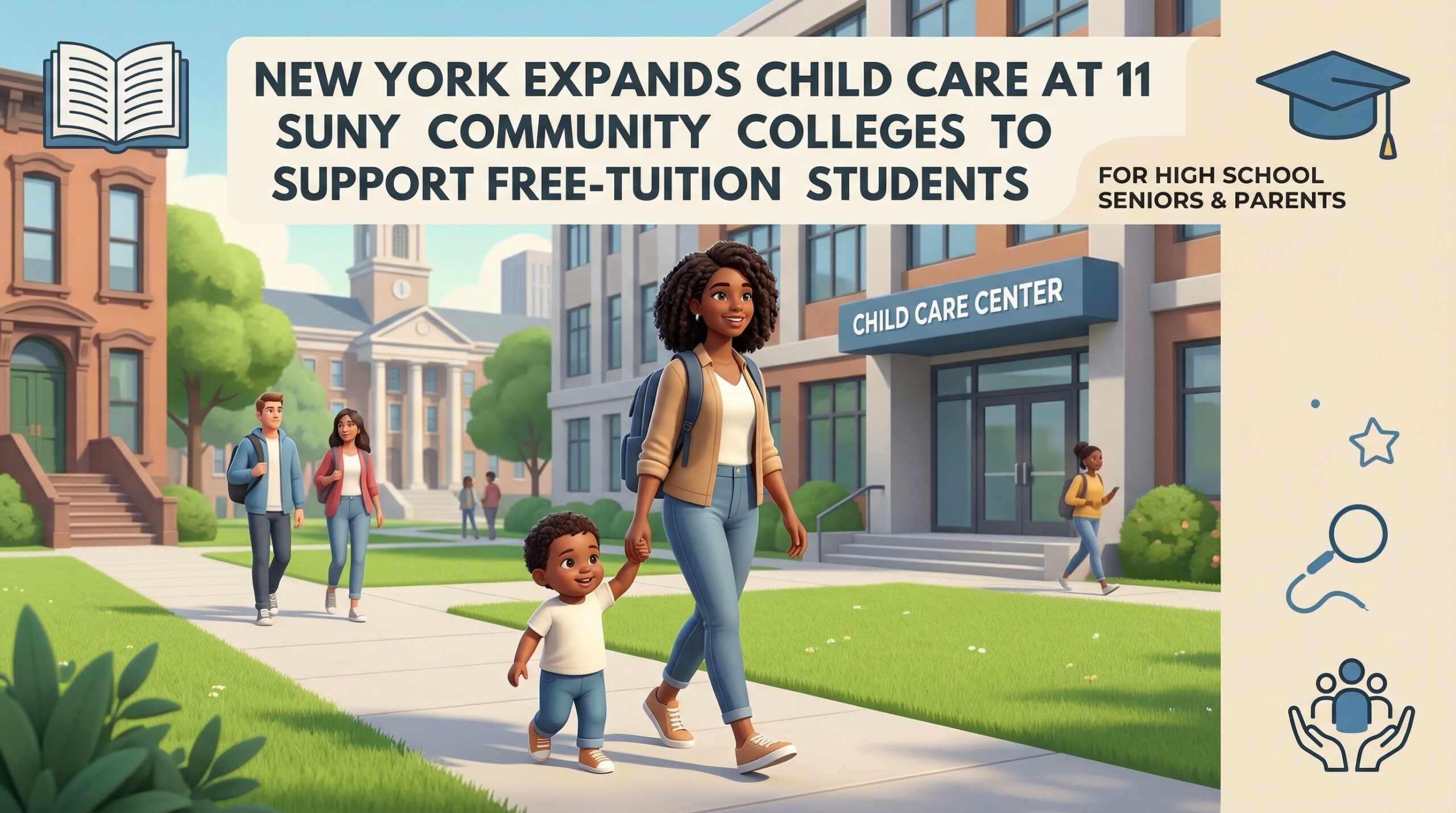
New York announced on March 12, 2026 that child care services will expand at 11 SUNY community colleges. According to the state, the changes will either add evening and weekend child care hours or create more infant and toddler slots, with the goal of helping student parents stay enrolled in high-demand programs, including SUNY Reconnect.
That makes this a real college-affordability story, not just a campus-services update. The state is directly addressing one of the biggest non-tuition barriers that can stop student parents from enrolling, persisting, or finishing a degree even when tuition support exists. New York’s own announcement frames the expansion as part of its effort to remove barriers to student success and improve access to reliable child care.
What SUNY Reconnect Actually Covers
SUNY Reconnect is SUNY’s free community college program for adult New Yorkers. Through the New York State Opportunity Promise scholarship, eligible students can get tuition, fees, books, and supplies covered after other aid, including New York State TAP, is applied. The program is for New York residents ages 25 to 55 who do not already have a college degree and who enroll full time or part time in an eligible associate degree program in a high-demand field.
Official SUNY materials list the main eligible fields as advanced manufacturing, artificial intelligence, cybersecurity, engineering, technology, nursing and allied health, green and renewable energy, and pathways to teaching in shortage areas. SUNY also says the program includes advising, flexible scheduling, and other adult-learner supports.
What New York Announced on March 12
The March 12 announcement did not create a statewide child care benefit for every SUNY campus. Instead, it expanded support at 11 SUNY community colleges, with some campuses extending hours into evenings or weekends and others creating more capacity for infants and toddlers. That distinction matters because the policy is targeted, not universal.
The five campuses adding evening or weekend-style access are:
- SUNY Broome Community College, which will create additional evening care hours.
- Dutchess Community College, which will add two more weeknights of evening hours and expand slots for infants and toddlers.
- Finger Lakes Community College, which will extend evening hours up to 9 p.m. two days per week.
- Monroe Community College, which will add 16 additional evening hours and create more infant and toddler slots.
- Onondaga Community College, which plans to partner with the YMCA to provide evening child care spots for adult learners enrolled through SUNY Reconnect.
The six campuses creating additional infant and toddler capacity are:
- Jamestown Community College
- Nassau Community College
- SUNY Niagara Community College
- Rockland Community College
- Tompkins Cortland Community College
- SUNY Westchester Community College
Why This Matters for College Affordability
A lot of financial-aid coverage focuses on tuition first. That makes sense, but it can miss the real-world reason many students stop out. For adult learners and student parents, the blocker is often not just the tuition bill. It is scheduling, transportation, lost work time, and child care. New York’s move is important because it pairs tuition-free access with practical support that can help students actually use the benefit.
This is also consistent with how SUNY has been building out the adult-learner system around Reconnect. SUNY reported that more than 5,600 New Yorkers had enrolled in SUNY Reconnect since the program launched in fall 2025. SUNY also said it allocated $4 million for implementation support, $1 million for equipment and capacity needs, and $1.1 million for its Adult Learner Leadership Initiative.
The state has also been investing in child care on SUNY campuses before this March 2026 move. Officials said Governor Hochul announced $10.8 million in 2022 to address child care deserts and expand capacity, and in 2023 announced 200 spots at 12 SUNY campus child care centers through $1.72 million in funding. That means the March 12 action is not a one-off press release. It fits into a broader affordability and student-support strategy.
The Bigger Policy Context
New York launched SUNY and CUNY Reconnect as part of its 2025 affordability push for adult learners in high-demand fields. The state said the program covers tuition, fees, books, and supplies after applicable aid and is designed for millions of working-age adults who do not already hold a college degree or credential. One official New York release described that population as roughly four million working-age adults statewide.
In the 2026 State of the State rollout, Governor Hochul also tied affordability policy to a broader path toward more universal and affordable child care. That does not mean college-campus child care problems are solved statewide. It does mean this SUNY expansion sits inside a larger state argument that affordability is about daily life supports, not only tuition stickers.
What High School Seniors Should Know
Most traditional high school seniors will not qualify for SUNY Reconnect right now because the program is designed for New Yorkers ages 25 to 55 who do not already have a college degree. But the story still matters for younger students and families because it shows where college-affordability policy is heading: stronger programs now try to cover the full path to attendance, including books, supplies, advising, and sometimes child care, not just tuition.
There is also a practical financial-aid lesson here for seniors. SUNY says Reconnect is a last-dollar style benefit that applies after other aid such as TAP. That means students still need to pay attention to the normal aid process and not assume “free tuition” means they can ignore forms and deadlines.
What Student Parents and Adult Learners Should Do Next
Students who think they may qualify should start with the official SUNY Reconnect page and the SUNY Reconnect FAQ. Those pages explain eligibility, approved fields, and which campuses offer eligible programs.
Next, they should check whether their local campus is one of the 11 colleges included in the child care expansion and ask specific questions about hours, age groups served, seat availability, waitlists, and whether the campus uses a college-run center or a community partner. The state announcement makes clear that campus arrangements are not identical.
Students should also complete the normal aid process. Since SUNY says Reconnect covers costs after other aid such as TAP is applied, New Yorkers should still review TAP, complete the NYS TAP application when required, and make sure they are handling FAFSA and state-aid steps on time. HESC says students eligible for federal aid must complete both the FAFSA and the NYS TAP application for TAP.
Bottom Line
New York’s March 12, 2026 expansion of child care at 11 SUNY community colleges matters because it targets the real-life barrier that can keep tuition-free students from actually using a college opportunity. SUNY Reconnect already removes major direct costs for eligible adult learners. This new child care expansion tries to make that promise more usable for student parents by matching care hours and capacity to the reality of evening classes, workforce programs, and family schedules.
For ScholarshipsAndGrants.us readers, the lesson is simple: the best affordability programs are no longer just about lowering tuition. They are about helping students stay enrolled long enough to finish. New York’s SUNY child care expansion is one of the clearest recent examples of that shift.
Official Links
- Governor Hochul Announces the Expansion of Child Care Services at SUNY Community Colleges
- HESC announcement on the SUNY child care expansion
- SUNY Reconnect: Free Community College for Adult Learners
- SUNY Reconnect FAQ
- SUNY Reconnect Information Sessions
- New York State TAP official page
- NYS TAP application