ED opens a new Talent Search cycle, but this is not a direct student application
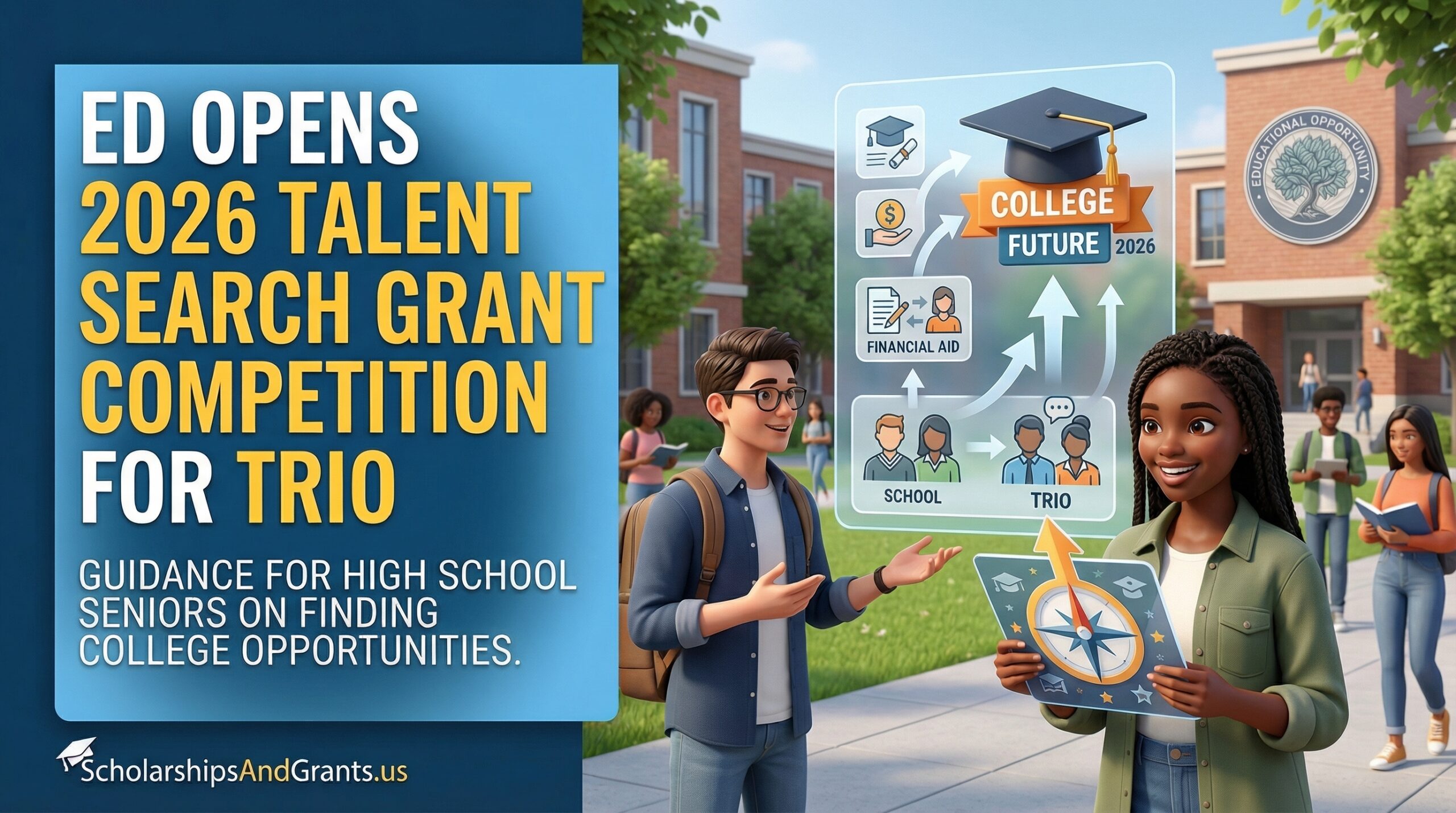
On March 17, 2026, the U.S. Departments of Education and Labor opened the Fiscal Year 2026 Talent Search competition, a major federal TRIO grant aimed at helping students from disadvantaged backgrounds prepare for college or training. The competition makes $175,152,359 available, estimates 175 awards, sets a 60-month project period, and gives applicants until May 1, 2026 to apply. ED also says this is the first grant competition under its postsecondary partnership with the Department of Labor.
For students and families, the biggest point is simple: Talent Search is not a scholarship or grant that an individual high school senior files for directly. It is a federal grant competition for colleges, school systems, nonprofits, tribes, and similar organizations that run college-access services for students. If a local organization wins funding, students benefit through advising, FAFSA help, college-planning support, tutoring connections, and career-pathway guidance.
What Talent Search actually does
The federal Talent Search program is designed to identify and support people from disadvantaged backgrounds who have the potential to succeed in postsecondary education. The program description and regulations say projects help students with academic planning, college admissions steps, financial-aid information, FAFSA completion, financial literacy, and guidance into secondary-school reentry, GED pathways, or postsecondary education. In other words, Talent Search is part advising system, part college-access bridge, and part navigation support for students who might otherwise miss college or training opportunities.
That matters because the services are practical. Federal regulations require projects to provide connections to tutoring, advice on course selection, help preparing for college entrance exams and admission applications, information on Pell Grants and other aid, and assistance completing financial-aid applications including the FAFSA. Projects may also offer counseling, mentoring, campus visits, family workshops, and career exploration.
Why this 2026 competition matters
This competition launches the FY 2026 TRIO grant cycle for Talent Search, and ED’s March 17 press release says additional TRIO competitions are expected later in the spring and summer. The new competition is also the first one run under the ED-DOL postsecondary partnership, which makes it more than a normal grant opening. It is also a test of a new way the federal government plans to administer some postsecondary grant programs.
The policy shift is administrative, not a rewrite of the Talent Search law itself. In a March 16, 2026 Dear Colleague letter, ED said new FY 2026 opportunities would still be posted on Grants.gov, but new awards would move to GrantSolutions, the Labor Department’s grants-management platform. The same letter says current and existing grants stay in ED’s G5 system, while new FY 2026 awards will also use the federal Payment Management System for payments.
The Labor partnership, in plain English
ED and DOL say their partnership is meant to connect postsecondary education programs more closely with workforce-development programs. The March 16 letter says the goals are to provide administrative reforms, improve the experience for students and grantees, and connect ED programs with DOL programs in a more coordinated federal approach. A January 15 ED announcement said DOL would help manage grant funds, provide technical assistance, and integrate covered postsecondary programs with the workforce programs DOL already runs.
For high school seniors, that does not mean Talent Search suddenly becomes a trade-school-only program or stops being about college access. What it does mean is that the 2026 competition explicitly connects college-access work with broader workforce and credential pathways, including pre-apprenticeships and Registered Apprenticeships.
What is new in the FY 2026 notice
The FY 2026 application materials show that every application must meet an absolute priority called Expanding Education Choice. In the notice, that includes expanding access to high-impact tutoring, distance education, pre-apprenticeships, Registered Apprenticeships, and programs or coursework that lead to in-demand, industry-recognized postsecondary credentials. The competition also includes a competitive preference priority worth up to 5 additional points for projects carried out by state agencies, state workforce boards, state higher-education agencies, or certain tribal entities.
The program page also says the Talent Search division plans to host 10 pre-application technical-assistance webinars with live Q&A from April 1 through April 8, 2026. That is a signal that the department expects serious organizational interest in the competition and wants applicants ready quickly.
Who can apply, and who is supposed to be served
Eligible applicants include institutions of higher education, public or private agencies or organizations including community-based organizations, secondary schools, and combinations of those entities. So again, this is a competition for organizations, not for individual students.
By regulation, applicants must assure that at least two-thirds of the people they serve will be low-income individuals who are potential first-generation college students. The current 2026 TRIO low-income table says the threshold is 150% of the poverty level. For the 48 contiguous states and D.C., that is $32,460 for a family of 2, $40,980 for a family of 3, and $49,500 for a family of 4.
Program participation rules are also broader than many families realize. Regulations generally allow participants who have completed five years of elementary school or are ages 11 through 27, including students in grades 6 through 12, dropouts, graduates needing reentry support, and some people who started but are not currently enrolled in postsecondary education. Veterans can qualify regardless of age if they meet the other eligibility rules.
What the grant can pay for, and what it cannot
Talent Search money supports services, not direct cash awards to students. The regulations and FY 2026 booklet make clear that projects can fund advising and support activities, but cannot use Talent Search dollars for stipends or other direct financial support to participants, financial-aid application fees, unrelated research, or construction/renovation.
That distinction matters for search traffic and reader expectations. A student may absolutely benefit from Talent Search, but this March 2026 announcement does not mean the federal government just opened a new direct scholarship portal where students can claim money on their own. The benefit is indirect but still important: if strong local projects win funding, students get more help navigating college and training choices.
The numbers behind Talent Search
The latest official Talent Search GPRA report helps explain why this program still matters. For the 2023-24 reporting year, ED said the Talent Search program-level postsecondary enrollment rate for college-ready senior participants was 71.5%, while the financial-aid application rate among senior participants was 78.3%. Among college-ready participants who enrolled, 57.4% went to four-year institutions and 39.3% went to two-year institutions. ED also cautioned that these are project-performance measures, not proof of causal impact by themselves.
That same federal report says 548 projects were funded in both 2022-23 and 2023-24, though two were not operating and did not submit APR data. By contrast, the FY 2026 notice estimates 175 awards. Taken together with the much larger possible award ceiling in the new notice, including up to $10 million annually for one governor-designated state-level applicant and for certain tribal applicants receiving the priority, the 2026 design appears to allow for fewer but potentially larger awards in some cases. That is a reasonable reading of the current documents, though final award patterns will depend on actual applications and agency decisions.
What high school seniors should do now
If you are a high school senior, your move is not to hunt for a Talent Search application form for yourself. Your move is to find out whether your school district, a nearby college, or a community-based organization in your area already runs a TRIO Talent Search project or plans to compete for one. Ask your counselor, college-access office, or local college outreach program. The students most likely to benefit are those who need hands-on help with admissions, FAFSA, scholarships, academic planning, and deciding between four-year college, community college, certificate programs, and apprenticeship-style options.
Families should also remember that Talent Search is a support layer, not a substitute for filing the FAFSA or applying for aid. Even with stronger outreach, students still need to handle their own college list, FAFSA timing, state deadlines, scholarship applications, and award-letter comparisons. Talent Search can help with those steps, but it does not replace them.
Bottom line
The March 17, 2026 announcement is one of the most important college-access funding stories of the month because it opens a new federal TRIO cycle and ties Talent Search to the Education-Labor postsecondary partnership. The money is not a direct grant for individual students, but it can shape whether low-income and first-generation students in many communities get advising, FAFSA help, admissions support, and clearer pathways into college, training, or apprenticeship opportunities over the next five years.
FAQ
Is the 2026 Talent Search competition a scholarship students apply for themselves?
No. The FY 2026 competition is for eligible organizations such as colleges, schools, nonprofits, and similar entities. Students benefit only if those organizations win funding and run local Talent Search services.
Who is Talent Search mainly meant to help?
By regulation, applicants must assure that at least two-thirds of participants are low-income individuals who are potential first-generation college students. Program rules also allow service for students in grades 6-12, some dropouts, reentry students, and certain others who need a pathway into postsecondary education.
Does the 2026 competition include career-training and apprenticeship pathways?
Yes. The FY 2026 priority language explicitly includes pre-apprenticeships, Registered Apprenticeships, and programs leading to in-demand, industry-recognized credentials.
Can Talent Search pay students cash?
Not as a general direct-aid program. Regulations say Talent Search funds cannot be used for stipends or other forms of direct financial support for participants.
Official resources
Use these active official links in your WordPress article:
-
U.S. Department of Education press release on the FY 2026 Talent Search competition
-
FY 2026 Talent Search application notice and instructions (PDF)
-
March 16, 2026 Dear Colleague letter on the ED-DOL grants partnership (PDF)
-
ED announcement on next steps in the postsecondary partnership
Related internal links
Add these active internal links near the top, middle, or end of the post: