ED and Treasury Announce New Federal Student Assistance Partnership
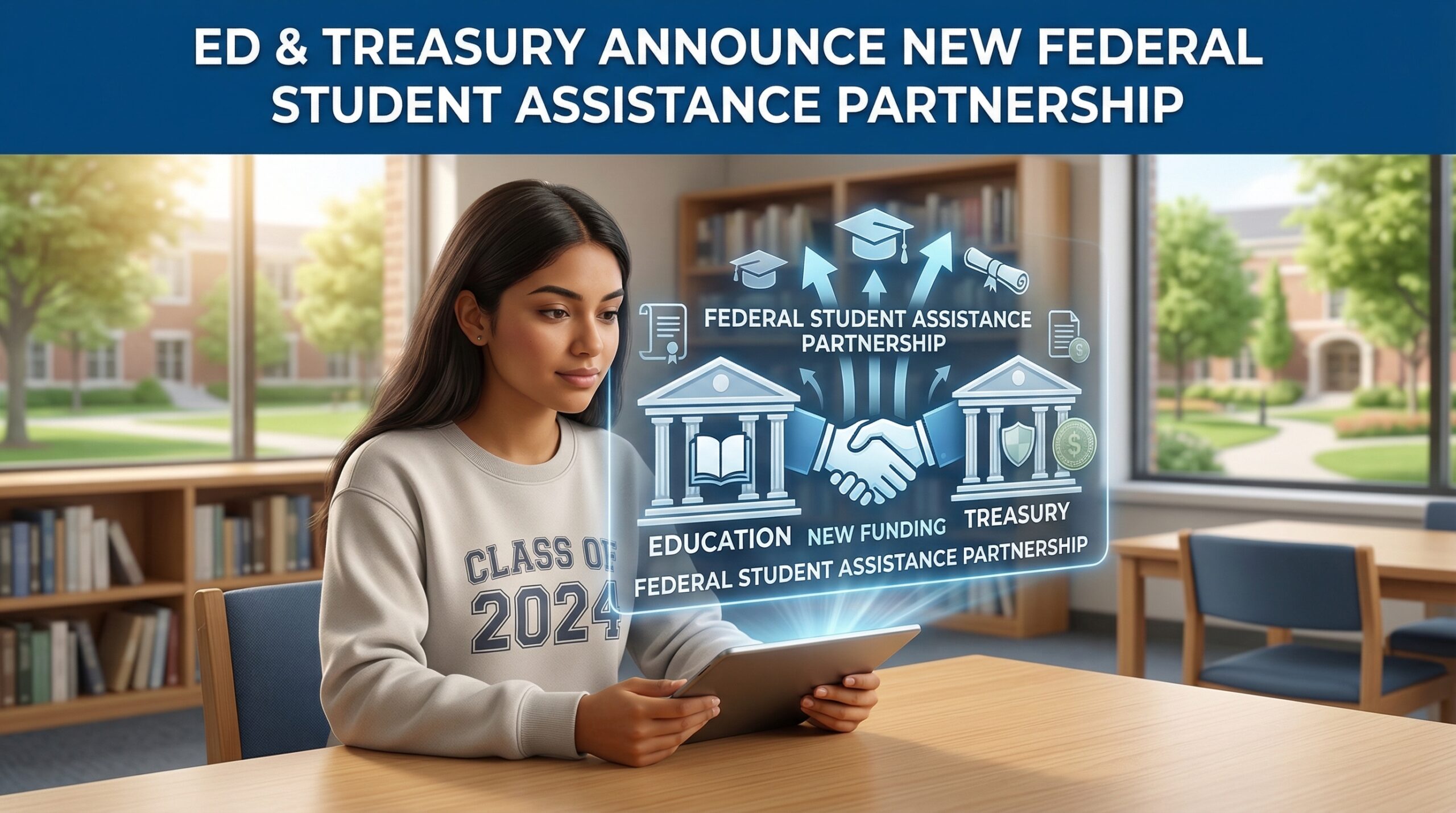
The U.S. Department of Education and the U.S. Department of the Treasury announced a new Federal Student Assistance Partnership on March 19, 2026. In plain English, this means Treasury will begin taking on some operational work tied to federal student aid and student loans, starting first with defaulted federal student loan debt. The agencies say the goal is to improve how the federal government runs student-aid programs and to help move defaulted borrowers back into repayment. U.S. Department of Education announcement, U.S. Department of the Treasury announcement.
For high school seniors and families, the most important point is this: the FAFSA is not being replaced, and current core aid systems are staying in place right now. The official fact sheet says existing systems such as the FAFSA, the Common Origination and Disbursement (COD) System, and the National Student Loan Data System (NSLDS) will remain in place, and borrowers should keep working with their assigned loan servicer. Official fact sheet.
What actually changed on March 19, 2026?
According to the official fact sheet, ED and Treasury entered into an interagency agreement to expand Treasury’s operational role in federal student aid. The first phase is focused on collecting defaulted federal student loan debt and supporting borrowers who are in default so they can return to good standing through tools such as rehabilitation. Treasury will also assume operational responsibilities for FSA’s Default Resolution Group and the Default Management and Collections System (DMCS).
The same fact sheet says later phases could expand Treasury’s operational support to non-defaulted federal student loan debt and potentially to other Federal Student Aid functions, including areas related to FAFSA administration, but only “to the extent practicable and permitted by law.” The Department of Education says it will still keep all statutory responsibilities and policy development authority. That is a crucial distinction: this is an operational partnership, not a full handoff of federal student-aid lawmaking or policy control.
Why ED says it is doing this
The Education Department’s March 19 press release says the federal student loan portfolio stands at nearly $1.7 trillion, with fewer than 40% of borrowers in repayment and almost 25% of borrowers in default. The agencies presented the partnership as a response to the size and complexity of the portfolio and as a way to use Treasury’s finance, collections, and systems expertise.
The fact sheet adds more institutional detail. It says Treasury already plays a significant role in federal student aid because Treasury disburses funds for federal student loans, supports ED’s use of federal tax information systems for FAFSA and income-driven repayment verification, and administers the Treasury Offset Program used in debt collections. The document also says Treasury intends to revoke an old exemption that had allowed FSA to service its own defaulted debt under the Debt Collection Improvement Act framework.
The bigger context: federal student aid is huge
This announcement matters because Federal Student Aid is not a small program. In its FY 2025 Agency Financial Report, the Department said FSA delivered more than $131.1 billion in Title IV aid to 10.5 million postsecondary students and families. The same report says FSA processed a record 19.2 million FAFSA forms in FY 2025 and delivered nearly $40 billion in Pell Grants to more than 7 million students.
That scale is why operational changes deserve attention even if they sound technical. A partnership that begins with default collections can still matter to future students because the same federal system handles grants, loans, repayment, servicing, and aid delivery. When Washington changes who operates part of that machinery, students should pay attention even if their own application steps do not change immediately. This is an inference based on the scale of FSA’s operations and the fact sheet’s description of possible later phases.
What this means for high school seniors right now
If you are a high school senior applying for college aid, your immediate to-do list is basically the same as it was before this announcement. You should still file the FAFSA, watch your school and state deadlines, review your FAFSA Submission Summary, and compare colleges based on net price, grants, scholarships, work-study, and loans. The partnership announcement did not say students need to change how they file the FAFSA or how colleges package aid right now.
If you already have federal loans and you are not in default, the official fact sheet says you do not need to take extra action because of this announcement. Borrowers should continue repaying their loans and keep working with their assigned loan servicer for questions or assistance.
If your loans are in default, the message is different. The fact sheet says defaulted borrowers should continue using MyEdDebt for help getting out of default and for updates as Treasury assumes responsibility for collections on defaulted loans. StudentAid.gov also says the two main ways to get out of default are loan rehabilitation and loan consolidation. StudentAid.gov default page, MyEdDebt.
How this connects to other 2026 federal aid changes
The official fact sheet says this partnership is meant to support implementation of upcoming federal student-aid changes in the Working Families Tax Cuts Act, especially the new Repayment Assistance Plan (RAP) and a second rehabilitation opportunity for defaulted borrowers.
ED’s January 29, 2026 press release on its proposed repayment rule says RAP is part of a broader overhaul that would simplify repayment choices and create a new income-driven option. That same release says the proposal would also allow a second opportunity to rehabilitate a defaulted loan, something borrowers previously could do only once. The Department separately told colleges on February 18, 2026 to prepare delinquent and at-risk borrowers for RAP and to inform defaulted borrowers about rehabilitation.
That matters because this March 19 partnership is not an isolated announcement. It fits into a wider 2026 federal student-aid transition that includes repayment reform, loan-limit changes, Workforce Pell implementation, and new operational updates across FAFSA and loan systems. In other words, the partnership is one piece of a larger federal student-aid restructuring cycle already underway.
The legal structure behind the partnership
For readers who want the deeper policy layer, the fact sheet says the partnership is being implemented through an interagency agreement under the Economy Act, 31 U.S.C. § 1535. It also says Treasury’s role in debt collection draws on the Debt Collection Improvement Act, 31 U.S.C. §§ 3701–3720E. That means the agencies are using existing federal administrative law tools to shift operational work without changing the underlying fact that ED still administers federal student aid under statute.
This is one of the most important technical details in the entire story. It suggests the government is not treating the March 19 move as a symbolic partnership only; it is building the shift on formal legal authority that federal agencies commonly use to share services and carry out operational support functions.
Student-friendly bottom line
Here is the simple version for families:
ED and Treasury launched a new partnership that starts with defaulted student loan operations and collections, not with a shutdown of FAFSA or a cancellation of Pell Grants. Existing aid systems stay in place, current borrowers should keep working with their loan servicers, and defaulted borrowers should continue using MyEdDebt and official federal resources. But the announcement still matters because it shows the federal government is reorganizing how student-aid operations work as larger 2026 changes roll out.
For students heading to college, the safest move is still the same: file the FAFSA early, watch deadlines, keep your StudentAid.gov account information current, compare aid offers carefully, and rely on official federal notices instead of rumors on social media. The operational plumbing may be changing in Washington, but the student’s job is still to protect eligibility, meet deadlines, and make decisions based on verified information.
Official resources
-
U.S. Department of Education press release: Federal Student Assistance Partnership
-
U.S. Department of the Treasury press release: Federal Student Assistance Partnership
-
U.S. Department of Education FY 2025 Agency Financial Report (PDF)
Related articles
-
Financial Aid for College: Complete Guide for High School Seniors
-
College & Student Loans (2026): Rates, Fees, Limits, and Smart Borrowing
-
FAFSA Processing Changes Coming April 26 for Workforce Pell and Loan Limits
FAQ
Is FAFSA changing because of this partnership?
Not right now. The official fact sheet says existing aid systems, including the FAFSA, stay in place.
Do current borrowers need to do anything immediately?
The fact sheet says borrowers should keep repaying their loans and continue working with their current loan servicer.
Who is affected first?
Borrowers with defaulted federal student loans are the first group directly affected because Treasury is taking on operational responsibility for collecting defaulted debt and supporting default resolution.
Where should defaulted borrowers go for help?
The official federal resources are StudentAid.gov’s default page and MyEdDebt.
Why should high school seniors care if they do not have loans yet?
Because this shows how the federal government is reshaping the systems that handle grants, loans, repayment, and aid delivery at the same time other 2026 policy changes are rolling out. Even if your FAFSA steps do not change today, the overall student-aid system is clearly in a transition period.