Michigan Sends 187,000 TIP Eligibility Letters to Students
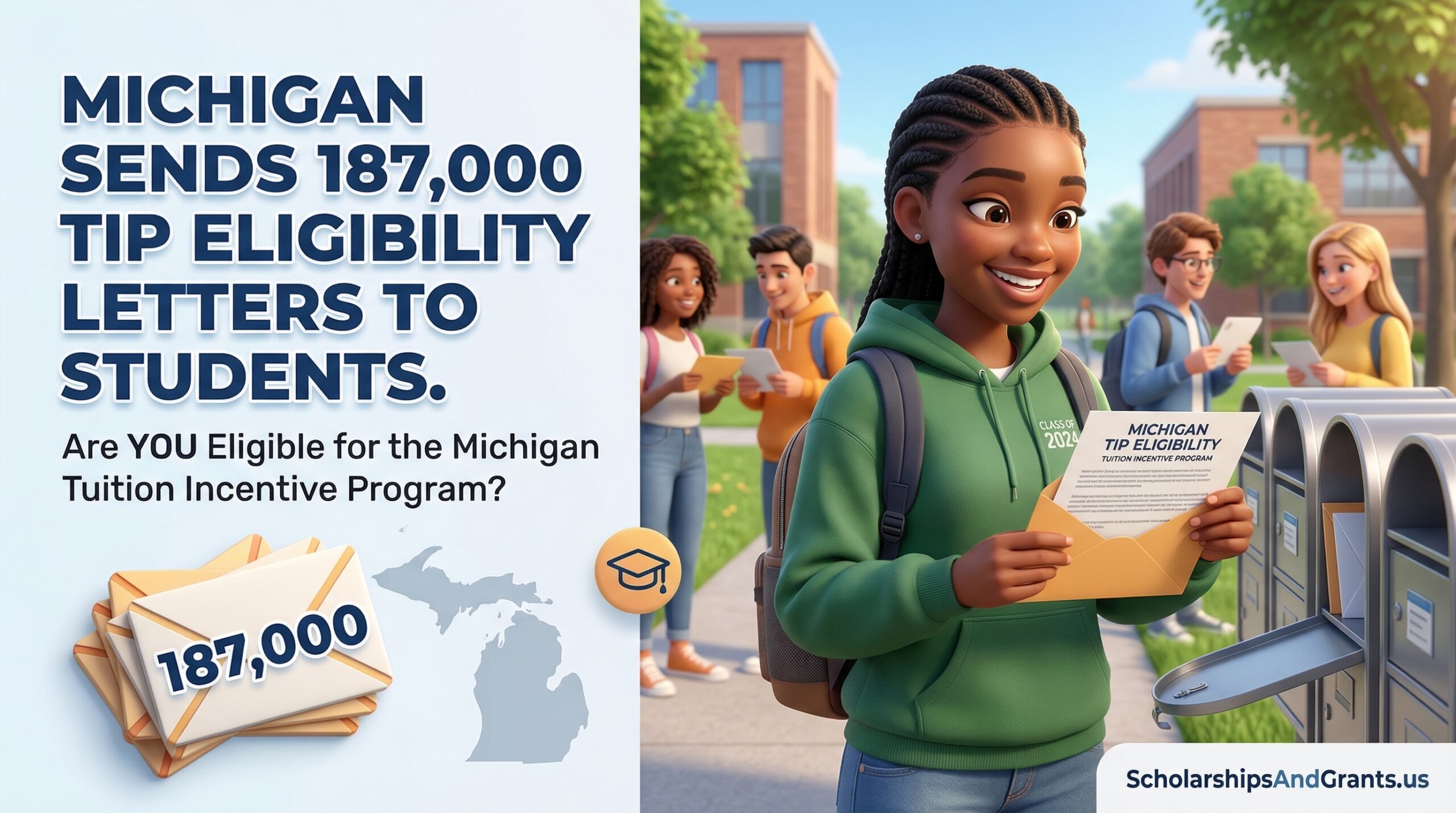
Michigan just turned one of its most important college-aid programs into a direct message for families. On March 16, 2026, the Michigan Department of Lifelong Education, Advancement, and Potential (MiLEAP) said it had recently mailed more than 187,000 letters to Michigan students and families about eligibility for the state’s Tuition Incentive Program, usually called TIP. MiLEAP said the letters were aimed at two groups: 11th–12th graders who are close to college decision season, and earlier-awareness students, sometimes as young as 12, whose families may need more time to plan. The state described TIP as a long-standing scholarship program that helps eligible Medicaid recipients pay for skill certificates, associate degrees, and later bachelor’s-degree study at participating Michigan colleges and universities.
For students and parents, this is a big deal because TIP is not just “nice to know” information. It is real tuition support. MiLEAP said that in academic year 2024–25, 39,773 students received TIP statewide, producing more than $118 million in savings for students and families. That makes these letters more than outreach; they are a large-scale aid signal telling families that college money may already be on the table if they complete the required next steps.
What happened on March 16, 2026
MiLEAP’s announcement said the letters were tailored by age and stage. Students in grades 11 and 12 received letters confirming TIP eligibility and explaining what to do next, including filing the FAFSA, listing the Michigan college or university they plan to attend, and creating a MiSSG Student Portal account to track eligibility and awards. Families of younger eligible students received an early-awareness version that introduced the program and encouraged earlier conversations about education, career interests, and postsecondary planning. MiLEAP also pointed families to planning tools such as Pathfinder.
That distinction matters. Juniors and seniors need action steps now. Younger students and families need time, awareness, and a plan. In policy terms, Michigan is trying to reduce “information friction”: a student can technically qualify for aid, but still miss it if the family never understands the program, never files the FAFSA, or never checks the state portal. That is why these letters matter so much. They turn a hidden eligibility rule into an actionable pathway. This is an inference from how Michigan designed the outreach and from the program rules MiLEAP highlighted.
What is the Michigan Tuition Incentive Program?
TIP is a Michigan state scholarship program tied to Medicaid-based eligibility. At the highest level, it has two phases:
Phase I helps eligible students in certificate or associate-degree pathways.
Phase II helps after that, when a student has earned a certificate, associate degree, or enough transferable credits to move into bachelor’s-level study.
Michigan’s main TIP page says students must file a current-year FAFSA to renew, remain Michigan residents, be undergraduate students, be enrolled in a qualifying program, and meet the school’s satisfactory academic progress policy.
Who qualifies for TIP?
The core state rule is that a student must have had Medicaid coverage for at least 24 months within a 36-month period between age 9 and high school graduation, and MiLEAP says only students identified by the Michigan Department of Health and Human Services as meeting that requirement are considered for TIP eligibility.
Michigan’s official student checklist adds more practical requirements. It says students must complete the FAFSA, begin using TIP at a participating institution within four years of graduation, enroll at least half-time, meet the school’s satisfactory academic progress policy, maintain Michigan residency, and create a MiSSG Student Portal account to review awards. The checklist also notes citizenship/eligible noncitizen requirements and says a student cannot be in default on a federal student loan.
The easiest way to explain this to a high school senior is this: the letter means Michigan believes you are in the pipeline for TIP, but you still have to do the FAFSA and enrollment steps correctly for the money to actually flow. That is exactly why the letters emphasized FAFSA completion, college selection, and MiSSG account creation.
How much money can TIP cover?
Phase I: the big value for certificate and associate-degree students
Michigan says Phase I covers tuition at the standard in-district rate at participating community colleges. If a student does not live in a community-college district, an out-of-district rate may be authorized. At participating public universities, Phase I covers the lower-level resident tuition rate, but students are not eligible for Phase I reimbursement if they are enrolled in a bachelor’s-degree program. At participating private or independent nonprofit institutions, Michigan says the 2025–26 Phase I rate is the average community-college tuition rate, listed as $135 per credit hour, with mandatory fees capped at $450 per semester or term.
Michigan also says Phase I benefits cannot exceed 80 semester credits or 120 term credits. Students must be in a certificate or associate-degree program, and TIP only covers classes within the student’s program of study. Phase I eligibility ends 10 years after first payment.
Phase II: help after transfer or after finishing the first credential
Michigan says Phase II begins after a student earns 56 transferable semester credits, 84 transferable term credits, a certificate of at least one year, or an associate degree. The state says Phase II provides standard in-district tuition and mandatory-fee assistance of up to $500 per semester or $400 per term, with a lifetime maximum of $2,000 for credits earned in a four-year program at a participating Michigan degree-granting college or university. Phase II must be completed within 30 months of completing the Phase I requirement point, and Phase II eligibility ends 10 years from high school graduation or recognized equivalent. Once Phase II has started, students can no longer go back and use unused Phase I benefits.
Why the letters matter so much for high school seniors
For a high school senior, the biggest takeaway is not just “I got a letter.” The bigger point is that Michigan is telling you early enough to build TIP into your college decision before you commit to a school. That is powerful, because financial aid decisions often go wrong when students choose first and ask funding questions later. MiLEAP’s own message in the press release was that early notice helps families make informed decisions and understand the next steps before enrollment.
This is especially important because TIP is targeted aid, not broad public messaging. A lot of families know about Pell Grants or hear about FAFSA every year, but fewer understand state programs linked to administrative eligibility rules like Medicaid history. Michigan’s approach here is unusually direct: find potentially eligible students, notify them, then tell them exactly what to do next. That is smart public policy because awareness gaps can be as damaging as funding gaps. This is an analytical reading of the state’s outreach model and the required FAFSA/MiSSG steps Michigan attached to the letters.
What students should do now if they received a TIP letter
1) Do not throw the letter away
Keep it with your college and financial-aid documents. Even though the official award process runs through state systems and your college, the letter is an important signal that Michigan has flagged you for TIP-related eligibility outreach.
2) File the correct FAFSA
If you are a high school senior graduating in 2026 and starting college in fall 2026, the correct form is the 2026–27 FAFSA. Michigan says students must complete the FAFSA each year they plan to use TIP, and Federal Student Aid says FAFSA information is also used by states and schools, not just for federal aid.
3) Make sure every required contributor has the right account
Federal Student Aid says each FAFSA contributor must have their own separate StudentAid.gov account. That includes the student and, in many dependent-student cases, at least one parent. Federal Student Aid also says a contributor without an SSN can still create a StudentAid.gov account and complete the required FAFSA section online.
4) Create a MiSSG Student Portal account
Michigan says students should create a MiSSG Student Portal account to monitor eligibility and awards. The portal is where Michigan students can check eligibility for MI Student Aid, including TIP-related status information.
5) List your Michigan schools and talk to your counselor
MiLEAP said the letters told upperclassmen to list the Michigan college or university they plan to attend. That matters because TIP is restricted to participating Michigan institutions and because school choice affects how Phase I and Phase II can be used.
6) Compare the full aid package, not just the headline
Even if TIP reduces tuition, your real college cost may still include housing, food, transportation, books, and fees. Students should compare the whole aid package, including grants, scholarships, work-study, and loans, before choosing a college. Federal Student Aid says families should complete FAFSA before state and school deadlines, and comparing net cost remains one of the smartest final-decision steps.
A simple way to understand TIP without getting lost in the rules
Think of TIP as a two-step Michigan tuition support system:
-
Step 1: It helps eligible students start with a certificate or associate-degree path.
-
Step 2: It can continue with limited support when that student moves deeper into a bachelor’s pathway.
That does not mean every student will use both phases the same way. Some schools do not offer the type of certificate or associate program needed for Phase I. Michigan says if a college or university does not offer associate-degree programs, a student may not receive Phase I assistance there and may instead first access help when reaching the Phase II threshold.
Common mistakes students should avoid
Mistake 1: Assuming the letter alone guarantees payment.
The letter is important, but Michigan still requires the FAFSA and other program conditions.
Mistake 2: Waiting too long.
Michigan says students must begin using TIP within four years of high school graduation, and the official checklist repeats that timing rule.
Mistake 3: Thinking FAFSA is optional because TIP is state aid.
It is not optional. Michigan says students must file a current-year FAFSA, and Federal Student Aid says states and schools use FAFSA data too.
Mistake 4: Sharing accounts with parents.
Federal Student Aid says each contributor needs a separate StudentAid.gov account because the login acts as a legal electronic signature.
Mistake 5: Looking only at tuition.
TIP can be a major tuition reducer, but the smartest comparison is still total cost after all aid.
FAQ
Does a TIP letter mean I definitely have free college?
Not automatically. It means Michigan has notified you about TIP eligibility or early-awareness status, but you still must complete the FAFSA, enroll at a participating Michigan institution, and meet ongoing program requirements.
Can TIP be used at a four-year university?
Yes, but the rules depend on the phase. Phase I can apply at participating public universities only in limited ways tied to certificate or associate-degree study, not bachelor’s-degree enrollment. Phase II can be used at participating Michigan degree-granting colleges and universities after the student reaches the required certificate, degree, or transferable-credit threshold.
Do I need to file the FAFSA every year?
Yes. Michigan says students must file a current-year FAFSA to renew TIP, and MiLEAP’s press release also says students must complete FAFSA each year they plan to use TIP benefits.
What if my parent does not have a Social Security number?
Federal Student Aid says a parent contributor without an SSN can still create a StudentAid.gov account and complete the required FAFSA section online.
What if I never got a letter but think I might qualify?
Michigan says only students identified by MDHHS as meeting the Medicaid rule are considered for TIP eligibility. The best next moves are to check your MiSSG Student Portal status, talk with your school counselor, and contact MI Student Aid if you think something is wrong.
Bottom line
Michigan’s March 2026 TIP-letter rollout is one of the clearest student-facing aid actions of the year. More than 187,000 students and families were told, directly, that tuition support may be available. The lesson for high school seniors is simple: if you received a TIP letter, treat it like a financial-aid action item, not just an informational mailer. File the FAFSA, set up the right accounts, check MiSSG, and compare your Michigan college options with TIP in the picture.
Official resources
Related articles
-
StudentAid.gov Account: Complete 2026 Guide for High School Seniors
-
FAFSA Contributor: Complete 2026–27 Guide for High School Seniors
-
Michigan Scholarships 2026: Michigan Achievement, TIP, MCS + Local Awards
-
Compare Financial Aid Offers: Complete 2026 Guide for High School Seniors
-
What Is Need-Based Financial Aid? Complete 2026 Guide for High School Seniors