FAFSA 2026–27: Complete Guide for High School Seniors
If you are a high school senior graduating in 2026 and starting college, career school, or trade school in fall 2026, the correct form is the 2026–27 FAFSA. That application covers aid for July 1, 2026, through June 30, 2027. The federal filing window opened no earlier than Oct. 1, 2025, and the form is available now through Federal Student Aid.
The FAFSA is free. It is used not only for federal grants, work-study, and loans, but also by many states, colleges, and some private aid programs. Federal Student Aid says most students can finish the online form in less than 30 minutes once they have their information ready.
This matters because FAFSA demand is rising again. Federal Student Aid reported that by the end of December 2025, nearly 5.8 million 2026–27 FAFSA forms had already been submitted, a 78% increase over the same point in the prior cycle. The same March 2026 federal update also said students received $39 billion in Pell Grants in 2024–25, up 24% from the previous award year.
What FAFSA 2026–27 means in plain English
FAFSA is the main form students use to unlock federal aid. After you submit it, colleges use your FAFSA information to build your financial aid package, and your state may use it for state grants too. Your FAFSA itself is not your final aid offer. That comes later from each college that admits you and receives your FAFSA data.
For the 2026–27 cycle, the form uses 2024 tax information. That is normal under the current “prior-prior year” system. So even if you are applying for aid for the 2026–27 school year, the income year the form looks back to is 2024.
The biggest FAFSA 2026–27 changes students should know
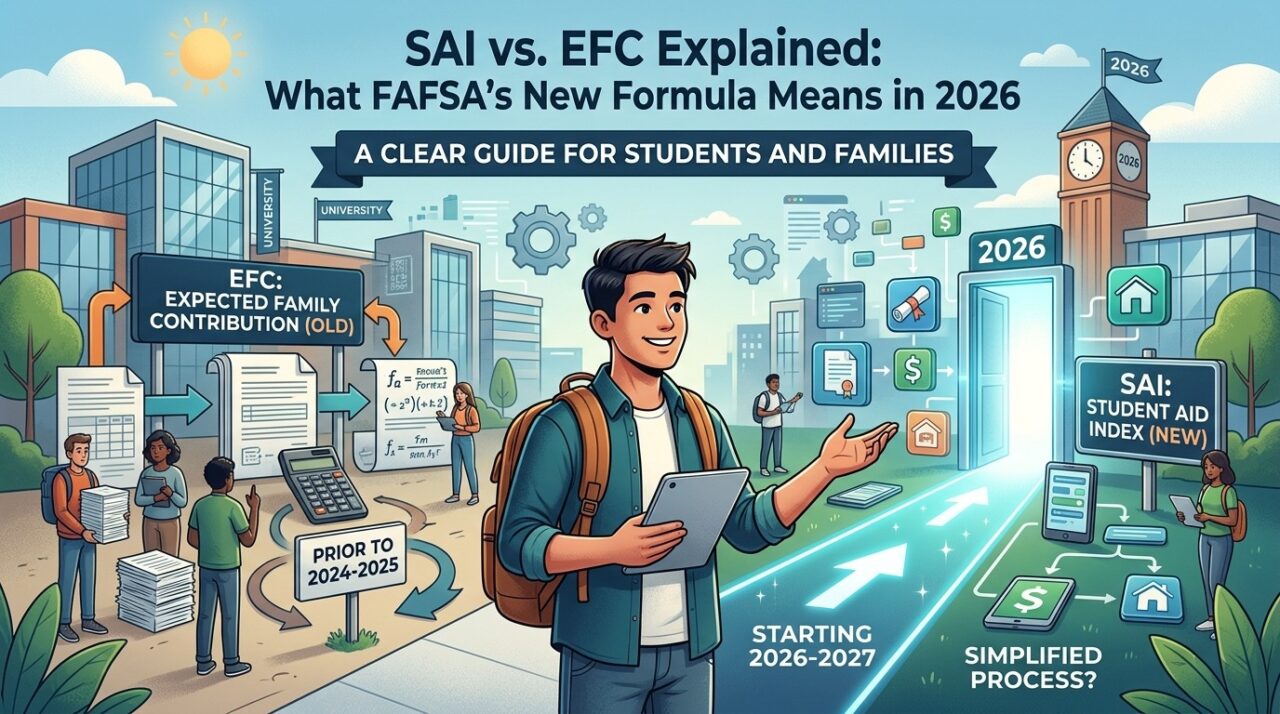
The most important calculation on today’s FAFSA is the Student Aid Index (SAI). Federal Student Aid explains that SAI is a formula-based number ranging from -1500 to 999999. It is not a bill, not a promise of aid, and not the amount your family must pay. Schools use it, along with cost of attendance and other aid, to decide how much need-based aid you may receive. A lower SAI usually means higher financial need.
Another important point for families with more than one child in college: the 2026–27 FAFSA still asks how many people in the student’s family will be in college during the award year, but the paper form states that this answer does not affect federal student aid eligibility or calculations. That is a major difference from older FAFSA rules that many parents still remember.
Federal Student Aid also announced key 2026–27 rule changes tied to a 2025 federal law. Beginning with 2026–27, the FAFSA asset calculation excludes the net worth of a family-owned business with 100 or fewer employees, the net worth of a farm the family lives on, and the net worth of a family-owned commercial fishing business and related expenses. The same federal update said the foreign earned income exclusion is added back into adjusted gross income for Pell eligibility, and students with an SAI at or above twice the maximum Pell Grant are generally ineligible for Pell. For 2026–27, that Pell cutoff is $14,790.
Federal Student Aid separately states that the maximum Pell Grant for 2026–27 is $7,395. That is the ceiling, not a guaranteed amount. Your actual Pell amount depends on the federal formula and your school’s cost and enrollment details.
Who needs to be involved on the FAFSA
If you are a typical high school senior, you will usually be a dependent student for FAFSA purposes, which means parent information is usually required. Federal Student Aid says that in most cases at least one parent will be identified as a required contributor. A contributor can be the student, a student spouse, a parent, or a parent’s spouse, depending on the situation.
The federal guidance is clear that the student should start the FAFSA first. Federal Student Aid recommends that students begin their own form and complete their own sections first because it saves time and reduces errors.
Each contributor must have their own StudentAid.gov account. Students should not share logins with parents, and parents should not create or reuse the student’s account. Federal Student Aid also says that contributors without a Social Security number can still create a StudentAid.gov account to complete their required FAFSA sections.
If your parents are divorced, separated, remarried, or living in different households, do not guess which parent should go on the form. Use the federal Who’s My FAFSA Parent? tool. Federal Student Aid says the tool usually takes less than five minutes and is especially helpful for separated and divorced families.
What you need before you start
Before opening the form, gather your basic information first. Federal Student Aid says students and contributors should be ready with their StudentAid.gov accounts, 2024 tax records, records of child support received, records of assets such as bank balances and investments, contributor email addresses, and a list of schools the student is considering. The online FAFSA lets students list up to 20 schools at a time.
FAFSA 2026–27 deadlines
For federal aid, the official deadline is 11:59 p.m. Central Time on June 30, 2027. Any FAFSA corrections or updates must be submitted by 11:59 p.m. Central Time on Sept. 12, 2027.
That said, students should treat the federal deadline as the absolute last stop, not the target. The 2026–27 FAFSA form itself warns that state and college deadlines may be as early as Oct. 1, 2025, and some aid is limited.
Just as important, Federal Student Aid said in March 2026 that almost half of states require students to complete a separate application or take another step to receive at least some state financial aid. Filing the FAFSA is essential, but for many students it is not the entire state-aid process.
How to complete the FAFSA 2026–27 step by step
Step 1: The student creates a StudentAid.gov account and starts the form.
Choose the student role when beginning the FAFSA. This is the recommended starting point for almost every first-time applicant.
Step 2: Answer the personal circumstance questions carefully.
These questions determine dependency status and whether parent information is required. FAFSA dependency rules are federal aid rules, not IRS dependency rules.
Step 3: Invite the right contributor.
Dependent students usually invite one parent first. If another parent or spouse must also contribute, the FAFSA workflow will prompt for that.
Step 4: Every required contributor gives consent and approval, then signs.
Federal Student Aid says consent and approval for IRS tax data transfer is required for federal student aid eligibility, even if the contributor did not file a U.S. tax return. Missing consent or missing signatures can delay or block processing.
Step 5: Add colleges and submit.
Students can list up to 20 schools online. Even if you are not sure where you will enroll, Federal Student Aid recommends listing every school you are seriously considering.
What happens after you submit
After an online FAFSA is submitted, Federal Student Aid says it is usually processed in one to three days. Once processed, the student can log in and review the FAFSA Submission Summary. That summary can show your SAI, estimated Pell and loan eligibility, selected schools, next steps, and whether you were selected for verification.
The FAFSA Submission Summary is useful, but it is still not your final financial aid offer. Colleges send those aid offers later, after admission decisions and after the school reviews your FAFSA data.
After submission, students should review the confirmation page, check the Submission Summary for errors, make corrections if needed, and complete any state aid application their state requires. Federal Student Aid has recently added more state-aid prompts inside the FAFSA experience for exactly this reason.
Special circumstances and unusual circumstances
If your family’s finances changed after 2024 because of job loss, reduced hours, high unreimbursed medical bills, or similar issues, do not skip the FAFSA. The official 2026–27 form says students in special financial circumstances should still submit the FAFSA and then talk with the financial aid office at the colleges they applied to or plan to attend. Schools can review those cases individually.
If you cannot safely contact a parent, or contacting a parent would put you at risk, Federal Student Aid says you may be treated as a provisionally independent student because of unusual circumstances. In those cases, students can submit the FAFSA without parent information and then work with the college on documentation.
A different situation is when parents simply refuse to provide information. Federal Student Aid says that if a dependent student completes the form without parent information because the parents refuse to provide it, the student is generally not eligible for Pell Grants or most other federal aid and may qualify only for an unsubsidized Direct Loan.
Latest 2026–27 FAFSA updates worth knowing
The 2026–27 cycle has been more stable than the troubled 2024–25 rollout, and Federal Student Aid has published several performance updates. In January 2026, FSA said an updated Review & Sign page nearly eliminated the cycle’s most common rejection reason: missing student signatures. According to the agency, missing-student-signature rejections fell by 97%, and missing-parent-signature rejections dropped by 90% after the redesign.
There was also an official FAFSA processing fix in late 2025. Federal Student Aid said it identified and resolved an asset-logic issue affecting a subset of FAFSA forms. For 2026–27, the agency reprocessed affected records for about 2,700 students, with estimated Pell eligibility changing for about 600 students; the average estimated Pell change was $80.
Official FAFSA links for students and families
Use official Federal Student Aid pages for the most reliable information and the live application.
Final advice for high school seniors
The smartest FAFSA strategy for the Class of 2026 is simple: file early, use the student account first, invite the correct contributor, sign carefully, and keep going after submission until every state and college requirement is done. That approach matches current Federal Student Aid guidance and gives students the best shot at Pell Grants, state grants, institutional aid, and work-study.
FAQ: FAFSA 2026–27
Which FAFSA should a student starting college in fall 2026 complete?
The correct form is the 2026–27 FAFSA, because it covers aid from July 1, 2026, through June 30, 2027.
What tax year does FAFSA 2026–27 use?
It uses 2024 tax information.
What is the federal FAFSA 2026–27 deadline?
The form must be submitted by 11:59 p.m. CT on June 30, 2027, and corrections are due by 11:59 p.m. CT on Sept. 12, 2027.
Does the FAFSA cost money?
No. The FAFSA is free to complete and submit.
Can a parent without an SSN still help complete the FAFSA?
Yes. Federal Student Aid says contributors without an SSN can still create a StudentAid.gov account and complete their required sections.
What if my family’s income dropped after 2024?
Submit the FAFSA anyway, then contact the financial aid office at your college to discuss special circumstances.