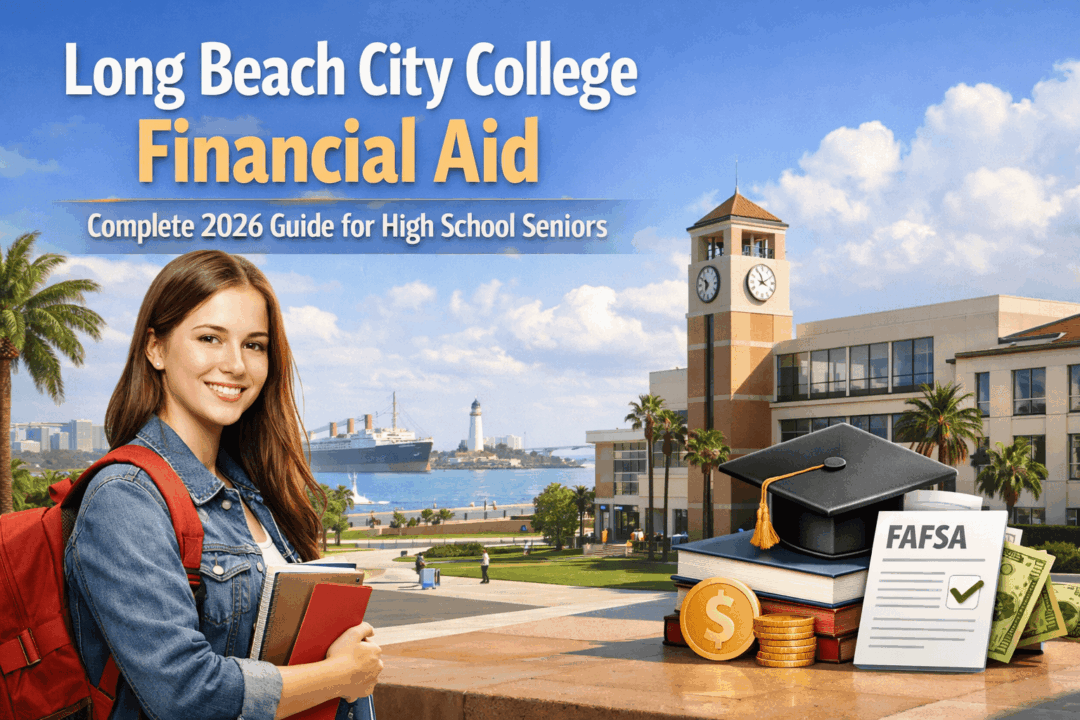
Long Beach City College Financial Aid: Complete 2026 Guide for High School Seniors
If you want financial aid at Long Beach City College (LBCC), the main starting point is simple: submit the FAFSA if you are a U.S. citizen or eligible noncitizen, or the California Dream Act Application (CADAA) if you are an eligible AB 540 student. LBCC tells students to list school code 001219 so the college receives the application.
LBCC is a large public community college serving 21,899 undergraduate students according to the U.S. Department of Education’s College Scorecard. For students who want local, lower-cost college options in Southern California, that matters because LBCC combines relatively low resident fees with access to federal aid, California aid, campus scholarships, and work-study.
What financial aid is available at LBCC?
At LBCC, students can be considered for several major forms of aid: Federal Pell Grants, Cal Grants, the California College Promise Grant (CCPG), Federal Supplemental Educational Opportunity Grant (FSEOG), Federal Work-Study, scholarships, Chafee Grants, EOPS/CARE support, and Direct Loans. LBCC’s scholarships and grants page also says its scholarship program awards more than 700 scholarships each year, and students generally complete one scholarship application to be matched with opportunities.
For 2026–27, the maximum Federal Pell Grant is $7,395, according to Federal Student Aid. Pell is usually the most important grant for students from lower-income households because it does not need to be repaid if you remain eligible.
The California College Promise Grant is especially important at community colleges. LBCC explains that CCPG can waive enrollment fees for qualifying California residents, but it does not cover the College Services Card, Student Health Services fee, or course materials.
How much does LBCC cost?
There are two different cost numbers students need to understand:
1) The billable school fees
For California residents at LBCC, the current published fees are $46 per unit for enrollment, plus a $20 College Services Card in fall/spring ($13 in summer/winter), a $24 Student Health Services fee in fall/spring ($17 in summer/winter), and a $2 Student Representation fee in fall/spring. Course materials fees vary by class. For nonresidents, LBCC lists $328 per unit in nonresident tuition, $46 per unit enrollment fees, and $40 per unit capital outlay, plus the other campus fees.
2) The official cost of attendance
LBCC’s financial aid budget is much bigger than billed fees because it includes living costs. LBCC lists an annual California resident cost of attendance at $20,442 for students living at home and $32,457 for students living away from home. For nonresidents, LBCC lists $33,218 living at home and $44,233 living away from home. These budgets include tuition and fees, books and supplies, transportation, food, housing, and personal expenses.
That difference is important: your student bill may be fairly low at a community college, but your financial aid eligibility is based on the broader cost of attendance, not just tuition.
How to apply for financial aid at LBCC
Step 1: Apply to LBCC
Before you can fully move through the aid process, you should become an LBCC student and get your student ID. LBCC’s scholarship system also requires you to be active with the college and have an LBCC ID number.
Step 2: Submit the right aid application
LBCC says most aid starts with either the FAFSA or the California Dream Act Application. If you want LBCC to receive your application, list Long Beach City College school code 001219.
Step 3: Watch for missing documents
LBCC says financial aid applicants may need to submit follow-up forms, and the college warns students to submit only the forms listed in their Missing Information Letter.
Step 4: Check your status and reply fast
LBCC’s main financial aid page tells students they can check awards, disbursement dates, and SAP status through its financial aid tools and status system. LBCC also says applicants whose files are complete by college priority deadlines receive maximum consideration for available funds.
2026 deadlines high school seniors should know
The 2026–27 FAFSA is open now. Federal Student Aid says students can complete it for attendance between July 1, 2026 and June 30, 2027. The federal FAFSA deadline for the 2026–27 year is June 30, 2027.
California timing is more complicated. CSAC’s Cash for College page shows a 2026–27 FAFSA/CADAA priority deadline of March 2, 2026, but CSAC’s financial aid application page also says the deadline for California community college students is September 2, 2026. Since today is March 14, 2026, the March 2 priority date has already passed, but the community-college deadline listed by CSAC has not. That means students who missed March 2 should still file now instead of assuming it is too late.
LBCC also says aid is packaged throughout the academic year and that students whose files are complete by college priority deadlines receive maximum consideration. So the safest move is still to file as early as possible and finish any document requests quickly.
Scholarships at LBCC
LBCC says its scholarship program awards more than 700 scholarships each year, which makes it one of the larger community-college scholarship programs in California. The college also says the scholarship application is available on AwardSpring, and one application can be used to match students to multiple scholarship opportunities.
LBCC’s scholarship application page says students must be active with the college, have an LBCC ID number, and have an email address listed in Viking Portal. It also says scholarship references must be submitted by LBCC employees or faculty members.
Work-study and student jobs
LBCC offers Federal Work-Study (FWS) for qualifying students. The college says work-study provides on-campus jobs and that students typically work about 15–20 hours per week, starting at California minimum wage. LBCC also explains that work-study pay is earned through hours worked rather than released like grant money.
For many high school seniors, work-study is useful because it can help with food, transportation, and books while keeping the job tied to campus.
Student loans at LBCC
LBCC participates in the William D. Ford Federal Direct Loan Program and says Direct Loans are the only student loan program it certifies. That matters because some colleges also certify private loans, but LBCC’s current public guidance points students to federal Direct Loans only.
Because LBCC is relatively low-cost for California residents, borrowing is often not the first option. Grants, CCPG fee waivers, scholarships, and work-study should usually be reviewed first. That matches LBCC’s own presentation of aid options on its financial aid and scholarships pages.
How and when LBCC pays aid
LBCC publishes a disbursement schedule and says authorization dates are usually on Mondays, while BMTX/BankMobile refund dates are generally on Fridays unless otherwise noted. The current public schedule posted on the site is the 2025–26 disbursement schedule.
LBCC also says Pell Grants are not usually sent all at once. The college uses a three-disbursement Pell model: 20% at the beginning of fall or spring, 30% during the second month, and the final 50% after the financial aid census date.
Another important LBCC rule is enrollment intensity. The college says Pell is based on the percentage of full-time enrollment a student is taking, and at LBCC 12 units counts as full-time for that calculation. If you take fewer units, your Pell amount can be lower.
Rules you must follow to keep your aid
LBCC requires students receiving aid to meet Satisfactory Academic Progress (SAP) standards. LBCC’s published standard is a 2.0 cumulative GPA, successful completion of at least 67% of attempted units, and staying within the allowed maximum timeframe for the program. A newer LBCC aid notice explains that this maximum timeframe is 150% of your program units.
The California College Promise Grant has an additional warning system. LBCC says any combination of two consecutive terms with a cumulative GPA below 2.0 and/or cumulative unit completion below 50% can lead to loss of CCPG eligibility.
LBCC also warns that if you withdraw from all classes before completing 60% of the semester, you may have to repay some or all of the aid received for that term.
Best official LBCC links to use
Use these official pages for your WordPress post:
Contact information
LBCC lists the Financial Aid Office at LAC A-1075 and TTC GG-102, phone (562) 938-3385. The published office hours are Monday through Thursday, 8:00 a.m. to 5:00 p.m., and Friday, 8:00 a.m. to 12:00 p.m. LBCC also publishes the scholarship contact at scholarship@lbcc.edu and financial aid email information through its scholarship office contact page.
Bottom line
For most high school seniors, the smartest LBCC financial aid path is: apply to LBCC, submit the FAFSA or CADAA, list school code 001219, respond quickly to any missing-document requests, and check both grants and scholarships before thinking about loans. LBCC’s biggest money-saving tools are its low resident fee structure, the California College Promise Grant, Pell Grants, Cal Grants, and its 700+ annual scholarship awards.