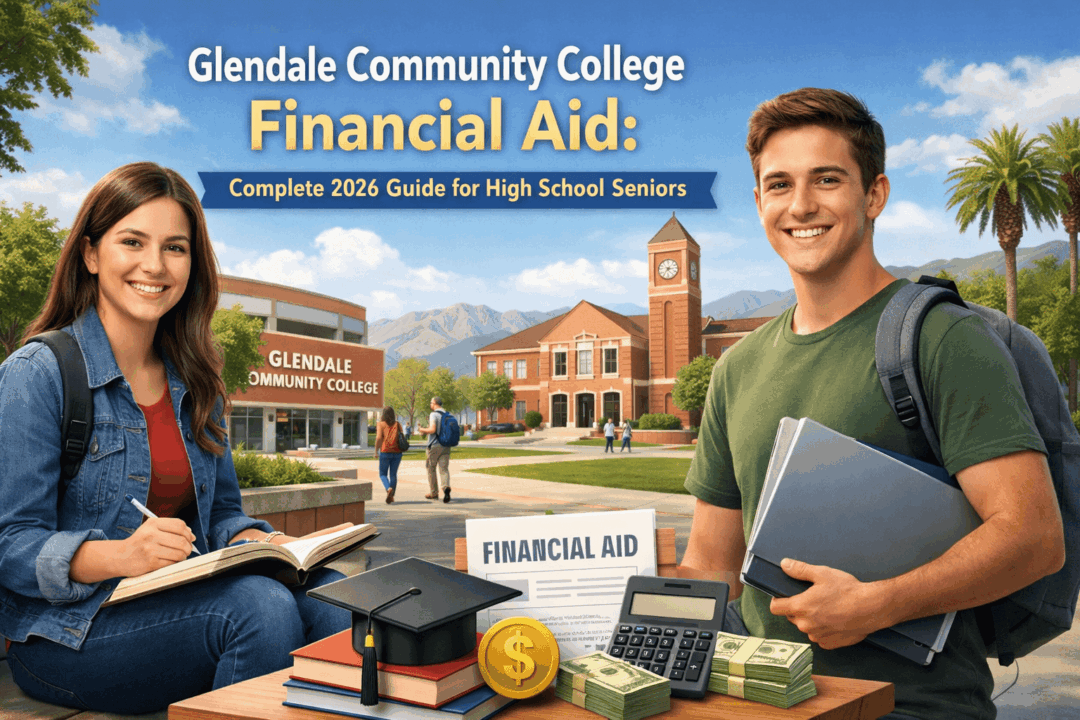
Glendale Community College Financial Aid: Complete 2026 Guide for High School Seniors
Editorial note: This guide is written for Glendale Community College in Glendale, California (glendale.edu), not Glendale Community College in Arizona. GCC’s federal school code is 001203.
Glendale Community College can be one of the more affordable college options in California, but only if students use the aid system correctly. GCC’s official cost-of-attendance budget shows that a California resident living with parents has an estimated annual budget of $19,694, while a California resident living off campus has an estimated annual budget of $31,366. For nonresidents, GCC lists estimated annual totals of $30,250 at home and $41,922 off campus. GCC also lists the resident enrollment fee at $46 per unit, with nonresidents paying an additional $406 per unit in nonresident tuition.
That sticker price does not mean most students pay the full amount. U.S. Department of Education College Scorecard data for GCC shows 9,807 undergraduate students and an average annual cost of $7,461 after grant and scholarship aid for students in the Scorecard methodology. GCC is also identified there as a Hispanic-Serving Institution.
For high school seniors, the big idea is simple: at GCC, financial aid usually comes from a stack of support rather than one single program. A student might combine the FAFSA or California Dream Act Application, a Federal Pell Grant, a California College Promise Grant, a Cal Grant, GCC’s Promise Plus program, and local or campus scholarships. Students who wait too long, skip verification, or misunderstand residency rules often leave money on the table.
What Glendale Community College financial aid really covers
GCC follows the standard federal aid formula built around cost of attendance minus Student Aid Index (SAI). GCC’s FAFSA simplification page explains that beginning with the newer FAFSA system, the old Expected Family Contribution was replaced by SAI, the number of FAFSA questions was reduced, contributors must consent to IRS tax-data transfer, and the formula now allows a minimum SAI of –1,500. GCC also explains that financial need is built from your budget and the aid data submitted on your FAFSA or CADAA.
That matters because GCC’s cost of attendance is broader than tuition alone. The college includes tuition and fees, books and supplies, housing and food, transportation, and personal expenses in the aid budget. This is why grants such as Pell can sometimes help with more than just registration charges, while fee-waiver programs like the California College Promise Grant usually target only specific college fees.
The most important aid programs at GCC
1) Federal Pell Grant
The Pell Grant is the first program most low-income students should look at because it does not have to be repaid. Federal Student Aid says the maximum Pell Grant for 2026–27 is $7,395. The actual amount depends on FAFSA results, enrollment intensity, and other eligibility rules. GCC’s own disbursement policy says Pell is tied to enrollment status, with 12 units considered full-time, and that Pell is recalculated at the term’s financial-aid census date if enrollment changes.
2) California College Promise Grant (CCPG)
For many California community college students, the California College Promise Grant is the most immediately useful program because it can wipe out the $46-per-unit enrollment fee. GCC explains that the CCPG is a California Community Colleges program for eligible California residents, and that it waives enrollment fees. GCC also makes clear that students only need to apply once each academic year, and that the application can cover the term of application plus later terms in that same school year.
A key warning for families: the CCPG is powerful, but it is not the same thing as full financial aid. It targets enrollment fees. It does not automatically cover housing, food, transportation, books, or all campus charges. Students who stop after getting only the CCPG can miss out on Pell, Cal Grants, and scholarships.
3) Cal Grant
Cal Grants are California state grants that do not need to be repaid. The California Student Aid Commission says students generally apply by filing the FAFSA or CADAA, and GCC says Cal Grant selections are based on FAFSA data and GPA information. GCC also states that students must be enrolled in at least 6 units at disbursement to receive a Cal Grant payment.
For deadlines, the safest rule for seniors is this: treat March 2 as your real target, even though California community college students may still have a later September 2, 2026 opportunity for some state-aid consideration. CSAC says the 2026–27 state priority deadline is March 2, 2026, and California community college students should apply by September 2, 2026. GCC’s aid pages also describe March 2 as the main priority point and mention September 2 as another chance for community-college Cal Grant consideration.
4) Student Success Completion Grant (SSCG)
This is one of the most valuable but least understood California community college grants. GCC says the Student Success Completion Grant is for Cal Grant B or C recipients who attend a California community college full-time. GCC lists current annual amounts of $1,298 for students enrolled in 12 to 14.99 units and $4,000 for students enrolled in 15 or more units, subject to eligibility and funding.
For students who can realistically handle a bigger course load, this creates a major strategy point: 12 units protects full-time status, but 15 units may unlock far more grant money. That only works if the student can succeed academically, because GCC still requires compliance with Satisfactory Academic Progress rules.
5) Federal SEOG
GCC says its Federal Supplemental Educational Opportunity Grant goes to students with the highest financial need, usually those who also qualify for the maximum Pell Grant, and that priority is given to students with negative or zero SAI. GCC lists the campus maximum at $200 per semester. Because funding is limited, not every eligible student receives it.
6) Federal Work-Study
Federal Student Aid describes Federal Work-Study as a program providing part-time jobs for students with financial need. GCC says students who want a work-study offer should contact Career Services or speak with a financial-aid advisor, and the college notes that work-study earnings are paid through submitted timesheets and monthly payroll.
7) Federal Direct Loans
Loans can help close a gap, but they should usually come after grants and scholarships. Federal Student Aid says dependent undergraduates can typically borrow $5,500 in the first year, $6,500 in the second year, and $7,500 in the third year and beyond, with lower subsidized portions inside those totals. GCC’s disbursement page adds school-specific operating rules: students need 6 or more units for loan disbursement, 12 or more units for a full per-term disbursement, and the college says loan proration applies starting July 1, 2026 for borrowers below full-time enrollment.
8) Chafee Grant
GCC explains that Chafee Grants provide up to $5,000 for current or former foster youth who meet the program rules, including age and dependency requirements. This is an important program for eligible students because it can stack with other aid.
GCC programs that can make college much cheaper
Promise Plus
GCC’s Promise Plus program is one of the strongest school-specific affordability tools for new students. GCC says it provides free tuition covering enrollment, health, and student service fees for up to two years for eligible students, but it does not cover winter or summer. The college lists requirements that include completing the FAFSA or CADAA, meeting California residency requirements, meeting with a Promise Plus counselor, attending full-time with at least 12 credits, and completing Summer Bridge.
For a high school senior, Promise Plus can be a game changer because it works alongside the broader aid system. A student might have basic GCC fees covered by Promise Plus or CCPG, then use Pell and Cal Grant funds for books, transportation, food, or other education costs.
Scholarships
GCC’s scholarship office says the college has hundreds of scholarships awarded every year and describes its scholarship program as the largest of any community college in California. The scholarship office currently says students may apply for over 500 scholarships using one application if they meet the minimum conditions of 12 completed GCC units, a 2.5 GPA, and enrollment in at least 3 units. The current scholarship page says the 2025–26 scholarship application cycle began July 30, and recipients are notified by the end of June via student email.
High school seniors should read that carefully: many GCC institutional scholarships are designed for students who have already taken GCC coursework. That means incoming freshmen should still watch the scholarship office page, but they should not assume all campus scholarships are available before they begin classes. External scholarships and Promise Plus may matter more in the first term.
Residency, AB 540, and why they matter so much
At GCC, residency status changes the math dramatically. California residents pay the state enrollment fee of $46 per unit, while nonresidents pay that fee plus $406 per unit in nonresident tuition. GCC’s residency page also explains AB 540 and related exemptions, including the standard rule of three years of California school attendance plus California high school graduation or equivalent, with expanded paths under laws such as AB 2000 and SB 68.
GCC also states that AB 540 students may qualify for in-state tuition, the California College Promise Grant, and Cal Grants through the California Dream Act framework. The official California Dream Act Application site says the CADAA is used to determine eligibility for state financial aid for eligible students.
This means undocumented or mixed-status families should not assume they are shut out of aid. GCC and California both make clear that some students who cannot use the federal FAFSA can still qualify for important state support through the CADAA.
How to apply for Glendale Community College financial aid, step by step
Step 1: Apply to GCC
Start with the college application and make sure you are applying to Glendale Community College in Glendale, California. GCC’s financial aid office and Promise Plus pages connect students directly to the GCC application process for the upcoming school year.
Step 2: Submit the right aid application
Most U.S. citizens and eligible noncitizens should file the 2026–27 FAFSA. Federal Student Aid says the 2026–27 FAFSA is now available for the award year running from July 1, 2026, to June 30, 2027. Eligible undocumented AB 540 students should use the California Dream Act Application instead of the FAFSA.
Step 3: Use GCC’s school code
When filing, list Glendale Community College school code 001203 so GCC receives your data. GCC publishes that code prominently on its financial aid page and on Promise Plus instructions.
Step 4: Make sure every contributor does their part
Under the newer FAFSA system, contributors such as parents or spouses must have their own StudentAid.gov account, receive an invite, provide consent for IRS data transfer, and complete their required sections before the FAFSA can be fully processed. GCC’s FAFSA simplification page and Federal Student Aid’s FAFSA instructions both emphasize this point.
Step 5: Watch GCC’s to-do list and verification system
GCC uses online forms and a StudentForms / Virtual Verification process for required documents. Students should check MyGCC and any financial-aid requests quickly, because incomplete verification is one of the main reasons aid is delayed.
Step 6: Track census dates and disbursement dates
GCC publishes term-by-term deadlines and disbursement timing. For example, GCC’s spring 2026 page shows first disbursement beginning February 9, 2026, a March 19, 2026 census date, and second disbursement starting March 23, 2026. That matters because Pell and some other aid can be adjusted to match actual eligible enrollment on the census date.
The 2026 deadlines high school seniors should know
For the 2026–27 FAFSA, Federal Student Aid says students may submit as early as October 1, 2025, the federal deadline is June 30, 2027 at 11:59 p.m. Central Time, and corrections must be submitted by September 12, 2027. But waiting for the federal deadline is a bad strategy because state and college aid run out earlier.
For California state aid, CSAC says the priority deadline is March 2, 2026, and California community college students should apply by September 2, 2026. GCC’s own deadlines page lists March 2, 2026 for the FAFSA/CADAA priority deadline and Cal Grant GPA verification.
For students entering GCC in 2026, the smartest move is to file well before March 2. That gives the family time to fix contributor issues, respond to verification requests, and stay eligible for both federal and California programs.
What Glendale Community College financial aid office wants students to do
GCC’s financial aid office makes the process clearer than many colleges do. The office publishes a contact form, callback option, Zoom appointments, in-person workshops, and its location in the Sierra Vista Building, 3rd Floor, at 1500 North Verdugo Road, Glendale, CA 91208-2894. GCC also publishes front-counter hours and identifies the FAFSA school code as 001203. A separate GCC directory page lists the financial-aid email as finaid@glendale.edu.
That means students should not guess when something looks wrong. If your award seems low, your residency is coded incorrectly, your contributor cannot access the FAFSA, or your CCPG disappears, contact the office immediately and use the official help options on the GCC site.
Best financial-aid strategy for a high school senior planning to attend GCC
First, file the FAFSA or CADAA early and do not wait for summer. Second, confirm your residency status because the price gap between resident and nonresident billing is huge at GCC. Third, pursue Promise Plus if you are a first-time, full-time student who can meet the program conditions. Fourth, aim for the most grant-heavy package possible before borrowing loans. Fifth, if your schedule and preparation make it realistic, consider whether 15 units could open up more aid through the Student Success Completion Grant.
The biggest mistake families make is focusing only on tuition. At a community college, tuition may be low enough to be waived, but the real pressure often comes from books, food, transportation, and lost work hours. GCC’s own budget figures show that living costs are a much larger share of attendance cost than tuition alone, which is why maximizing grants matters so much.
Official resources and legitimate links
Use these official pages when building your GCC aid plan:
Bottom line
For many students, Glendale Community College is affordable because of financial aid, not because college is automatically cheap. The students who do best are the ones who file early, verify residency, use the correct application, respond fast to GCC document requests, and stack every non-loan dollar they can find. At GCC, that usually means aiming for some combination of CCPG, Pell, Cal Grant, Promise Plus, scholarships, and only then loans if needed.