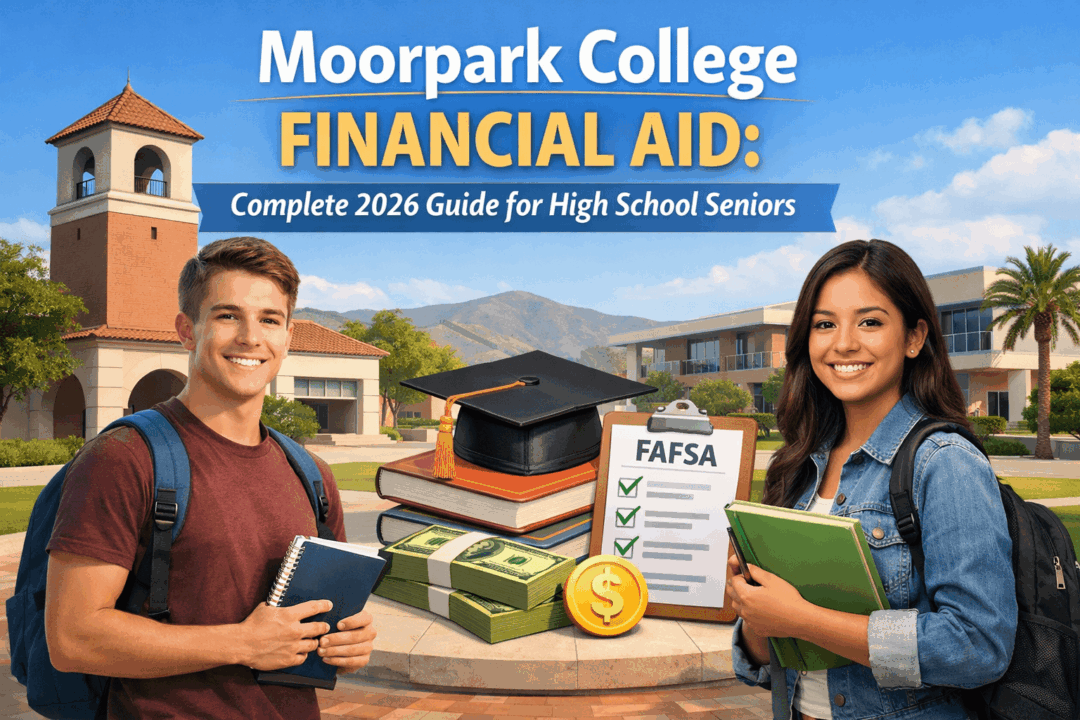
Moorpark College Financial Aid: Complete 2026 Guide for High School Seniors
If you are a high school senior looking at Moorpark College, the big takeaway is this: Moorpark is one of the lower-cost college options in California for residents, and the Financial Aid Office actively points students to grants, fee waivers, scholarships, work-study, and federal loans. Moorpark’s federal school code is 007115, and the Financial Aid Office says it is not too late to apply and encourages students to file now if they still need help paying for school.
Moorpark College financial aid quick facts
Financial Aid Office contact: 7075 Campus Road, Moorpark, CA 93021; phone (805) 378-1462; text line (877) 822-0435; email mcfa@vcccd.edu.
Office hours: Monday 8 a.m.–5 p.m.; Tuesday 8:30 a.m.–6 p.m.; Wednesday 8 a.m.–5 p.m.; Thursday 8 a.m.–5 p.m.; Friday 8 a.m.–12 p.m.
Federal school code: 007115. Put this code on your FAFSA so Moorpark receives your information.
College size and affordability snapshot: College Scorecard lists Moorpark College with 12,011 undergraduate students, an average annual cost of $742, and median earnings of $49,044 after attendance. That federal “average annual cost” is a net-price style figure, not a standard tuition bill, but it does show why Moorpark is often considered a strong value option.
Why Moorpark College can be affordable
For California residents, Moorpark lists the mandatory enrollment fee at $46 per unit. Other charges can include a health fee, student center fee, and class-specific materials or lab fees. For non-California residents, the college lists $397 per unit in nonresident tuition plus the regular enrollment fee and a $15 per-unit nonresident capital outlay fee.
That matters because Moorpark’s aid programs are designed to attack different parts of the bill. The California College Promise Grant (CCPG) can waive the $46-per-unit enrollment fee for eligible students, while FAFSA-based aid such as the Federal Pell Grant can help with expenses like books, supplies, transportation, and other living costs. Moorpark explicitly tells students that if they need help beyond fees, they should complete the FAFSA or California Dream Act Application.
What financial aid is available at Moorpark College
Moorpark says it offers a full array of Title IV federal programs, California state programs, institutional scholarships, and other aid resources. The school’s financial-aid materials specifically list Federal Pell Grant, FSEOG, Federal Work-Study, Cal Grant, Student Success Completion Grant, CCPG, scholarships, and federal loans.
1) Federal Pell Grant
The Pell Grant is the main federal need-based grant for undergraduates. For the 2026–27 award year, Federal Student Aid says the maximum Pell Grant is $7,395. The exact amount depends on your financial need, cost of attendance, enrollment status, and other factors.
2) California College Promise Grant (CCPG)
At Moorpark, the CCPG waives enrollment fees only. That means it can erase the core $46-per-unit resident enrollment charge, but it does not automatically cover everything else such as books, transportation, health fees, or lab/material charges. Moorpark also says students can file both a CCPG application and a FAFSA.
3) Cal Grant and Student Success Completion Grant
Moorpark’s grants page lists Cal Grant B and Cal Grant C, and it says the Student Success Completion Grant can pay up to $4,000 annually for full-time students who are Cal Grant B or C recipients. Moorpark also notes that Cal Grant applicants may need a GPA verification form in addition to the FAFSA or Dream Act application.
4) Federal Work-Study
Moorpark describes Federal Work-Study as need-based aid that is earned through employment and paid as an hourly wage directly to the student. The college says students must indicate interest in work-study on the FAFSA, and awards are made on an ongoing first-come, first-served basis, subject to available funding. Moorpark also says Federal Work-Study wages are paid twice per month once time sheets are submitted on schedule.
5) Federal Direct Loans
Moorpark participates in the William D. Ford Federal Direct Loan Program. The college lists Subsidized, Unsubsidized, and Parent PLUS loans. For a dependent first-year student, Moorpark lists a total annual loan limit of $5,500, with $3,500 subsidized and $2,000 additional unsubsidized; for a dependent second-year student, the total is $6,500.
6) Scholarships
Moorpark has a dedicated Scholarship Office and a Moorpark College Foundation Scholarships page. The Foundation page reports that more than $160,000 was awarded to 245 students in spring 2020. That number is older, so do not treat it as the current-year award total, but it does confirm that Moorpark has a real institutional scholarship pipeline. For current-cycle opportunities, use the Scholarship Office, newsletter, and Foundation scholarship pages.
7) Chafee Grant and special California programs
Moorpark’s grants page says the California Chafee Grant Program can award up to $5,000 annually for eligible current or former foster youth. Moorpark also lists California community college aid programs such as the California College Promise Program Grant and the Student Success Completion Grant in its financial-aid overview.
2026 application timeline for high school seniors
For the 2026–27 FAFSA, Federal Student Aid says the form is now available for attendance between July 1, 2026, and June 30, 2027. Federal Student Aid also says the 2026–27 FAFSA uses 2024 tax information. Students and required contributors need their own StudentAid.gov accounts to complete the form.
For California, the state deadlines matter a lot. Federal Student Aid’s state-deadline page lists March 2, 2026 for many California state aid programs, and the FAFSA PDF specifically says California community-college students have a later September 2, 2026 date for additional community-college Cal Grants. CSAC’s current pages repeat that March 2, 2026 is the state priority deadline and September 2, 2026 is the California community-college deadline. Since today is March 14, 2026, the main California priority deadline has already passed, but the community-college deadline has not.
Moorpark’s own Promise page says that for the 2026–27 cycle, the FAFSA or Dream Act deadline for the Moorpark College Promise aligns to March 2, 2026. That page also says the program is limited, depends on available funding, and that eligibility criteria may change. So if you are reading this after March 2, 2026, you should still file immediately and contact the Financial Aid Office to ask what aid options remain open for your situation.
The Moorpark College Promise: one of the most important aid programs for new seniors
Moorpark says its Moorpark College Promise may provide free tuition even for some students who are not eligible for federal financial aid. The program is aimed at first-year, first-time students who enroll immediately after high school graduation, submit a FAFSA or Dream Act application each year, place Moorpark on the FAFSA/CADAA using school code 007115, enroll full time (12 or more units), live in the service area as a California resident or eligible AB 540 student, and have not previously earned a postsecondary degree or certificate.
For families, this is the biggest Moorpark-specific point to understand: the CCPG helps many low-income California residents by waiving enrollment fees, but the Moorpark College Promise is a separate institutional/state-supported pathway that can also create a free-tuition outcome for qualifying first-time students. Those are not the same thing.
California residency matters a lot
Moorpark’s residency page says tuition classification is based on California law and college application information. In general, a California resident for tuition purposes must be financially independent, physically present in California for at least one year, and show intent to make California a permanent home. The fees page also notes that students who have lived in California for less than one year and one day before the first day of the semester are generally treated as nonresidents for tuition purposes unless another exemption applies.
For undocumented or certain nonresident students, AB 540 and the California Dream Act can be crucial. Moorpark’s Dream Act materials say eligible AB 540 students may apply for state-funded financial aid such as institutional grants, community-college fee waivers, Cal Grant, and Chafee Grant, but they should use the California Dream Act Application, not the federal FAFSA.
How much aid can realistically reduce your Moorpark bill?
Here is the simple version for a California resident taking 12 units in a regular semester: the base enrollment charge is $46 per unit, so that core tuition piece is $552 before other fees. If you qualify for the CCPG, that $552 enrollment charge can be waived. If you also qualify for a Pell Grant, Cal Grant, scholarships, or work-study, those funds can then help with the other real-world costs of attending college, including books, transportation, food, and supplies.
That is why students should not stop at the fee-waiver application. Moorpark repeatedly tells students to complete the FAFSA or Dream Act application because many students discover they qualify for more than just waived enrollment fees.
How to keep your aid after you enroll
Moorpark’s Satisfactory Academic Progress policy says financial-aid students generally must maintain a 2.00 cumulative GPA, complete at least 67% of attempted coursework, and stay within 150% of the units required for their program.
The CCPG has its own warning/loss rules. Moorpark says students can lose CCPG eligibility if they fail to keep at least a 2.0 cumulative GPA and complete more than 50% of coursework over two consecutive primary terms.
Best strategy for a high school senior applying to Moorpark in 2026
Create your StudentAid.gov account early, make sure your parent or other required contributor has their own account, complete the 2026–27 FAFSA or California Dream Act Application, list Moorpark College (007115), and then watch your MyVCCCD and WebGrants accounts for follow-up items and award status. If you are interested in campus jobs, check the Federal Work-Study box on the FAFSA and move quickly, because Moorpark says funding is first-come, first-served.
Official resources and legitimate links
FAQ for high school seniors
Is it too late to apply for Moorpark financial aid if I missed March 2, 2026?
Not necessarily. Moorpark’s Financial Aid Office says, “No! We strongly encourage you to apply today!” California’s main priority deadline was March 2, 2026, but California community-college students still have a September 2, 2026 deadline for additional community-college Cal Grants.
Do I still need the FAFSA if I think my family income is too high for Pell?
Yes. Moorpark says many students learn they qualify for more aid when they file the FAFSA on time, and FAFSA data can be used for grants, work-study, loans, and some school or state programs.
I am an AB 540 student. Should I file the FAFSA?
Usually no. Eligible AB 540 students should generally use the California Dream Act Application for state-funded aid such as fee waivers, Cal Grant, Chafee Grant, and institutional grants.
Can I get money for books and transportation, not just tuition?
Yes. Moorpark specifically tells students that the FAFSA or Dream Act can help with books, supplies, transportation, and other costs, not only enrollment fees.
Should I borrow loans right away?
Borrow only what you truly need. Moorpark offers federal Direct Loans, but loans must be repaid with interest. Grants, fee waivers, scholarships, and work-study are usually the better first options.
Bottom line
For most high school seniors, the smartest Moorpark plan is: file the 2026–27 FAFSA or CADAA immediately, use school code 007115, pursue the CCPG, ask about the Moorpark College Promise, check scholarship pages, and follow up with the Financial Aid Office if anything is missing. Moorpark is already low-cost for California residents, and the right aid mix can reduce that cost dramatically.