Community College Financial Aid: Complete 2026 Guide
Community college is one of the most affordable ways to start college in the United States, but affordability is not the same thing as automatic access. In 2025–26, the average published in-district tuition and fees at public two-year colleges are $4,150, while the average full student budget is $21,320. That gap matters. Tuition is only part of the real cost. Books, transportation, food, housing, supplies, and daily living costs often make up most of the bill. The encouraging part is that College Board reports that, on average, first-time full-time in-district students at public two-year colleges have received enough grant aid to cover tuition and fees since 2009–10.
For high school seniors, the big idea is simple: community college financial aid is not just one program. It is a stack. That stack can include federal grants, state grants, Promise programs, institutional aid, scholarships, work-study, and loans. The smartest strategy is to go after the money that does not have to be repaid first, then use jobs or loans only if a gap remains.
What community college financial aid actually includes
Community college financial aid usually comes in three buckets:
1. Grants and scholarships
This is the best money because it usually does not have to be repaid. That includes the Federal Pell Grant, the Federal Supplemental Educational Opportunity Grant (FSEOG), state grants, local Promise programs, and college foundation scholarships.
2. Work-study
Federal Work-Study lets eligible students earn money through a part-time job while in school. It can be helpful, but it is not the same as a grant because you must work to receive the money, and the job is not guaranteed forever.
3. Loans
Federal student loans can help close a remaining gap, but they must be repaid with interest. At community college, borrowing should usually be the last layer, not the first.
How colleges decide what aid you can get
Your college builds your aid offer using a simple logic:
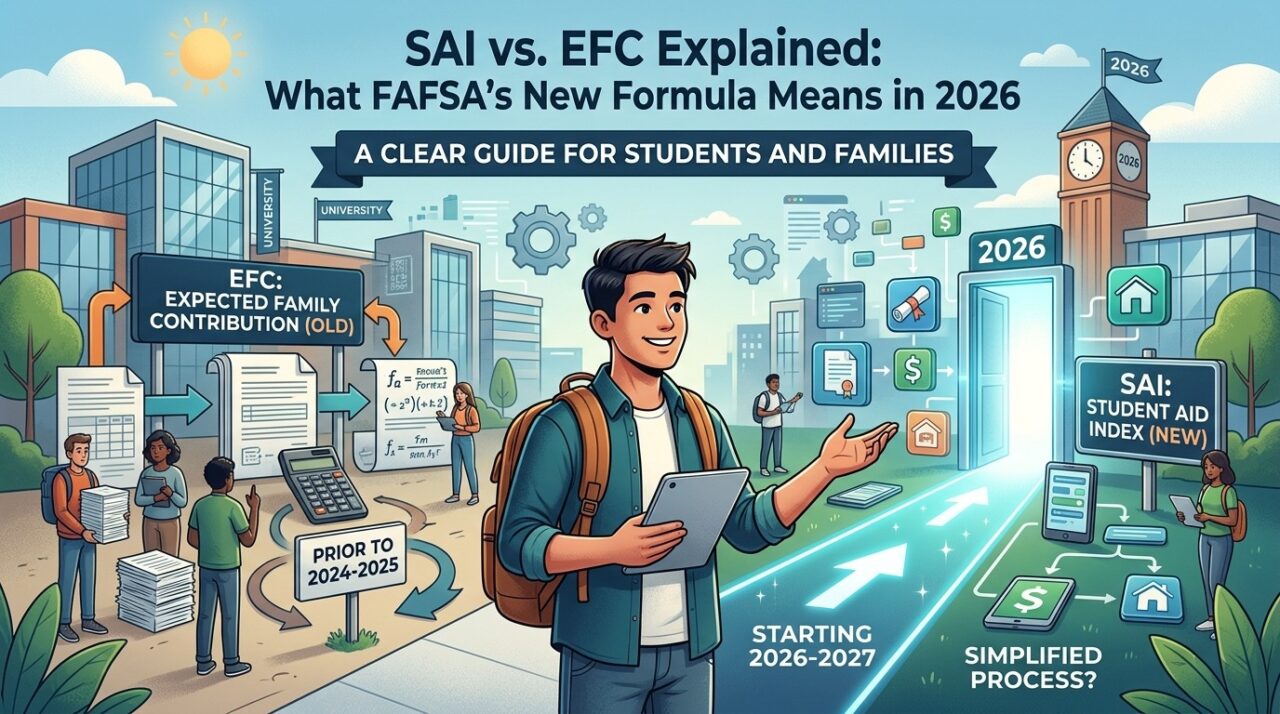
Cost of Attendance (COA) – Student Aid Index (SAI) = financial need. The SAI is not a bill, not a price tag, and not the amount your family is required to pay. It is a formula-based index number used by colleges to calculate aid eligibility. For the current FAFSA system, the SAI ranges from –1500 to 999999, and lower numbers generally indicate greater need.
That matters at community colleges because the sticker price may look low, but schools still use the full cost of attendance, which can include transportation, books, supplies, housing, food, and personal expenses. A student living at home may still have a real financial gap even if tuition is relatively low.
The FAFSA comes first
If you want serious community college financial aid, the FAFSA is the starting point. The 2026–27 FAFSA is for school attendance from July 1, 2026, through June 30, 2027. Federal Student Aid says students should submit it as early as possible, but no earlier than October 1, 2025, and the federal deadline is June 30, 2027. Just as important, state and college deadlines can be much earlier, sometimes as early as October 1, 2025. The 2026–27 FAFSA also uses 2024 tax information.
The FAFSA is free. That sounds obvious, but it is still one of the most important facts in college financing. Students should never pay a third party just to access the federal form. Federal Student Aid also tells families to file the FAFSA even when current finances have changed, then talk with the financial aid office about special circumstances such as job loss, pay cuts, or high unreimbursed medical or dental expenses.
The most important community college grants in 2026
Federal Pell Grant
For many community college students, the Pell Grant is the backbone of the entire aid package. Federal Student Aid says the maximum Pell Grant for the 2026–27 award year is $7,395. Pell Grants can be used at eligible two-year community colleges, and award amounts depend on factors such as financial need, cost of attendance, and whether the student is enrolled full time or part time. Some students can also receive year-round Pell, which can allow additional funding for summer enrollment. Federal Student Aid also notes that students can generally receive Pell for about six years total.
One important point for families: Pell is not based on one simple national income cutoff. Federal Student Aid explains that eligibility depends on more than income alone; it also considers factors like family size, tax filing status, and federal poverty guidelines. That is why students should file the FAFSA even if they assume they “make too much.”
Federal Supplemental Educational Opportunity Grant (FSEOG)
The FSEOG is another federal grant, but it works differently from Pell. It is a campus-based grant for undergraduates with exceptional financial need, and schools often give priority to students with the greatest need, including Pell-eligible students. Federal Student Aid says FSEOG awards can range from $100 to $4,000, and you apply by filing the FAFSA so the college can determine eligibility. Because the money is limited by campus funding, applying early matters.
State grants and Promise programs
Community college students should also look beyond federal aid. State grant agencies, local governments, and colleges themselves may offer Promise or free-tuition programs. Education Commission of the States describes college Promise programs as scholarships that can cover all or part of tuition and fees, often through state or local funding. These programs can be powerful, but the rules vary a lot. Some are last-dollar, meaning they pay only after Pell and other grants are applied. Others are first-dollar, which is much more generous.
Scholarships still matter at community college
A common mistake is thinking scholarships are only for students going straight to four-year universities. That is wrong. At community college, outside scholarships and school-based scholarships can be especially valuable because they can help cover the part of the budget that grants do not always fully erase: books, tools, commuting, food, childcare, and transfer-related costs. Since the average public two-year budget is much larger than tuition alone, scholarships can make the difference between merely enrolling and actually staying enrolled.
Students should check three places first: the community college financial aid office, the college foundation scholarship page, and local scholarships from employers, chambers of commerce, religious organizations, hospitals, nonprofits, and community foundations. These smaller awards are often less competitive than national scholarships, and at the community college level they can go a long way.
Work-study: helpful, but not the same as free money
Federal Work-Study can be a smart part of a community college plan, especially for commuters who need cash for daily expenses. Federal Student Aid says students must submit the FAFSA to be considered, and those who file early often have a better chance of receiving work-study funds. But work-study is not guaranteed income. Students must usually find and apply for a job, and they receive money through a regular paycheck, not as an upfront tuition discount. Federal Student Aid also notes that work-study earnings usually help with day-to-day costs like food, transportation, and supplies.
A major upside is that Federal Student Aid says Federal Work-Study earnings do not count against future aid eligibility the same way ordinary student income can, which makes it more attractive than a random off-campus job for some students. Still, if a student’s aid offer includes work-study, the family should not treat it like cash already in hand. It only becomes real money if the student gets the job and works the hours.
Loans: use carefully, and understand the difference
Federal loans can help if grants, scholarships, and work-study still leave a gap. But community college students should borrow with a transfer plan or job plan in mind, not just “because the aid offer says yes.” Federal Student Aid explains that Direct Subsidized Loans are better than Direct Unsubsidized Loans when available because the student is not charged interest on subsidized loans while enrolled in school and during the six-month grace period, while interest on unsubsidized loans starts accumulating earlier.
For dependent undergraduates, Federal Student Aid shows annual combined limits of $5,500 in the first year and $6,500 in the second year, with only part of that eligible to be subsidized. Independent students, and certain dependent students whose parents cannot obtain PLUS loans, can borrow more. Federal Student Aid also notes that students must be enrolled at least half time to receive Direct Subsidized or Unsubsidized Loans.
For most community college students, the best loan rule is simple: accept subsidized first, then unsubsidized only if needed, and avoid borrowing for costs you can reduce another way. At a two-year college, even small borrowing decisions can follow you into transfer school later.
How to read a community college aid offer correctly
When a school sends an aid offer, do not look only at the total number. Break it apart.
First, separate grants and scholarships from loans. Grants lower what you owe. Loans delay what you owe. Those are not the same thing. Federal Student Aid also warns that the aid amounts shown in your FAFSA Submission Summary are estimates, and the school makes the final decision about what it actually offers.
Second, treat work-study as potential earnings, not guaranteed upfront aid. Third, look at the school’s cost of attendance, not just tuition. A campus with lower tuition but higher commuting or living costs may not actually be cheaper. Fourth, check the renewal rules. Federal student aid is not permanent by default; students must file the FAFSA each year and maintain satisfactory academic progress under school rules.
What community college really costs after aid
For 2025–26, College Board places average public two-year in-district tuition and fees at $4,150, but the average full budget is $21,320. NCES separately reports that in 2021–22, the average net price at public two-year institutions for first-time, full-time students awarded Title IV aid was $8,300. Those two facts explain why community college affordability is more complicated than a tuition headline. Students are often solving for the non-tuition side of college, not just the tuition bill itself.
This is also why community college financial aid can look surprisingly strong on paper but still feel tight in real life. A Pell Grant may wipe out most or all tuition, yet a student can still struggle with transportation, technology, food, books, and reduced work hours while attending school. Families should evaluate aid around cash flow and total budget, not only around whether “tuition is covered.”
If your family’s finances changed, ask for a review
The FAFSA uses prior-prior year tax data, which means the 2026–27 form uses 2024 tax information. That can create a mismatch if a family’s finances dropped after that year. Federal Student Aid tells students to file anyway and then contact the college about special circumstances. Examples listed by Federal Student Aid include loss of employment, pay cuts, elementary or secondary school tuition expenses, and high unreimbursed medical or dental expenses.
This process is sometimes called professional judgment. It is not automatic, and schools are not required to change your aid, but it is a legitimate path backed by federal policy. Students with changed family finances should not quietly accept an unaffordable aid offer without asking.
Biggest mistakes students make with community college financial aid
Students heading to community college often lose money in predictable ways: they file the FAFSA too late, assume they will not qualify for Pell, ignore college-specific deadlines, treat work-study like guaranteed aid, borrow before asking about Promise programs, or forget that aid has to be renewed every year. Federal Student Aid repeatedly emphasizes early FAFSA filing for limited programs like work-study and campus-based aid, while colleges also require continued eligibility through satisfactory academic progress.
Another major mistake is picking a college based only on sticker price. Since public two-year tuition varies widely by state, and because total budgets include living costs, the smartest comparison is always net price plus transfer value plus support services, not just the tuition line on the homepage.
Simple action plan for high school seniors
-
Complete the 2026–27 FAFSA as early as possible after October 1, 2025.
-
Apply to community colleges early enough to meet school-specific aid deadlines.
-
Ask each college about Pell, FSEOG, state grants, Promise programs, and school foundation scholarships.
-
Compare aid offers by net price, not by total aid number.
-
Use work-study if it fits your schedule, but do not count it like guaranteed grant money.
-
Borrow only after grants, scholarships, and work-study have been fully considered.
-
If your family income changed, request a professional-judgment review from the financial aid office.
FAQ
Can community college be free?
For some students, yes. Between Pell Grants, state grants, and local or statewide Promise programs, tuition and fees can sometimes be fully covered. College Board reports that, on average, first-time full-time in-district students at public two-year colleges have received enough grant aid to cover tuition and fees since 2009–10. That does not mean every other cost disappears, but it does mean true low-cost attendance is possible.
Do I need the FAFSA for community college?
Yes, if you want access to federal grants, work-study, and federal loans, and often state or college aid too. The FAFSA is the gateway form.
Can I get aid if I attend part time?
Often yes, but the amount may change. Pell awards can vary based on enrollment status, while Direct Subsidized and Unsubsidized Loans generally require at least half-time enrollment.
Do I have to reapply every year?
Yes. Federal Student Aid says students must fill out the FAFSA every year and continue meeting eligibility standards, including satisfactory academic progress.
Trusted official links
Related internal links for ScholarshipsAndGrants.us
Closing takeaway
The smartest way to think about community college financial aid is this: community college is cheap compared with many four-year colleges, but it is not automatically cheap enough without a plan. The students who do best usually file the FAFSA early, chase grants first, ask about Promise and state aid, compare net price instead of sticker price, and borrow only after every non-repayable option has been used. In 2026, that is still the winning formula.