College Cost Guide (2026): Tuition, Net Price, FAFSA, and the Real Cost of College
A complete 2026 college cost guide for high school seniors: sticker price vs. net price, FAFSA, Pell Grant, CSS Profile, federal loans, tax credits, and smart ways to lower college costs.
College Cost Guide: What High School Seniors Need to Know
College is expensive, but the number students see first is often the sticker price, not the real price. The real price depends on financial aid, where you live, whether you attend in-state or out-of-state, and how much of your cost comes from housing, food, books, and transportation. The smartest way to think about college cost is not “What is tuition?” but “What will my family actually have to pay after grants, scholarships, and tax benefits?”
For 2025–26, the average published tuition and fees are $4,150 at public two-year in-district colleges, $11,950 at public four-year in-state colleges, $31,880 at public four-year out-of-state colleges, and $45,000 at private nonprofit four-year colleges. But average student budgets are much higher because they also include housing, food, books, supplies, transportation, and personal expenses. Average 2025–26 total budgets are $21,320 at public two-year in-district colleges, $30,990 at public four-year in-state colleges, $50,920 at public four-year out-of-state colleges, and $65,470 at private nonprofit four-year colleges.
Average College Costs in 2025–26
| College Type | Average Published Tuition & Fees | Average Total Student Budget |
|---|---|---|
| Public 2-year (in-district) | $4,150 | $21,320 |
| Public 4-year (in-state) | $11,950 | $30,990 |
| Public 4-year (out-of-state) | $31,880 | $50,920 |
| Private nonprofit 4-year | $45,000 | $65,470 |
Source: College Board Trends in College Pricing and Student Aid 2025.
Sticker Price vs. Net Price
This is the most important concept in any college cost guide:
Sticker price is the published price.
Net price is what remains after grant and scholarship aid.
The U.S. Department of Education’s Net Price Calculator Center explains that each college’s net price calculator helps students estimate what students like them paid in the previous year after grants and scholarships were applied. That makes the net price calculator one of the best early planning tools a family can use.
National data show why net price matters. In 2021–22, the average net price of attendance for first-time, full-time students who received Title IV aid was about $8,300 at public two-year institutions, $15,200 at public four-year institutions, and $29,700 at private nonprofit four-year institutions. Those numbers are still serious, but they are often much lower than the published price families assume they will pay.
There is another useful layer here: net tuition and fees is not the same as net price of attendance. College Board reports that in 2025–26, the average net tuition and fees paid by first-time, full-time in-state students at public four-year institutions is estimated at $2,300, and first-time, full-time students at public two-year colleges have, on average, been receiving enough grant aid to cover tuition and fees since 2009–10. That sounds dramatic, but it does not mean college is free, because housing, food, books, transportation, and other living costs still remain.
What “College Cost” Actually Includes
A true college cost guide has to go beyond tuition. The National Center for Education Statistics defines the total cost of attendance as the sum of tuition and required fees, books and supplies, and average room, board, and other expenses. Federal Student Aid also makes clear that financial need is based on cost of attendance, which can include living expenses, not just the bill from the bursar.
In plain English, college costs usually break into two categories:
Direct costs
These are charges commonly billed by the school:
-
Tuition
-
Required fees
-
On-campus housing
-
Meal plan
Indirect costs
These are real education costs that may not show up as one school bill:
-
Books and supplies
-
Laptop and software
-
Transportation
-
Off-campus rent
-
Food
-
Personal expenses
That distinction matters because a college may look affordable on tuition alone but still be hard to afford once off-campus rent, commuting, and everyday living costs are added. Federal Student Aid specifically advises students to add up both expected and unexpected costs when comparing aid offers.
Why Housing Often Matters More Than Tuition
One of the biggest mistakes families make is focusing only on tuition. College Board reports that public two-year students in 2025–26 still need to cover an estimated $9,660 in housing and food after grant aid, plus another $6,320 for books, supplies, transportation, and personal expenses. In many cases, the non-tuition part of college cost is what breaks a budget.
That is why strategies such as living at home, commuting, choosing an in-state public campus, or starting at a community college and transferring can produce savings that are just as important as winning a scholarship.
FAFSA: The Main Form That Unlocks Aid
For most students, the FAFSA is the main application that opens the door to federal grants, work-study, and federal student loans. The 2026–27 FAFSA covers aid for attendance between July 1, 2026 and June 30, 2027. Federal Student Aid’s official 2026–27 form states that students should submit as early as possible, but not earlier than October 1, 2025, and that the federal deadline is June 30, 2027. State and college deadlines can be much earlier.
That timing matters. Even when the federal deadline is late, many state grant programs and institutional aid pools work on priority deadlines or limited funding. Filing early is often the difference between getting only federal loans and getting grants on top of them.
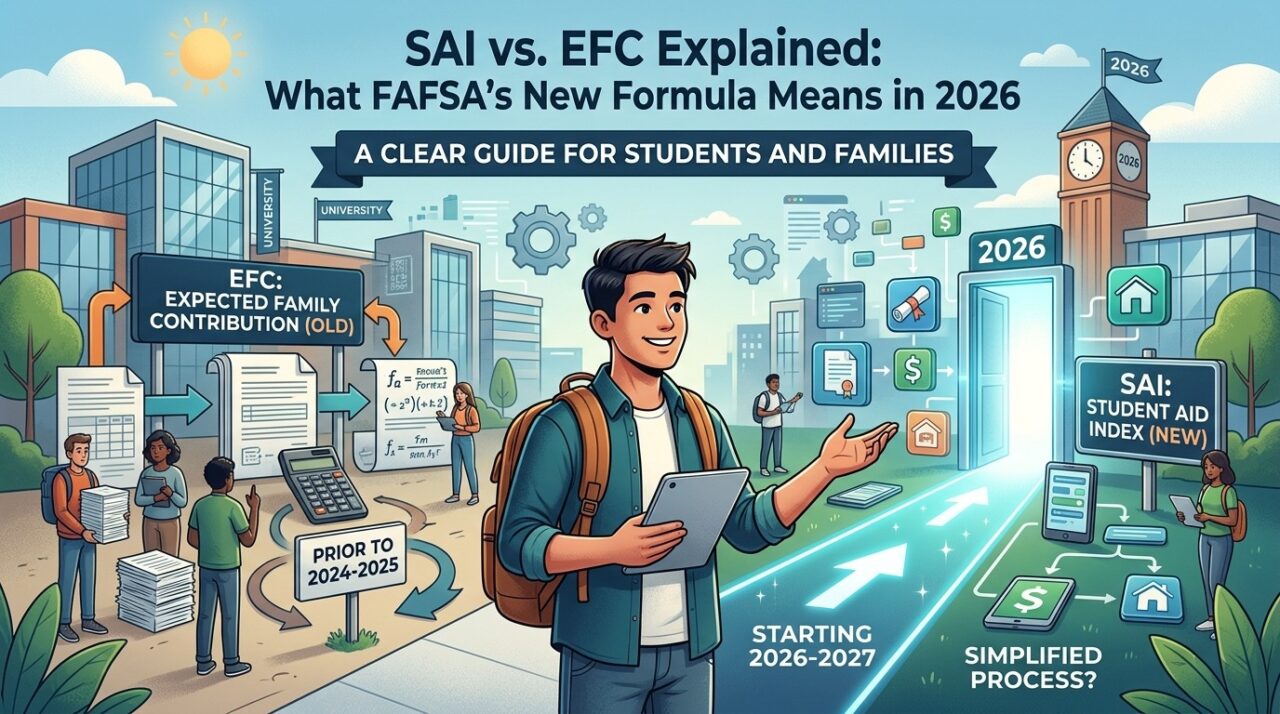
What the Student Aid Index (SAI) Means
The FAFSA now produces a Student Aid Index (SAI). This is a formula-based number ranging from –1500 to 999999. It is not the amount of aid you will receive, not your college bill, and not the amount your family is expected to write in a check. It is an eligibility index that schools use when building aid offers. Federal Student Aid explains that a lower SAI generally signals higher financial need.
The working formula is simple:
Financial Need = Cost of Attendance – Student Aid Index
That means two students with the same SAI can still get different aid offers if they apply to schools with different costs, different institutional grant budgets, or different packaging policies.
Pell Grant: The Most Important Federal Grant
For students with significant financial need, the Federal Pell Grant is usually the most important grant in the college financing system. Federal Student Aid states that the maximum Pell Grant for 2026–27 is $7,395. Pell does not have to be repaid if the student remains eligible and follows program rules.
For many lower-income students, Pell is the foundation of the funding stack. But Pell alone rarely covers the full cost of attendance at a four-year residential college. It helps most when combined with state grants, institutional grants, scholarships, work-study, and careful school choice.
CSS Profile: Important at Some Colleges
Not every college uses only the FAFSA. Many private colleges and some scholarship programs also use the CSS Profile to award non-federal institutional aid. College Board states that CSS Profile helps unlock more than $14 billion in nonfederal aid each year. For Fall 2026/Spring 2027, the platform is active, and CSS Profile is free for domestic undergraduate students from families making up to $100,000 annually; otherwise the fee is $25 for the initial application and $16 for each additional report.
That means students should never assume FAFSA is the only form. If a college requires CSS Profile and the student skips it, the school may not fully consider that student for institutional need-based aid.
Federal Work-Study and Student Jobs
Federal Work-Study can be a useful part of a college cost plan because it allows eligible students to earn money through part-time work while enrolled. Federal Student Aid notes that work-study jobs are part time, students are paid through a regular paycheck, and work-study earnings do not reduce future aid the way ordinary student earnings might be treated.
The key limitation is that work-study is not automatic. Funds and jobs can be limited, and not every school has the same availability. Students should treat work-study as helpful support, not as the single answer to a college cost gap.
How Much Students Can Borrow in Federal Loans
Federal loans should usually come before private loans because they offer more standardized protections and repayment options. For dependent undergraduates, the annual combined Direct Subsidized and Unsubsidized Loan limits are $5,500 for first year, $6,500 for second year, and $7,500 for third year and beyond, with a total undergraduate limit of $31,000. For independent undergraduates, the annual limits are $9,500, $10,500, and $12,500, with a total limit of $57,500.
Those numbers are important because they show a basic truth: federal student borrowing for undergraduates is not unlimited. When a school is far above those loan limits, the family usually needs grants, savings, income, payment plans, Parent PLUS borrowing, or private loans to close the gap. That is why college choice matters so much on the front end.
Parent PLUS and the Hidden Family Risk
When families cannot cover remaining costs, they sometimes turn to Parent PLUS Loans. These loans can fill gaps, but they shift repayment risk to the parent. Families should be cautious about treating Parent PLUS as automatic, because the existence of a financing tool does not make the underlying price affordable. Federal Student Aid’s guidance on comparing aid offers emphasizes understanding the total debt burden before accepting aid.
A strong college cost guide always comes back to the same principle: borrow for the cheapest path to the credential that gets the student where they want to go.
Tax Benefits and 529 Plans
College cost is not just about aid forms. The tax code can reduce net cost too. The IRS states that the American Opportunity Tax Credit (AOTC) can provide up to $2,500 per eligible student per year for the first four years of higher education, with up to $1,000 refundable.
The IRS also explains that a 529 plan is a qualified tuition program established by a state or state agency that allows contributors to save for qualified higher education expenses. Families using 529 funds should coordinate their withdrawals carefully with tax credits and school billing cycles.
The Smartest Ways to Lower College Cost
For high school seniors, the most effective cost-reduction strategy is usually a sequence, not a single trick:
-
Run each college’s net price calculator before applying.
-
File the FAFSA as early as possible.
-
Complete the CSS Profile when required.
-
Prioritize in-state public options when the academic fit is strong.
-
Consider community college + transfer for lower-cost majors or general education.
-
Reduce housing costs where realistic by commuting or living at home.
-
Compare aid offers using total out-of-pocket cost, not just grant amount.
-
Use federal loans before private loans.
-
Capture tax benefits such as AOTC when eligible.
-
Appeal your aid offer if your family had a major financial change.
That last point matters. The official FAFSA form specifically says that students with major financial changes or special circumstances should still submit the form and then discuss those circumstances with the college financial aid office.
How to Compare Colleges the Right Way
A student deciding between colleges should not compare only prestige, campus vibe, or scholarship headline numbers. The better comparison is:
Net price today + likely borrowing + time to degree + probable earnings after graduation
The U.S. Department of Education’s College Scorecard is useful here because it lets students compare colleges and fields of study, including debt and earnings information for graduates. The Net Price Calculator Center is useful earlier in the process because it helps estimate what similar students actually paid. Used together, these tools create a much better decision process than looking at brochure prices alone.
Bottom Line
The main lesson of any serious college cost guide is simple: college cost is not just tuition, and sticker price is not the final price. The real number depends on aid eligibility, school choice, housing, state policy, and whether the student uses every major tool available: FAFSA, Pell, state aid, institutional grants, net price calculators, scholarships, federal loans, and tax credits.
For many students, the lowest-risk strategy is not “find the most famous school you can get into.” It is “find the strongest academic option that produces the best outcome at a price your family can sustain without dangerous borrowing.” That is the difference between getting into college and graduating from it in a financially stable position.
FAQ: College Cost Guide
Is tuition the same as cost of attendance?
No. Tuition is only one part of cost of attendance. Total cost of attendance can also include fees, books, supplies, room, board, transportation, and other expenses.
What is the difference between sticker price and net price?
Sticker price is the published price before aid. Net price is the amount left after grants and scholarships are subtracted.
What is the FAFSA for?
The FAFSA is used to apply for federal grants, work-study, and loans, and many states and colleges also use FAFSA data to award their own aid.
What is the 2026–27 maximum Pell Grant?
The maximum Pell Grant for the 2026–27 award year is $7,395.
Do all colleges use the CSS Profile?
No. Some colleges and scholarship programs use it to award non-federal institutional aid, but many colleges do not require it. Students should check each college individually.
Are federal student loans unlimited?
No. Annual and lifetime federal loan limits apply, and many colleges cost far more than those limits.