10 Year Forgiveness Student Loan: Complete 2026 Guide
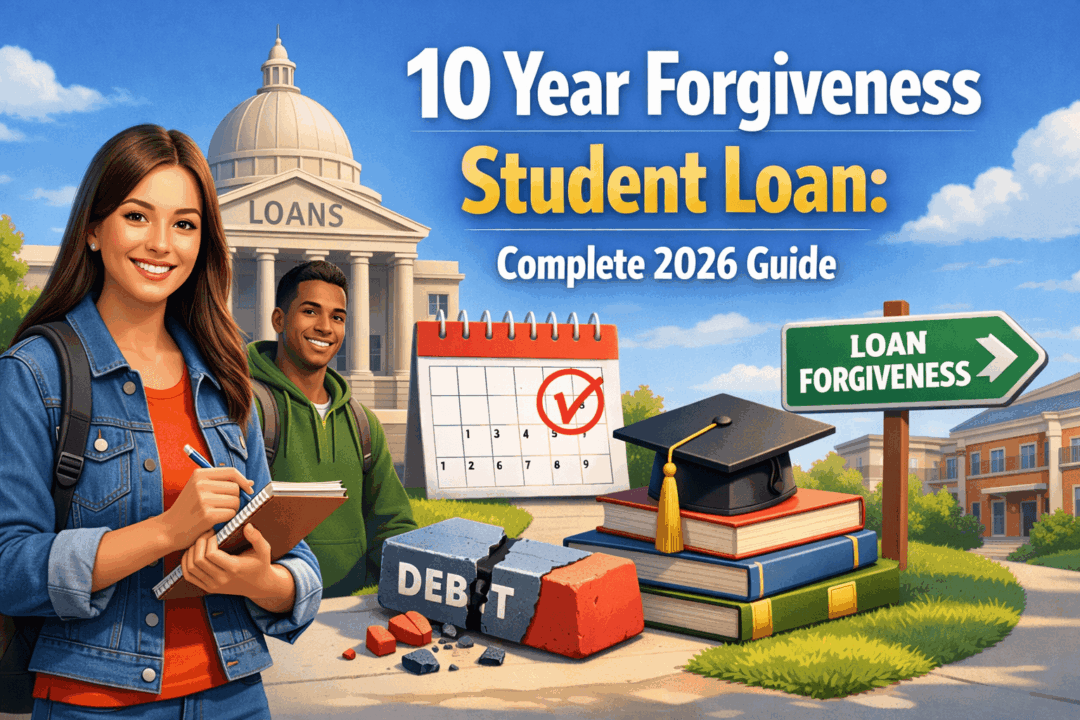
If you search for “10 year forgiveness student loan,” you are usually looking for one real federal program: Public Service Loan Forgiveness (PSLF). PSLF can forgive the remaining balance on eligible Direct Loans after a borrower makes 120 qualifying monthly payments while working full-time for a qualifying employer. That is why people often call it “10-year loan forgiveness.” But this is important: there is no general rule saying all student loans disappear after 10 years just because 10 years have passed.
For students and families planning ahead, the most useful takeaway is simple: 10-year forgiveness is real, but it is career-based and rule-based. It mainly works for people who build their careers in public service, such as government, public schools, certain nonprofits, the military, and similar qualifying sectors. It is not a universal benefit for every borrower, and it does not apply to most private student loans.
PSLF is also a major, functioning federal program, not just a theory. In the Federal Student Aid FY 2024 Annual Report, the U.S. Department of Education said that as of September 2024, 960,000 borrowers had been approved for about $70 billion in PSLF forgiveness. That matters because it shows this is a real pathway people are using successfully, not just a marketing phrase on the internet.
What “10-year student loan forgiveness” actually means
When people say “10-year forgiveness,” they usually mean this formula:
120 qualifying payments + full-time public-service work + eligible Direct Loans = possible forgiveness of the remaining balance. Federal Student Aid says PSLF forgives the remaining balance on Direct Loans after 120 qualifying monthly payments while working full-time for an eligible employer. Those 120 payments do not have to be consecutive.
That last point is important for real life. A borrower can move between qualifying jobs, pause, return to public service, and keep building progress later. The program is based on reaching 120 qualifying months, not on staying in one single job for an unbroken decade.
Who qualifies for 10-year forgiveness under PSLF?
The biggest rule is that your employer matters more than your job title. Federal Student Aid explains that PSLF is based on whether you work for a qualifying employer, not whether your title sounds public-service related. A person generally must work an average of at least 30 hours per week for a qualifying employer to meet the full-time standard for PSLF.
Qualifying employers generally include government organizations at any level—federal, state, local, or tribal—and many 501(c)(3) nonprofit organizations. Full-time volunteer service in AmeriCorps or the Peace Corps can also count. Some other nonprofits may qualify if they provide certain public services.
This means many borrowers in fields like teaching, nursing, social work, public health, public defense, firefighting, law enforcement, city government, and military service may qualify if their employer qualifies. A nurse at a public hospital may qualify; a nurse at a private for-profit employer may not. A teacher at a public school or qualifying nonprofit school may qualify; a teacher at a for-profit school generally would not.
Which loans qualify?
The cleanest rule is this: non-defaulted federal Direct Loans qualify for PSLF. Federal Student Aid says a qualifying PSLF loan is a non-defaulted loan under the William D. Ford Federal Direct Loan Program.
That means these loans do not directly qualify for PSLF unless fixed first:
-
FFEL loans
-
Perkins loans
-
Private student loans
For many federal borrowers with older loan types, the fix is Direct Consolidation. FFEL and Perkins loans can become PSLF-eligible if they are consolidated into a Direct Consolidation Loan. But borrowers should be careful: consolidation can affect how prior payment history is credited, so they should check the official rules before acting.
Parent PLUS borrowers are a special case. Parent PLUS loans do not directly qualify for normal IDR options, but a borrower may be able to consolidate and then use ICR, and public-service employment can still potentially lead to PSLF. That makes Parent PLUS forgiveness more complicated than standard undergraduate Direct Loans, but not necessarily impossible.
One more warning: defaulted loans are not eligible for federal forgiveness programs until the borrower resolves the default status.
Which repayment plans count?
Federal Student Aid says PSLF works when a borrower makes qualifying payments under a qualifying repayment plan. In practice, the two most important options are:
-
Income-Driven Repayment (IDR) plans
-
The standard 10-year repayment plan
But there is a catch that confuses many people: if a borrower stays on the standard 10-year plan for the full 10 years, there may be nothing left to forgive at the end because the loan may already be paid off. That is why StudentAid.gov says borrowers who want to benefit from PSLF usually need an IDR plan.
IDR plans are popular because payments are based on income and family size, and the application is free through StudentAid.gov. Federal Student Aid says IDR payments can be as low as $0 depending on the borrower’s situation, and IDR plans can also lead to separate long-term forgiveness after 20 or 25 years for borrowers who are not using PSLF.
The biggest mistake borrowers make
The most common misunderstanding is believing that time alone creates forgiveness. It does not. A borrower must line up all of the PSLF rules at the same time: qualifying loan type, qualifying repayment plan, qualifying employer, and 120 qualifying months. Missing even one of those pieces can block forgiveness.
Another major mistake is refinancing federal loans into private loans. The CFPB warns that borrowers can lose federal forgiveness benefits when they refinance federal loans with a new private student loan. For anyone hoping for PSLF, refinancing into private debt can permanently shut that door.
A third mistake is waiting too long to document progress. The Department says PSLF is now fully managed through StudentAid.gov, where borrowers can submit forms, track status, review correspondence, and access payment counts. In plain English, borrowers should not wait until year 10 to see whether the government agrees with their records.
How to apply for 10-year forgiveness
A smart PSLF workflow in 2026 looks like this:
Step 1: Check your loan types. Log in to your federal account and confirm whether your loans are Direct Loans or older loan types that may need consolidation.
Step 2: Compare repayment options. Use the federal Loan Simulator to estimate payments and compare plans. This is especially important because the repayment environment is changing in 2026.
Step 3: Choose a qualifying repayment plan. Most PSLF borrowers benefit from an IDR plan, not the standard 10-year plan, because IDR is more likely to leave a remaining balance to forgive.
Step 4: Use the PSLF Help Tool. Federal Student Aid says the PSLF Help Tool helps borrowers understand the program, check employer eligibility, and prepare the form. The tool also supports employer search and digital signature workflows.
Step 5: Certify employment regularly. A borrower can use the same PSLF form to update qualifying payment counts and later apply for forgiveness once 120 qualifying payments have been reached.
Step 6: Track counts inside StudentAid.gov. The Department now manages PSLF directly through StudentAid.gov, which means borrowers should actively monitor counts and correspondence instead of assuming everything is being counted automatically.
What if a borrower used the wrong plan or spent time in deferment?
Some borrowers may have a backup path. Federal Student Aid still describes Temporary Expanded Public Service Loan Forgiveness (TEPSLF) as a temporary opportunity for borrowers who were otherwise eligible for PSLF but made some payments under a nonqualifying repayment plan.
There is also a PSLF buyback option in certain situations. Federal Student Aid servicer guidance says borrowers may be able to buy back some months that did not count because they were in certain deferment or forbearance statuses, but only if they already have 120 months of qualifying employment and the buyback would lead directly to forgiveness.
Other forgiveness programs people confuse with “10-year forgiveness”
Not every forgiveness program is PSLF. Some common look-alikes are shorter, longer, or more limited:
Income-Driven Repayment forgiveness: remaining balance may be forgiven after 20 or 25 years, depending on the plan and loan history. That is real forgiveness, but it is not the same as 10-year PSLF.
Teacher Loan Forgiveness: eligible teachers can receive up to $17,500 after five complete and consecutive academic years in certain low-income schools or educational service agencies. Federal Student Aid also warns that the same teaching period cannot be used for both Teacher Loan Forgiveness and PSLF.
School-related discharges: borrowers may qualify for relief through borrower defense or closed school discharge in specific cases involving school misconduct or school closure.
Total and Permanent Disability discharge: borrowers with qualifying severe disabilities may have federal student loans discharged.
Taxes: will forgiven loans count as income in 2026?
For PSLF, Federal Student Aid says amounts forgiven under PSLF are not considered income for federal tax purposes. TEPSLF is treated the same way. That makes PSLF especially valuable because forgiveness is not just large; it is also generally federally tax-free.
For other forgiveness programs, the tax story is more complicated in 2026. IRS Publication 970 says the American Rescue Plan changed the treatment of student loan forgiveness for discharges in 2021 through 2025, and IRS Publication 4681 reflects that the broader temporary exclusion does not continue in the same way after 2025 except for certain cases such as death or total and permanent disability. Because tax rules differ by program and some states may still tax forgiven debt, borrowers should check the current IRS guidance and state rules before assuming a forgiven balance will be tax-free.
2026 rule changes borrowers should watch
This topic is moving. The Department of Education announced a final PSLF rule in October 2025 that takes effect July 1, 2026, including changes to how qualifying employers are defined.
The repayment system is also changing. Federal guidance says a new Repayment Assistance Plan (RAP) is expected to be available by July 1, 2026, and the Department has said payments under RAP will count toward PSLF if the borrower meets the rest of the PSLF requirements. At the same time, the Department announced a proposed settlement in December 2025 that would end the SAVE plan, and official servicer notices say borrowers should monitor federal updates and use Loan Simulator to compare alternatives.
For a website article in 2026, this means one editorial rule matters a lot: do not publish old advice that says “just sign up for SAVE and wait 10 years.” That advice may already be outdated depending on when the reader lands on the page.
What high school seniors should learn from this now
If you are still in high school, the smartest way to think about 10-year forgiveness is not as “free college later,” but as a possible career-linked safety net. PSLF can be powerful for future teachers, nurses at public hospitals, social workers, military members, government employees, and nonprofit workers. But it only works well when borrowing, repayment plan choice, and career path all fit the federal rules.
That is why families should still focus first on borrowing as little as possible, choosing affordable colleges, maximizing grants and scholarships, and understanding the difference between federal and private loans. PSLF is best treated as a bonus for eligible public-service careers, not as a reason to borrow carelessly. Federal forgiveness can help later, but cost control at the start is still the safer strategy.
FAQ
Is there a program that forgives all student loans after exactly 10 years?
No. The main 10-year pathway is Public Service Loan Forgiveness, which requires 120 qualifying payments, qualifying employment, and eligible Direct Loans. Most other forgiveness routes take longer or apply only in narrow situations.
Do private student loans qualify for 10-year forgiveness?
No federal PSLF program covers private student loans. Private loans also cannot be turned into federal Direct Loans through consolidation.
Can teachers get 10-year forgiveness?
Yes, if they work for a qualifying employer and meet PSLF rules. Teachers may also qualify for Teacher Loan Forgiveness after five years, but they cannot use the same service period for both benefits.
Can nurses, social workers, and military members qualify?
Yes, often. But the key question is whether the employer qualifies, not the job title alone. Military service can also count toward PSLF.
Can Parent PLUS loans ever qualify?
Sometimes. Parent PLUS borrowers may need to consolidate into a Direct Consolidation Loan and usually must use ICR if seeking an IDR-based path. Public-service employment can still matter for PSLF.
Official government links to use in WordPress
Use these as the main external links in the article:
Bottom line
The phrase “10 year forgiveness student loan” is real in one main sense: PSLF can forgive remaining federal Direct Loan debt after 10 years of qualifying public-service work and qualifying payments. But it is not automatic, it is not universal, and it usually does not apply to private loans. In 2026, the safest reader-friendly explanation is this: PSLF is the real 10-year program, IDR is usually 20 to 25 years, and borrowers should use official StudentAid.gov tools—not third-party promises—to see what they actually qualify for.