Going Back to College at 25: Complete 2026 Guide
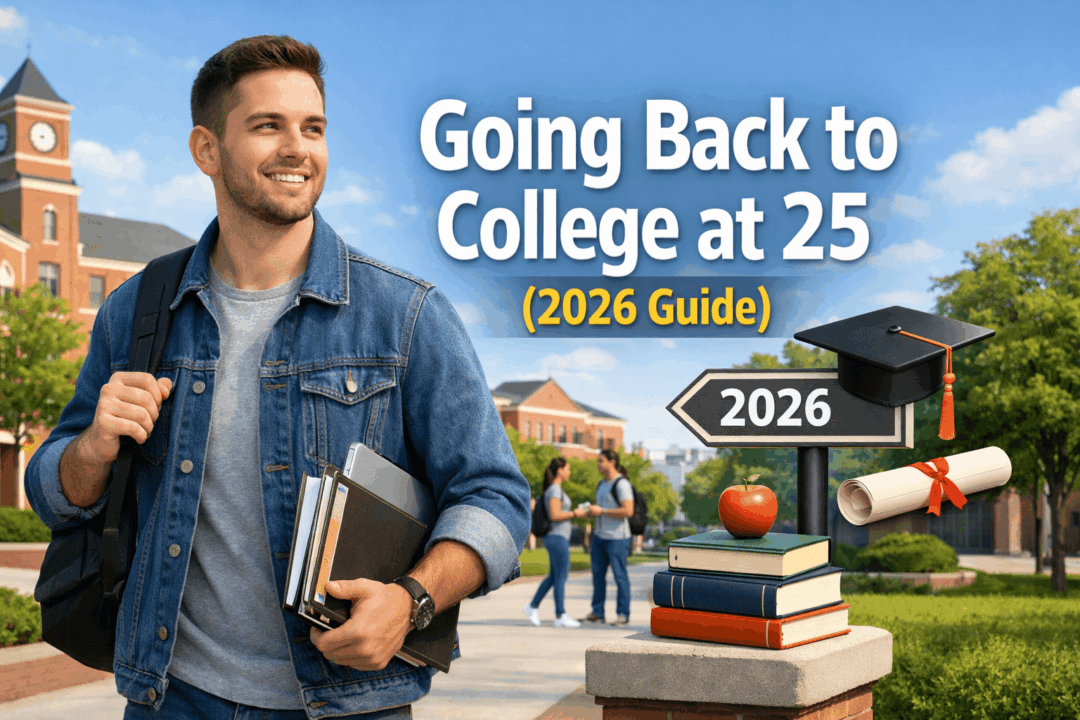
Going back to college at 25 is not “late.” In the United States, millions of college students are already 25 or older. NCES reports that 6,269,521 students age 25 and over were enrolled in postsecondary education in fall 2023, and the National Student Clearinghouse reported that undergraduate enrollment for students ages 25 to 29 grew 3.3% in fall 2025. That means returning at 25 is not unusual at all; it is part of the real shape of modern college attendance.
For many students, age 25 can actually be a strong time to return. At that age, students often have clearer goals, better self-management, work experience, and a sharper understanding of why they are paying for school. That matters because college works best when the student enters with purpose, not just momentum from high school. The data also show that education still has a strong labor-market payoff: in the first quarter of 2025, median weekly earnings for full-time workers age 25 and over were $953 for high school graduates with no college, $1,096 for workers with some college or an associate degree, and $1,754 for workers with a bachelor’s degree or higher.
The job market data point in the same direction. In February 2026, the unemployment rate for people age 25 and over was 4.8% for high school graduates with no college, 3.5% for workers with some college or an associate degree, and 3.0% for workers with a bachelor’s degree or higher. College does not guarantee wealth, but it still improves average earnings and lowers unemployment risk.
So the better question is not, “Am I too old?” The better question is, “What is the smartest, lowest-risk way for me to go back now?” That is the question this guide answers.
1) What changes when you go back to college at 25?
The biggest change is financial aid. For federal student aid, students who are 24 or older are generally treated as independent students on the FAFSA. In practical terms, that usually means you report your own income and, if applicable, your spouse’s income, rather than your parents’ financial information. For many returning students, this can materially change aid eligibility.
That does not mean every 25-year-old gets a full Pell Grant or a free ride. Aid still depends on your income, assets, enrollment intensity, school costs, and state or institutional rules. But it does mean the aid formula often matches adult learners more realistically than it does younger dependent students.
There is also a timing issue. If your program begins before July 1, 2026, the relevant federal form may be the 2025–26 FAFSA. If your enrollment begins on or after July 1, 2026, the relevant form is generally the 2026–27 FAFSA, which opened no earlier than October 1, 2025 and has a federal deadline of June 30, 2027. The 2025–26 FAFSA covers July 1, 2025 through June 30, 2026 and has a federal deadline of June 30, 2026.
Another important detail: the FAFSA uses tax information from two years earlier. Federal Student Aid explains that the 2026–27 FAFSA uses 2024 tax information. This matters for 25-year-olds because many are changing jobs, moving, marrying, or returning after income disruption. If your current finances are worse than the tax-year snapshot on the FAFSA, you may need to talk directly with the school’s financial aid office.
2) Is going back to college at 25 worth it?
For many students, yes, but only if they choose the right program, the right price point, and the right completion strategy. The payoff of college is real on average, but the payoff is not identical across every major, school, and path. Georgetown’s Center on Education and the Workforce reported in 2025 that prime-age workers with a bachelor’s degree earn 70% more at the median than workers with only a high school diploma. At the same time, earnings vary significantly by field of study.
That means returning to college at 25 should be approached as an investment decision, not a vague life upgrade. The strongest decisions usually have three features. First, the program leads to a clearly understood credential: certificate, associate degree, bachelor’s degree, or licensure path. Second, the total price is controlled. Third, the student can realistically finish. A cheap program you complete is usually better than an expensive program you leave halfway through.
The “finish” point is important because many adults already have prior credits. The National Student Clearinghouse’s 2025 Some College, No Credential report found that over one million former students returned to higher education in 2023–24. That is strong evidence that stopping out is not the end of the story. Many adults re-enter, reassemble credits, and finish later.
3) How much college costs in 2026
For 2025–26, the College Board reports average published tuition and fees of $4,150 at public two-year in-district colleges, $11,950 at public four-year in-state colleges, and $45,000 at private nonprofit four-year colleges. Average full student budgets are much higher once housing, food, transportation, books, and other living costs are included.
That sounds intimidating, but sticker price is not the same as what students actually pay. College Board also reports that, after grant aid, the average net tuition and fees paid by first-time full-time in-state students at public four-year institutions declined to an estimated $2,300 in 2025–26, and that first-time full-time students at public two-year colleges have, on average, been receiving enough grant aid to cover tuition and fees since 2009–10.
For a 25-year-old, that means the cheapest smart path is often one of these:
-
community college first, then transfer;
-
an in-state public university with strong transfer acceptance;
-
an employer-supported program;
-
a hybrid or online program with transparent outcomes and transfer rules;
-
a short occupational program tied to licensure or direct labor-market demand.
The wrong path is usually the one with the weakest price transparency, the poorest transferability, and the highest borrowing pressure. That is why students returning at 25 should compare net price, graduation/completion, debt, and earnings before enrolling. The U.S. Department of Education’s College Scorecard and Net Price Calculator tools exist for exactly this reason.
4) Financial aid for students going back to college at 25
FAFSA and Pell Grant
The first step is the FAFSA. Filing it is how students become eligible for federal grants, work-study, and loans, and often for state and institutional aid too. Federal Student Aid states that the maximum Pell Grant for 2026–27 is $7,395. Pell Grants do not have to be repaid except in limited circumstances.
Because a 25-year-old is generally independent for FAFSA purposes, aid may reflect the student’s own current household circumstances more directly than it would for a dependent 18-year-old. That can help adult learners, especially those returning after lower earnings, job changes, or family transitions.
Federal Direct Loans
If grants and scholarships do not cover everything, federal student loans are usually safer than private loans because they come with standardized protections and repayment options. Federal Student Aid shows that independent undergraduates can generally borrow up to $9,500 in the first year, $10,500 in the second year, and $12,500 in the third year and beyond, with an aggregate undergraduate cap of $57,500, of which no more than $23,000 may be subsidized.
That does not mean students should automatically borrow the maximum. Borrowing capacity is not the same thing as an affordability plan. The safest borrowing pattern is usually to keep total debt low enough that first-year earnings in your intended field can comfortably support repayment.
Federal Work-Study
Federal Work-Study can also help. Federal Student Aid explains that it provides part-time jobs for students with financial need, and that students usually receive funds through a regular paycheck. It also notes that work-study earnings do not reduce future student aid eligibility in the usual way.
For a 25-year-old, that matters because many returning students are balancing rent, transportation, food, and school supplies. A part-time campus or community-based job that fits around classes can be better than random off-campus work with unstable hours.
Professional judgment and aid appeals
If your current situation is worse than the tax year shown on the FAFSA, talk to the financial aid office. Federal Student Aid says special financial circumstances can include loss of employment, pay cuts, private K–12 tuition, and high medical expenses, and schools can review those cases individually. This process is often called professional judgment.
For returning adults, this matters a lot. A student who earned more in 2024 but lost income later should not assume the FAFSA result is final. Sometimes the correct move is not a new form; it is a documented appeal through the aid office.
5) Other ways to pay for college at 25
A smart 25-year-old funding plan usually mixes several tools instead of relying on one.
Employer education benefits are one of the most overlooked options. The IRS states that employers can provide up to $5,250 per employee per year in educational assistance that can be excluded from wages under qualifying programs. In 2026 guidance, the IRS also notes that recent law permanently extended the $5,250 exclusion for employer-provided educational assistance for payments made after 2025.
Tax credits matter too. The IRS says the American Opportunity Tax Credit can be worth up to $2,500 per eligible student for the first four years of higher education, and the Lifetime Learning Credit can be worth up to $2,000 per return. The Lifetime Learning Credit is especially relevant for adult learners because it is not limited to the first four years of college in the same way the AOTC is.
Scholarships are also not just for 17-year-olds with perfect GPAs. ScholarshipsAndGrants.us already has a current Adult Learners page, and adult-targeted awards often look for persistence, life experience, career change goals, military service, parenting responsibilities, community leadership, or prior stop-out status rather than only traditional high-school metrics.
6) The best college paths for a 25-year-old
The best path is the one that reduces cost, protects transfer value, and fits your life.
Community college first
This is often the strongest value path, especially if you are unsure of your major, need to rebuild academic confidence, or want to keep working. Average published tuition and fees at public two-year colleges are far below four-year prices, and grant aid often covers tuition and fees on average for first-time full-time students.
Transfer to a public university
If your goal is a bachelor’s degree, starting cheap and transferring can make the final degree far less expensive. The key is to verify transfer equivalencies and articulation agreements before enrolling. Use school advising plus College Scorecard and the school’s Net Price Calculator to compare the true cost of completion, not just the first year.
Career certificate or licensure program
If your goal is faster entry into a field such as healthcare support, information technology, skilled trades, or other applied fields, a short certificate can be a rational choice. But this only works if the credential has real labor-market value and the school has acceptable cost and outcome data.
Online or hybrid college
This can be a good fit for working adults, but students should look carefully at transfer credit acceptance, residency requirements, program accreditation where relevant, and total debt. “Flexible” is not always the same as “good value.” Use official comparison tools, not only marketing pages.
7) A realistic 8-step plan for going back to college at 25
Step 1: Decide the credential
Pick the endpoint first: certificate, associate degree, bachelor’s degree, or license. A vague plan creates expensive drift.
Step 2: Pull your old transcripts
If you attended college before, collect every transcript. Returning students often save time and money by recovering old credits. The National Student Clearinghouse data show that re-entry is common; old coursework can matter.
Step 3: Build a low-cost school list
Compare public two-year, public four-year, and any employer-friendly or hybrid options. Do not compare only tuition; compare net price, transfer policy, and outcomes.
Step 4: File the correct FAFSA
Use the award year that matches your actual start date. Remember that 2026–27 covers July 1, 2026 to June 30, 2027 and uses 2024 tax data.
Step 5: Ask about adult-learner aid
Check school-based re-entry scholarships, completion grants, emergency aid, and department scholarships. Also check your employer’s benefits.
Step 6: Appeal if your income changed
If your FAFSA does not reflect job loss, reduced hours, or large medical bills, contact the financial aid office and ask about special circumstances review.
Step 7: Choose a schedule you can finish
Part-time may feel safer, but too few credits can stretch costs and delay the payoff. Choose the heaviest schedule you can realistically complete while protecting your work and family obligations.
Step 8: Borrow last
Use grants, scholarships, employer aid, tax credits, savings, and manageable work income first. Use federal loans carefully and only for the remaining gap.
8) Biggest mistakes to avoid
One common mistake is picking a school based on ads rather than verified outcomes. The better move is to compare schools with the College Scorecard and the school’s Net Price Calculator.
Another mistake is assuming age alone solves aid problems. Being 25 helps because you are generally an independent student, but grants still depend on the numbers in your household finances and on school cost.
A third mistake is borrowing for an unclear goal. If you do not know what credential you want and what jobs it leads to, pause and map the outcome first.
A fourth mistake is ignoring transfer policy. Students often lose money when credits do not transfer cleanly. Always verify this in writing.
A fifth mistake is failing to ask for help after a life change. A FAFSA form is not the last word if your income fell or your circumstances changed.
9) Bottom line
Going back to college at 25 is normal, financially meaningful, and often smart. Millions of Americans 25 and older are enrolled in college, adult-student enrollment has recently increased, and workers with more education continue to earn more on average and face lower unemployment. But the decision is strongest when students choose a program with a clear labor-market purpose, control price from day one, file the right FAFSA, and use every legitimate funding source available.
Age 25 is not a disadvantage. In federal aid terms, it can actually be an advantage, because you are generally treated as an independent student. The smartest path back is not the flashiest school. It is the program you can afford, finish, and convert into a better long-term outcome.
Official links to include in the post
Use these as the “legit website” links in WordPress:
Suggested internal links for ScholarshipsAndGrants.us
These are relevant internal pages already live on your site: