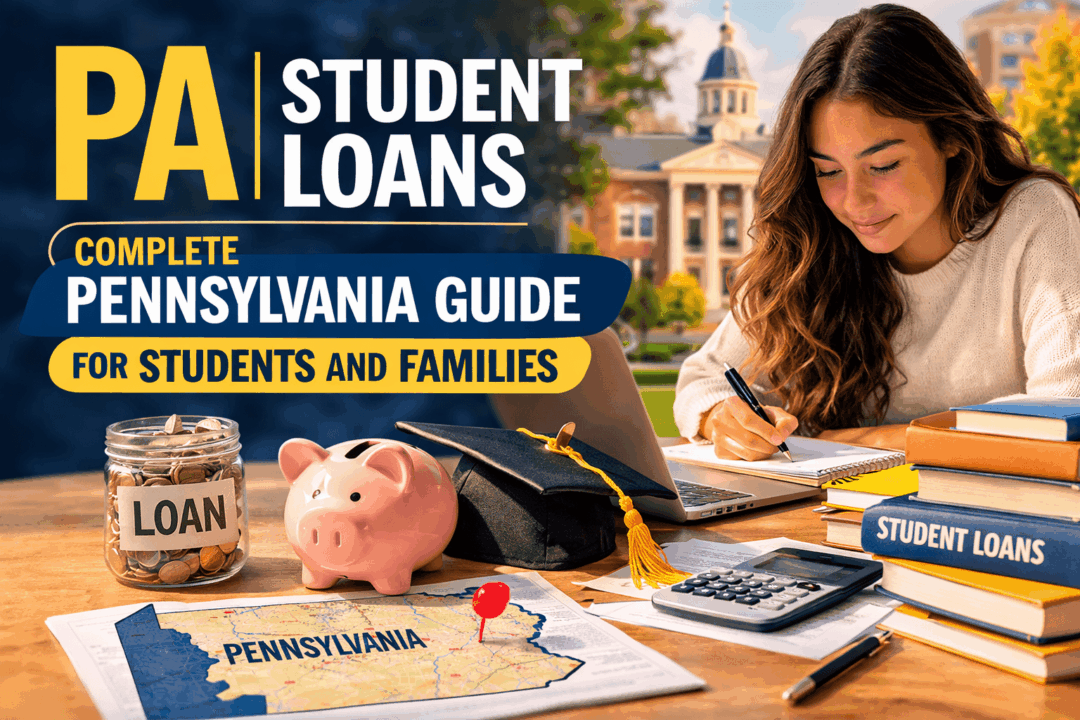
If you are a Pennsylvania student trying to pay for college, the safest way to think about student loans is this: use grants and scholarships first, use federal student loans second, and use private loans only if you still have a gap. In Pennsylvania, that usually means starting with the FAFSA, checking for the PA State Grant and other PHEAA-run programs, then comparing federal Direct Loans with Pennsylvania-based private options such as PA Forward. The Consumer Financial Protection Bureau says federal loans are the best option for most borrowers because they have fixed rates and stronger repayment protections.
This matters because student debt is still a major financial issue. The New York Fed reported $1.66 trillion in outstanding student loan debt nationwide in Q4 2025, and 9.6% of balances were at least 90 days delinquent. In the Federal Reserve’s 2025 household survey, the median amount of education debt for people who owed money for their own schooling in 2024 was $20,000 to $24,999. A Pennsylvania-focused estimate from EducationData puts the state at about 1.866 million borrowers, $67.4 billion in student debt, and an average balance of $36,120.
What “PA student loans” usually means
In Pennsylvania, “student loans” usually falls into three buckets. First are federal student loans from the U.S. Department of Education. Second are Pennsylvania-based private loans, mainly through PHEAA’s PA Forward Student Loan Program. Third are loans from banks, credit unions, and national private lenders. PHEAA’s own 2026–27 Student Aid Guide says the agency offers the Pennsylvania-based PA Forward Student Loan Program and administers major state aid programs, including the PA State Grant Program.
The smartest borrowing order for Pennsylvania families
1) Start with money you do not have to repay
Before thinking about loans, Pennsylvania students should look hard at grants. The Pennsylvania Department of Education says the PA State Grant is the largest grant program in the state. PHEAA also runs or helps administer other aid programs, including Grow PA, PATH, FosterEd, the Chafee Grant, and several military- and occupation-related programs. PHEAA’s guide also reminds families that the FAFSA is free and that the official process should not ask for a credit card just to apply.
Two Pennsylvania programs are especially worth knowing about. The PA State Grant is the main need-based state grant for eligible Pennsylvania residents. The Grow PA Scholarship Grant Program can award up to $5,000 per year to qualifying in-state students in approved high-demand fields. For the 2026–27 cycle, PHEAA says Grow PA applications are accepted until October 1, 2026, but funds may run out earlier because the program is first-come, first-served.
2) Federal student loans usually come next
For most Pennsylvania high school seniors, the best loan option is a federal Direct Loan. The CFPB says federal loans are the better choice for the vast majority of borrowers because they have fixed interest rates and more flexible borrower protections than private loans. Federal loans also come with federal repayment systems, including standard repayment and other federal relief pathways that private loans do not match.
For loans first disbursed between July 1, 2025, and June 30, 2026, federal rates are currently:
-
6.39% for undergraduate Direct Subsidized and Direct Unsubsidized Loans
-
8.94% for Direct PLUS Loans for parents
-
7.94% for graduate/professional Direct Unsubsidized Loans
These rates are fixed for the life of each loan once borrowed, even though the government sets a new rate each year for new disbursements.
Federal loans also have fees. For loans first disbursed on or after October 1, 2020, the origination fee is 1.057% for Direct Subsidized and Direct Unsubsidized Loans, and 4.228% for Direct PLUS Loans. That means the amount you receive is a little less than the amount you borrow.
For undergraduates, the current annual federal borrowing limits are still relatively modest, which is one reason many families feel a funding gap:
-
Dependent first-year student: up to $5,500 total, including up to $3,500 subsidized
-
Dependent second-year student: up to $6,500 total, including up to $4,500 subsidized
-
Dependent third-year and beyond: up to $7,500 total, including up to $5,500 subsidized
If a student is independent, or if a dependent student’s parent cannot get a Direct PLUS Loan, the higher annual caps are $9,500, $10,500, and $12,500.
Where Pennsylvania’s PA Forward loans fit in
When federal aid, grants, scholarships, savings, and work income still do not cover the bill, Pennsylvania families often look at PA Forward. PHEAA describes PA Forward as the state-based private option for undergraduate students, graduate students, parents, and borrowers seeking refinance. In its 2026–27 Student Aid Guide, PHEAA says PA Forward can cover up to 100% of remaining education costs after other aid is used.
PHEAA also highlights some features families like: official PA Forward pages say there are no application or origination fees, and the undergraduate FAQ says there is no prepayment penalty and no late fees. PHEAA also notes that many students may benefit from having a creditworthy co-signer, because a co-signer can improve approval odds and pricing.
That said, PA Forward is still a private student loan. Even when it comes from a trusted Pennsylvania agency, it does not turn into a federal loan. That means students should still compare it the same way they would compare any private lender: rate type, repayment options, co-signer release, hardship help, and total repayment cost. The CFPB warns that private loans are often more expensive and generally offer less flexibility if you later struggle to pay.
Private loans are not “bad,” but they are riskier
Private student loans can make sense in narrow situations, especially if a family has strong credit, has already maxed out safer aid, and needs a final gap loan. But they carry more risk. CFPB guidance says private loans may have variable rates, can leave borrowers with fewer repayment options, and usually depend more heavily on credit history and co-signers. Most lenders also require the school to certify that you truly need the extra borrowing.
The biggest mistake students make is borrowing like future income is guaranteed. It is smarter to ask one hard question first: How much salary is realistic in my first year after graduation, and can I handle this payment on that income? That question matters because Pennsylvania students have real alternatives to borrowing more, including community college transfer paths, in-state public options, work-study, employer tuition help, state grants, and occupation-targeted aid like Grow PA.
Be very careful with refinancing
PHEAA’s PA Forward refinance product is aimed at borrowers already in repayment, but refinancing federal loans into a private refinance loan is a serious tradeoff. PHEAA’s own refinance FAQ warns that refinancing federal loans means giving up current and possible future federal benefits, including income-driven repayment and certain federal interest-rate or forgiveness-related protections. That is why refinancing is usually more of a decision for graduates than for first-time freshmen.
Pennsylvania-specific borrower protections you should know
Pennsylvania has added a few borrower-protection rules that families should know about. The Pennsylvania Department of Education says Act 69 of 2024 added student fee transparency, higher education cost transparency, and exit counseling requirements to state law. It also says Act 121 of 2018 requires colleges to tell student borrowers each year how much they have borrowed so far. These rules do not erase debt, but they do make it harder for colleges to keep students in the dark about costs.
One important 2026 update for families planning ahead
There is a major federal loan change on the horizon. In a January 29, 2026 Department of Education announcement, the Department said that, beginning in July 2026, federal law will limit new graduate students to $20,500 per year and $100,000 total in federal loans, and new professional students to $50,000 per year and $200,000 total. The Department also said the law is moving toward a simpler, narrower repayment structure. Those changes matter more for future graduate and professional borrowing than for a typical first-year undergraduate, but high school seniors planning a long education path should still keep an eye on them.
The simplest rule for PA students
For most Pennsylvania seniors, the cleanest strategy is:
FAFSA → PA State Grant and other grants → federal Direct Loan → private loan only for the remaining gap. That order gives you the most protection and usually the lowest long-run risk. Pennsylvania does have a trusted state-based private option in PA Forward, but it should usually be your backup, not your first move.
Official links to legit websites
Here are the best official or consumer-protection pages to link from your article: