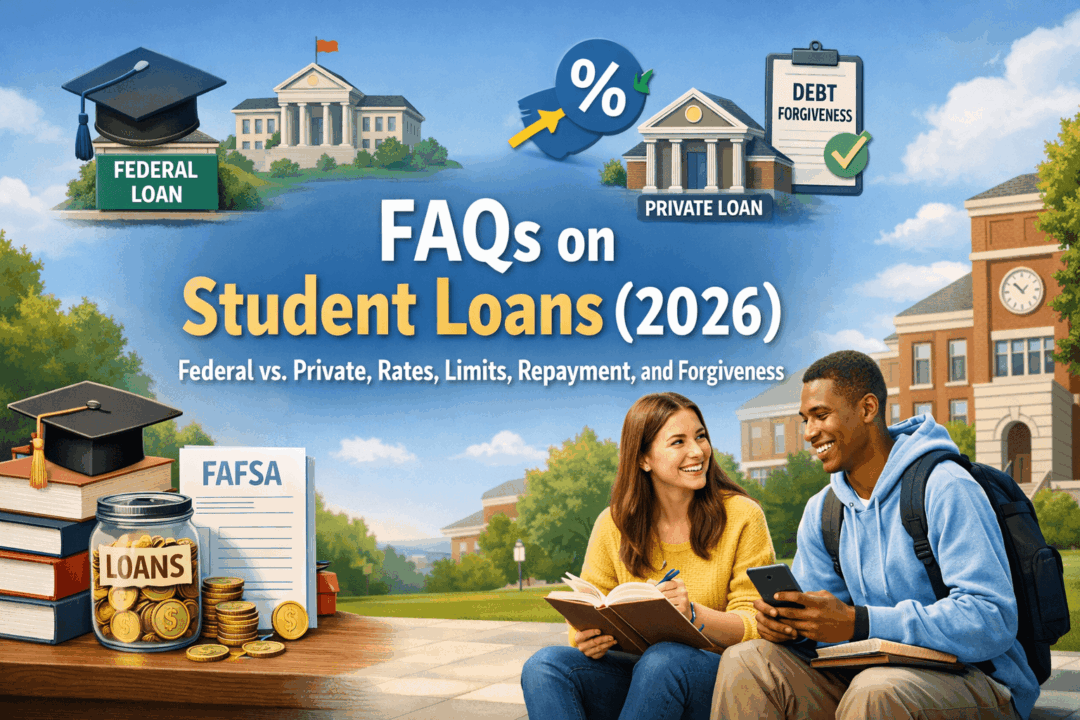
FAQs on Student Loans (2026): Federal vs. Private, Rates, Limits, Repayment, and Forgiveness
A research-backed, easy-to-understand guide to student loans for high school seniors, covering federal vs. private loans, 2025–26 rates and fees, borrowing limits, repayment plans, default risks, and official resources.
Student loans are money you borrow for college or career school and pay back later with interest. The big rule for most families is simple: use free money first, then federal student loans, and only look at private loans if you still have a real gap. The CFPB says federal Direct loans are the better option for most student borrowers because they usually cost less and are easier to repay.
This topic matters because student debt is big, but it is also often misunderstood. The New York Fed reported outstanding student loan debt of $1.66 trillion in 2025 Q4, with 9.6% of balances 90+ days delinquent. At the same time, the Federal Reserve found that among people with debt for their own education, the median amount owed in 2024 was between $20,000 and $24,999, and 28% owed less than $10,000. In other words, many borrowers do not owe huge six-figure balances, but missed payments can still cause real damage.
1) What is the difference between federal and private student loans?
Federal student loans come from the U.S. government through the Direct Loan Program. Private student loans come from banks, credit unions, and other lenders. Federal loans usually win on borrower protection: fixed interest rates, more flexible repayment, options to lower or pause payments, and access to forgiveness or discharge programs in some situations. Private loans can be useful only after you have exhausted grants, scholarships, work-study, savings, and federal loan options.
For most students, federal loans are easier to access. The CFPB notes that most students can get federal loans without a credit check or co-signer, except Parent PLUS loans. Private loans, by contrast, commonly require stronger credit or a co-signer, and they generally offer fewer safety nets if life goes sideways after graduation.
2) What are Direct Subsidized and Direct Unsubsidized Loans?
A Direct Subsidized Loan is the cheaper federal undergraduate loan if you qualify for it. It is need-based, and the government pays the interest while you are in school at least half-time, during the grace period, and during certain deferments. A Direct Unsubsidized Loan is available more broadly, but interest starts building right away.
That difference sounds small, but it matters. If you let unsubsidized interest build for years, your total cost goes up. That is why students should accept subsidized loans first, then unsubsidized loans only as needed.
3) How do I apply for a federal student loan?
You start with the FAFSA. The FAFSA is the form used to apply for federal grants, work-study, and loans. After your school sends your financial aid offer, you decide whether to accept the federal loans listed there. Before the money is disbursed, first-time Direct Loan borrowers generally must complete entrance counseling and sign a Master Promissory Note.
There is also an Annual Student Loan Acknowledgment on StudentAid.gov. It is not required, but Federal Student Aid recommends it because it helps borrowers understand how much they already owe, how much more they can borrow, and how loans may affect their future.
4) How much can undergraduates borrow in federal loans?
For dependent undergraduates, the annual limits are $5,500 in year one, $6,500 in year two, and $7,500 in year three and beyond, with a total undergraduate limit of $31,000, of which no more than $23,000 may be subsidized.
For independent undergraduates, and for certain dependent students whose parents cannot get a PLUS loan, the annual limits are higher: $9,500 in year one, $10,500 in year two, and $12,500 in year three and beyond, with a total undergraduate limit of $57,500, again with no more than $23,000 in subsidized loans.
These caps are important because they stop federal borrowing from running unlimited. If your school costs far more than these limits, that is a sign to compare net price very carefully before filling the gap with private debt.
5) What are the current federal student loan interest rates and fees?
For federal loans first disbursed between July 1, 2025 and June 30, 2026, the interest rate is 6.39% for Direct Subsidized and Direct Unsubsidized Loans for undergraduates, 7.94% for Direct Unsubsidized Loans for graduate or professional students, and 8.94% for Direct PLUS Loans. Federal loan rates are fixed for the life of each loan, which means that once your loan is made, that rate does not change.
Loan fees matter too because you do not actually receive the full amount you borrow. For Direct Subsidized and Direct Unsubsidized Loans first disbursed on or after Oct. 1, 2025 and before Oct. 1, 2026, the fee is 1.057%. For Direct PLUS Loans in that period, the fee is 4.228%. Federal Student Aid also notes that these fees are deducted proportionately from each disbursement.
6) When do I have to start paying student loans back?
Most federal student loans do not require payments while you are in school at least half-time. After you leave school, graduate, or drop below half-time, most Direct Subsidized and Unsubsidized Loans have a six-month grace period before regular repayment starts. Exit counseling is required when you graduate, leave school, or drop below half-time enrollment.
Private loans are different. Some private lenders let you delay payments, but others require payments while you are still in school. The exact rule depends on the lender and the loan contract.
7) What repayment plans exist for federal student loans?
If you do not choose a repayment plan, federal servicers place you on the Standard Repayment Plan, which is a 10-year fixed-payment plan. There are also Graduated plans, where payments start lower and usually rise every two years, and Extended plans, which can stretch payments up to 25 years for qualifying borrowers with more than $30,000 in eligible federal loan balances.
Federal borrowers may also qualify for income-driven repayment, or IDR. These plans base payments on income and family size, and for some borrowers, payments can be as low as $0 per month. The official Loan Simulator is the best tool for checking which plan fits your loan mix and budget.
8) Is the SAVE plan still a thing?
This is one of the biggest “current events” questions in student loans. Federal Student Aid servicer pages currently state that on Dec. 9, 2025, the Department of Education announced a proposed settlement that would end the SAVE Plan, but that settlement still must be approved by the court. Those pages tell borrowers to use Loan Simulator to explore other repayment options.
For a website article, the safest wording is this: repayment programs can change, especially when lawsuits or new regulations are involved, so students should always verify the current status of any plan on StudentAid.gov before making decisions.
9) Can I lower or pause payments if I cannot afford them?
Yes, for federal loans there are usually several ways to get relief. Income-driven repayment may reduce the payment. Deferment can postpone repayment, and subsidized loans generally do not charge interest during qualifying deferments. Forbearance can also temporarily postpone payments, extend time, or allow smaller payments, though interest generally continues to build.
This is why ignoring the bill is almost never the right move. If you are struggling, contact your servicer early. Federal guidance repeatedly points borrowers toward lower-payment options or temporary relief before delinquency turns into default.
10) What happens if I miss payments?
Missing payments can hurt your credit, and if you do not make scheduled federal loan payments for at least 270 days, the loan goes into default. After more than 360 days without action, the government can begin involuntary collections, including wage garnishment of up to 15% of pay and Treasury offset, which can take tax refunds or other federal payments.
That is not just theory. The New York Fed reported that student-loan delinquency remained elevated in late 2025, and about one million borrowers who were more than 120 days past due had their loans transferred to the Department of Education’s Default Resolution Group.
11) Can student loans be forgiven, canceled, or discharged?
Sometimes, yes, but only under specific rules. For federal loans, Public Service Loan Forgiveness can forgive eligible Direct Loan balances after 120 qualifying payments while working in qualifying public service employment. Federal loan pages also note discharge options for death, total and permanent disability, certain school closures, and borrower defense cases involving school misconduct.
These are real programs, but they are not “easy money.” Each one has eligibility rules, paperwork, and limits. Borrower defense applies to federal loans, not private student loans. Closed-school discharge may wipe out the obligation if the school closes while you are enrolled or soon after withdrawal and you meet the criteria.
12) What is the difference between consolidation and refinancing?
Federal consolidation means combining one or more federal loans into one Direct Consolidation Loan with one payment and a fixed interest rate. It can simplify repayment and sometimes help borrowers access federal programs, but it can also stretch out repayment and increase total interest paid.
Refinancing usually means taking out a new private loan to pay off existing loans. The CFPB warns that if you refinance federal loans into a private loan, you lose federal protections such as federal forgiveness programs and federal income-driven repayment options.
13) Do private student loans usually need a co-signer?
Often, yes. The CFPB says students generally need a parent or other family member to co-sign private loans unless they already have strong credit. A co-signer is legally responsible for the debt if the primary borrower does not pay.
That risk is not small. CFPB guidance also warns borrowers and co-signers to read the terms carefully, including whether the lender offers co-signer release and under what conditions.
14) How do I know whether a loan amount is smart?
There is no magic number that works for everyone. The smarter question is whether the school’s net price, graduation odds, and likely earnings make the borrowing manageable. The Department of Education’s College Scorecard lets students compare schools on average cost, net price, graduation, post-school earnings, and average debt.
A high school senior should compare at least three things before borrowing: the school’s net price after grants and scholarships, how much borrowing will be needed each year, and what monthly repayment might look like after graduation. Federal tools such as College Scorecard and Loan Simulator exist exactly for this reason.
15) What is the smartest borrowing strategy?
The safest order is usually: scholarships and grants first, then savings and work-study, then federal subsidized loans, then federal unsubsidized loans, and private loans last. That order matches CFPB guidance to explore federal options first because they usually cost less and are easier to repay.
If you do borrow, borrow only what you truly need for school costs, not for lifestyle inflation. Use the Annual Student Loan Acknowledgment, read your aid offer carefully, and check your school in College Scorecard before accepting the full loan amount just because it is offered.
Official websites to link in your article
These are solid, legitimate resources for readers:
Bottom line
The best student loan is the smallest one you need after free aid and federal options have been fully explored. For most high school seniors, the smartest path is to file the FAFSA, compare schools by net price and outcomes, use federal loans before private loans, and understand repayment before accepting any debt. That is the difference between borrowing as a tool and borrowing as a trap.