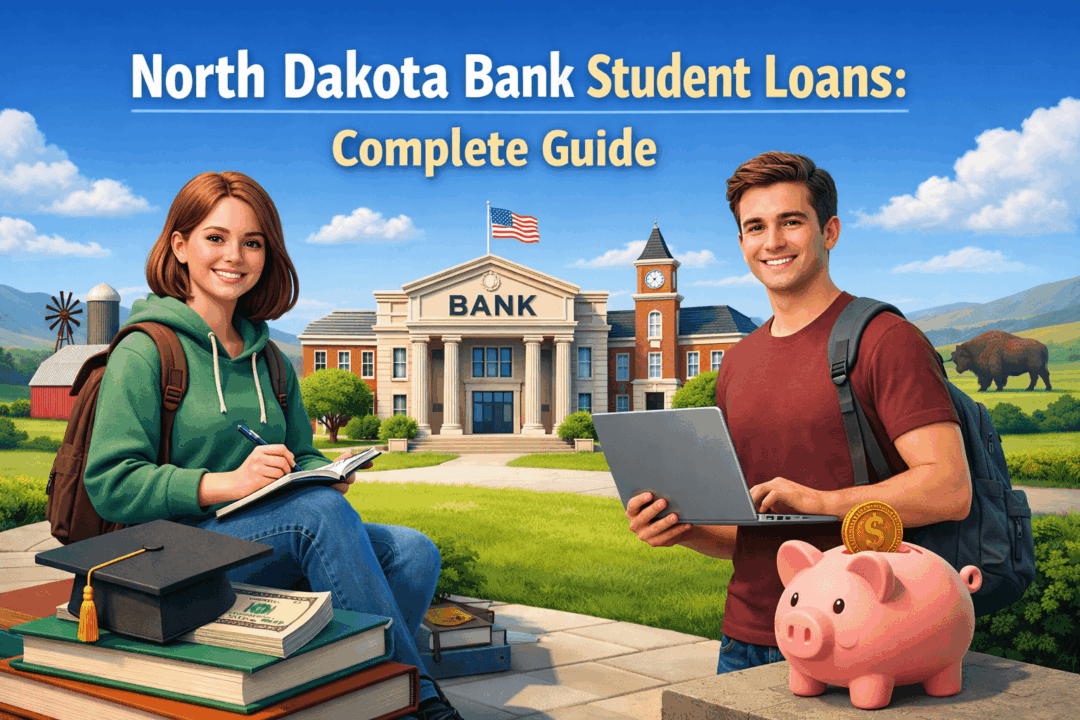
North Dakota Bank Student Loans: Complete Guide
North Dakota offers unique bank-originated student loans through the Bank of North Dakota (BND) as well as access to national private lenders. BND’s DEAL Student Loan (for current students) and DEAL One Loan (for loan refinancing) provide low, fixed interest rates (around 6.4% fixed and 5.2% variable as of 2026) and no origination fees. These loans require U.S. citizenship, ND residency (or attendance at an ND school) and satisfactory credit (a creditworthy cosigner is often required for applicants with limited credit). By contrast, federal Direct student loans (which BND and financial aid offices recommend first) have fixed rates of 6.39% (undergraduate) or 7.94–8.94% (graduate/PLUS) for 2025–2026. National private lenders (SoFi, Sallie Mae, College Ave, Earnest, etc.) offer wider rate ranges (often 3%–18% APR) and flexible terms (5–20 years) but typically require strong credit or cosigners and may lack federal borrower protections.
North Dakota also has state grants and loan-forgiveness programs (e.g. ND Academic Scholarship, STEM loan forgiveness) and a Gabriel J. Brown Trust Loan at 5% APR for qualifying ND students. When comparing options, students should consider interest rates, fees, repayment terms, and borrower benefits. The tables below summarize key loan programs and lenders. (Additional resources include the LIDIT website, https://lidit.com, though its content was not identifiable during our research.)
Types of Bank-Originated Student Loans
- Federal Loans: U.S. Department of Education loans (Direct Subsidized, Unsubsidized, PLUS) are technically not “bank” loans but are administered by the government. They have fixed rates set each year (e.g. 6.39% for undergrad, 7.94% grad, 8.94% PLUS for 2025–2026) and offer income-driven repayment and forgiveness options.
- Private Student Loans: Issued by banks or credit unions to cover the college cost gap. These include loans in the student’s name or Parent PLUS loans (for parents) that are funded by private lenders (though Parent PLUS is now federal). Rates and terms vary by lender.
- Refinance/Consolidation Loans: Used after leaving school to combine multiple loans (federal or private) into one loan. BND’s DEAL One Loan is an example for ND residents.
- Specialized State Loans: North Dakota offers a few niche loans via BND: the CEAL Loan (Career Education & Alternative Learning) for vocational training, and the ACIL (Addiction Counselor Internship Loan). These have similar rates to BND’s DEAL loan but may carry small fees (e.g. CEAL has a 2% fee).
Bank of North Dakota (BND) Loan Programs
BND is a state-owned bank that offers student loans with preferential terms for ND residents. Two flagship programs are:
-
DEAL Student Loan (Dakota Education Alternative Loan): Available to ND residents (or out-of-state residents attending an ND school) for undergraduate or graduate study. Borrowers must be U.S. citizens aged 16+ and not in default. Rates (as of Jan–Mar 2026) are 6.39% fixed (APR 6.02%) or 5.21% variable (APR 4.96%). There is no origination fee (BND pays it) and no prepayment penalty. A cosigner can qualify borrowers with weak credit and gives a 0.25% rate discount. In-school deferment is available (interest accrues), with a 6-month grace period after graduation. BND advises taking federal loans first, then BND loans if needed.
-
DEAL One Loan (Refinancing): Allows ND residents (6+ months) age 16+ to refinance existing student loans (federal or private) into one new loan with BND. Eligible loans include federal Stafford, PLUS, Perkins, BND’s own loans, and most private loans. Rates are fixed 6.39% or variable 5.21% (same as DEAL, and BND covers fees). The result is one payment and potentially lower rate. Important: refinancing federal loans eliminates federal benefits (deferment/forgiveness). A creditworthy cosigner is required if the borrower’s credit is insufficient.
-
CEAL Loan: For ND residents in career/technical or certification programs. Same interest (6.39% fixed/5.21% var) but a 2% origination fee. Must be full-time in an approved non-degree program.
-
ACIL Loan: For internships in addiction counseling (unpaid or paid). Details (rates, fees) are similar to CEAL but specific to nursing internships.
BND’s full interest rate schedule is published online. For example, a $10,000 DEAL loan at 6.39% with no payments until after a 4.5-year school/grace period yields an APR of 6.02%. The variable rate will never exceed 10%. (Rates are adjusted quarterly; see BND’s website for current rates.)
Other Lenders and North Dakota Students
North Dakotans may also borrow from national banks, credit unions, and other lenders. Key points:
-
SoFi (Social Finance): Offers private undergrad/grad loans with no origination fees. Rates (fixed) roughly 3.18%–15.99% APR, variable 4.39%–15.99% APR. A cosigner improves approval chances and rates. Terms range up to 20 years. SoFi loans require credit scores (often 650+) or cosigners; autopay discount (0.25%) applies.
-
Sallie Mae (Smart Option Loan): Offers private undergrad/parent loans with no fees. Current fixed rates range 2.89%–17.49% APR, variable 3.75%–16.37% APR. Sallie Mae emphasizes multiple repayment options (interest-only, deferred, etc.) and allowing up to 100% of certified costs. Cosigners greatly improve approval (over 90% of undergrad loans had cosigners).
-
College Ave: Private loans with flexible options. Undergrad rates start as low as 2.84% APR and go up to 17.99% APR. No origination fees; offers term choices (5–15 years). Requires creditworthy borrower or cosigner.
-
Earnest (by SoFi): Private undergrad/grad loans. Current rates (with autopay) start ~2.79% fixed (with cosigner) or ~4.49% without. No origination fees. Terms typically 5–15 years.
-
Bank/ Credit Union Loans: Some local banks may offer education loans, though many do not publicize them widely. Bismarck State College notes that only BND and Sallie Mae had active programs for students in recent years. No statewide “state bank” besides BND is known to offer a special student loan.
Each lender has its own credit requirements and borrower benefits (e.g. forbearance options). Generally, private loans lack federal forgiveness and deferment rules. Borrowers should examine each lender’s policies on in-school deferment (some allow it; interest accrues), cosigner release, death/disability discharge, and repayment flexibility. (For example, Sallie Mae allows interest-only or full-deferment in school.)
Comparison of Top Lenders
The table below summarizes key loan programs available to North Dakota students. Links go to official lender sites for details. Rates and terms are illustrative; actual offers depend on credit and dates.
| Lender & Loan | Key Terms | Interest Rates (APR) | Fees | Cosigner | Terms | Link |
|---|---|---|---|---|---|---|
| Bank of North Dakota – DEAL (Student Loan) | Undergraduate/Graduate. ND residents (or out-of-state at ND school). BND recommends federal loans first. 6-month grace after school. | Fixed 6.39% (APR 6.02%) / Var 5.21% (APR 4.96%) | No origination fee (BND pays it) | Cosigner optional (improves rate) | Up to 10‑year repayment (standard) | BND DEAL Loan |
| Bank of North Dakota – DEAL One (Refi) | Refinance federal/private loans into one ND loan. Must be ND resident (6+ months), no loan defaults. | Fixed 6.39% (APR 6.39%) / Var 5.21% (APR 5.21%) | No fee (BND pays it) | Cosigner required if borrower lacks credit | Up to 10‑year repayment | BND DEAL One |
| Bank of North Dakota – CEAL | Career/tech training loan for ND residents. | Fixed 6.39% (APR 6.25%) / Var 5.21% (APR 5.18%) | 2.0% origination fee | Cosigner optional | Varies by program (often 5–10 yrs) | BND CEAL |
| SoFi – Undergraduate/Graduate Private Loan | Private loans (student or parent). Online 3-min app; autopay discounts available. No origination fee. | Fixed 3.18%–15.99% APR (with auto-debit) / Var 4.39%–15.99% APR | $0 origination fee | Creditworthy borrower or cosigner required (low scores may need cosigner) | 5–20 years (full repayment) | SoFi Student Loans |
| Sallie Mae – Smart Option Loan | Private (student or parent) loan. Offers multiple repayment plans (deferred, interest, fixed). No origination fee. | Fixed 2.89%–17.49% APR / Variable 3.75%–16.37% APR | $0 origination fee | 91% of undergrad loans had cosigners last year | 10–15 years (varies by payment choice) | Sallie Mae Private Loans |
| College Ave – Private Student Loan | Private undergrad/parent loans. Customizable terms (5–15 years). No origination fee. | Fixed 2.84%–17.99% APR (parent/undergrad) / Var up to 17.99% | $0 origination fee (100% coverage of costs) | Requires credit or cosigner | 5–15 years | College Ave Private Loans |
| Earnest (by SoFi) – Student Loan | Private loans (student or parent). No origination fee. Cosigners increase approval chance. | Fixed APR 2.79%–(higher) (with cosigner 2.79% min) / Var 4.49%+ | $0 origination fee | Cosigner optional (improves rates) | 5–15 years | Earnest Student Loans |
Sources: Bank of North Dakota official site; lender websites (SoFi, Sallie Mae, College Ave) and CollegeInvestigator’s ND guide.
Interest Rates, Fees, and APR
-
Interest Rates: BND’s current interest rates are very competitive. For example, as of early 2026 the BND DEAL loan charges 6.39% fixed (APR 6.02%) or 5.21% variable (APR 4.96%). Federal Direct undergrad loans are 6.39% fixed for 2025–26, so BND’s fixed rate matches the federal rate but adds flexible structure. Many private lenders offer lower starting rates (around 3% APR) but can go much higher (up to ~18% APR) depending on credit. For example, College Ave’s fixed APR for undergrads ranges 2.84%–17.99%.
-
APR vs Interest: The APR includes origination fees (if any) and reflects total cost. BND loans have 0% fees, so APR ≈ interest rate. In contrast, federal PLUS loans charge a 4.228% fee; many private loans have no fee (0% APR discount) or a small fee. For instance, CEAL has a 2% fee (raising its APR slightly above 6.39%). APR helps compare loans: for example, BND’s 6.39% rate yields 6.02% APR because of fee waivers.
-
Fees: Most private loans we reviewed have no origination fee. BND loans have no fee (or BND covers it) except CEAL (2%). Federal loans charge a fee (1.057% for subsidized/unsubsidized, 4.228% for PLUS in 2025–26). Other lender fees (late, etc.) vary by contract.
Credit and Cosigner Requirements
Banks look at credit history and income. BND loans require a credit check; if the borrower’s credit is weak, a cosigner is required. BND encourages cosigners by reducing rates (e.g. the fixed rate drops to 6.39% APR). National lenders (SoFi, Sallie Mae, etc.) generally require a good credit score (often 650+) for low rates. Applicants with limited credit history must use a creditworthy cosigner. In fact, Sallie Mae notes that about 91% of its undergrad loans had cosigners. Cosigners should understand their obligation (for example, BND has a special cosigner info guide).
Credit tip: Creditworthy means steady income and no recent defaults. Lenders may require no recent bankruptcy or student loan default. BND specifically bars applicants (or cosigners) who are delinquent or in default on any student loan.
Repayment Terms, Deferment, and Forbearance
-
BND Loans: Repayment typically begins after a 6-month grace period post-graduation. Standard term is up to 10 years. Prepayment is allowed with no penalty (BND waives it). For hardship, BND offers deferment (in-school, in-training, unemployment) and forbearance up to 12 months (interest still accrues) – forms are available from BND. BND also has a Salary-to-Debt Calculator tool to help plan affordable borrowing.
-
Federal Loans: Undergraduate loans have 6-month grace after school; PLUS loans enter repayment immediately. Repayment plans include standard 10-25 years or income-driven plans (SAVE, etc.). Deferment and forbearance are available under certain conditions (in-school, economic hardship, etc.). The recent “SAVE” plan is set to replace older income-driven plans by mid-2026.
-
Private Loans: Repayment terms vary. Most start repayment immediately or after graduation. Some lenders offer in-school deferment or interest-only payments; others may not. Private loans generally have fewer protections: forbearance options and forgiveness are lender-specific. Borrowers should check: May private lenders allow in-school deferment? (Some do, interest accrues.) Do they forgive loans if borrower dies or is disabled? (Some waive balance, but policies differ.) Always read the borrower benefits for each lender.
North Dakota State Financial Aid and Loan Programs
In addition to bank loans, North Dakota provides other aid:
- State Grants/Scholarships: Merit grants (e.g. ND Academic Scholarship up to $6,000), need-based grants (e.g. ND State Grant up to $1,375/semester), and scholarships (ND Scholars full-tuition, Career Builders up to $17,000). These do not require repayment.
- Loan Forgiveness Programs: Programs for teachers and STEM grads (see NDUS STEM loan forgiveness, Teacher Shortage Forgiveness). These forgive part/all of federal loans after service in ND.
- Gabriel J. Brown Trust Loan: An ND residence loan at 5% APR (fixed) for students who have earned 4+ semesters (or 48 credits) with GPA >2.5 and demonstrate financial need. Applications go through a trustee in Bismarck.
- 529 Plans: Tax-advantaged savings plans (College SAVE ND) help families save for college; not loans but useful for funding education costs.
Compared to these, bank loans must be repaid with interest. They can fill gaps after scholarships/grants. BND’s low-cost loans are generally cheaper than private alternatives.
Applying for Loans: Steps & Timeline
- Fill out the FAFSA early (by spring) to qualify for federal aid (and state aid). Federal/most private loans require FAFSA on file.
- Review and Accept Federal Loans offered by financial aid offices (Direct Subsidized/Unsubsidized and PLUS if needed). These have fixed rates and borrower protections.
- Estimate remaining need. If there’s a funding gap, consider a BND or private loan.
- Compare private lenders. Use tools (ND colleges recommend FastChoice) and BND’s “Compare Before You Sign” chart.
- Apply:
- For BND loans, apply via BND’s online portal (Campusdoor). COSIGNERS are invited during application.
- For private loans, apply directly with the lender (requires personal and school info, credit check, cosigner paperwork).
- School certification: After approval, the lender sends required forms to the college; the school certifies enrollment.
- Disbursement: Loan funds are sent to the school (timing varies; apply early – e.g. many ND schools suggest applying by July for fall).
- Repayment: Make any required in-school interest payments or prepare for payments after graduation/grace period begins.
Borrower Protections and Default
-
Federal loans have strong protections: income-driven plans, deferment options (unemployment, hardship), and potential forgiveness (Public Service, SAVE after 10–20 years). Default consequences (credit damage, wage garnishment) are severe, but ND and federal policies have recently aimed to minimize defaults (federal “Fresh Start” program ended defaults for many borrowers, lowering the default rate to under 1% in 2023).
-
BND loans are NOT federal loans, so they do not qualify for federal forgiveness. However, BND does offer deferment/forbearance in hardship and a loan rehabilitation process to avoid default. Interest accrues in deferment. BND’s default rate is not publicly reported, but historically ND has lower higher-education debt burdens than national average. Borrowers should stay in contact with BND if facing difficulty; the “Difficulty Making Payments” page and Income-Driven options may help.
-
Private loans typically have limited protections. Some lenders (like Sallie Mae) allow deferment during school (accruing interest) and cancellation upon death/disability. There is no federal forgiveness for private loans. To avoid default, pay at least the minimum on time or contact the lender to arrange forbearance/deferment if needed (though usually interest continues).
FAQs (for High School Seniors)
Q: Should I get a BND loan or a private loan?
A: First use federal loans (via FAFSA) and scholarships. If you still need money, compare BND versus private. BND loans often have lower effective costs and no fees for ND students. Private loans can have lower starting rates but can end up more expensive and require credit. Always “compare before you sign”.
Q: What interest rate will I pay?
A: It depends on the lender and your credit. For example, BND’s DEAL loan is ~6.39% fixed. Federal Direct loans for undergrads are 6.39% for 2025–26. Private loan rates typically start lower (around 3–4%) but may go much higher based on credit.
Q: Do I need a cosigner?
A: If you have limited credit history, almost certainly. BND and most private lenders allow cosigners (often a parent). A creditworthy cosigner usually gets you approved and can lower your rate. You may also have an option to release a cosigner later if your credit improves (check lender policies).
Q: How do repayments work?
A: For loans taken out now, you’ll typically start payments after college (with a 6-month grace period for student loans). Federal loans offer multiple plans; BND has a standard 10-year plan. You can pay extra at any time. Ask your lender about deferment or payment plans if you have trouble paying.
Q: What is APR?
A: Annual Percentage Rate includes the interest rate plus fees, spread over the year. If a loan has no fees (like BND’s), APR ≈ interest. If there’s a fee, APR is higher than the raw rate. Always compare APRs when shopping for loans.
Q: Are there any North Dakota programs I should know about?
A: Yes. ND offers grants like the Academic Scholarship (up to $6,000) and State Grant (need-based). There are also loan-forgiveness programs (for STEM grads, teachers, nurses). If you qualify, these can reduce your debt (they apply to federal loans or state programs, not private bank loans). BND also highlights the Salary-to-Debt Calculator to avoid over-borrowing.
Q: How do I apply for a BND loan?
A: Go to BND’s website and follow the “Apply for a New DEAL Student Loan” link. You’ll need your FAFSA, school information, and personal/cosigner info. The process is online (through CampusDoor) and BND provides application status tracking.
Q: What is LIDIT?
A: The user requested links to “LIDIT” (at https://lidit.com). However, this site did not appear to have relevant content on ND student loans at the time of research. It may be a resource for education or financing, but we could not verify its contents. Students should rely on official sources (like BND or federal StudentAid) and recognized lenders.
Q: How can I estimate monthly payments?
A: Use a loan calculator: for example, a $20,000 loan at 6.39% over 10 years would be about $226/month. Many lenders (and federal StudentAid.gov) have calculators. BND has an online payment calculator. Remember: longer terms lower monthly payment but increase total interest.
Definitions (Plain Language)
- Fixed Interest Rate: An interest rate that stays the same for the life of the loan. Your payments stay constant (if the term stays the same).
- Variable Interest Rate: An interest rate that can change over time (usually tied to an index like the Prime Rate). Payments may go up or down. BND caps its variable rate at 10%.
- APR (Annual Percentage Rate): The yearly cost of a loan including fees, expressed as a percentage. APR lets you compare loans with different fees.
- Origination Fee: A one-time fee charged by the lender to process the loan, usually a percentage of the loan amount. (BND loans have no fee to borrower; the fee is paid by the bank.)
- Cosigner: A person (often a parent) who agrees to be responsible for the loan if the primary borrower can’t pay. Cosigners typically must have good credit.
- Grace Period: Time after school when no payments are required. Interest may still accrue during this period (for unsubsidized loans).
- Deferment/Forbearance: Options to temporarily pause or reduce payments. Interest may continue accruing. Typically granted for school enrollment, unemployment, or hardship.
- Default: Failure to pay a loan as agreed. This can severely damage credit and trigger collections actions. Federal loans default after ~9 months of nonpayment; private loan timelines vary.
- Refinance (Consolidate): Replacing one or more loans with a new loan, ideally at a lower rate or with one payment. Note: refinancing federal loans into a private loan means losing federal benefits.
- Cosigner Release: When a cosigner is removed from the loan obligation (usually after the borrower makes a certain number of on-time payments and meets credit criteria).
Sources: North Dakota state and Bank of North Dakota websites (student loan program pages, interest rate tables); federal sources (Student Aid interest rate announcements); lender websites (SoFi, Sallie Mae, College Ave); North Dakota university financial aid guides. These provide the data and definitions above.