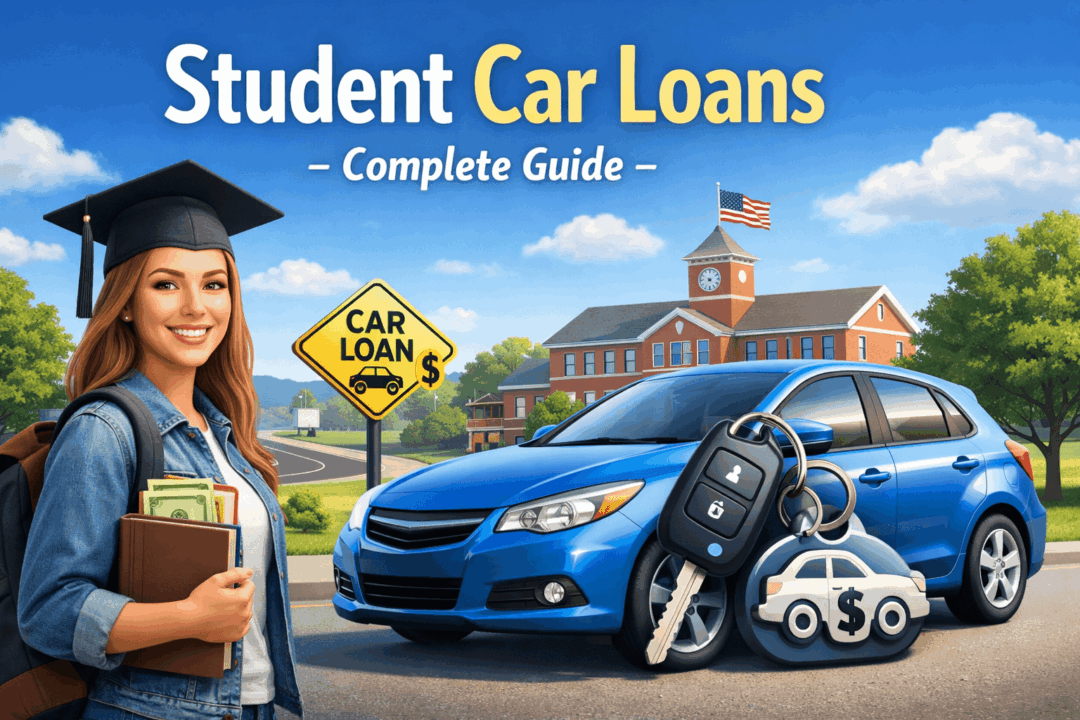
Student Loans for a Car: Complete Guide for 2026
Many students search for “student loans for a car” when what they really need is help covering transportation for college. The most important rule is this: federal student loans are for authorized educational expenses, not for buying a vehicle. Federal Student Aid says loan money may be used only for authorized educational expenses, and the federal cost-of-attendance rules allow transportation costs such as travel between home, school, and work, including operating and maintaining a vehicle used for that transportation, but they do not allow the purchase of a vehicle itself.
That means a student loan refund may help with things like gas, parking, bus fare, and some school-related transportation costs, but it is not a lawful substitute for an auto loan or cash purchase for the car itself. Schools typically apply aid to tuition, fees, and campus housing/food first, then send any remaining balance to the student for other educational expenses. If you borrowed too much, Federal Student Aid says you can cancel the excess within 120 days after disbursement without interest or fees on that cancelled portion.
The plain-English answer
If a high school senior asks, “Can I use student loans to buy a car?” the most accurate answer is: usually no for the purchase price, yes only for limited transportation expenses tied to school attendance. The transportation part of cost of attendance can include commuting and operating costs, but not the actual vehicle purchase.
This distinction matters because student loans and auto loans are built for different purposes. Federal student loans are education debt. Auto loans are secured consumer loans built around a specific vehicle, its value, and the borrower’s income and credit profile. Mixing the two creates legal, budgeting, and repayment problems.
Why this topic is so important in 2026
Cars are expensive enough now that trying to “solve” transportation with education debt can backfire fast. Kelley Blue Book reported that the average new-vehicle transaction price hit a January record in 2026, after topping $50,000 in late 2025, while Cox Automotive reported an average used-vehicle listing price of $25,730 in late 2025.
Financing is expensive too. Experian reported that in Q4 2025 the average financed amount for a new vehicle rose to $43,582, with an average interest rate of 6.37% and an average monthly payment of $767. For used vehicles, the average financed amount rose to $27,528, with an average interest rate of 11.26% and an average monthly payment of $537.
At the same time, Federal Student Aid’s current undergraduate Direct Loan rates for loans first disbursed between July 1, 2025 and June 30, 2026 are 6.39% for Direct Subsidized and Direct Unsubsidized Loans, and annual federal borrowing limits for dependent undergraduates are only $5,500 for first year, $6,500 for second year, and $7,500 for third year and beyond. In other words, even if student loans were allowed for car purchases, the math usually would not work well for a typical student borrower.
Ownership costs go far beyond the monthly payment. AAA’s 2025 “Your Driving Costs” study estimated that the average cost to own and operate a new vehicle was $11,577 per year, or about $965 per month, once you include depreciation, finance charges, fuel, insurance, maintenance, registration, and taxes. That is why smart student budgeting must focus on total cost, not just whether the monthly payment seems survivable.
What students should do instead
The best practice is to treat the problem as transportation planning, not “how do I stretch my student loan.” For most students, the safest order is: grants and scholarships first, then school-based aid, then a modest transportation plan, and only then a carefully shopped auto loan if a car is truly necessary. Federal Student Aid also emphasizes that grants and scholarships reduce net price without repayment, while loans increase future debt.
For some students, the smartest answer is not buying a car at all during the first year. A commuter train pass, bus system, bike, rideshare backup, or campus shuttle may cost far less than financing, insuring, fueling, parking, and repairing a vehicle. Federal Work-Study wages also can typically be used for day-to-day needs such as transportation and supplies, which can be a better fit than borrowing more.
If a car is truly necessary, the strongest student-friendly path is usually a modest used car, purchased either with cash, family help, or a carefully compared auto loan. The key word is modest. A student’s goal should be reliable transportation, not a status purchase. FTC and CFPB guidance consistently pushes buyers to know the total cost, compare financing before arriving at the dealership, and avoid unnecessary extras.
Best industry practice for getting a car as a student
Before shopping, pull your credit reports from the official site authorized by law, AnnualCreditReport.com. CFPB warns consumers to be careful with lookalike sites and says the legally authorized place to get the free report is AnnualCreditReport.com. Reviewing your reports first helps you catch errors, identity theft, or collection items that could raise your APR.
Next, get preapproved before going to the dealership. CFPB and FTC both advise shopping for financing ahead of time so you know your APR, term, and maximum amount before negotiating the vehicle itself. This gives students and families a benchmark and makes it easier to reject overpriced dealer financing.
Students often worry that comparing lenders will wreck their credit. CFPB says shopping for the best auto loan generally has little to no impact on credit scores, and scoring models usually recognize that consumers rate-shop in a short window. So comparison shopping is not something students should fear.
When comparing offers, focus on APR, loan term, total amount financed, and total cost, not just the monthly payment. CFPB’s comparison guidance says those are the numbers that matter most. A low payment can hide a long loan term and much higher total interest.
Lenders usually price auto loans based on credit score, credit history, income, existing debts, and down payment. CFPB also notes that a bigger down payment reduces how much you need to finance and may reduce the rate charged. For students with thin credit files, family support or a co-signer may improve approval odds, but that also means the co-signer is fully exposed if payments are missed.
Loan length matters a lot. CFPB explains that a shorter term lowers total loan cost, while a longer term lowers the payment but increases interest and the risk of negative equity, meaning you owe more than the car is worth. That risk is especially important for students because income often changes from semester to semester.
How to buy a used car the smart way
For most students, a used car is the better fit, but only if they verify what they are buying. The FTC’s used-car guidance says dealer-sold used cars should come with a Buyers Guide, and buyers should get a vehicle history report, ask for an independent mechanic inspection, and check for open recalls before signing.
For recalls, the official federal source is NHTSA’s VIN recall tool, which tells you whether a specific vehicle has an open safety recall. For title, salvage, total-loss, and brand history, the FTC points consumers to VehicleHistory.gov, the U.S. Department of Justice’s NMVTIS portal. DOJ explains that NMVTIS is designed to help prevent auto fraud and unsafe-vehicle resale.
Students should also watch for dealership tactics involving add-ons and yo-yo financing. The FTC warns that dealers cannot charge for add-ons you do not want, and it advises buyers to read the contract carefully, demand removal of unwanted extras, and know the full cost in writing. The FTC also warns about yo-yo financing, where a buyer is told after taking the car home that financing “fell through” and is pressured into worse terms.
What student loan money can cover instead
A student loan refund can reasonably help cover school-related transportation expenses such as gas for commuting to class, parking fees, transit passes, and costs of operating and maintaining a vehicle used for getting between school, work, and home, if those expenses fit within your school’s cost of attendance framework. Federal Student Aid’s cost-of-attendance rules explicitly allow transportation and vehicle operating/maintenance costs for that purpose.
But that does not mean a student loan refund should become a back door to car shopping. The purchase price of the car, a down payment on a car, custom upgrades, and unrelated consumer spending are outside the intended use of federal student aid. If a student receives more loan money than needed, returning the excess within 120 days is one of the best financial moves available because it avoids interest and fees on the cancelled amount.
A simple framework for high school seniors
A smart high school senior should ask these questions in order:
-
Do I truly need a car for school, work, or caregiving?
-
What is the lowest total-cost transportation option that still works?
-
Can grants, scholarships, work-study, or family support reduce borrowing?
-
If I need a car, have I checked credit, gotten preapproved, and compared total loan cost?
-
Have I priced insurance, maintenance, taxes, title, registration, and parking too?
If the answer to step 5 is no, the student is not ready to buy. The biggest first-time buyer mistake is believing a car costs only the monthly payment. In real life, the payment is just one line in a much bigger budget.
Frequently asked questions
Can FAFSA money buy a car?
Not the car itself. Federal aid can help cover transportation expenses related to attendance, but federal cost-of-attendance rules say the transportation allowance may not include the purchase of a vehicle.
Can I use leftover student loan refund money for gas or repairs?
Usually, transportation and vehicle operating/maintenance costs related to school attendance are allowed educational expenses, but the actual car purchase is not.
What if I already borrowed too much?
Federal Student Aid says you can cancel part of a disbursed federal loan within 120 days and avoid interest and fees on that cancelled portion.
Should I get dealership financing or a bank/credit union loan?
Shop both. CFPB and FTC recommend getting financing terms in advance, then using that preapproval to compare or negotiate at the dealer.
Will shopping around hurt my credit?
Usually not much. CFPB says rate shopping for an auto loan generally has little to no impact on your score, and scoring models usually account for comparison shopping in a short period.
What official sites should students use?
For student-aid rules, use Federal Student Aid. For loan shopping guidance, use CFPB. For dealer and used-car protections, use FTC. For recall checks, use NHTSA. For official title/salvage history sources, use VehicleHistory.gov / NMVTIS.
Student Car Loans – Executive Summary
Student car loans are auto loans taken by students (often high-school seniors or college students) to finance a car purchase. In practice, they function like regular auto loans but students often lack credit history and income. Lenders typically require a co-signer (e.g. a parent) for young borrowers. Types of loans include traditional bank or credit-union auto loans, dealer financing, peer-to-peer (P2P) loans, and specialized “credit-builder” loans.
Eligibility: Borrowers generally must be at least 18 (almost every state requires this to sign a loan contract), have a valid driver’s license and Social Security number, and demonstrate income or a creditworthy co-signer. Co-signer: A co-signer with strong credit can greatly improve approval odds and interest rates. Some lenders even offer “good student” discounts for high GPA. Without a co-signer or income, students will face high APRs or may be denied.
Loan Terms: Student auto loans today often range 60–84 months. Average loan terms have stretched to ~69–70 months for new cars. Interest rates depend on credit: prime borrowers see low single-digit APRs (some loan deals <3–4%), whereas subprime students may pay into the high teens or higher. Industry data show ~7.0% APR on new cars (Q3 2025) and ~10.8% on used cars. Down Payments: Recommendations typically suggest 10–20% down, but many buyers are putting less. For example, in Q3 2025 the average new-car down payment was only $6,020 (≈12% of price), the lowest in years.
Credit Impact: Making timely payments builds credit; missed payments hurt credit and may lead to repossession. Auto loans are often reported to credit bureaus, so on-time payments can improve credit scores (like a student “credit-builder” loan). Conversely, delinquency (30+ days late) appears on credit reports and may become public records after 120 days. Delinquencies have spiked: by mid-2024 about 3.8% of auto loan balances were 30+ days late (a multi-decade high). Broadly, auto loans are now one of the riskiest consumer debts. Even prime borrowers saw rising delinquency by 2025, and Fed analysts note auto loan delinquency has returned to Great-Recession-era levels. Students and young adults in particular carry heavy auto debt and struggle with payments.
Repayment & Refinancing: Loans are typically repaid in fixed monthly installments. Strategies include making larger payments or biweekly payments to pay off faster, or refinancing if credit improves. About 70% of new-car borrowers take >5-year terms; lenders advise cautious use of very long loans (e.g. 7-year) because interest cost balloons (see Table 3). If rates fall or credit scores rise, students can refinance. For example, Q3 2025 guidance notes borrowers can refinance to save on interest. However, refinancing often requires improved credit, and the vehicle’s age and remaining balance limit eligibility.
Default Risks & Consequences: Failing to repay can lead to repossession. After ~30–60 days late, borrowers face late fees and credit hits. If delinquency continues (120+ days), lenders will repossess the car and may seek a deficiency (the remaining unpaid balance) through collection. Defaults dramatically harm credit and can make future loans impossible. Even 30-day delinquencies on auto loans more than doubled since 2010, indicating rising risk for auto-borrowers.
Interaction with Financial Aid: Cars themselves are not counted as assets in federal financial aid calculations, so owning a car won’t reduce need-based aid. However, FAFSA does not let students finance car purchases with aid: transportation costs (gas, insurance, maintenance) are included in Cost of Attendance (COA), but the purchase price of a vehicle is specifically excluded. In practice, this means federal aid cannot be used to buy a car, though living/transportation allowances cover operating costs. (Some schools offer “commuter student” stipends or emergency grants for travel, but these vary by institution.)
Tax Implications: Generally, interest on personal auto loans is not deductible on federal taxes (unlike mortgage interest) – unless the loan is used for business or if the vehicle is for self-employment. New law (2025–2028): Thanks to recent tax legislation, borrowers can deduct up to $10,000/year of interest on loans for new U.S.-made cars. So a student (or family) buying a qualifying new car may benefit if they itemize. However, this is a special case; typically auto loan interest is a non-deductible personal expense.
Alternatives to Loans: Students should weigh non-loan options:
- Public Transit: In many cities, student passes or metro cards (often $100–200/month) offer far cheaper commuting. For example, a $100 monthly bus pass is $1,200/year, versus ~$11,600/year average car cost (which includes loan, fuel, insurance, maintenance). – Car-Sharing & Ride-Sharing: Services like Zipcar (rent by the hour) or Uber/Lyft can substitute for occasional use without ownership costs. Some campuses partner with car-share programs.
- Used or Older Cars: Buying a well-maintained used car (lower purchase price) dramatically cuts finance cost and depreciation risk. Lower loan amounts mean lower monthly payments.
- Savings & Scholarships: Before taking loans, students should exhaust cash savings or parental help. Scholarships/grants for education (tuition/fees) effectively free up budget that can be spent on living costs. Some need-based grants or campus emergency funds can be used for transportation (e.g., a low-income student grant might cover bus fare or car repairs). In fact, certain grants explicitly list “transportation” as an allowable expense.
Data Snapshot (US, 2024–2026): Auto loan totals are at record highs ($1.5+ trillion in Q3 2022). By mid-2025, ≈2.3 million new auto loans were originated in a month, totaling $70.2B. The average new-car loan balance is ~$40,000. Delinquency rates have surged from pandemic lows: 30-day delinquency was 3.8% in June 2024 (versus ~1.5% in 2018). Young borrowers carry much of this stress: Experian finds ~80% of Gen Z (18+) have at least one auto loan, and Gen Z and Millennials saw the largest payment jumps of any generation in 2022.
Sources: This guide draws on federal and industry data (Fed and CFPB reports, Edmunds, Experian, AAA, etc.) to provide up-to-date statistics and analysis. Citations link to original publications. (See References for full details.)