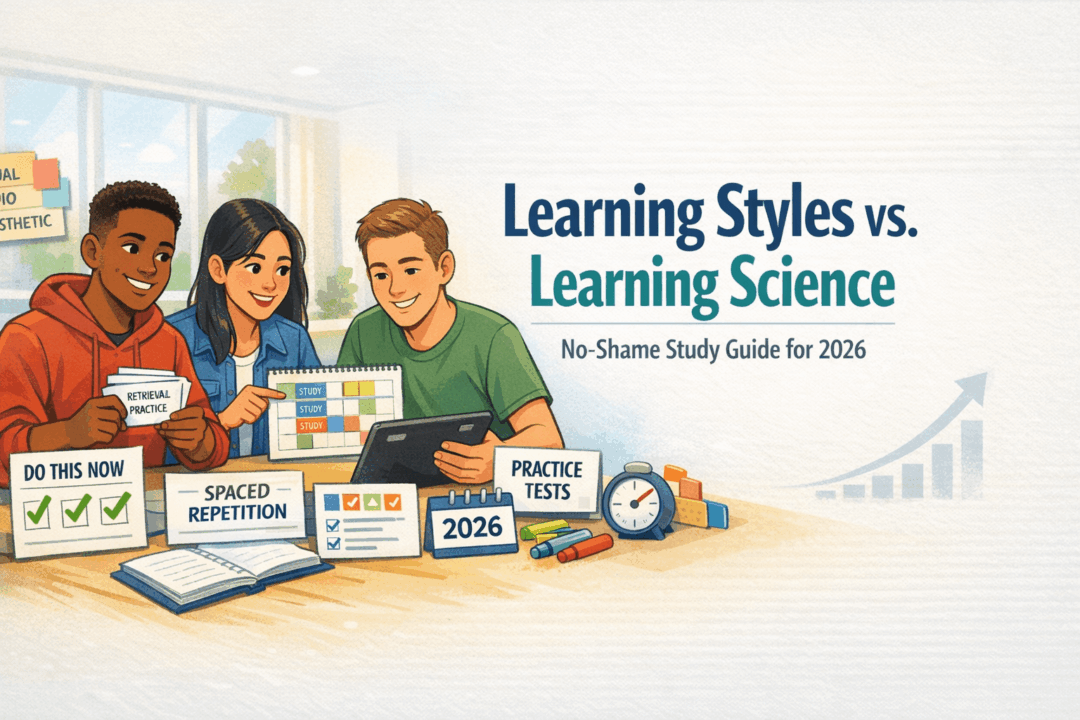
Learning Styles vs. Learning Science (2026)
Not sure if you’re a “visual” or “auditory” learner? Good news: you don’t have to fit a box. This 2025 guide shows high-school students the evidence-based study moves—retrieval practice, spacing, interleaving, dual coding, and metacognition—plus free tools and links you can use tonight.
You don’t need a “type.” You need a toolkit.
he popular idea that you must match lessons to your “learning style” (e.g., VARK) hasn’t held up in research. Matching instruction to a labeled style doesn’t reliably improve learning. What does work for almost everyone: practice remembering (retrieval), space your study sessions, mix problem types (interleaving), pair words with visuals (dual coding), and plan-monitor-reflect (metacognition). Simon Fraser UniversityEEF
What “learning styles” really means (and why you shouldn’t stress about it)
-
Preferences ≠ prescriptions. It’s totally normal to prefer videos over text or sketch notes over outlines. Keep what helps you focus. But large reviews find no strong evidence that customizing instruction to a declared “style” boosts outcomes. Simon Fraser UniversityDigital Commons USF
-
Better framing: Think Universal Design for Learning (UDL)—design your study in multiple ways to access and show learning, so you can lean into strengths and cross-train weaknesses (inclusive and non-embarrassing for everyone). UDL Guidelines+1
Bottom line: Use your preferences to get started, then apply the science-backed strategies below to actually remember more with less stress. Western Kentucky University
The Big 6: Evidence-Based Study Moves (with “do-it-tonight” steps)
1) Retrieval Practice (aka: quiz yourself) 🎯
Why it works: Actively recalling information strengthens memory more than re-reading. This is one of the most robust effects in learning research. PsychnetRetrieval Practice PDF
Try tonight:
-
Close the notes. Write or say everything you remember, then check.
-
Make 5 quick Qs for Future-You after each class.
-
Swap questions with a friend and teach back.
Free guide for students/teachers: RetrievalPractice.org (downloadables + classroom and at-home templates). Retrieval Practice PDFPooja K. Agarwal, Ph.D.
2) Spaced Practice (don’t cram) ⏳
Why it works: Studying in shorter sessions over days/weeks leads to long-term retention. Meta-analyses show reliable benefits of spacing. Augmenting CognitionLearning Attention and Perception Lab
Try tonight:
-
Study 25–35 minutes daily for each tough class instead of 2 hours on Sunday.
-
Put tiny reviews 2–3 days apart in your calendar.
-
Use an SRS app (e.g., Anki, free/open source) to automate intervals. Anki
3) Interleaving (mix it up) 🧩
Why it works: Mixing related problem types (not AAAAA then BBBBB) improves discrimination and flexible use of skills—in labs and classrooms. The Learning Scientists
Try tonight:
-
For math/science, shuffle practice sets (e.g., linear vs. quadratic vs. systems).
-
For history, mix time periods or question types (IDs, compare/contrast, sourcing).
-
Rotate topics every 20–30 minutes within a study block. The Learning Scientists
4) Dual Coding (words + visuals) 🖼️+📝
Why it works: Combining verbal explanations with meaningful visuals engages two complementary routes for understanding and recall. (Not just “add pictures”—make visuals carry information.) eclass.uth.grThe Learning Scientists
Try tonight:
-
Turn a page of notes into a diagram, timeline, or concept map.
-
For bio, draw the process (e.g., photosynthesis flow). For literature, map character ties.
-
Keep visuals clean—avoid clutter to reduce cognitive load. Cambridge AssetsThe Learning Scientists
5) Elaboration & Concrete Examples 🧩➡️📚
Why it works: Connecting ideas to prior knowledge (the “why/how”) and using concrete, worked examples deepens understanding and transfer. Western Kentucky University
Try tonight:
-
After a section, answer out loud: “How would I explain this to a 9th-grader?”
-
Collect 2–3 real examples for each key concept from class, news, or life.
6) Metacognition (plan → monitor → reflect) 🧭
Why it works: Students who set goals, choose strategies, and evaluate what worked learn more. (EEF’s guidance is practical and readable.) EEFDigital Education Resource Archive
Try tonight:
-
Plan: What will I learn in 30 minutes? Which strategy?
-
Monitor: Midway checkpoint—am I guessing or actually recalling?
-
Reflect: What tripped me up? What will I do differently tomorrow? CloudFront
“Find your vibe” without the labels (inclusive & no-shame) 🌈
Use this menu to start where you’re strongest and add cross-training so you don’t get stuck in one lane:
-
🎧 Audio-leaning? Record 60-second voice notes, then quiz yourself from memory (retrieval).
-
✍️ Sketch-leaning? Turn each page into one diagram (dual coding), then write 3 Qs to test it later.
-
📖 Text-leaning? Convert headings into flashcards and schedule them with spacing.
-
🧑🤝🧑 Talk it out? Do a teach-back: you explain, partner interrupts with “why/how” questions (elaboration).
You’re not “locked” into any style. Blend methods that help you focus now and remember later. Simon Fraser University
A 7-Day Study Sprint (plug-and-play) 🚀
Goal: Raise your next quiz grade and keep the knowledge.
Daily (25–40 min/class):
-
Mon: Retrieval warm-up (5 Qs from memory) → 2 short practice sets (interleaved).
-
Tue: Dual-code your notes (diagram/map) → quick self-quiz.
-
Wed: Spaced review (yesterday’s Qs) → 1 new practice set.
-
Thu: Elaboration: “Explain like I’m in 9th grade” → add 3 concrete examples.
-
Fri: Mixed practice set from the week → reflect (what’s shaky?).
-
Sat: 15-min spaced flashcards (SRS app) + chill.
-
Sun: Mini mock-test (no notes), then check and plan next week.
Scholarships & Grants angle
Selection committees love evidence of impact. Consider adding a short “Learning Game Plan” to your application or interview:
-
A one-page chart showing retrieval/spacing calendar for core classes
-
A reflection paragraph (“What changed in my scores/confidence since using these methods”)
-
Examples of self-made resources (e.g., dual-coded diagrams, interleaved problem sets)
This demonstrates self-management, persistence, and academic growth—exactly what funders look for.
Free, Actually Useful Links (student-friendly)
-
Myth-busting on “learning styles”: Pashler et al., 2008 (Psychological Science in the Public Interest), and EEF’s evidence summary. Simon Fraser UniversityEEF
-
What works (big review): Dunlosky et al., 2013—ranks study techniques; backs retrieval, spacing, etc. Western Kentucky UniversitySAGE Journals
-
Retrieval practice how-to & downloads: RetrievalPractice.org guides for students/teachers. Retrieval Practice PDFPooja K. Agarwal, Ph.D.
-
Spacing effect (meta-analyses): Cepeda et al., 2006/2008. Augmenting CognitionLearning Attention and Perception Lab
-
Interleaving explained (with examples): Learning Scientists posts (updated regularly). The Learning Scientists+1
-
Dual coding (how to do it well): Learning Scientists + Mayer’s multimedia learning principles. The Learning Scientistseclass.uth.gr
-
UDL (inclusive design mindset): CAST’s UDL Guidelines (v3.0, 2024). UDL Guidelines
-
Anki (free SRS app): ankiweb.net (open-source flashcards for spacing). Anki
FAQs students ask (and what science says)
“So… should I still take a learning-styles quiz?”
You can if it’s fun—but treat results as preferences, not destiny. Build your study around retrieval, spacing, interleaving, and dual coding, regardless of the quiz type. Simon Fraser University
“I’m embarrassed drawing diagrams / talking aloud.”
Don’t be. Use private voice memos, sketch on scrap paper, or teach a stuffed animal (seriously). It’s about activating memory—not performance. Dual coding and elaboration can be as public or private as you want. The Learning Scientists
“I tried this once and didn’t feel smarter.”
Learning that sticks often feels harder in the moment (a “desirable difficulty”). That’s normal and expected when you retrieve and space. Track your quiz scores over 2–3 weeks—you’ll see it. PsychnetRetrieval Practice PDF
Copy-and-Paste Templates 🧩
Daily 10-minute “Exit Ticket”
-
3 terms I can define from memory → check → fix errors (retrieval)
-
1 sketch or timeline (dual coding)
-
1 question to ask Future-Me (metacognition)
Weekly Review Card
-
What improved? What’s still shaky? (monitor)
-
Which strategy helped most this week? (reflect)
-
Where will I schedule spacing next? (plan)
Final pep talk 💬
You don’t need a label to learn like a pro. Start with the vibes that make studying feel doable, then lock in with retrieval, spacing, interleaving, dual coding, and metacognition. This combo is respectful, inclusive, and wildly effective—and it’ll help your grades, your confidence, and your scholarship story.