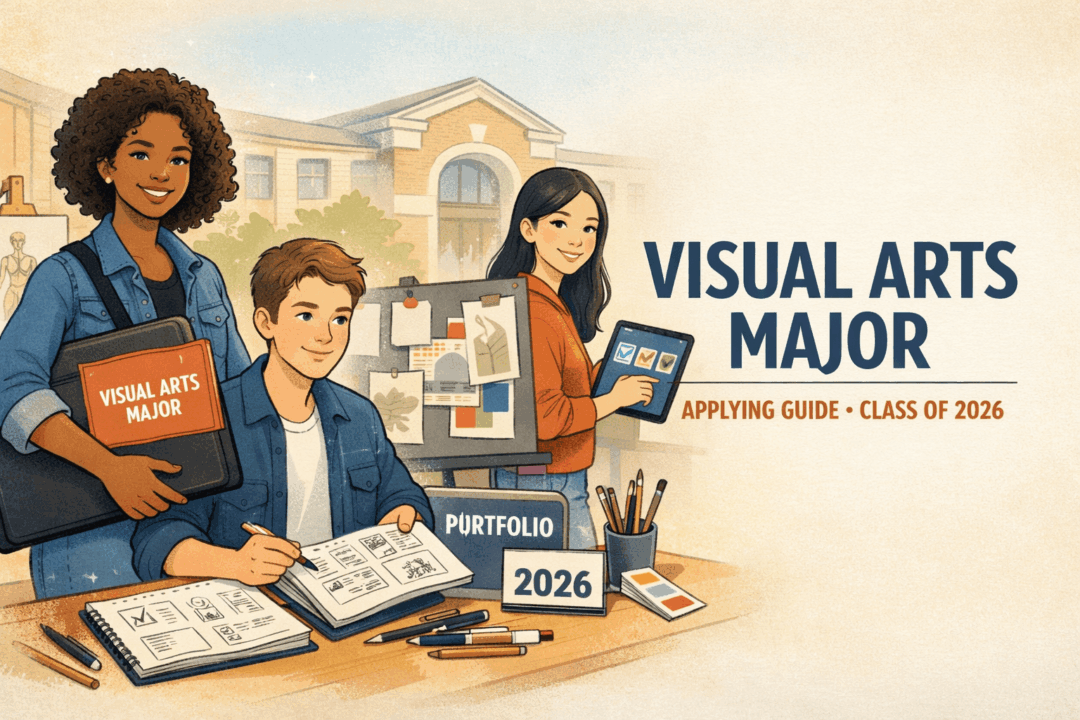
Ultimate Guide to Applying as a Visual Arts Major (Class of 2026)
-
Portfolio rules the world. Most schools want ~10–20 works showing observation, ideas, range, and process. Check each school’s exact specs. MICA, SCAD.edu, art.ucla.edu, CCA
-
You don’t need pre-college to get in—but pre-college/summer programs build work fast and earn feedback. School of the Art Institute of Chicago, MICA
-
Get professional feedback early via National Portfolio Day (free; in-person/virtual). National Portfolio Day Association
-
Scholarships exist (many tied to portfolio strength). Read each school’s aid page; e.g., SCAD awards merit/portfolio scholarships. SCAD.edu
🧭 What Schools Actually Want (Portfolio 101)
-
Follow directions (piece count, formats, media). Each school differs: e.g., MICA 10–15 pieces, SCAD 10–20 pieces, UCLA Art 8–10 images + statements. MICASCAD.eduart.ucla.edu
-
Show thinking, not just polish: process, iterations, sketchbook spreads, and risk. (RISD publishes detailed tips + month-by-month prep.) RISD
-
Originality > fan art. Demonstrate observation (life drawing), design decisions, and your voice.
-
Submission platforms: many schools use SlideRoom (see MICA/VCUarts portals). micaundergrad.slideroom.comvcuarts.slideroom.com
🧑🎓 Do You Need Pre-College?
No. It’s optional, not a requirement. But the right program can level you up quickly and produce portfolio-ready work. Good examples:
-
SAIC Early College Program (Chicago) — year-round & summer. School of the Art Institute of Chicago+1
-
MICA Pre-College (Baltimore) — focused on portfolio building. MICA+1
-
CSSSA (California) — state-run, intensive month-long arts program. csssa.ca.gov+1
🧪 Get Feedback Early (free!)
-
National Portfolio Day → short one-on-one critiques with reps from top schools; events run all year (virtual + in-person). National Portfolio Day Association+1
-
Many schools also host their own reviews/workshops (e.g., VCUarts virtual portfolio reviews). VCUarts
⏱️ How Fast Can You Prepare a Portfolio?
-
Ideal runway: 6–12 months for 12–20 strong works.
-
Fast-track (12 weeks) if you’re late:
-
Weeks 1–2: pick 3 themes you love (e.g., identity/space/nature).
-
Weeks 3–8: produce 6–8 observation-based and 3–4 concept pieces; document process.
-
Weeks 9–10: refine + photograph work.
-
Weeks 11–12: curate, title, write statements, upload to SlideRoom.
-
👉 Use school guides to sanity-check content and counts (MICA, SCAD, CCA). MICASCAD.eduCCA
🏆 Contests & Enrichment (helpful, not required)
-
Scholastic Art & Writing Awards (national; scholarships + exhibitions). Scholastic Art & Writing AwardsScholastic
-
YoungArts (15–18) — selective, great network; 2026 app closes Oct 8, 2025. YoungArts+2YoungArts+2
-
National Portfolio Day (again!)—feedback that directly improves your submission. National Portfolio Day Association
🗂️ School-Specific Quirks (examples)
-
RISD — detailed first-year checklist + portfolio prep tips (read them!). Rhode Island School of DesignRISD
-
Parsons (The New School) — BFA portfolio + sometimes Parsons Challenge (conceptual prompt). The New School
-
Pratt — clear undergrad portfolio instructions (10–15 works typical). Pratt Institute+1
-
UCLA Art — supplemental app; 8–10 images; written components; tips for digital submission. art.ucla.edu+1
-
ArtCenter — portfolio by major + short video essay requirements. ArtCenter College of Design+1
-
CCA — 10–15 images via SlideRoom; portfolio guide available. CCACCA
-
Ringling/VCUarts/SAIC — specific counts & examples; many route you to SlideRoom. ringling.eduVCUartsSchool of the Art Institute of Chicagosaicundergraduate.slideroom.com
💰 Money Talk (Do you have to be rich?)
No—but plan. Many art schools award merit/portfolio scholarships (sometimes significant). Example: SCAD lists multiple scholarship types; portfolio can boost awards. Use each school’s Net Price Calculator + file FAFSA/CSS on time. SCAD.edu+1
📍 Choosing a School by U.S. Region (quick compare)
West (CA/WA/OR/AZ)
-
Cal/SoCal hubs: UCLA Arts, CalArts, ArtCenter, CCA—strong industry ties (entertainment, design, tech). art.ucla.eduCalArtsArtCenter College of DesignCCA
Northeast (NY/MA/PA/MD/DC)
-
NYC/Boston/Philly/Baltimore: Parsons, Pratt, SVA (NYC), RISD (RI), MICA (MD)—dense gallery/internship ecosystems. The New SchoolPratt InstituteRhode Island School of DesignMICA
Midwest (IL/OH/MI/MN/MO)
-
SAIC (Chicago), CIM adjacent design in Cleveland? (skip)—also KCAI, MCAD (not linked here); lower cost of living + museums/festivals. (Use SAIC links for portfolio expectations.) School of the Art Institute of Chicago+1
South & Texas (TX/GA/FL/VA)
-
SCAD (GA), Ringling (FL), VCUarts (VA), UT Austin/UNT (TX)—animation/illustration/UX pipelines and active recruiter visits. SCAD.eduringling.eduVCUarts
Score your shortlist: Fit (40%) + Opportunities (25%) + Cost/Aid (25%) + Double-major flexibility (10%).
🧳 Portfolio Review “Audition” Days (travel tips)
-
Arrive the day before → rest, scout buildings, avoid transit drama.
-
Book smart: partner hotels near campus; on a budget use university-adjacent Airbnbs/hostels; confirm practice-friendly spaces if bringing physical work.
-
Day-before routine: light run-through of talking points (concepts, process), rehearse 60-second project intros, check upload/USB backups.
-
In-person vs virtual: in-person shows scale, materials, and you; virtual works fine if travel is impossible—but test audio/video and share process slides.
-
Bring: tablet/printed mini-portfolio, a few physical pieces (if invited), sketchbook, resume, and questions.
(For ongoing free reviews and to meet reps, use National Portfolio Day.) National Portfolio Day Association
🧑🎓 Life After Graduation — Art Edition
Pick a lane (you can mix later)
-
Studio artist / galleries / residencies — build a strong website, apply to juried shows/residencies; track grants via local arts councils/NEA.
-
Design (graphic/UX/UI/brand) — join AIGA, build a UX case-study portfolio, learn product tools. (AIGA also lists jobs.) CCA
-
Animation/illustration/game art — ArtStation/Behance presence; target studios’ test briefs; tailor to pipelines.
-
Photography/film — assist pros, pitch editorial sets, master rights/licensing.
-
Industrial/fashion/interior/product — emphasize process books, models, CAD; know each school’s recruiter network.
-
Arts education & community practice — after BFA, consider MAT/teacher licensure or museum ed internships.
-
Arts admin/creative ops — museums, nonprofits, galleries; pair with internships during school.
Your post-grad toolkit
-
EPK/Website: 1-page resume, artist statement (100–150 words), 12–20 best works, contact.
-
Platforms: Behance/ArtStation/Instagram (curated), LinkedIn.
-
Jobs/Calls: start with AIGA Design Jobs and your school’s career center boards. CCA
-
Keep learning: short certificates (UX, motion, 3D) can multiply your options.
Money & runway
-
Build a 12-month budget (rent, health, software, gear).
-
Use school alumni networks and career fairs (many art/design schools host employer days).
-
Scholarships at grad level exist too (check departmental pages at your target programs).
📝 How to Talk About Your Work (review day & interviews)
-
60-second opener: “This series explores ___ through ___; I iterated from sketches → prototypes → final; here’s what I changed after critique.”
-
Answer like a designer: constraints, research, iterations, results.
-
Bring questions: “How does first-year critique work?” “Internship pipeline for my major?” “What does an A-level project look like?”
📅 HS Timeline (Class of 2026)
Freshman (9th) 🌱
-
Draw from life weekly; join art club/yearbook/design roles.
-
Start a sketchbook habit; visit galleries/museums.
Sophomore (10th) 🌿
-
Take one structured class (community college or online).
-
Do a summer program (SAIC/MICA/CSSSA) to generate portfolio pieces. School of the Art Institute of ChicagoMICAcsssa.ca.gov
Junior (11th) 🌳
-
Shortlist schools; National Portfolio Day for feedback; revise. National Portfolio Day Association
-
Build 8–10 strong works + process docs.
Senior (12th) 🌲
-
Aug–Nov: finish 12–20 works; photograph everything; write statements.
-
By school deadlines: submit Common App + SlideRoom portfolio (watch counts & formats). micaundergrad.slideroom.comvcuarts.slideroom.com
-
Jan–Mar: interviews/reviews as assigned; compare offers/scholarships (e.g., SCAD scholarship matrix). SCAD.edu
🔗 Save-worthy Links
-
National Portfolio Day (events & schedule). National Portfolio Day Association
-
Scholastic Art & Writing Awards (competitions & scholarships). Scholastic Art & Writing Awards
-
YoungArts (national competition; Visual Arts). YoungArts
-
Portfolio requirements: RISD, Parsons, Pratt, UCLA Art, CCA, ArtCenter, SCAD, MICA, SAIC, Ringling, VCUarts.