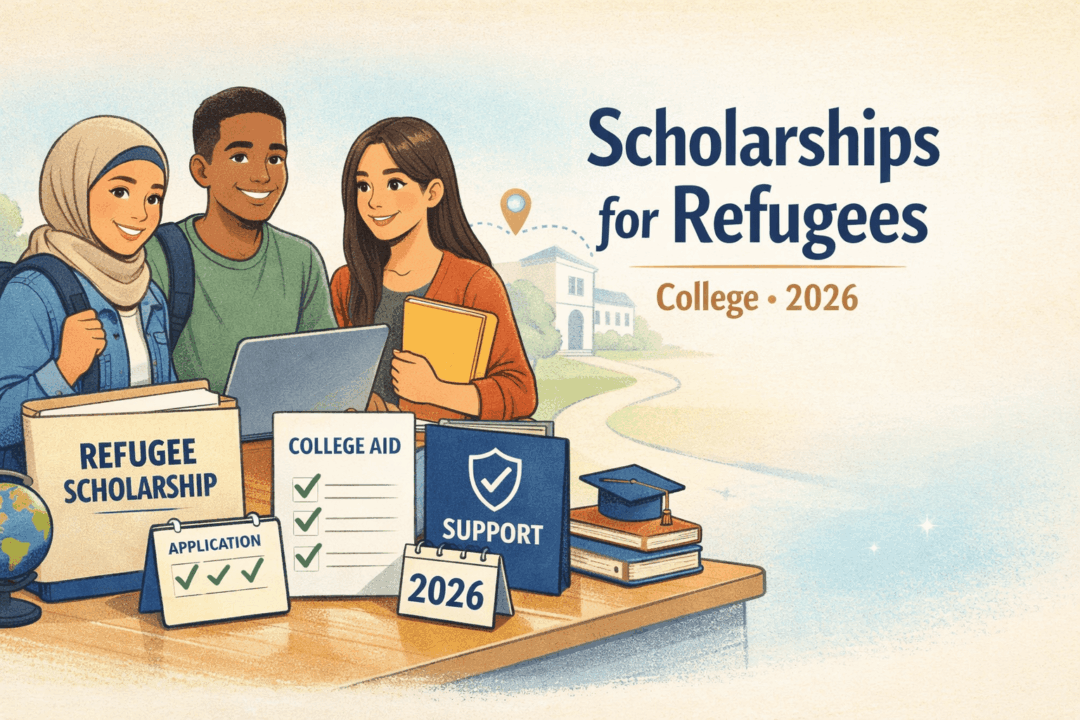
Scholarships for Refugees (College)
Executive summary
reduces dependency on crisis assistance, and builds skills that support communities in resettlement and (when possible) reconstruction.
Yet access to college remains structurally constrained—by legal status rules, documentation friction, affordability gaps, and the
uneven distribution of “refugee-specific” scholarships.
- Demand is unprecedented: UNHCR estimates 123.2 million people were forcibly displaced worldwide at the end of 2024.
- Higher-ed access is improving but still low: UNHCR reports tertiary enrollment was ~7% in 2023 and later reported movement toward ~9%, while maintaining a target of 15% by 2030 (“15by30”).
- U.S. policy volatility matters: U.S. refugee admissions ceilings and program operations can shift quickly—affecting who can arrive, when, and what documentation they hold.
- Federal aid can be a game-changer: Many refugees and asylees qualify as “eligible noncitizens” for FAFSA—but verification and paperwork are frequent bottlenecks.
- Scholarships exist, but they’re lumpy: A handful of programs cover full cost-of-attendance; more commonly, students must “stack” aid (federal + state + institutional + private + emergency microgrants).
Quick start: If you’re a refugee/asylee in the U.S., prioritize (1) FAFSA eligibility + documentation, (2) your college’s need-based aid,
then (3) refugee/displaced-student scholarships listed below, and (4) emergency funds to prevent “stop-out.”
Why refugee scholarships matter (the data logic)
Higher education for displaced learners is often discussed as “nice to have,” but the evidence base supports treating it as a
core stabilization strategy. For host countries, postsecondary attainment is associated with higher earnings and lower unemployment.
For displaced learners, credentials also reduce deskilling (being locked into low-skill work despite capability), improve language
acquisition via structured environments, and expand professional networks—one of the strongest predictors of job quality after migration.
1) The access gap is structural—not motivational
Refugee learners face a classic “capability vs. constraint” problem: high motivation and prior achievement are frequently present,
while constraints cluster in predictable ways: documentation gaps, interrupted schooling, trauma load, household financial obligations,
limited credit recognition, and admissions systems that assume stable addresses, transcripts, and standardized testing history.
2) College payoff is real—but timing and support decide outcomes
U.S. labor data consistently show earnings increase with education. That doesn’t mean every degree is equal; outcomes vary by major,
completion, and local labor markets. For refugee students, the highest ROI usually comes from (a) completion-focused funding that reduces
work hours, (b) credential pathways aligned to local demand, and (c) wraparound supports that prevent stop-out.
3) Policy volatility raises the value of “flexible funding”
Refugee admissions levels, resettlement pathways, and the availability of processing can change across years. This volatility increases
the value of scholarships that (1) accept multiple displaced statuses, (2) include emergency microgrants, and (3) fund non-tuition costs
(housing, health, childcare, books, transportation).
Who counts as “refugee” (and why status matters for aid)
Scholarship eligibility frequently depends on immigration category. Unfortunately, many listings casually use “refugee” as a catch-all.
For funding, you must be precise: different statuses map to different federal/state aid rules and different documentation.
Common categories you’ll see in scholarship rules
| Status (common label) | What it generally means | Why it matters for funding |
|---|---|---|
| Refugee (resettled) | Admitted under U.S. refugee law and resettled through a formal process. | Often an “eligible noncitizen” for federal aid; may access state aid depending on residency rules. |
| Asylee (asylum granted) | Granted protection after applying for asylum (inside the U.S. or at a port of entry). | Often eligible for federal aid; documentation/verification can be a friction point. |
| Asylum seeker (pending) | Application filed, decision pending. | May be ineligible for federal aid until asylum is granted (but may qualify for institutional/private support). |
| Humanitarian parole | Temporary permission to enter/stay for urgent humanitarian reasons. | Federal aid eligibility depends on category rules; some colleges create scholarships specifically for parolees. |
| TPS (Temporary Protected Status) | Temporary protection due to conditions in the home country. | Usually not federal-aid eligible by default; state/institutional aid varies widely. |
| SIV (Special Immigrant Visa) | Immigration category often used for certain allied nationals (e.g., translators). | Many schools and programs treat SIV holders as part of “ORR-eligible” or displaced populations for targeted support. |
FAFSA note: “eligible noncitizen” and verification
Many refugees and asylees can qualify for federal student aid as “eligible noncitizens.” In practice, the biggest barrier is often
verification—a mismatch between FAFSA records and DHS databases, or a financial aid office requesting different documents than you have.
When this happens, respond quickly, provide your most recent immigration documentation (often including I-94 and/or A-Number), and ask the school what exact
document type resolves the mismatch. If needed, point the office to federal guidance on eligible noncitizen documentation and DHS matching.
- Federal Student Aid (Non-U.S. citizens): https://studentaid.gov/understand-aid/eligibility/requirements/non-us-citizens
- FSA Partner Handbook (U.S. citizenship & eligible noncitizens): https://fsapartners.ed.gov/knowledge-center/fsa-handbook/2025-2026/vol1/ch2-us-citizenship-eligible-noncitizens
- Financial Aid Toolkit (Non-U.S. citizens outreach): https://financialaidtoolkit.ed.gov/tk/outreach/target/noncitizens.jsp
Important: This article is educational information, not legal advice. If your status is complex (or your aid is blocked),
ask your college’s financial aid office for a written list of required documents and consult a qualified immigration or legal services provider.
The “stacking” model: how refugee students actually pay for college
Refugee scholarships are often discussed as if one award covers everything. In reality, most students assemble a funding package from multiple layers.
A good strategy is to map costs into categories (tuition/fees, housing, food, books, transport, health, childcare) and then match each category to
the most realistic funding channel.
Layer 1: Federal and state aid (when eligible)
- Federal grants: Pell Grant + campus-based aid (FSEOG, work-study) for eligible students.
- State grants: depend on residency and state rules; some states treat refugees/asylees favorably for in-state tuition and aid.
- Institutional need-based aid: often the biggest lever at private colleges with strong endowments.
Layer 2: Refugee/displaced-student scholarships (targeted awards)
These are the awards people search for most—because they explicitly name refugees, asylum seekers, or displaced students. They are also often the most
competitive and the most limited in number.
Layer 3: General scholarships open to “New Americans” or all students
Many refugee students win scholarships that are not refugee-labeled. If you qualify for FAFSA, you often qualify for mainstream scholarships too.
The key is positioning your narrative ethically: focus on academic goals and community impact, not trauma details you don’t want to disclose.
Layer 4: Emergency funding (the hidden retention engine)
Stop-out is frequently triggered by small shocks: a car repair, a family crisis, a medical bill, a laptop replacement.
Programs that include emergency microgrants can be the difference between graduation and dropout.
Scholarships for refugees (U.S. + global): vetted directory with active links
Below are programs that (a) explicitly mention refugees/asylees/displaced students or (b) function as major scholarship databases for displaced learners.
Where a program is not “direct apply” (nomination-based), that is noted.
✅ Link verification date: January 25, 2026
A) Full cost-of-attendance / full-tuition scholarships (U.S. colleges)
| Scholarship / Program | What it can cover | Who it’s for (high-level) | Apply / Info |
|---|---|---|---|
| Wheaton College (MA) — Refugee Scholarship | Full cost of attendance (one 4-year award per year) | Eligible refugee student pursuing a first undergraduate degree | https://wheatoncollege.edu/admission/scholarships/refugee-scholarship/ |
| Syracuse University — Special Refugee Award | Full tuition and fees (from combined grant/scholarship sources; renewable with requirements) | Refugee applicants admitted to Syracuse | https://financialaid.syr.edu/scholarships/su/ |
| Champlain College (VT) — New American Scholarship | Full tuition (need-based; designed for Vermont refugee and asylum students) | Refugee/asylum students living in Vermont (per program description) | https://www.champlain.edu/office/institutional-advancement/your-giving-matters/giving-priorities/new-american-scholarship/ |
| Western Kentucky University — Kentucky Innovative Scholarship Pilot Project (KISP) | Up to total cost of attendance (undergraduate) | Displaced students (refugees, asylees, some parole/SIV/TPS categories per WKU) | https://www.wku.edu/refugee/apply/ |
| Notre Dame of Maryland University — Afghan Refugee Scholarship | Full tuition + on-campus housing (program described as multi-year for selected students) | Afghan refugees (per NDMU program announcement) | https://www.ndm.edu/news-and-events/news/ndmu-offers-full-tuition-scholarships-afghan-refugees |
B) Major scholarship programs for refugees/displaced students (U.S. + global)
- IIE Odyssey Scholarship (comprehensive support for refugee and displaced students; often nomination/partner-driven):https://www.iie.org/programs/iie-odyssey-scholarship/
- Columbia University Scholarship for Displaced Students (CUSDS) (program details + status updates; may not always be open):https://globalcenters.columbia.edu/CUSDS
- UNHCR DAFI Tertiary Scholarship Programme (undergraduate scholarships in first country of asylum; apply via UNHCR country office where DAFI operates):https://www.unhcr.org/us/what-we-do/build-better-futures/education/higher-education-and-skills/dafi-tertiary-scholarship-0
- UNHCR Opportunities (Verified scholarships & education programs database):https://services.unhcr.org/opportunities/
- EducationUSA / IIE PEER Platform (database of education opportunities in emergencies):https://educationusa.state.gov/scholarships/platform-education-emergencies-response-peer
C) Pathways that function like “scholarship + resettlement” (campus sponsorship)
Some programs combine education with structured arrival support—housing, onboarding, community sponsorship, and navigation help. These are not always
called scholarships, but they can be more powerful than money alone because they reduce “systems friction.”
- Welcome Corps on Campus — Information for Refugee Students (program criteria and calls for applications vary):https://welcomecorps.org/become-a-sponsor/campus/information-for-refugee-students/
- Community Sponsorship Hub — Campus Institutions (partner/placement model for students of refugee background):https://communitysponsorshiphub.org/campus/institutions/
- Every Campus A Refuge (ECAR) (housing + resettlement support on campuses; not a scholarship, but a stability intervention):https://www.everycampusarefuge.org/
D) Graduate-level opportunities that may include refugees/asylees
- Paul & Daisy Soros Fellowships for New Americans (graduate study; many campus fellowships offices summarize eligibility):https://urds.uoregon.edu/paul-and-daisy-soros-fellowships-new-americans
- Johns Hopkins Bloomberg School of Public Health — Refugee Scholarship (MPH) (program-specific funding details):https://publichealth.jhu.edu/academics/mph/tuition-and-funding
E) Emergency funding (especially for students already in the U.S.)
Emergency funds are crucial for retention. They’re also one of the most underused resources because students assume they don’t qualify.
Many emergency funds are institution-mediated (your international office, dean of students, or financial aid office nominates you).
- IIE Emergency Student Fund (grants for international college students in the U.S. facing crisis shocks):https://www.iie.org/programs/emergency-student-fund/
- NAFSA — Primer on emergency funds (policy and practice overview; useful for campuses and student advocates):https://www.nafsa.org/ie-magazine/2024/2/15/primer-emergency-funds-international-students
How to apply strategically (what actually increases odds)
Step 1: Document your status like a grant writer (clean, consistent, fast)
Many refugee students lose time—and sometimes scholarships—because documents are scattered, inconsistent, or submitted late.
Build a single PDF packet and keep it updated.
- Identity documents (passport if available, state ID if you have it)
- Immigration documentation (I-94, A-Number, EAD card, asylum approval letter if applicable)
- Proof of residency (state ID, lease, bills—needed for in-state tuition decisions)
- Academic history (transcripts, credential evaluation if needed, translated documents)
- Financial documents (tax returns if any, proof of income, benefit letters if relevant)
Step 2: Treat FAFSA + institutional aid as the “base layer” (when eligible)
If you’re FAFSA-eligible, do not skip this step. Many colleges use FAFSA for institutional grants even when scholarships are external.
If DHS matching delays your aid, ask the school for an interim plan (payment hold, emergency grant, or tuition deferment).
Step 3: Choose “completion-safe” colleges (not just admission-friendly)
A scholarship that gets you in but leaves you with high housing costs can be a trap. Compare:
net cost after grants, housing stability, childcare access, mental health services, English support, transfer credit policy,
and whether the school has a dedicated office/liaison for immigrant or displaced students.
Step 4: Write one “core narrative” and customize lightly
Refugee students are often pressured to disclose trauma to prove need. You can win scholarships without reliving trauma:
use a strengths-based narrative. A strong structure is:
(a) context (brief, factual), (b) trajectory (what you did despite constraints),
(c) purpose (what you will do with education), and (d) community impact.
Step 5: Build an “aid timeline” like a project plan
The students who secure full funding treat applications like a pipeline:
weekly targets, document checklist, drafts, recommenders, and submission buffers.
This matters even more for refugees because one missing document can stall the entire package.
Institutional design: what colleges can do (evidence-informed recommendations)
If you’re a counselor, advisor, or campus leader, refugee scholarship design works best when it’s paired with
“low-friction delivery” and completion supports.
1) Fund the real barrier: non-tuition costs
Tuition-only awards often fail because housing, food, transportation, and technology costs break budgets.
Best-in-class programs include cost-of-attendance funding or layered stipends.
2) Build a verification playbook for “eligible noncitizens”
Financial aid staff turnover creates inconsistent decisions. A simple internal playbook referencing federal guidance
prevents students from being incorrectly blocked or asked for impossible documents.
3) Provide bridging: language + academic transition + credential evaluation
Refugee learners may have high ability but need short-term academic acculturation (U.S. classroom norms, research writing,
citation styles, office hours, advising navigation). A one-semester bridge program can dramatically improve persistence.
4) Normalize emergency microgrants
Emergency microgrants have outsized impact for students with limited family safety nets. The best programs are fast,
low-bureaucracy, and paired with coaching to prevent repeat shocks.
Scam-proofing: how to tell if a “refugee scholarship” is legitimate
- No one should charge you to apply for a scholarship that claims to be humanitarian.
- Prefer primary sources: .edu, .gov, and established nonprofits with transparent leadership and contact info.
- Watch for “wire transfer” requests or “processing fees.” Real programs don’t do this.
- Verify deadlines and contact emails on the official site (not only on social media reposts).
Tip: Use official databases first (UNHCR Opportunities, EducationUSA/PEER). Then verify each scholarship on the host organization’s site.
Sources & further reading (primary / high-trust)
- UNHCR Global Trends (forced displacement): https://www.unhcr.org/global-trends-report-2024
- UNHCR Higher education & skills (15by30 framing): https://www.unhcr.org/us/what-we-do/build-better-futures/education/higher-education-and-skills
- BLS “Education pays” data table: https://www.bls.gov/emp/tables/unemployment-earnings-education.htm
- Refugee Admissions & Arrivals (U.S. Refugee Processing Center): https://www.rpc.state.gov/admissions-and-arrivals/
- FAFSA eligibility for non-U.S. citizens: https://studentaid.gov/understand-aid/eligibility/requirements/non-us-citizens
- Higher Ed Immigration Portal (refugee/displaced eligibility resources): https://www.higheredimmigrationportal.org/eligibility/