FAFSA for Graduate School (2026–27 and Beyond)
Graduate education is often framed as a “return on investment” decision, yet the financing mechanisms behind that investment are frequently misunderstood—especially the role of the Free Application for Federal Student Aid (FAFSA). While the FAFSA is widely associated with undergraduate grants, it remains the primary gateway to federal student aid for graduate and professional students, including Direct Unsubsidized Loans, (historically) Grad PLUS Loans, certain federal grants (e.g., TEACH for eligible programs), and many state and institutional aid programs. This paper synthesizes the most current federal guidance and nationally representative data on graduate aid receipt, explains how the FAFSA process works under the modern “contributors + IRS Direct Data Exchange + Student Aid Index (SAI)” system, and analyzes the policy shift beginning July 1, 2026 that restructures graduate borrowing and eliminates Grad PLUS for new borrowing. We conclude with practical, evidence-based strategies to minimize borrowing costs, avoid administrative delays, and align graduate funding with labor-market realities.
1. Why the FAFSA Still Matters in Graduate School
A common misconception is that “FAFSA is just for undergrads.” In practice, graduate students file the FAFSA because:
-
Federal loans for graduate study generally require a FAFSA (even when need-based grants are limited).
-
Many universities use FAFSA data to award institutional scholarships, tuition discounts, and need-based grants—even at the graduate level (especially in professional programs and private institutions).
-
Some state grants and workforce programs require FAFSA filing, including programs that explicitly target adults and returning students, which can include graduate students depending on state rules (the FAFSA itself points applicants to state deadlines and requirements).
The data show graduate students are deeply engaged with aid systems. In the nationally representative NPSAS:20 (2019–20) estimates, 74% of graduate students received some type of financial aid, 42% borrowed, 39% used Direct Unsubsidized Loans, and 11% used Direct PLUS (Grad PLUS) Loans. Among graduate aid recipients, the average total aid received was $25,300, and borrowers took out an average of $26,000 in loans.
That pattern matters: graduate financing is not “rare” or “edge-case”—it is structurally central to how graduate education is funded in the United States.
2. Graduate FAFSA Basics: What’s Different From Undergraduate Filing?
2.1 Graduate students are (generally) treated as independent for federal aid
For federal student aid purposes, graduate/professional students are treated as independent—meaning parent information is typically not required. Federal guidance for graduate/professional students emphasizes that the FAFSA does not ask for parent financial information for independent students (with limited exceptions tied to unusual situations and institutional policy).
2.2 Graduate students typically do not receive Pell Grants
Pell Grants are designed primarily for undergraduate students who have not earned a bachelor’s degree. Federal guidance is explicit that Pell eligibility is tied to undergraduate status/first bachelor’s completion in almost all standard scenarios.
2.3 The FAFSA still drives “need analysis,” but graduate aid is more loan-heavy
Even when grants are limited, the FAFSA still produces an aid index (SAI) used by schools to package aid and to determine eligibility for certain programs. The FAFSA itself explicitly describes the SAI’s role in how schools determine aid relative to cost of attendance.
3. The Modern FAFSA System: Contributors, IRS Data Exchange, SAI, and the FAFSA Submission Summary
3.1 “Contributors” and consent are now non-negotiable
Under the redesigned FAFSA process, some applicants must include “contributors” who provide required information. Importantly, “contributor” does not mean they are obligated to pay; it means their information is required to complete the application. Federal guidance also emphasizes a key compliance point: if required consent/approval is not provided, the student is not eligible for federal student aid.
For graduate students, the most common contributor scenario is a spouse, depending on marital and tax status. The 2026–27 FAFSA paper form is organized into sections including “Student” and “Student Spouse,” reflecting how information can be required across parties.
3.2 IRS Direct Data Exchange (DDX) and data sharing
The FAFSA now relies more heavily on direct transfer/verification of federal tax information. Federal Student Aid guidance underscores that consent practices matter for any data-sharing workflows connected to FAFSA data.
3.3 The Student Aid Index (SAI) replaces EFC
The FAFSA uses the Student Aid Index (SAI) (not the old Expected Family Contribution/EFC). Federal guidance describes SAI as a key output used for eligibility and packaging and notes that it appears on the FAFSA results summary.
3.4 FAFSA Submission Summary (FSS) replaces the “Student Aid Report”
After processing, applicants receive a FAFSA Submission Summary, which functions as the main “results + next steps” document (the older “SAR” label is deprecated).
Processing time can be fast (often a few days), but real-world timelines vary, especially during peak windows. Federal guidance notes typical processing ranges and also flags that students should correct errors quickly.
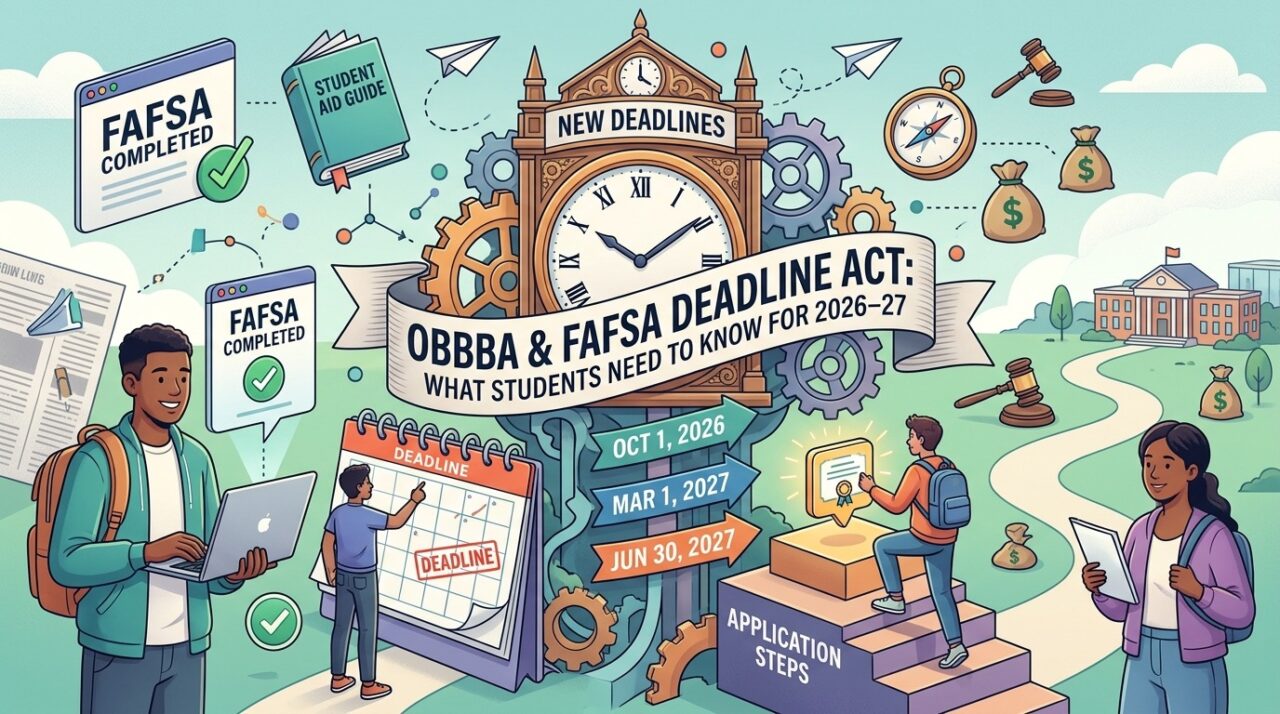
4. Timeline and Deadlines for the 2026–27 FAFSA (Graduate Students Included)
The 2026–27 FAFSA runs July 1, 2026 through June 30, 2027.
For federal aid, the 2026–27 FAFSA can be submitted as early as October 1, 2025, and must be received no later than June 30, 2027.
State and institutional deadlines can be earlier (sometimes much earlier), and the FAFSA explicitly instructs applicants to check state deadlines and school requirements.
Strategic implication for graduate applicants:
Graduate admissions timelines often run later than undergraduate cycles, but aid budgets—especially institutional and state funds—can still be “first-come, first-served.” Filing early protects access to limited pools, even if you later change your target school list.
5. What You’ll Need to File: Graduate-Specific Inputs and Common Tripping Points
5.1 Prior-prior year taxes (and why 2024 matters for 2026–27)
For 2026–27 filing, the FAFSA’s tax references anchor to 2024 IRS tax forms in the relevant sections (e.g., student spouse tax return information).
5.2 ITIN support exists on the form
The 2026–27 FAFSA paper form includes an ITIN field for students who do not have an SSN.
(Practical note: online account creation and identity verification can still be the bottleneck; build extra time.)
5.3 Listing schools: now up to 20 online (10 on the PDF)
Federal Student Aid guidance is explicit: you can list up to 20 schools online and up to 10 schools on the FAFSA PDF, and you can later update the school list.
For graduate applicants applying broadly (e.g., MSW, MBA, MPH, MEd, PA, PT, nursing pathways), this matters: list all serious options so you can compare aid offers without redoing your base filing.
6. How Schools Turn FAFSA Data Into a Graduate Aid Offer
6.1 Cost of Attendance (COA) is the baseline
Schools calculate a COA that includes direct charges (tuition/fees) and estimated living costs. The FAFSA form itself frames financial need as the difference between COA and the SAI.
6.2 Graduate assistantships and employer benefits complicate “aid” in a good way
The NPSAS data show 12% of graduate students received assistantships, with an average value of $18,800 among those who received them.
Assistantships often reduce out-of-pocket costs and can reduce borrowing needs, but the interaction with COA and required enrollment status can be program-specific.
6.3 Professional judgment and “special circumstances” exist
If your finances changed substantially (job loss, medical costs, etc.), the FAFSA explicitly instructs applicants to submit the form and then discuss special circumstances with the financial aid office.
For graduate students—who are more likely to have income shocks, dependents, or career transitions—this step is often decisive.
7. Federal Aid Options for Graduate Students (Pre–July 1, 2026 Framework)
7.1 Direct Unsubsidized Loans (graduate/professional)
Graduate students generally borrow through Direct Unsubsidized Loans (no subsidized option). Federal loan policy reflects that graduate subsidized eligibility was eliminated for loans first disbursed after July 1, 2012.
Interest rate example (2025–26): 7.94% fixed for Direct Unsubsidized loans to graduate/professional students (for loans first disbursed July 1, 2025–June 30, 2026).
Origination fees (through Sept. 30, 2026 under sequester guidance): Direct Subsidized/Unsubsidized loans carry a fee of 1.057% for first disbursements in the covered window.
7.2 Grad PLUS Loans (historically)
Before July 1, 2026 reforms (discussed below), graduate/professional students could borrow Grad PLUS up to COA minus other aid, subject to credit requirements.
Interest rate example (2025–26): 8.94% fixed for Grad PLUS for loans first disbursed July 1, 2025–June 30, 2026.
Origination fee (sequester guidance through Sept. 30, 2026): Direct PLUS loans carry a 4.228% fee.
Reality check: NPSAS:20 shows Grad PLUS use exists but is not universal—11% of graduate students borrowed Grad PLUS in 2019–20, but average Grad PLUS amounts among those borrowers were high (average $25,100).
7.3 Federal Work-Study (for graduate students at participating schools)
Work-study is not “undergrad-only.” However, availability is campus- and funding-dependent, and graduate programs vary in how (or whether) they package it.
7.4 TEACH Grant (for eligible graduate programs)
Federal sequester guidance also affects TEACH Grant maximum award amounts; for the relevant period the adjusted maximum reflects a required percentage reduction.
(Graduate TEACH eligibility depends on enrollment in an eligible teacher-prep program and service obligations; programs differ, so the FAFSA is necessary but not sufficient.)
8. The 2026 Pivot: Major Federal Borrowing Reforms Starting July 1, 2026
8.1 What changed (and why graduate students must pay attention)
A major statutory shift takes effect for borrowing on or after July 1, 2026, driven by enacted federal law and summarized in Congressional Research Service analysis.
Among the most consequential changes for graduate financing:
-
Elimination of Grad PLUS loans for new borrowing on/after July 1, 2026 (per CRS summary of the new framework).
-
New aggregate borrowing limits that restructure how much graduate students can borrow across their academic lifetime:
-
Graduate (non-professional) aggregate limit: $100,000 (CRS summary).
-
Professional aggregate limit: $200,000 (CRS summary).
-
-
Annual limits are also described in CRS tables for borrowers of new loans after July 1, 2026, with different ceilings for graduate vs. professional tracks.
8.2 Why this matters operationally for FAFSA filers
The FAFSA will still function as the eligibility gateway, but the menu of federal borrowing options becomes narrower. Practically:
-
Programs that previously expected students to “fill the gap” with Grad PLUS will need new funding strategies.
-
Students may face earlier “cap pressure,” especially those with prior undergraduate debt or those entering high-cost programs.
-
Institutional aid negotiations, assistantships, employer reimbursement, service scholarships, and state workforce grants become more important—not optional.
8.3 Graduate program choice becomes more financially consequential
With tighter ceilings and no Grad PLUS expansion, the old behavior of “borrow up to COA, sort it out later” becomes less available for new borrowing after July 1, 2026. For high-cost professional degrees, this pushes students toward:
-
lower-cost schools or in-state options,
-
accelerated pathways (reducing living costs),
-
paid clinical/assistantship models, or
-
employer-sponsored routes (especially in nursing, education, public service, analytics, and some tech roles).
9. Evidence-Based Strategies: Getting the Most From FAFSA (and Borrowing the Least)
9.1 File early, even if you’re still deciding
Because the FAFSA allows up to 20 schools online and can be updated, filing early enables earlier packaging and avoids deadline compression.
9.2 Treat consent and contributor completion as the critical path
If a spouse (or other required party) must complete their section, delays can stall processing. Federal guidance is explicit: without required consent/approval and signatures, you will not be eligible for federal aid.
9.3 Use the FAFSA Submission Summary as your audit tool
Your FAFSA Submission Summary is designed to help you verify data and make corrections, and it is the modern replacement for the older SAR.
9.4 Build a “COA gap map” before you borrow
Use your COA and expected aid to map what remains. Because graduate aid packages can mix:
-
institutional grants/scholarships,
-
assistantships,
-
employer benefits,
-
Direct Unsubsidized eligibility (and, depending on timing, Grad PLUS),
you should create a term-by-term plan rather than borrowing the maximum “just in case.”
9.5 If your financial situation changed, immediately pursue special circumstances review
The FAFSA explicitly anticipates special circumstances and directs you to discuss them with the financial aid office after filing.
Graduate students often qualify for adjustments due to childcare costs, medical expenses, job changes, or loss of income.
10. Common Graduate FAFSA Mistakes (and How to Avoid Them)
-
Not listing enough schools (limits comparisons). Use the 20-school online list.
-
Missing consent/signature requirements (stalls eligibility).
-
Assuming FAFSA is pointless because “no Pell”—ignoring loans and institutional aid impacts.
-
Waiting for admission before filing (can forfeit early institutional aid pools).
-
Borrowing without modeling the July 1, 2026 rule change (for students enrolling into 2026–27 who may be “new loan” borrowers after that date).
11. Graduate FAFSA FAQ (High-Impact Answers)
Do I need my parents’ information for graduate FAFSA?
Generally no—graduate/professional students are treated as independent for federal aid purposes.
If I’m married, does my spouse have to be involved?
Depending on tax and marital status, the FAFSA includes a student spouse section and can require spouse tax information; the paper form structure reflects this.
What are the key federal deadlines for 2026–27?
Submit no earlier than Oct 1, 2025, and no later than June 30, 2027 for federal aid.
How many schools can I list?
Up to 20 online or 10 on the FAFSA PDF, and you can update later.
Is Grad PLUS still a thing?
For loans disbursed before the July 1, 2026 change, Grad PLUS exists under the historical framework; however, federal reforms beginning July 1, 2026 eliminate Grad PLUS for new borrowing per CRS summaries.
Conclusion: FAFSA as the Graduate Funding “Operating System”
For graduate students, the FAFSA is less about “free money” and more about unlocking the core financing infrastructure—federal loans, institutional aid formulas, and state program eligibility. Data from NPSAS:20 show that graduate aid is common and consequential, with nearly three-quarters of graduate students receiving some aid and large average borrowing amounts among those who borrow.
The stakes rise further with the July 1, 2026 borrowing reforms that eliminate Grad PLUS for new borrowing and introduce tighter aggregate limits, changing how graduate education can be financed—especially in high-cost professional pathways.
Bottom line for ScholarshipsAndGrants.us readers: the “smart” graduate FAFSA strategy in 2026 is not simply filing correctly—it’s filing early, managing contributor consent, using the FAFSA Submission Summary to prevent errors, and building a funding stack (assistantships + employer aid + scholarships + controlled borrowing) that remains viable under the post–July 1, 2026 federal loan regime.