Financial Aid for Parents Paying for College
Parents in the United States increasingly function as the “financial operating system” behind college enrollment—managing federal forms, interpreting aid offers, arbitrating borrowing decisions, and smoothing cash-flow shocks that arise from tuition, housing, food, transportation, and technology costs. Yet the parent-facing aid environment is changing quickly: FAFSA simplification has replaced the Expected Family Contribution (EFC) with the Student Aid Index (SAI), altered how assets and household factors are treated, and shifted administrative requirements toward “contributors” who must provide consent for federal tax information (FTI) transfer. Simultaneously, a major legislative overhaul signed July 4, 2025 (the One Big Beautiful Bill Act, “OBBBA”) is scheduled to reshape Parent PLUS borrowing limits and repayment pathways beginning July 1, 2026. These changes arrive amid persistent affordability gaps: average net price rises sharply by income level and differs substantially across institution types and selectivity tiers. This paper synthesizes the most current federal guidance and credible national datasets (NCES, College Board, Federal Student Aid, IRS, GAO, Federal Reserve) to provide a rigorous framework for how parents can: (1) maximize grant and scholarship aid; (2) minimize avoidable aid loss from timing, reporting, and form errors; (3) choose borrowing instruments with an explicit risk model; and (4) coordinate tax benefits, 529 strategies, and payment plans without triggering compliance or aid-calculation pitfalls.
Executive Summary for Parents (the “so-what” in plain English)
1) “Sticker price” is not “net price”—and net price varies wildly. National data show net price climbs with income and differs by institution type; you must evaluate net price + cash-flow risk, not published tuition.
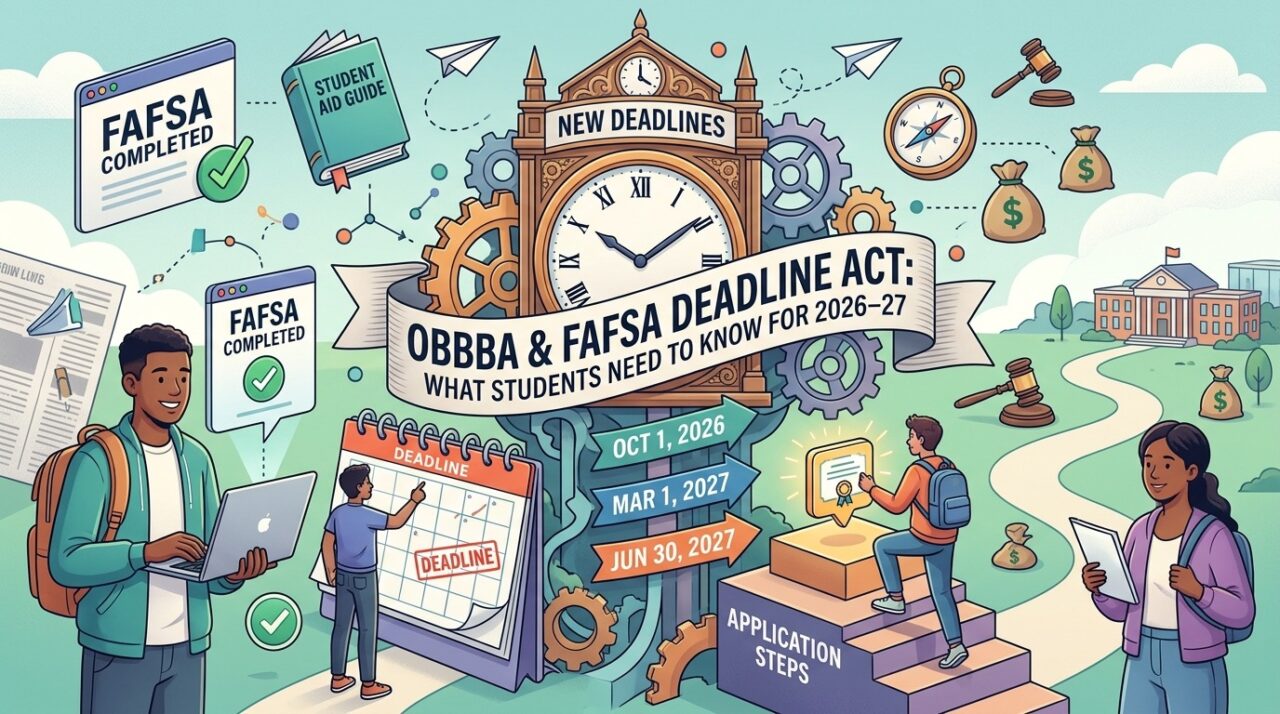
2) File FAFSA early and treat it like a compliance document. The 2026–27 FAFSA opened early (public release Sept. 24, 2025 after beta testing) and requires each “contributor” to participate; early filing matters because some aid is first-come/first-served at the state and campus level.
3) Know the SAI rules—and the policy updates. The SAI replaces EFC starting 2024–25 and can be negative (down to –1500). Key 2026–27 updates include a Pell ineligibility threshold at SAI ≥ $14,790 (twice the max Pell award) and updated asset-treatment rules tied to OBBBA.
4) “Free money” strategy beats “loan optimization.” Pell, state grants, institutional grants, outside scholarships, and work-study reduce both total cost and parent borrowing pressure. The maximum Pell Grant is $7,395 for 2025–26.
5) Parent PLUS is changing. OBBBA creates new borrowing limits for new Parent PLUS borrowers (annual $20,000; lifetime $65,000 per dependent student) beginning July 1, 2026—replacing the historical “up to cost of attendance” structure.
6) Tax tools are real money—if you coordinate them correctly. The American Opportunity Tax Credit (AOTC) can be up to $2,500 per eligible student (partially refundable), while the Lifetime Learning Credit (LLC) is up to $2,000 per return. Income limits and scholarship coordination rules matter.
7) 529 flexibility is higher than it used to be. 529 funds can support qualified education costs, and SECURE 2.0 allows eligible rollovers from a 529 to the beneficiary’s Roth IRA (lifetime max $35,000) under specific conditions.
1. Introduction: Why “financial aid for parents” is its own field
Financial aid is often framed as a student-facing system. In practice, for dependent undergraduates, parents are the primary coordinators of eligibility documentation, cash-flow planning, and borrowing risk. The FAFSA is the gatekeeper not only for federal grants and loans but also for many state and institutional programs. The shift from EFC to SAI and the post-2023 modernization of FAFSA workflows elevated a new compliance burden: multiple “contributors” must supply consent for IRS data transfer, and small errors can delay or suppress aid offers.
At the same time, affordability is best understood through net price (cost of attendance minus grants/scholarships), not published tuition. Federal and national datasets show net price rises with income and varies across sectors; selective institutions may discount tuition heavily for lower-income families while less-resourced schools may provide less grant aid but lower total budgets.
Parents therefore need a framework that is simultaneously (a) technical enough to avoid administrative failure and (b) strategic enough to minimize borrowing. This paper proposes such a framework, grounded in data and current federal guidance, and adapted to the 2026–27 policy landscape.
2. Data and Methods
This paper synthesizes evidence from:
-
Federal Student Aid / U.S. Department of Education (FAFSA availability, SAI rules, Pell/asset guidance, interest-rate announcements, work-study definitions, PLUS credit criteria).
-
NCES (net price by income; tuition/fee indicators).
-
College Board Trends (pricing, student aid, borrowing totals; contextualization of borrowing shares and net-price patterns by selectivity).
-
IRS (education credits; qualified expenses; 529 definitions; Roth rollover rules; student-loan discharge tax rules through 2025).
-
GAO and Federal Reserve (portfolio size, repayment stress indicators; parent household financial well-being).
-
NASFAA policy briefs (implementation-oriented summaries of OBBBA aid and loan changes).
Methodologically, the paper uses a “household finance” lens: parents allocate resources between current consumption, retirement security, home equity, and human-capital investment in children. The goal is not simply to maximize aid eligibility but to minimize risk-adjusted family cost: expected payments plus downside risk (default, retirement under-saving, liquidity shocks).
3. The affordability baseline: net price and why parents feel squeezed
3.1 Net price rises with income—but remains substantial for most families
NCES reporting shows that at public 4-year institutions in 2021–22, average net price ranged from $9,700 for families with income $30,000 or less to $24,200 for families with income $110,001 or more.
This gradient matters because many “middle-income” families are not Pell-eligible yet still face high net costs relative to discretionary income—especially when multiple children overlap in college or when parents are simultaneously supporting younger siblings and saving for retirement.
3.2 Selectivity complicates the story: lower-income students may pay less at some selective schools
College Board analyses based on NPSAS show that among very selective public four-year institutions (2019–20), average net tuition/fees for dependent students was $1,840 for parent income below $40K versus $14,240 for parent income $160K+, and many low-income students received grants that fully covered tuition/fees.
Implication for parents: “Cheaper college” is not only about lower sticker price; it is also about which schools have the grant capacity to meet need. A parent strategy that excludes selective schools purely due to sticker shock can be financially irrational for low- and sometimes middle-income households.
3.3 Borrowing is still common—and totals remain massive
College Board reports that parents and students borrowed $102.6 billion in federal and nonfederal loans in 2024–25.
Meanwhile, GAO observed the federal portfolio at about $1.5 trillion for nearly 43 million borrowers (as of early 2024), emphasizing the scale of repayment exposure nationally.
4. The architecture of aid (what parents are actually “buying” with paperwork)
Parents interact with four overlapping systems:
-
Federal aid (Pell, work-study, Direct Loans, Parent PLUS).
-
State aid (often FAFSA-triggered, sometimes deadline-sensitive).
-
Institutional aid (need-based and merit-based; often requires FAFSA and sometimes CSS Profile).
-
Private aid (outside scholarships, employer benefits, philanthropy, tuition discounts, and negotiated payment plans).
The parent’s job is to coordinate these systems so that awards stack efficiently and do not inadvertently cancel each other out (e.g., outside scholarships that reduce institutional grants dollar-for-dollar).
5. FAFSA in 2026–27: SAI, contributors, assets, and “do not mess this up” rules
5.1 FAFSA timing and operational reality
The Department of Education announced the public launch of the 2026–27 FAFSA on Sept. 24, 2025, following an extended beta period (with beta availability beginning Aug. 3, 2025).
Parent takeaway: treat FAFSA as a time-sensitive pipeline. States and colleges may have earlier priority deadlines than the federal end date, and institutional packaging often begins once valid ISIR data is received.
5.2 SAI replaces EFC (and what that means for parents)
Federal guidance confirms the transition from EFC to SAI beginning in award year 2024–25.
SAI is a formula-based index used to determine eligibility for need-based aid, and can be negative (down to –1500), which increases potential eligibility for the highest-need supports.
Critical parent misconception: SAI is not a bill and not a promise of what you will pay. It is an eligibility index; the actual price depends on the institution’s cost of attendance and how it chooses to meet need.
5.3 Pell Grant thresholds and the “twice-max-Pell” rule
Federal aid guidance for 2026–27 indicates that an applicant with SAI equal to or greater than twice the maximum Pell Grant is ineligible for Pell; the threshold for 2026–27 is $14,790.
For 2025–26, the maximum Pell Grant is $7,395 (most families care about this because the max amount anchors multiple eligibility thresholds and planning calculators).
5.4 Asset treatment updates: small business/farm/fishing exclusions return (26–27)
Federal Student Aid guidance for 2026–27 addresses asset calculation changes tied to OBBBA, including exclusions for certain small businesses, family farms, and commercial fishing businesses.
Parent implication: asset reporting has become more dynamic. Families with business/farm assets should not assume old FAFSA rules apply; they should follow award-year-specific instructions.
5.5 Contributors, consent, and the new compliance center of gravity
The FSA Handbook emphasizes that online FAFSA completion depends on each contributor providing consent/approval for federal tax information access and use; the process is structured so contributors may only see what they must answer.
Parent risk: if a contributor fails to complete their section or declines consent, the FAFSA may not process for aid determination (functionally “aid ineligibility” until corrected).
6. “Free money first”: maximizing grants, scholarships, and work-study
6.1 Pell, state grants, and institutional need-based aid
Pell remains the largest federal grant program for undergraduates and is tied to SAI and cost of attendance. The max for 2025–26 is $7,395.
But for many families, the bigger dollars may be in state and institutional grants, which can exceed Pell at flagship publics and private nonprofits with robust endowments.
Parent strategy: use FAFSA to keep eligibility open even if you “think you won’t qualify.” Eligibility cutoffs shift with rule changes and household circumstances, and many schools use FAFSA to award institutional grants.
6.2 Work-study as a parent cost-reduction tool
Federal Work-Study provides part-time jobs for students with financial need and encourages community service work; it is aid that does not require repayment.
Advanced parent move: treat work-study not as “extra spending money” but as planned substitution for parent cash contributions in the campus budget (books, personal expenses, transport). When structured well, work-study can reduce the need for Parent PLUS borrowing for indirect costs.
6.3 Outside scholarships and “stacking” mechanics
Outside scholarships can reduce net cost, but at some institutions they may reduce institutional grants (a “scholarship displacement” effect). Parents should:
-
Ask schools for their scholarship displacement policy (in writing).
-
Push to have outside scholarships first reduce loans/work expectation.
-
Time scholarship applications around institutional priority deadlines.
7. Parent borrowing: Parent PLUS, interest rates, credit standards, and 2026 policy shock
7.1 What Parent PLUS is (and why parents use it)
Parent PLUS loans are federal loans available to parents of dependent undergraduates, requiring that the borrower not have an “adverse credit history” (credit check required).
Historically, the Parent PLUS annual limit has been effectively up to the school’s cost of attendance minus other aid, enabling families to finance both direct and indirect costs.
7.2 Current cost of borrowing: rates and caps for 2025–26 disbursements
For loans first disbursed between July 1, 2025 and June 30, 2026, federal announcements specify the interest-rate framework and statutory maximum rates, including a maximum of 10.50% for Direct PLUS loans (parents/grad).
Parent implication: even before rule changes, the “price” of Parent PLUS is materially higher than undergraduate Direct loans, so borrowing hierarchy matters (student federal loans first; Parent PLUS only after grants/scholarships/work-study and reasonable cash-flow planning).
7.3 OBBBA changes beginning July 1, 2026: Parent PLUS limits and repayment eligibility
NASFAA’s campus leadership brief summarizes that new Parent PLUS borrowers will have an annual limit of $20,000 and an aggregate limit of $65,000 per dependent student, replacing the historic ability to borrow up to the full cost of attendance.
NASFAA also documents that new Parent PLUS loans from July 1, 2026 onward must be repaid under the standard repayment plan and are not eligible for RAP, the new income-driven structure under OBBBA.
Why this is huge for parents: OBBBA effectively converts Parent PLUS from an “unlimited backstop” into a capped instrument. Families who previously used Parent PLUS to cover housing/meal plans may face a forced pivot to (a) lower-cost schools, (b) institutional payment plans, (c) private loans, or (d) higher student work hours—each with different risk profiles.
7.4 Credit denial and fallback paths
If denied due to adverse credit, FSA guidance describes options (appeal with extenuating circumstances or obtain an endorser).
Risk note: credit denial is not rare in financially stressed households; parents should model “credit denial probability” as a real constraint rather than a remote possibility, especially when college choices assume Parent PLUS availability.
8. Repayment risk and the “parent balance sheet” problem
8.1 Parents borrow later in life, at higher rates, with less runway
Parent borrowing differs from student borrowing because it often occurs when parents are 40–60 and simultaneously:
-
saving for retirement,
-
paying mortgages/medical costs,
-
supporting multiple children, and
-
facing labor-market volatility.
Federal Reserve reporting notes meaningful stress among borrowers and shifting well-being among parents over time, reinforcing that parent borrowing should be evaluated with a household risk lens rather than a simple “monthly payment affordability” snapshot.
8.2 Portfolio stress signals after repayment resumption
GAO reports show significant shares of borrowers past due after repayment resumed, underscoring system-level repayment fragility.
Parent translation: borrowing decisions should assume nontrivial risk of income interruption, health shocks, or family disruption. The best defense is lowering principal (free money), not hoping to refinance later.
9. The tax layer: credits, deductions, and coordination rules parents miss
9.1 AOTC and LLC: the two workhorse education credits
The IRS states:
-
AOTC: maximum annual credit $2,500 per eligible student; 40% refundable up to $1,000 under rules.
-
LLC: 20% of the first $10,000 of qualified expenses (max $2,000 per return), not refundable.
IRS Form 8863 instructions include MAGI limits (notably, $180,000 MFJ / $90,000 single for the education credits in the referenced instructions).
Parent coordination pitfall: tax-free scholarships/grants reduce the qualified expenses you can use to claim credits; families should optimize allocation (e.g., using scholarships for non-credit-eligible costs when allowed, while paying at least $4,000 of qualifying costs out-of-pocket for full AOTC eligibility where feasible). See IRS qualified expense guidance for coordination issues.
9.2 Student loan interest deduction and employer assistance
IRS guidance (Publication 970 and Topic 456) describes the student loan interest deduction framework and notes ARPA-era timing rules that changed certain treatments through 2025.
Employer-provided educational assistance is also covered in Publication 970, and can be meaningful for parents (and for working students) when structured as a formal employer program.
9.3 Student loan forgiveness tax treatment: the “2026 tax bomb” risk returns for some
The IRS confirms that ARPA modified treatment of student loan forgiveness for discharges in 2021 through 2025.
NASFAA notes that some forgiveness becomes taxable again in 2026, while PSLF remains not considered taxable income.
Parent relevance: Parent PLUS repayment pathways can intersect with long-horizon forgiveness scenarios. Families planning for IDR-style forgiveness must incorporate potential tax liability where applicable and watch for further legislative changes.
10. 529 plans and parent strategy: savings, aid treatment, and Roth rollover flexibility
10.1 What 529 plans are (baseline)
The IRS defines qualified tuition programs (QTPs), also known as 529 plans, as state-sponsored programs enabling prepayment or savings for qualified higher education expenses.
10.2 SECURE 2.0: 529-to-Roth IRA rollover (guardrails matter)
IRS Publication 590-A states that, beginning with distributions after Dec. 31, 2023, a beneficiary may be permitted to roll over a distribution from a 529 to a Roth IRA if requirements are met.
Credible summaries describe key constraints, including the $35,000 lifetime cap, account age rules (e.g., 15-year requirement), and annual Roth contribution limit interactions.
Parent takeaway: this reduces the fear of “overfunding,” but it is not a free-for-all. It’s a safety valve—best used as a secondary planning feature, not the primary reason to contribute.
10.3 Grandparent 529 distributions and FAFSA treatment (simplification advantage)
Independent analyses of FAFSA simplification indicate that, starting with the 2024–25 FAFSA environment, 529 distributions are no longer counted as student untaxed income regardless of owner, removing the historical penalty on grandparent-owned 529 distributions.
Parent implication: grandparents can help pay without the prior FAFSA hit—though CSS Profile schools may still consider broader family resources.
11. Institutional aid and the CSS Profile: the parent “shadow system”
Many private colleges (and some publics for specific programs) use the CSS Profile to allocate institutional funds. Unlike FAFSA, Profile methodology often considers factors FAFSA excludes (commonly including home equity, and more detailed asset questions). Independent guidance for families consistently notes that FAFSA does not count home equity, while CSS Profile schools may.
Parent strategy:
-
Treat FAFSA and CSS Profile as two different models.
-
Ask each college how it treats home equity and business assets.
-
If home equity is high but liquidity is low, prepare for an appeal narrative with documentation.
12. Appeals, Professional Judgment, and “special circumstances”: where parents can still move the needle
FAFSA outputs are formulaic; life is not. Parents can sometimes secure better aid outcomes through:
-
Special circumstances (job loss, medical expenses, divorce/separation changes, disaster impacts).
-
Dependency overrides (rare, student-focused).
-
Professional judgment adjustments by aid administrators.
Best-practice appeal packet (parent-built):
-
A one-page letter summarizing the change and the requested reconsideration.
-
Evidence (termination letter, medical bills, death certificate, insurance EOBs, court documents).
-
A cash-flow snapshot (monthly fixed obligations + dependents).
-
A comparison of aid offers (if multiple schools) and a specific ask (“replace loans with grant,” “increase need-based grant,” “re-evaluate income year,” etc.).
While the federal rules govern eligibility, institutional discretion determines whether unmet need becomes grants or loans. Parents who can document verifiable, non-discretionary expenses often outperform parents who argue in generalities.
13. A parent decision framework: minimizing risk-adjusted family cost
Parents typically face four levers: choice of school, choice of major/program, choice of financing mix, and choice of timing.
13.1 A simple risk model (practical, but academically grounded)
Define:
-
NP = net price (COA − grants/scholarships)
-
EFC* ≈ “affordable family contribution” (household budget-based, not FAFSA-based)
-
B = borrowing required = NP − EFC* − student earnings contribution
-
r = effective interest rate (incl. fees where relevant)
-
σ_income = probability-weighted income disruption risk
Parent goal: minimize Expected Cost = B × (repayment factor) + downside penalties, where downside penalties include default risk, retirement underfunding, and forced high-cost refinancing.
This yields three robust rules:
-
Shrink principal first (aid, school choice, work-study), because interest compounds and risk is convex.
-
Borrow in the cheapest name possible (student federal Direct before Parent PLUS; grants before everything).
-
Avoid using retirement as the backstop unless survival needs are met and a professional plan exists.
13.2 The “Parent PLUS shock test” (2026+)
With OBBBA limits for new Parent PLUS borrowers (annual $20k; lifetime $65k per student), parents should run a shock test:
-
Can the family still enroll if Parent PLUS is capped?
-
If not, what is Plan B—lower-cost school, more scholarships, or private loans?
Because private loan pricing and approval depend on credit and market rates, a plan that relies on “we’ll just private loan the rest” is structurally risky.
14. Implementation playbook: what parents should do and when
9th–11th grade (or 2+ years before enrollment)
-
Build a school list with net-price estimates, not sticker prices (use each school’s net price calculator + historical aid patterns).
-
Start a scholarship tracking system (monthly deadlines, categories, “stackable” rules).
-
Contribute to 529 if possible; do not sacrifice emergency fund/retirement match.
Senior year (Aug–Dec)
-
Create FSA IDs for student and all contributors.
-
File FAFSA as soon as practical after opening; track state priority deadlines.
-
Apply for institutional aid forms (CSS Profile if required).
-
Target scholarships that reduce loan need (renewables and local awards often have higher odds).
Aid offer season (Feb–Apr)
-
Compare offers using a standardized worksheet: COA, grants, scholarships, work-study, student loans, parent loans, unmet need.
-
Appeal where justified (documented special circumstances).
-
Re-optimize tax strategy (AOTC/LLC) relative to tuition payments.
Enrollment and each renewal year
-
Refile FAFSA annually; keep a “documentation folder.”
-
Monitor SAP requirements and credit completion to avoid aid loss.
-
Keep borrowing cumulative totals visible; treat debt like a household liability, not “school money.”
15. Equity and policy: why these changes matter system-wide
Policy shifts like SAI modernization and OBBBA loan caps reflect competing goals: simplify access, target aid, and reduce runaway borrowing. Yet equity effects can be mixed: caps may reduce extreme Parent PLUS exposure but can also restrict access for families whose only feasible path was high borrowing—especially if institutional grant supply doesn’t expand accordingly. Meanwhile, the administrative burden of multi-contributor consent and the history of FAFSA processing errors (as documented in prior cycles) can disproportionately harm first-generation and low-resource families who have less time to navigate corrections.
Policy recommendation direction (evidence-aligned):
-
Expand proactive counseling for Parent PLUS and repayment outcomes at point of borrowing.
-
Require standardized aid-offer formats to reduce parent confusion.
-
Strengthen “automatic eligibility” pathways for high-need families using existing tax data, reducing form friction.
-
Expand grant aid or institutional incentives in parallel with borrowing caps to avoid access reductions.
References (selected, authoritative sources used)
-
U.S. Department of Education / Federal Student Aid: FAFSA launch announcements; SAI definitions; Pell guidance; loan interest rate announcements; PLUS credit rules; work-study definition.
-
NCES: College affordability indicators, including net price by income; tuition fast facts.
-
College Board Trends (2024–2025): net price by selectivity/income; borrowing totals; contextual notes on OBBBA implications.
-
IRS: AOTC, LLC, education credits instructions; Publication 970; Publication 590-A; Topic 313 (QTP/529); student-loan discharge tax rules through 2025.
-
GAO / Federal Reserve: repayment environment and household well-being context.
-
NASFAA: implementation-oriented summaries of OBBBA changes for loans and repayment.