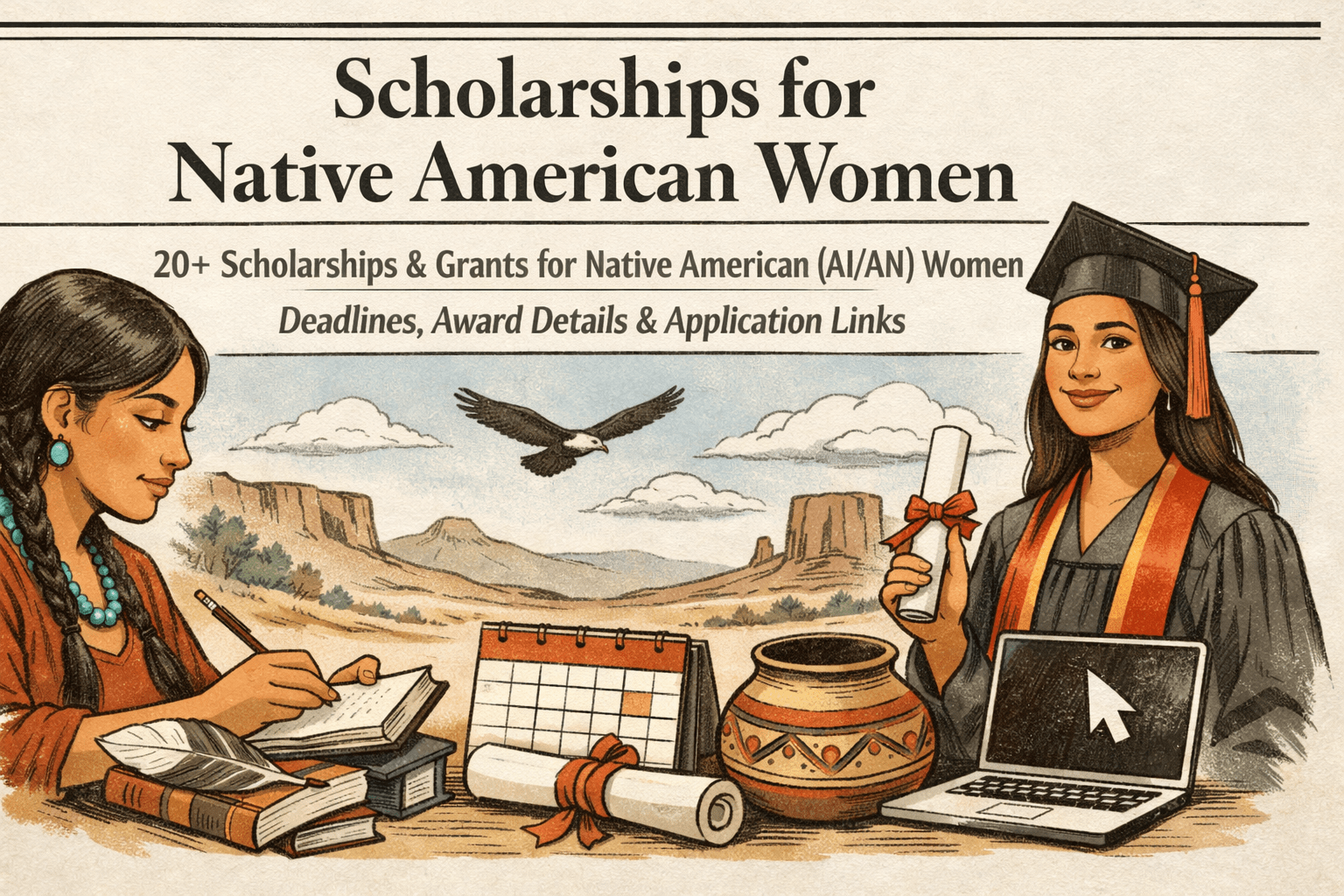
2026 Scholarships for Native American Women
Fresh, verified list of 20+ scholarships and grants for Native American and Alaska Native women and students. Sorted by deadline, with award details, eligibility highlights, and direct application paths.
Native American Women Scholarships & Grants (Sorted by Earliest Deadline →)
DAR American Indian Scholarship
Why It Slaps: Longstanding national award for Native students at any accredited college, university, or technical program. Preference is given to undergraduate applicants.
Amount: $4,000 one-time.
Deadline: January 31 each year at 11:59 p.m. Hawaii Time. The 2026 cycle has closed, so the next expected cycle is the next January 31 window.
Apply/info: DAR American Indian Scholarship
Frances Crawford Marvin American Indian Scholarship (DAR)
Why It Slaps: Reserved for one Native student through the same DAR system, so it is easy to stack into the same application season.
Amount: Varies annually.
Deadline: January 31 each year at 11:59 p.m. Hawaii Time. The 2026 cycle has closed.
Apply/info: DAR Scholarship Portal
Indian Health Service (IHS) Scholarship Program
Why It Slaps: One of the strongest Native-serving health career programs in the country because it can cover tuition and required fees and includes a living stipend in exchange for service in Indian health.
Amount: Tuition, required fees, and living stipend.
Deadline: The 2026-2027 cycle closed February 28, 2026. The IHS site says the next application will open December 15, 2026.
Apply/info: IHS Scholarship Program
Udall Undergraduate Scholarship (Native Health Care or Tribal Policy)
Why It Slaps: Prestigious national award for Native students committed to Tribal public policy or Native health care. Strong signal value for graduate school, internships, and future leadership roles. Campus nomination is required.
Amount: $7,500.
Deadline: March 4, 2026 at the foundation level. The next cycle typically opens in mid-October through campus representatives, and campus deadlines come earlier.
Apply/info: Udall Undergraduate Scholarship
American Indian Education Fund (AIEF) Scholarships
Why It Slaps: National program for undergrad, grad, and vocational students with a live 2026-2027 cycle and a straightforward online application.
Amount: Varies.
Deadline: Early deadline March 1, 2026 at 11:50 p.m. ET; final deadline April 4, 2026 at 11:50 p.m. ET.
Apply/info: American Indian Education Fund
AISES (American Indian Science and Engineering Society) Scholarships
Why It Slaps: Major STEM umbrella application for Indigenous students. AISES says it awards over $1 million annually, and the portal rolls many STEM opportunities into one place.
Amount: Varies by scholarship.
Deadline: Apply by April 30, 2026 for currently listed opportunities.
Apply/info: AISES Scholarships
Cobell Scholarship
Why It Slaps: One of the biggest Native scholarship names in the country. Strong for students at nonprofit institutions, with separate academic-year, summer, vocational, and fellowship tracks.
Amount: Recent official FAQ says 2025-2026 awards were $5,000 for new undergraduate awardees, up to $8,000 for returning undergraduates, up to $12,500 for graduate and professional students, and up to $7,500 for vocational awardees.
Timeline: 2026-2027 undergraduate and graduate academic-year applications closed March 31, 2026, with references due April 7, 2026. The 2026 summer scholarship closes May 4, 2026. Vocational funding is open year-round until funds run out.
Apply/info: Cobell Scholarship
Sealaska Heritage Institute Scholarships
Why It Slaps: Strong option for Sealaska shareholders and descendants, with a live 2026-2027 cycle and a clear yearly schedule.
Amount: Varies by fund.
Deadline: Early bird April 1, 2026; full school year deadline May 1, 2026; winter/spring-only cycle opens July 15, 2026 and closes October 1, 2026.
Apply/info: Sealaska Heritage Institute Scholarships
Association on American Indian Affairs (AAIA) Scholarships
Why It Slaps: One of the oldest Native scholarship programs in the country, and the current cycle is open now. It supports undergrad and grad students and includes benefits like annual membership and access to internships and fellowships.
Amount: Varies by scholarship.
Deadline: May 31, 2026 for Fall 2026 and Spring 2027.
Apply/info: AAIA Scholarships
American Indian College Fund — Full Circle Scholarships (Non-TCU students)
Why It Slaps: One of the biggest Native scholarship pipelines. One application can place you into a wide portfolio, and award amounts commonly average around $2,000 to $3,000.
Amount: Varies; average awards are in the $2,000 to $3,000 range.
Deadline: Application opens February 1 each year; priority review by May 31.
Apply/info: American Indian College Fund Scholarships
American Indian College Fund — Scholarships for TCU Students
Why It Slaps: Dedicated lane for students at Tribal Colleges and Universities, with the same broad College Fund ecosystem behind it.
Amount: Varies; average awards are in the $2,000 to $3,000 range.
Deadline: Application opens February 1 each year; priority review by May 31.
Apply/info: College Fund Scholarships for TCU Students
Wi’áaşal (Great Oak) Future Leaders Scholarship (Pechanga/College Fund)
Why It Slaps: One of the largest single Native scholarships for many California tribal students pursuing vocational, associate, or bachelor’s study.
Amount: Up to $20,000 per year.
Timeline: The official fund page still displays a May 31, 2025 on-page deadline, so the amount and program remain strong, but applicants should verify the current cycle directly with the College Fund before relying on the date.
Apply/info: Wi’áaşal Future Leaders Scholarship
American Indian Medical Scholarship (NSCDA)
Why It Slaps: Long-running support for Native students in nursing and other health programs, with renewable semester-based support.
Amount: $1,500 per semester for up to 8 semesters.
Deadlines: June 1 for fall and December 1 for spring.
Apply/info: American Indian Medical Scholarship
Native Forward Scholars Fund
Why It Slaps: Native Forward is the largest direct scholarship provider to Native students in the U.S., and its general application can route students into multiple funding opportunities across undergraduate, graduate, and professional study.
Amount: Varies by opportunity.
Deadline: June 1, 2026 at 11:59 p.m. MST. Tribal Eligibility Certificate and Financial Needs Form are due by July 15 for each academic year.
Apply/info: Native Forward Scholars Fund
Navajo Nation Scholarship & Financial Assistance (ONNSFA)
Why It Slaps: Central funding source for Navajo students, with a dependable term-based cycle and multiple forms of support.
Amount: Varies by program; the separate Chief Manuelito Scholarship program provides $7,000 per academic year for eligible high-achieving students.
Deadlines: June 25, 2026 for the 2026-2027 Fall/Spring academic year and November 25, 2026 for 2027 Winter/Spring terms.
Apply/info: ONNSFA
The CIRI Foundation (Higher Education & Competitive Scholarships)
Why It Slaps: Excellent for CIRI original enrollees and descendants, with a live June 2026 window and competitive scholarships that reach five figures.
Amount: Higher Education Scholarship up to $3,000 per year; Competitive Scholarships include awards up to $8,000, $10,000, and $20,000 depending on fund and criteria.
Deadlines: June 30 and December 31 for higher education cycles; designated endowment and competitive scholarships are June 30 only; CTE applications are accepted year-round.
Apply/info: The CIRI Foundation
American Indian Services (AIS) College Scholarships
Why It Slaps: Predictable term-based deadlines make this one easy to build into a scholarship calendar.
Amount: Varies by need and term.
Deadlines: July 1 for fall-start terms and November 1 for winter/spring-start terms.
Apply/info: American Indian Services Scholarships
North Dakota Native American Scholarship (State Program)
Why It Slaps: State-backed option for North Dakota resident Native students with both merit- and need-based paths.
Amount: Up to $2,000 per year.
Deadline: Apply annually, with priority consideration by July 15.
Apply/info: North Dakota Native American Scholarship
American Indian Library Association — Virginia Mathews Memorial Scholarship
Why It Slaps: Niche graduate funding for Native students entering library and information science, which can be a smart low-competition lane.
Amount: $4,000.
Timeline: The public scholarship page still shows a July 15, 2025 deadline and has not yet posted a refreshed 2026 cycle on-page as of April 3, 2026, so verify before building this into your plan.
Apply/info: Virginia Mathews Memorial Scholarship
Native American Fish & Wildlife Society (NAFWS) Scholarships
Why It Slaps: Strong niche fit for conservation, wildlife biology, fisheries, and natural-resource students.
Amount: Varies by scholarship and region.
Timeline: The public scholarship page currently highlights 2025 scholars rather than a live 2026 deadline, and NAFWS communications indicate scholarships are advertised through its updates. Verify the current cycle directly before relying on a date.
Apply/info: NAFWS Scholarships
The Gates Scholarship (High School Seniors)
Why It Slaps: Elite last-dollar scholarship for high-achieving, low-income high school seniors, and Native students are eligible.
Amount: Last-dollar funding for remaining cost of attendance after other aid.
Timeline: The site currently shows the 2025 cycle as closed, with the profile having opened July 15, 2025 and the deadline on September 15, 2025. Watch the official site for the next opening rather than assuming the dates will stay identical.
Apply/info: The Gates Scholarship
Society for American Archaeology — Native American Scholarships Fund
Why It Slaps: Excellent for Native students in archaeology, heritage, collections, and museum-linked study. It also includes the Bertha Cody Parker Scholarship supporting museum- or collection-based study by a Native American woman.
Amount: Varies by scholarship.
Deadline: Scholarship applications open in October and are due January 31 each year.
Apply/info: SAA Scholarships and Grants
Oregon Tribal Student Grant (State Grant)
Why It Slaps: Potentially huge for eligible Oregon tribal students because the grant is designed to offset cost of attendance after other gift aid.
Amount: Varies by school and degree level; grants cannot exceed cost of attendance.
Timeline: The 2026-2027 application opened December 1, 2025 and is open now. The public page does not currently show the new closing date on-page, so apply early.
Apply/info: Oregon Tribal Student Grant
BIE Higher Education Grant (via Tribal Education Offices)
Why It Slaps: Federal support administered through tribal education offices, so it can stack with outside scholarships when available.
Amount: Varies by Tribe and funding.
Deadline: Varies by Tribe. The BIE information packet says the application comes from the education officer of the Tribe with which the student is affiliated or a member.
Apply/info: BIE Grants
Scholarships for Native American Women: Equity-Centered Research Review (2026)
Scholarships for Native American women sit at the intersection of Native nationhood, gender, geography, affordability, and persistence. The current evidence still points in the same direction as before, but the 2026 update makes the case even clearer: Native students continue to face lower college enrollment and lower first-year retention than the national average, while Indigenous women continue to face a severe wage gap. That is exactly why scholarship money for Native women functions as more than help with tuition. It functions as completion support, debt prevention, and community workforce development.
1. The case for targeted support: enrollment, persistence, and economic context
NCES reports that in 2022 the college enrollment rate for American Indian and Alaska Native 18- to 24-year-olds was 26 percent, below the rates for White students at 41 percent and well below the rate for Asian students at 61 percent. At the same time, the National Women’s Law Center reports that Indigenous women working full time, year round were paid 58 cents for every dollar paid to White, non-Hispanic men nationally. That combination matters. When enrollment entry points are weaker and the labor-market penalty is still steep, outside scholarship support becomes one of the few tools that can reduce both short-term college risk and long-term earnings loss.
For Native women specifically, the financing question is not just can I get into college. It is also can I stay enrolled without getting pushed into more work hours, more unmet need, or more debt. That is why even medium-size grants can matter a lot. In a population facing lower enrollment on the front end and a persistent pay gap on the back end, scholarship dollars are not marginal extras. They can change whether a student starts, continues, transfers, or stops out.
2. Where the pipeline leaks: return rates and stop-out risk
The strongest recent persistence data in the Native context still come from the National Student Clearinghouse. For first-time college entrants, Native American students were retained for a second year at 52.8 percent compared with 68.2 percent nationally. That gap is large. It means the scholarship problem is not only about helping students pay the first bill. It is also about reducing the risk of disappearing between semesters or between years.
The broader U.S. stop-out picture is also still serious. The Clearinghouse reported in 2024 that more than 36.8 million adults under 65 had some college experience but no earned credential. That number is not Native-specific, but paired with the lower Native retention rate it reinforces the real danger of incomplete education. For Native women, that danger can be amplified by family responsibilities, travel distance, childcare, and geographic isolation. The practical implication is simple: the best scholarship is often the one that prevents interruption, not just the one with the biggest headline amount.
3. Why scholarships matter in Native women’s real financing lives
Scholarships reduce at least three kinds of risk. First is within-term liquidity risk: books, housing, childcare, transportation, internet, lab fees, and emergencies. Second is between-term continuation risk: the student who can finish spring but cannot bridge into fall. Third is post-school debt-distress risk: borrowing heavily without completing. Those risks are especially important for Native women because the wage-gap data show how costly incomplete or delayed degree progress can become over a lifetime.
That is why women-centered Native scholarship research should not judge programs only by total dollars awarded. A stronger lens is whether the program lifts persistence, protects credit momentum, and helps a student finish on time or closer to time. In other words, money matters, but timing and flexibility matter too.
4. The scholarship ecosystem: who funds Native women, and how
The current ecosystem still breaks into a handful of important channels. Tribal and tribal-office funding remains foundational, especially through tribe-specific education offices and the BIE Higher Education Grant process. The BIE packet still makes clear that students get the application through their tribe’s education officer, not from the federal government directly. That means tribal citizenship documentation and early coordination remain essential.
Tribal Colleges and Universities remain central as culturally grounded access and persistence institutions. AIHEC says there are 37 Tribal Colleges and Universities with more than 80 sites in the United States, representing well over half of federally recognized Tribes. That matters because Native women frequently need pathways that are affordable, local or closer to home, and culturally anchored. Scholarship strategies that ignore TCU pathways miss one of the most important completion structures in Native higher education.
At national scale, Native Forward Scholars Fund and the American Indian College Fund remain the big levers. Native Forward says it is the largest direct scholarship provider to Native students in the United States, awarding $15 million annually. The College Fund reports 6,900 scholarships and $22.2 million in scholarships in 2024-25, with 150,600 scholars served since 1989. Add in AISES for STEM, IHS for health-service careers, Udall for Native policy and health leadership, and Cobell for broad merit-based Native scholarship support, and you have the backbone of the modern Native scholarship stack.
5. Big levers Native women should understand in 2026
Native Forward matters because one general application can unlock multiple opportunities across undergraduate, graduate, and professional study, and the current 2026-2027 application is live with a June 1, 2026 deadline. It also requires FAFSA participation, a Tribal Eligibility Certificate, and a Financial Needs Form, which means applicants should treat it as a full packet project, not a last-minute form.
The American Indian College Fund matters because it combines scale with repeatability. The Fund’s own reporting shows 6,900 scholarships and $22.2 million in 2024-25, while its student-facing scholarship pages emphasize a February 1 opening and May 31 priority review. For Native women, that combination is powerful because it supports students at Tribal Colleges, non-TCUs, and even high school seniors entering higher education.
Cobell matters because it reaches multiple levels and, in the latest official FAQ, shows award bands that are large enough to materially change unmet need. AISES matters because it keeps an Indigenous STEM-specific lane open and says it awards over $1 million annually. Udall matters because prestige still has real labor-market and graduate-school value, especially in Native health care and Tribal public policy. Together, these are not just scholarship names. They are infrastructure.
6. The systems environment: why paperwork and process still matter
One of the most under-discussed barriers for Native students is administrative burden. The BIE Higher Education Grant packet still directs students to tribal education officers for access to the application, which means timing, documentation, and local coordination matter before money is even on the table. That is normal in Native education funding, but it still creates friction.
More broadly, complex and unclear agency processes can create barriers for Tribes and Native students trying to access funding. The same logic applies to scholarship systems. Native women often do not lose out because they are unqualified. They lose out because documents, verification, deadlines, and follow-up are stacked against real life.
7. Design principles: what works best for Native women
The evidence still supports a few strong design principles. First, renewable funding beats one-time money when persistence is the problem. Second, flexible funds that can cover more than tuition matter because real college costs include books, travel, internet, housing, and childcare. Third, support systems matter. Programs that pair money with mentoring, advising, care packages, laptops, community, or academic support often create better outcomes than money alone.
That last point matters more than it may seem. For Native women in fields where they may feel isolated, especially STEM, health, policy, or graduate study, mentorship and belonging are not side benefits. They are retention tools. Scholarship design that pairs cash with coaching, community, or navigation is much more likely to help a student stay enrolled and finish.
8. Applicant strategy: building a high-probability scholarship stack right now
As of April 3, 2026, the smartest Native women’s scholarship strategy is deadline sequencing. The live spring runway is unusually strong: AIEF closes April 4, AISES April 30, Sealaska May 1, Cobell summer May 4, AAIA May 31, College Fund priority May 31, Native Forward June 1, ONNSFA June 25, and CIRI June 30. That means one strong packet assembled now can still be reused across multiple major programs in the next few weeks.
The highest-yield move is to build a proof packet once: tribal citizenship or enrollment documentation, transcript, FAFSA confirmation, resume, recommendation list, and one strong personal statement that can be adapted for community impact, career purpose, and resilience. Then anchor first with high-scale Native-serving programs, add one prestige application where relevant, and layer in state, tribal, health, STEM, and niche-field funding. For Native women, especially those balancing work or family, reuse is not laziness. It is the strategy.
9. Recommendations for funders and systems
If the goal is to move outcomes for Native women, the best reforms are not mysterious. Funders should favor renewable awards, allow total cost-of-attendance uses, reduce verification friction, and bundle scholarships with advising, mentorship, and emergency supports. Institutions and systems should treat Native women’s persistence as the real target, not just application volume.
There is also a strong argument for more intentionally women-centered Native funding lanes inside broader Native-serving programs. Women-specific scholarships still exist, but many of the strongest opportunities Native women will actually use are general Native programs, state grant programs, or field-specific awards. In practice, that means scholarship ecosystems should not assume women will be well served by generic access alone. They should be designing for caregiving, place, flexibility, and completion.
Conclusion
Scholarships for Native American women are most powerful when they are treated as completion infrastructure. The live 2026 evidence still points to the same core reality: Native students face lower enrollment and lower retention than national averages, Indigenous women still face a major wage gap, and Native-serving scholarship organizations remain essential because they provide both money and support structures. The strongest strategy in 2026 is not chasing random awards. It is building a layered, Native-centered scholarship stack around major Native-serving programs, tribal and state aid, and field-specific opportunities, then using that stack to protect continuous enrollment and reduce debt.
Notes & Tips
- Many College Fund applications use May 31 as a priority review date, not necessarily the end of all opportunity flow, so applicants should still submit if they miss the priority window.
- Health-care pathways such as IHS and NSCDA’s American Indian Medical Scholarship can be especially valuable for Native women in nursing and allied health, but students should read service expectations and program rules carefully.
- Complete FAFSA or the relevant state equivalent early. Oregon Tribal Student Grant and Native Forward both explicitly tie eligibility or application requirements to FAFSA or related documentation.